- The paper introduces HERMIT, a hybrid framework combining manifold-preserving hyperbolic temporal graph neural networks with tree-based regression for joint link and RTT prediction.
- The methodology leverages learnable edge encoding and historical RTT statistics to achieve state-of-the-art link prediction (AUC > 0.995) and RTT regression improvements on decade-spanning data.
- The paper demonstrates practical implications for latency-aware routing and online traffic engineering by aligning geometric inductive biases with the Internet's scale-free topology.
Temporal Hyperbolic Graph Representation Learning for Internet Routing and RTT Prediction
Introduction
The characterization and prediction of Internet round-trip time (RTT) is a fundamental problem in large-scale network management, directly influencing quality-of-service, routing optimization, and real-time traffic engineering. Existing methods often underperform when faced with the intrinsic hierarchical, dynamically evolving, and scale-free nature of Internet topologies and the heavy-tailed, non-stationary distribution of RTTs between hosts. "Temporal Hyperbolic Graph Representation Learning for Scale-Free Internet Routing and Delay Prediction" (2605.28155) presents HERMIT, a hybrid learning framework that integrates hyperbolic manifold-preserving temporal graph neural networks (TGNNs) with tree-based regression for joint link and latency prediction. This approach is evaluated over a decade-spanning, large-scale Internet measurement dataset.
Challenges in Internet RTT Modeling
RTTs in the Internet display pronounced heavy-tailed characteristics, driven by path diversity, congestion, and non-linear routing updates. Conventional approaches, such as geometric embeddings (e.g., Vivaldi), matrix factorization, and tabular regression, typically neglect either the temporal or topological dependencies critical for RTT evolution. Deep learning models like LSTM and classical ensemble methods (e.g., Random Forests) improve temporal modeling but still treat links largely independently of the graph structure, limiting generalization under topological change.
Conversely, existing graph neural network (GNN) approaches (both static and temporal) operationalize in Euclidean space, which is suboptimal for hierarchically organized, scale-free Internet topologies. Euclidean embeddings either require high dimensionality or suffer from distortion when representing the exponential node growth characteristic of real Internet graphs.
HERMIT Framework
HERMIT operationalizes on the premise that hyperbolic geometry, with exponential volume growth, is inherently well-suited to Internet-like graph structures. Leveraging HMPTGN as its backbone, HERMIT introduces two principal enhancements:
- Learnable Edge Encoder: Explicitly incorporates log-transformed RTT mean, RTT standard deviation, and link usage statistics into the graph message passing via a learnable edge-level attention mechanism.
- Hybrid Prediction Architecture: Combines hyperbolic node embeddings (capturing topological evolution) with historical RTT statistics as input to a Random Forest regressor, enabling robust regression over non-linear, heavy-tailed RTT targets.
The framework is trained on temporally ordered snapshots of the CAIDA Ark traceroute dataset (2015–2024), each snapshot encoding the Internet routing topology and per-link RTT statistics.
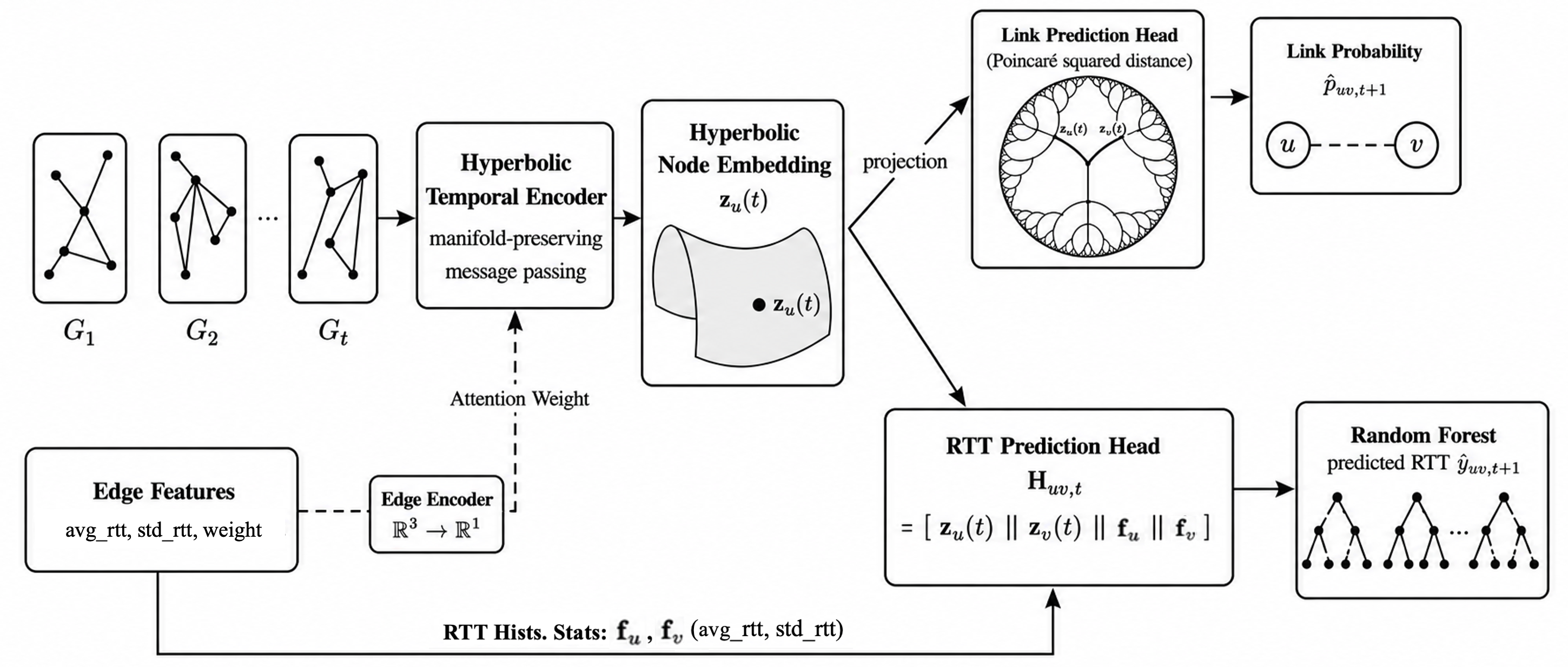
Figure 1: Overview of the proposed HERMIT architecture, combining a manifold-preserving hyperbolic temporal encoder with edge-aware features and Random Forest regression for joint link and RTT prediction.
Edge Feature Integration
Heavy-tailed RTT distributions are log-transformed and normalized, mitigating the impact of outliers and enabling stable model training for both link and latency prediction tasks.
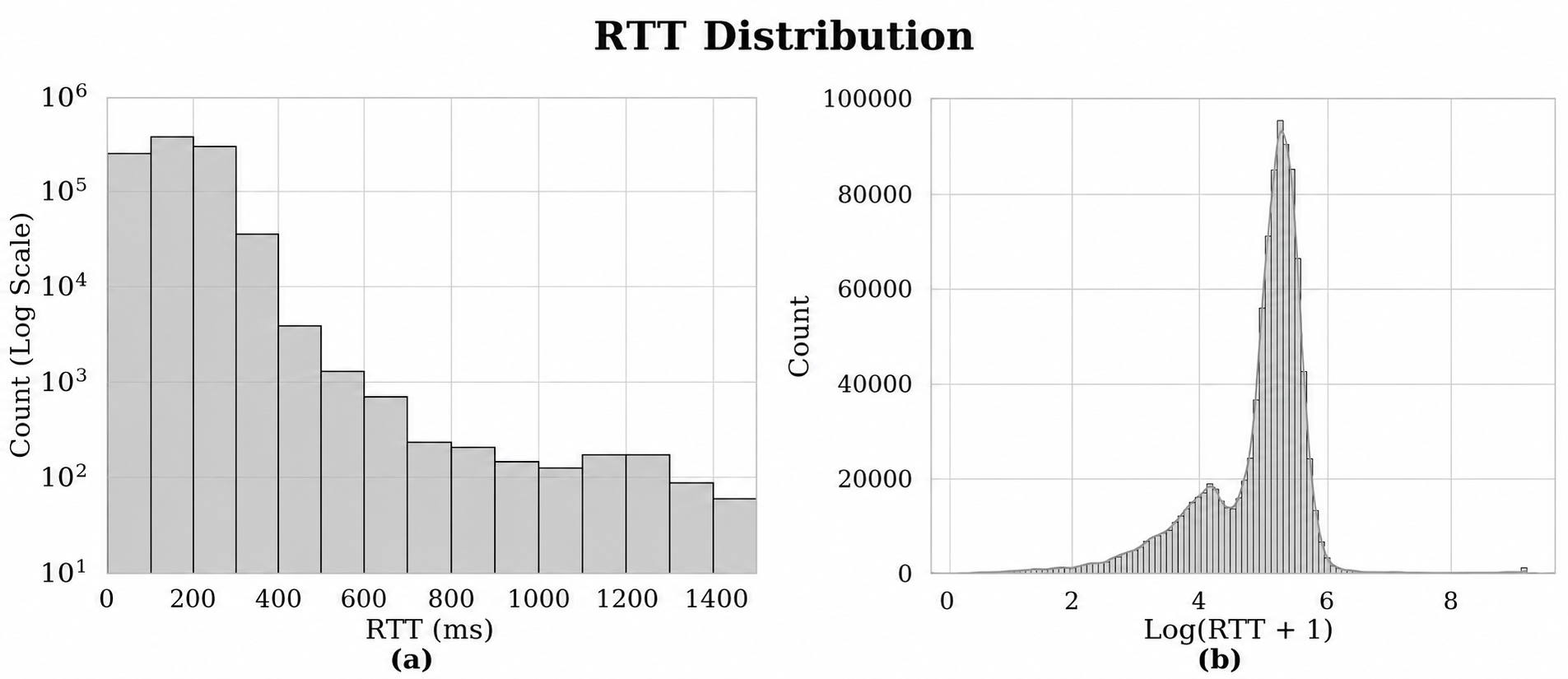
Figure 2: (a) Linear RTT distribution showing a pronounced heavy-tail; (b) log-transformed RTT is approximately Gaussian, facilitating regression stability.
Learning Tasks and Model Design
HERMIT operates over three principal tasks:
- Link Prediction: For each candidate node pair, the model predicts the likelihood of future connectivity based on structural and temporal dynamics.
- New Link Prediction: Targets generalization, identifying previously unseen routing relationships.
- RTT Prediction: Estimates future RTT for all edges, including both recurring and emergent links.
The core encoder generates hyperbolic embeddings for nodes across time. For link prediction, edge existence probability is computed using Poincaré distance and a Fermi-Dirac decoder. For RTT prediction, embeddings of each edge’s endpoints are concatenated with their historical statistics and submitted to the Random Forest.
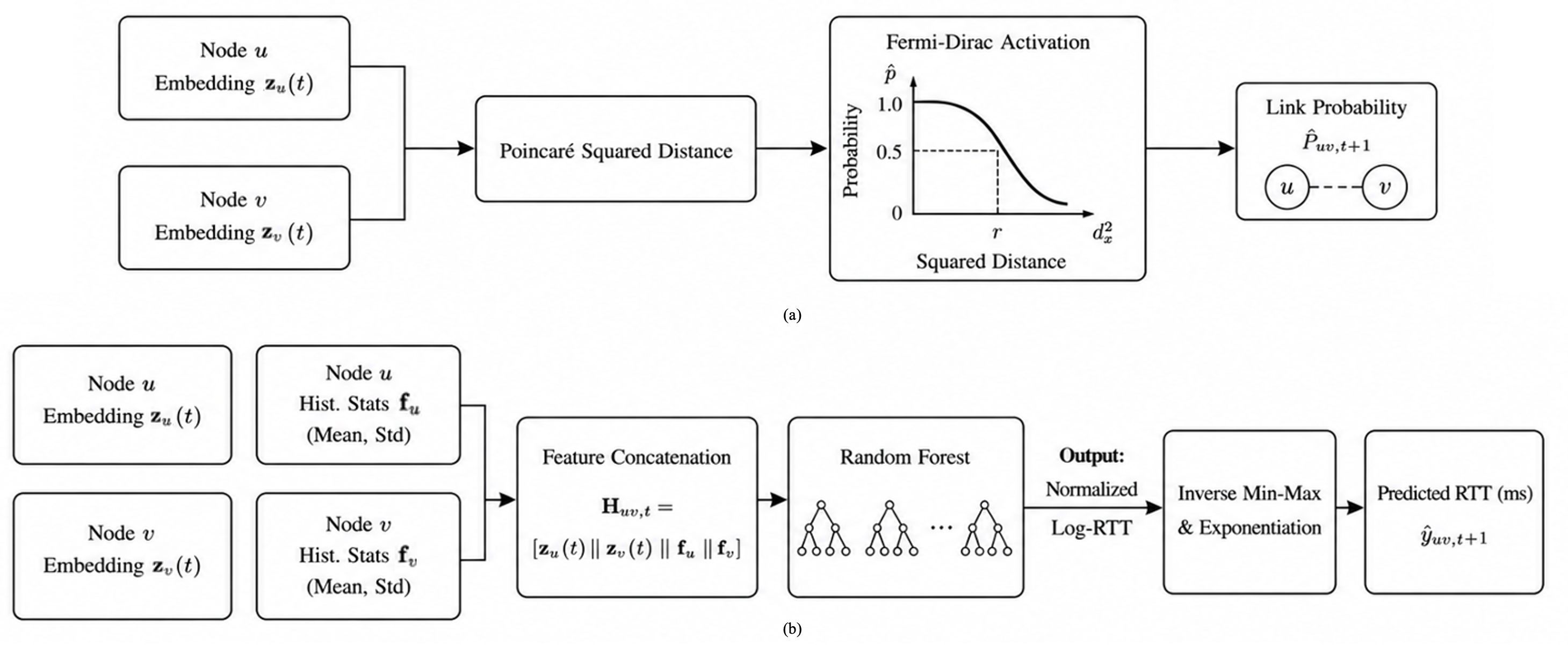
Figure 3: (a) Link prediction utilizes hyperbolic distances and Fermi-Dirac activation; (b) RTT prediction leverages both hyperbolic embeddings and historical RTT statistics, culminating in denormalized millisecond-scale predictions.
The total loss function linearly combines binary cross-entropy for link prediction and MSE for RTT prediction, with a hyperparameter controlling the task balance.
Empirical Evaluation
HERMIT is benchmarked using 1,456 temporal snapshots from the CAIDA dataset, spanning 10 years post-processed into edge-weighted directed graphs with per-link RTT aggregates. The data split ensures strict temporal ordering (85% train, 5% validation, 10% test), preventing leakage.
Key baseline comparisons:
- HTGN: Hyperbolic temporal GNN with tangent space message passing.
- HMPTGN: Manifold-preserving hyperbolic TGNN.
- Random Forest: Tabular RTT regression on historical statistics only.
HERMIT achieves the following on the link prediction task:
- AUC: 0.9953
- Average Precision (AP): 0.9956
- New Link AUC: 0.9932
These results substantially exceed both HMPTGN (AUC 0.9713, New AUC 0.9654) and HTGN (AUC 0.9628, New AUC 0.9517), indicating that explicit edge feature integration and manifold-preserving operations provide significant representational and generalization benefits.
In RTT prediction, HERMIT outperforms the tabular Random Forest baseline:
- Global Test RMSE: 20.85 ms (vs. 22.18 ms, +6% improvement)
- Test MAE: 5.35 ms (vs. 5.42 ms)
- New Link RMSE: 24.52 ms (vs. 25.09 ms)
Improvements in RMSE, particularly in the heavy-tail regime, demonstrate effective mitigation of large prediction errors.
Implications and Future Developments
HERMIT demonstrates that fusing hyperbolic geometric representations with edge-aware features and classical ensemble regression delivers robust, scalable solutions to dynamic, temporally evolving Internet graphs. This approach is computationally efficient, as the (potentially expensive) hyperbolic encoding can be precomputed and cached for deployment, with subsequent low-latency RTT inference feasible even at Internet scale due to the Random Forest’s efficiency.
Practically, HERMIT enables improved latency-aware routing, online traffic engineering, and proactive monitoring, particularly as Internet topologies continue to evolve with growing hierarchies and dynamic connectivity. The explicit modeling of edge-level dynamics further allows for direct interpretability and richer feature integration in future work.
Theoretically, this research underscores the need to align geometric inductive biases with the intrinsic structure of Internet-scale graphs and to hybridize deep learning with classical regression for tasks plagued by heavy-tailed, non-stationary distributions.
Conclusion
HERMIT offers a generalizable, topologically expressive, and statistically robust framework for the joint prediction of Internet routing evolution and end-to-end delays. By integrating manifold-preserving hyperbolic TGNNs with edge-aware attention and tree-ensemble regression, HERMIT achieves state-of-the-art performance in both link and RTT prediction under real-world, heavy-tailed latency conditions. Extensions to multi-metric prediction, adaptive online learning, or deeper integration of domain-specific network features represent promising future directions for robust performance analytics in scale-free dynamic graphs.