- The paper presents a closed-form probabilistic framework that integrates hyperbolic geometry and memory decay to predict next-step link formation.
- The methodology uses power-law decayed past interactions and maximum-likelihood estimation to quantify link persistence and geometric influences.
- The results highlight strong link persistence across networks and demonstrate the model's potential for improving network forecasting and design.
Temporal Connection Probabilities in Real Networks
The paper "Temporal connection probabilities in real networks" (2604.23714) introduces a principled closed-form expression for predicting the probability of link formation between node pairs in temporal networks. The model unifies latent hyperbolic geometry with memory of past interactions, yielding interpretable probability forecasts governed by three parameters: interaction persistence (ω1), inactivity penalty (ω2), and memory decay (λ). The formulation explicitly addresses the non-Markovian nature of real network dynamics, with the next-step probability depending on the entire history of link states and the evolving geometric proximity.
Central to the model is the computation of prior link activity, Φijt, for node pair (i,j), defined via a power-law–decayed sum of past link occurrences. This construction allows for flexible characterization of both short-term and long-term temporal correlations in link dynamics.
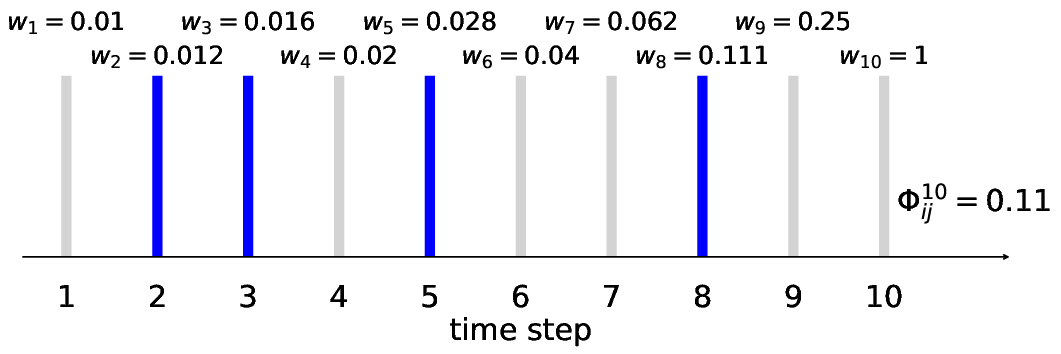
Figure 1: Computation of Φijt, illustrating how prior link activity aggregates past connectedness with decay governed by λ.
The predictive link probability Pijt+1 is determined by a piecewise function that separates pairs with nonzero Φijt (prior interactions) from those with zero Φijt (first-time connections). The geometric effect enters through hyperbolic embedding—specifically, the effective distance between nodes modulated by snapshot-inferred network temperature.
Empirical Validation Across Heterogeneous Systems
The approach is empirically tested on four large real networks: IPv6 Internet, PGP Web of Trust, Bitcoin transaction network, and arXiv co-authorship graph. Parameter inference is performed via maximum-likelihood estimation using temporal snapshots spanning several years, with networks exhibiting diverse link formation and removal behaviors.
Strong numerical results are reported for parameter trajectories in these systems.

Figure 2: Inferred trajectories of ω20, ω21, and ω22 for the Internet over time, demonstrating high persistence and decreasing inactivity penalty.
The inferred values of ω23 are consistently high (mean near 0.98–0.999), confirming strong persistence in link formation across all networks. Notably, ω24 shows a decreasing trend in the Internet, indicating an increasing role of geometry in facilitating first-time links as the system evolves. The memory decay ω25 remains stable, with mean values typically between 2.2 and 3.7, indicative of significant non-Markovian memory encompassing several past timesteps.
Joint Influence of Geometry and Memory
The model is validated against empirical next-step connection probabilities, measured jointly as functions of geometric distance and realized ω26. Comparison reveals quantitative agreement, with the model capturing both limiting regimes and intermediate behaviors.
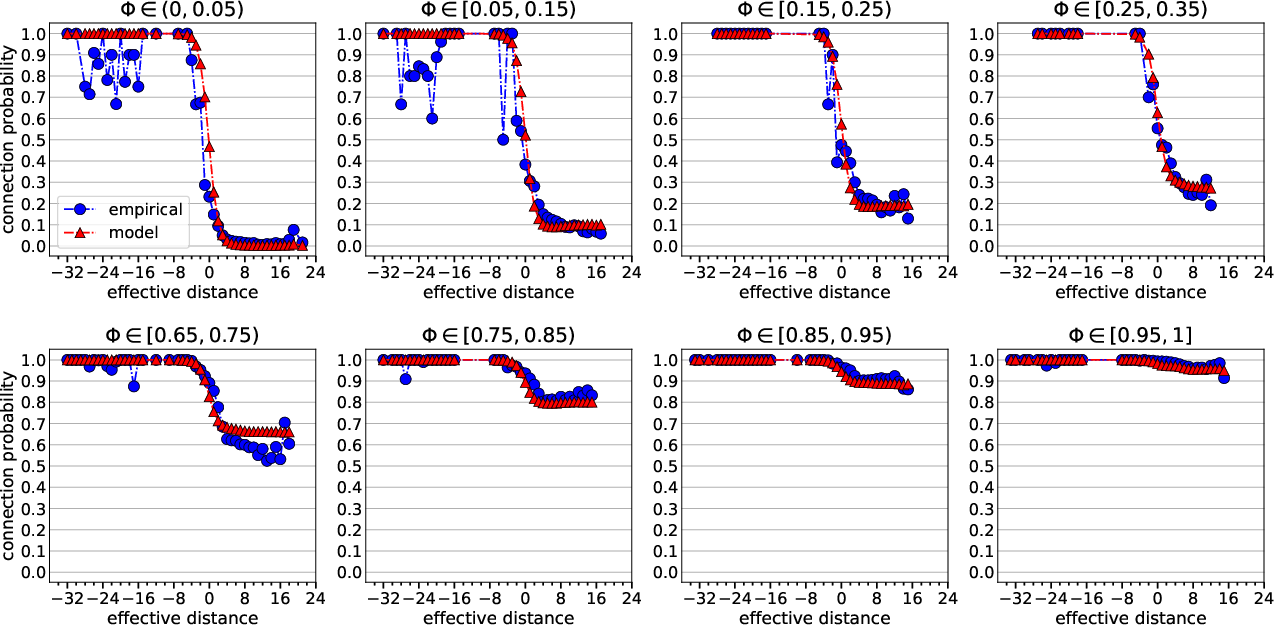
Figure 3: Probability of next-step connection in Internet as a function of effective distance and ω27; blue: empirical, red: model predictions.
At large effective distances and high ω28, connection probability asymptotes to ω29, consistent with strong persistence. At small distances, geometry dominates, leading to high probability even for modest prior activity. A purely geometric or memory-only model fails to capture this interplay.
Distinct qualitative behavior arises for λ0, corresponding to node pairs without prior interaction. The probability decays exponentially with distance for these pairs, with empirical results best matched when using maximal network temperature (λ1), indicating weaker geometric coupling for first-time links.
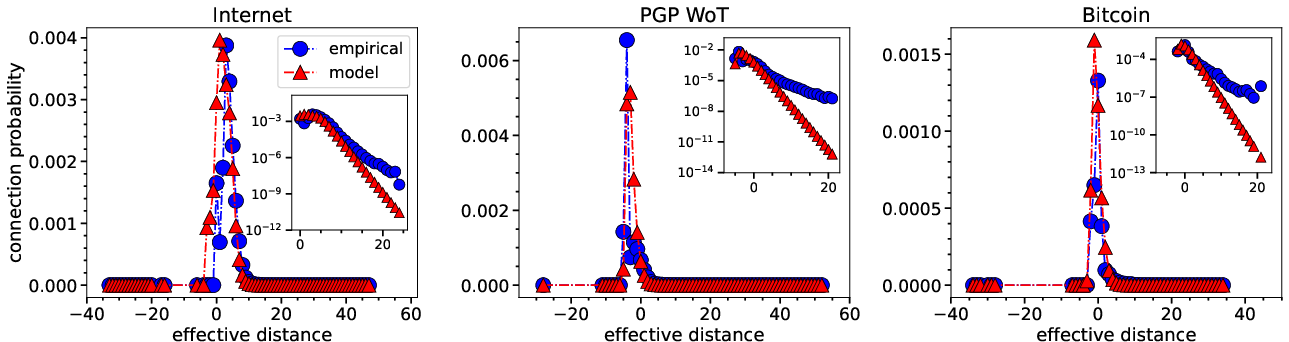
Figure 4: Next-step connection probabilities for λ2 in Internet, PGP, and Bitcoin, exhibiting nonmonotonic dependence on effective distance.
Moreover, for geometrically close but never-connected pairs, the probability can vanish for nonzero λ3, reflecting persistent constraints not captured by geometry alone. The model correctly predicts a maximum probability at intermediate distances for λ4 pairs.
Dynamics and Distribution of Links
The paper analyzes the rates of new and removed links in each network, revealing system-specific rewiring dynamics.
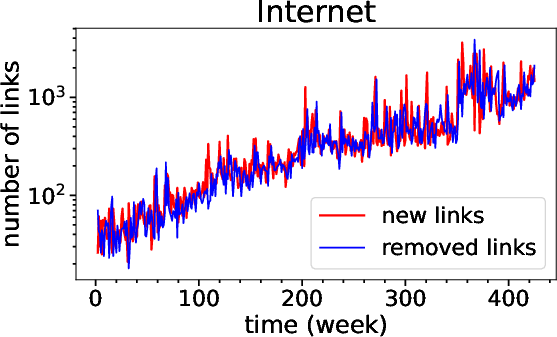
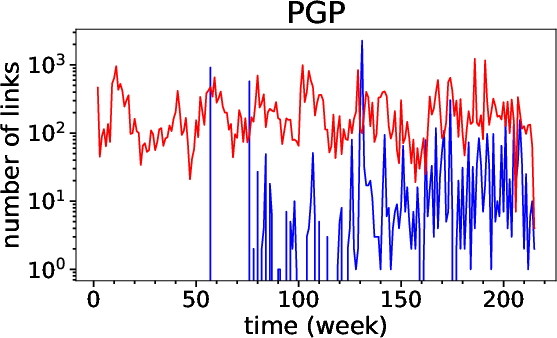
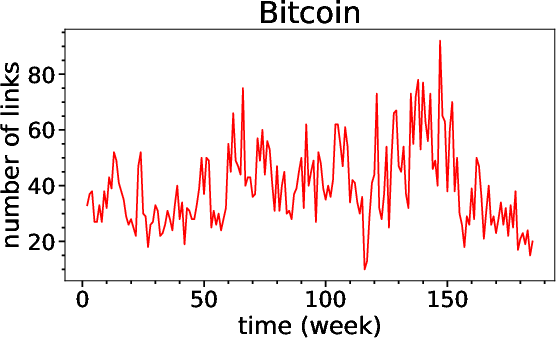
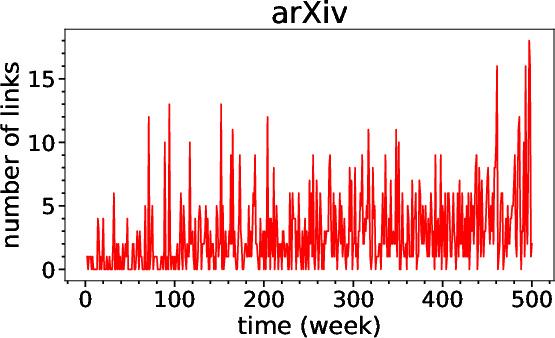
Figure 5: Temporal evolution of new and removed links in the four networks; Bitcoin and arXiv are strictly accumulative (no removals).
In the Internet and PGP, both link addition and removal occur; in Bitcoin and arXiv, links, once formed, persist indefinitely. This leads to trivial next-step probabilities of λ5 for nonzero λ6 in the latter networks, further emphasizing the importance of inactivity modeling for networks with different semantics.
Practical and Theoretical Implications
The minimal closed-form probabilistic model establishes a foundation for temporal link forecasting that is interpretable, extensible, and analytically tractable. By combining geometric latent space and temporally decayed memory, it provides a rigorous basis for modeling complex systems—enabling improved forecasts in recommendation, infrastructure resilience, and social or financial network analysis.
Practically, the explicit probability formula can be used for recursive multi-step predictions, temporal hyperbolic embeddings, and can serve as a benchmark against heuristic link prediction scores. Its applicability across diverse empirical datasets, with robust parameter stability and quantitative agreement, substantiates its generality.
Theoretically, the model highlights the distinction between persistence-driven dynamics and geometry-driven exploration in network evolution. The observed parameter trends, particularly the decreasing λ7 in the Internet, suggest a shift from memory-dominated to geometry-driven link formation over time, potentially indicative of evolving structural constraints in the underlying system.
Speculation on Future Developments
Extensions to higher-dimensional latent spaces or temporally dependent embedding could further enhance model fidelity and predictive performance. Integration with standard binary link prediction frameworks can facilitate comprehensive benchmarking and application to recommender systems or network control. Investigating closed-form expressions for multi-step probabilities absent stationarity remains a compelling open problem.
The methodology also opens avenues for translation to network design, control, and intervention—by quantifying the roles of memory and geometry, system administrators may gain leverage for modulating link formation, e.g., in cybersecurity or communication infrastructure.
Conclusion
"Temporal connection probabilities in real networks" presents a principled, interpretable probabilistic model for link dynamics, grounded in hyperbolic geometry and non-Markovian memory. Empirical results across heterogeneous networks reinforce its validity, with strong persistence, meaningful inactivity modeling, and robust non-Markovian memory. The analytical tractability and predictive accuracy position this framework as a foundational tool for understanding and forecasting temporal network topology.