- The paper introduces a tri-trust evidence model that decomposes trust signals into entity, interaction-behavior, and contextual channels for refined graph propagation.
- It implements channel-specific propagation controls and component-decoupled temporal memory to enhance dynamic trust prediction and calibration.
- Empirical evaluations show superior MRR and robust uncertainty calibration across datasets, demonstrating improved resilience against poisoning attacks.
Tri-Trust Conditioned Heterogeneous Graph Learning for Reliable Dynamic Trust Prediction
Trust Prediction Problem and Existing Limitations
The paper "TCHG: Tri-Trust Conditioned Heterogeneous Graph Learning for Reliable Dynamic Trust Prediction" (2606.16611) addresses the challenge of modeling user–user trust relations in dynamic, heterogeneous web networks, a task relevant for recommendation, manipulation detection, and risk analyses. Traditional GNN-based trust models treat heterogeneous trust evidence as flattened features or generic attention weights, failing to exploit distinct roles across evidence channels (entity reliability, interaction-behavior reliability, contextual trust) in the propagation process. This conflation leads to ineffective message control and limits the reliability of learned trust predictions, especially under sparse or conflicting evidence.
TCHG Framework: Architecture and Propagation Mechanisms
TCHG introduces a structured evidence-controlled heterogeneous graph learning paradigm that decomposes trust signals into three functionally differentiated channels and assigns them distinct control roles during graph propagation: entity reliability governs message admission, interaction-behavior reliability modulates propagation strength, and contextual trust selects propagation operators conditioned on context.
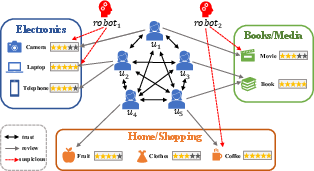
Figure 1: A typical Web trust network where trust prediction relies on entity reliability, behavioral normality, and scenario-specific context evidence.
The workflow of TCHG consists of four modules:
- Tri-Trust Evidence Construction and Encoding: Structured statistics are extracted from historical trust links, rating records, and local context, then encoded into latent embeddings and channel-specific reliability scores.
- Tri-Trust Conditioned Heterogeneous Propagation: Entity reliability activates message-admission gates for each incoming edge; interaction-behavior reliability modulates message intensity; contextual trust softly selects among multiple propagation operators for each relation type via a learnable context-conditioned selector.
- Component-Decoupled Temporal Trust Memory: Independent temporal memory states with non-uniform decay rates are maintained for each evidence channel, allowing asynchronous trust evolution modeling (slow entity accumulation, mixed behavior, volatile context) and preventing mutual overwriting.
- Uncertainty-Aware Prediction and Calibration: The model predicts trust probability and estimates prediction uncertainty, aligning confidence calibration (Brier Score, ECE, NLL) with empirical error risk for reliable downstream filtering.
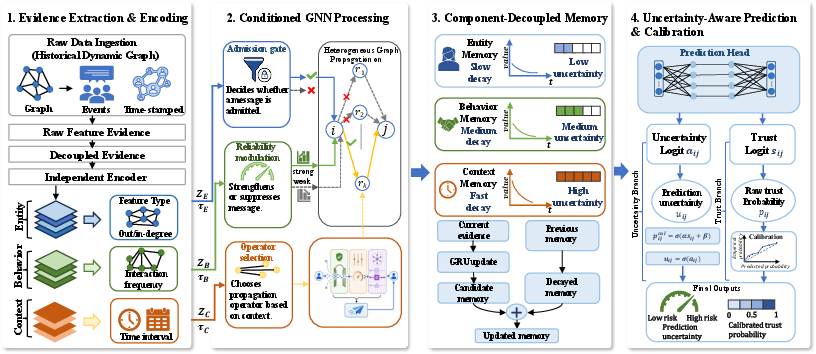
Figure 2: TCHG architecture with tri-trust evidence encoding, conditioned propagation, component-specific temporal memory, and uncertainty-aware calibration.
Empirical Evaluation and Numerical Results
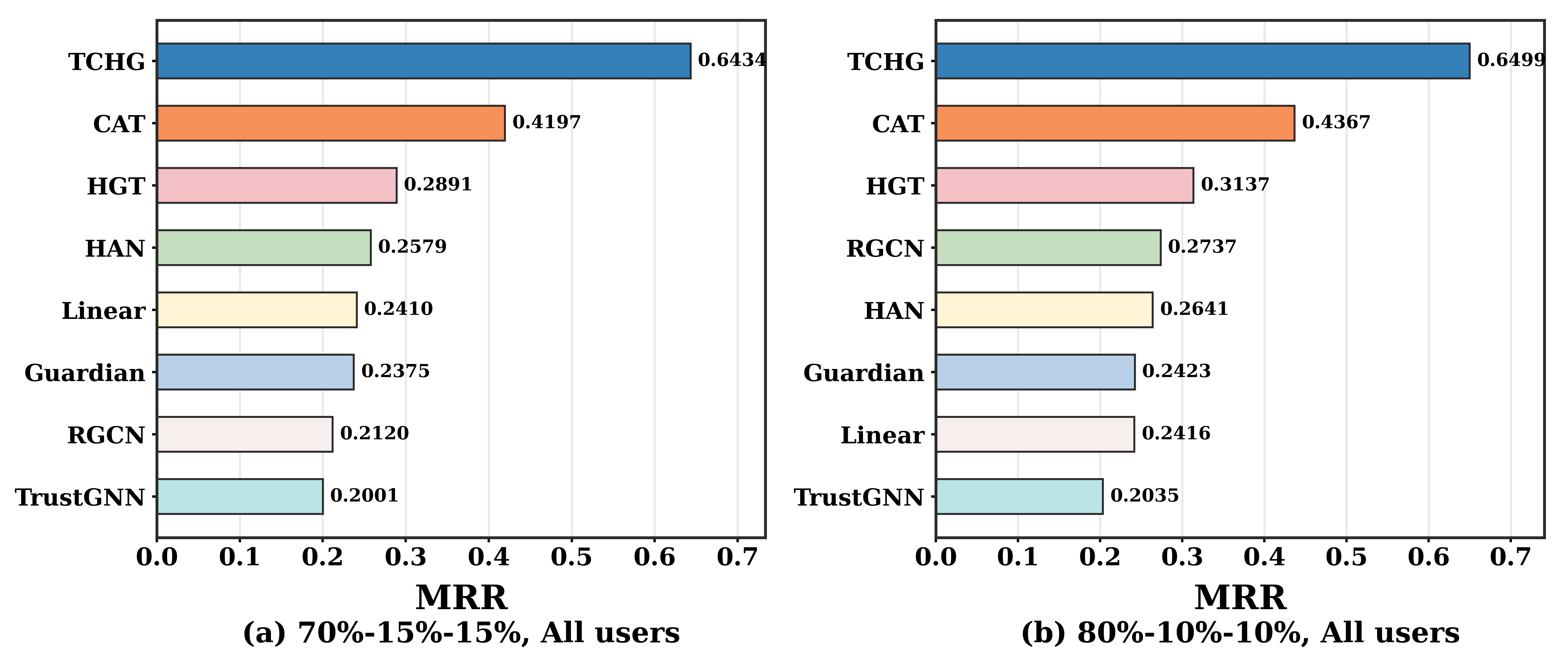
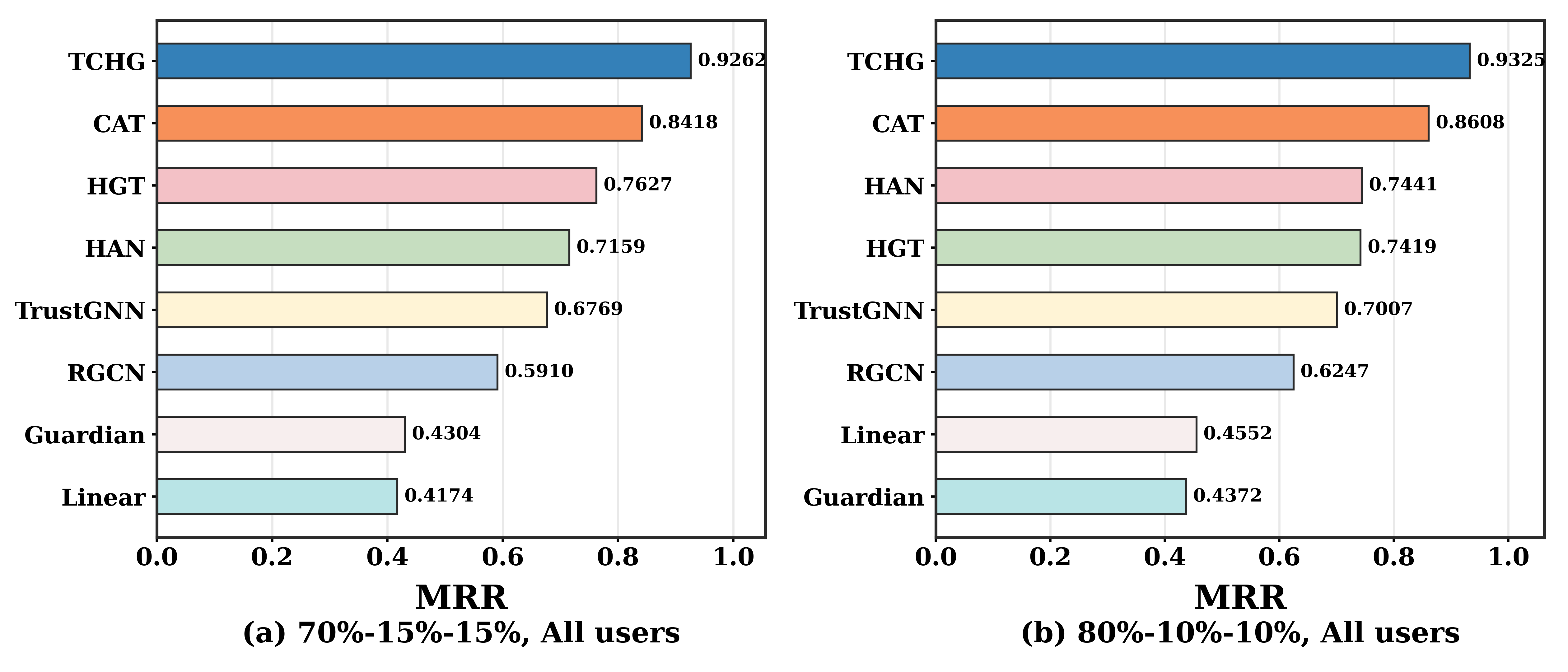
TCHG was benchmarked against a suite of baselines (Linear, Guardian, TrustGNN, CAT, HAN, RGCN, HGT) on three public datasets (Epinions, Ciao, CiaoDVD), representing both timestamped dynamic trust prediction and all-users random trust-link splits. Strong numerical improvements are observed:
Evidence-Controlled Propagation and Memory Analysis
A key claim supported by ablation is that tri-trust evidence must be used for propagation control—not as mere feature enrichment. Feature Injection Only and Attention Only variants result in significantly lower MRR. Ablations removing entity admission, behavior modulation, or context-operator selection confirm that all three components are necessary for top-ranked trust-link retrieval.
Component-wise temporal memory, with non-uniform decay and uncertainty, further improves test performance and reliability over memoryless or uniform-decay alternatives, especially for medium-to-long time gaps and observed-user scenarios. Memory statistics reveal entity memory as high-norm/low-uncertainty, contextual memory as low-norm/high-uncertainty, consistent with functional roles.
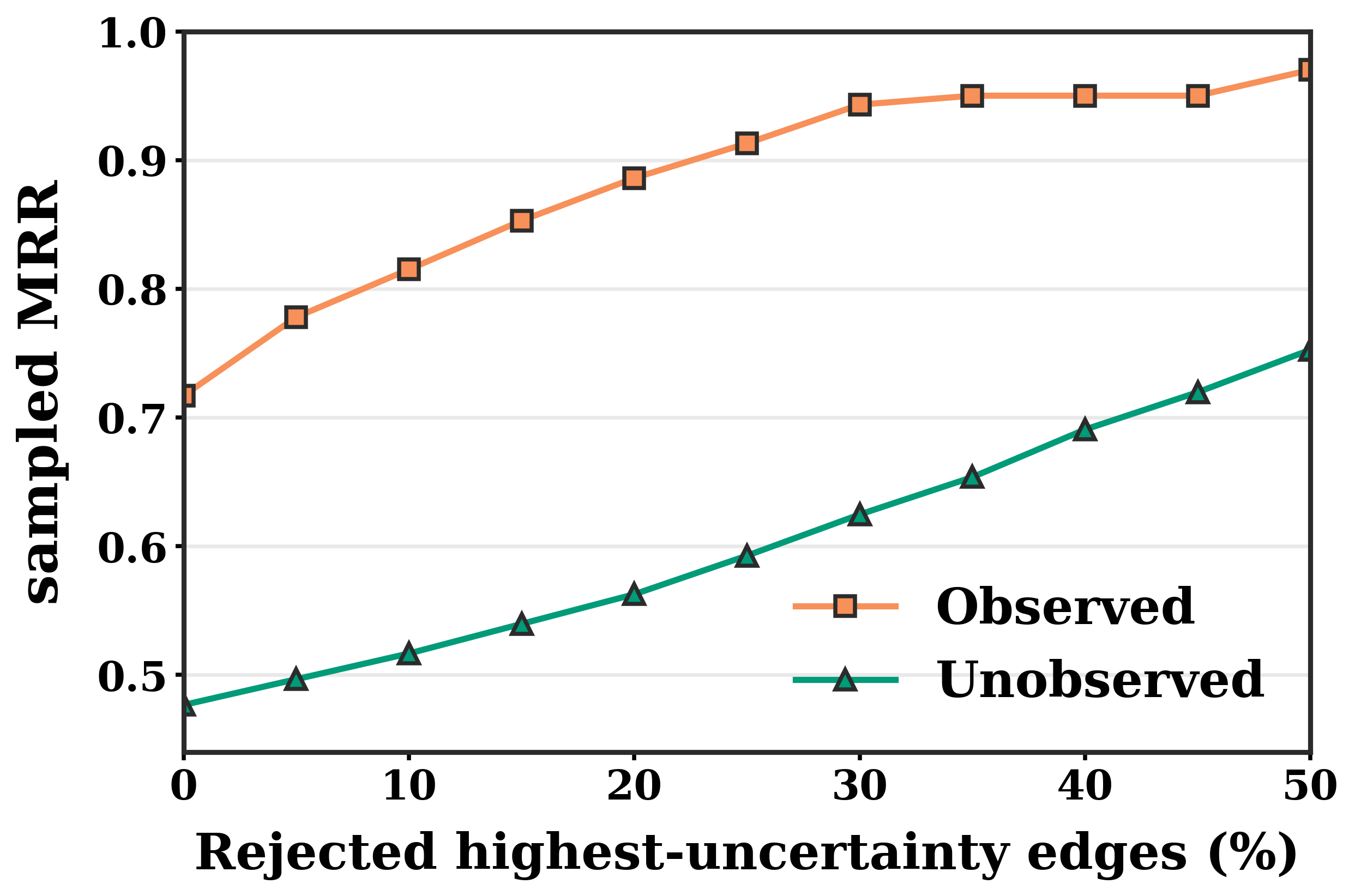
Figure 5: Selective prediction results—rejecting high-uncertainty edges yields higher sampled MRR, reflecting effective uncertainty calibration.
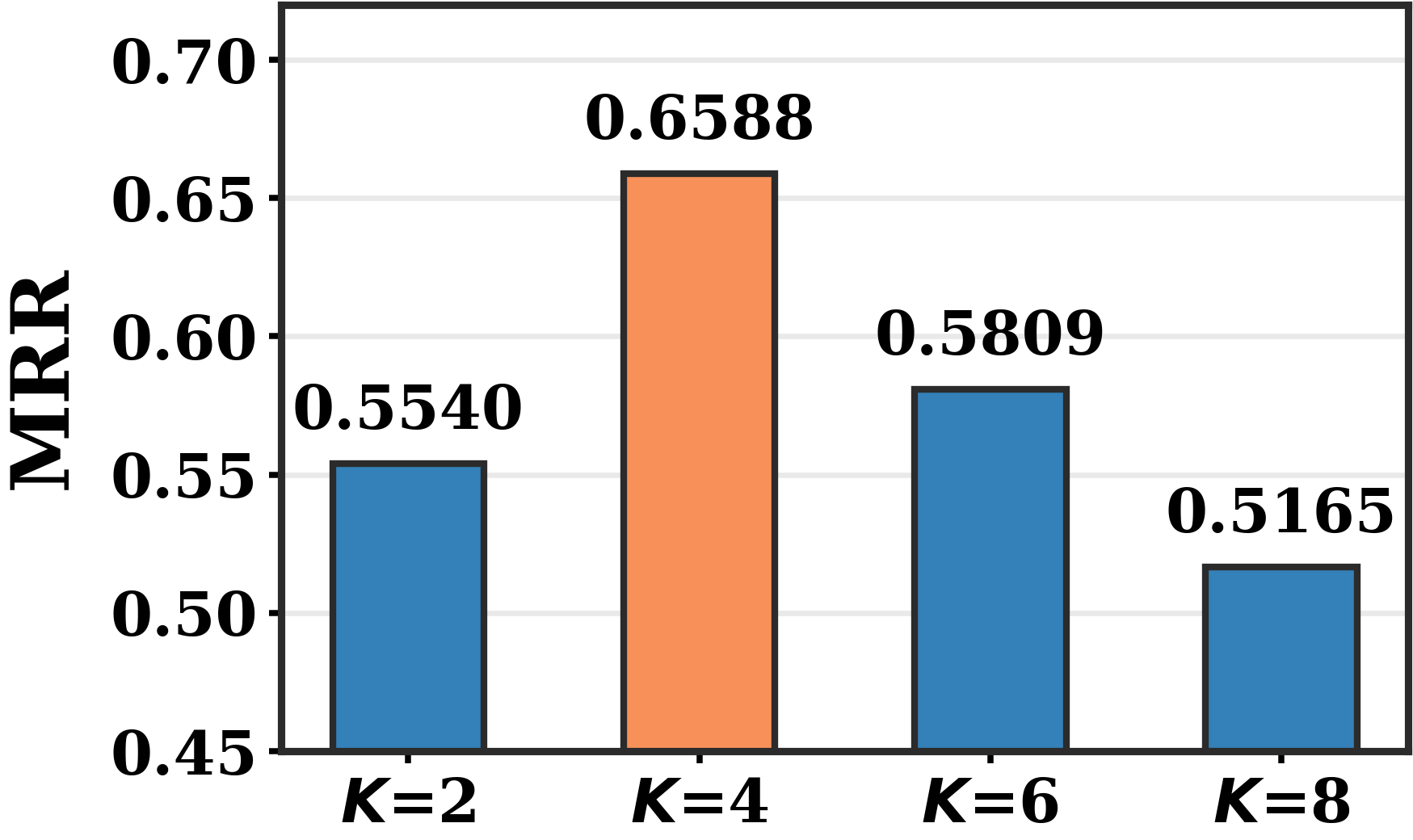
Figure 6: Sensitivity of overall MRR to the number of candidate heterogeneous propagation operators K.
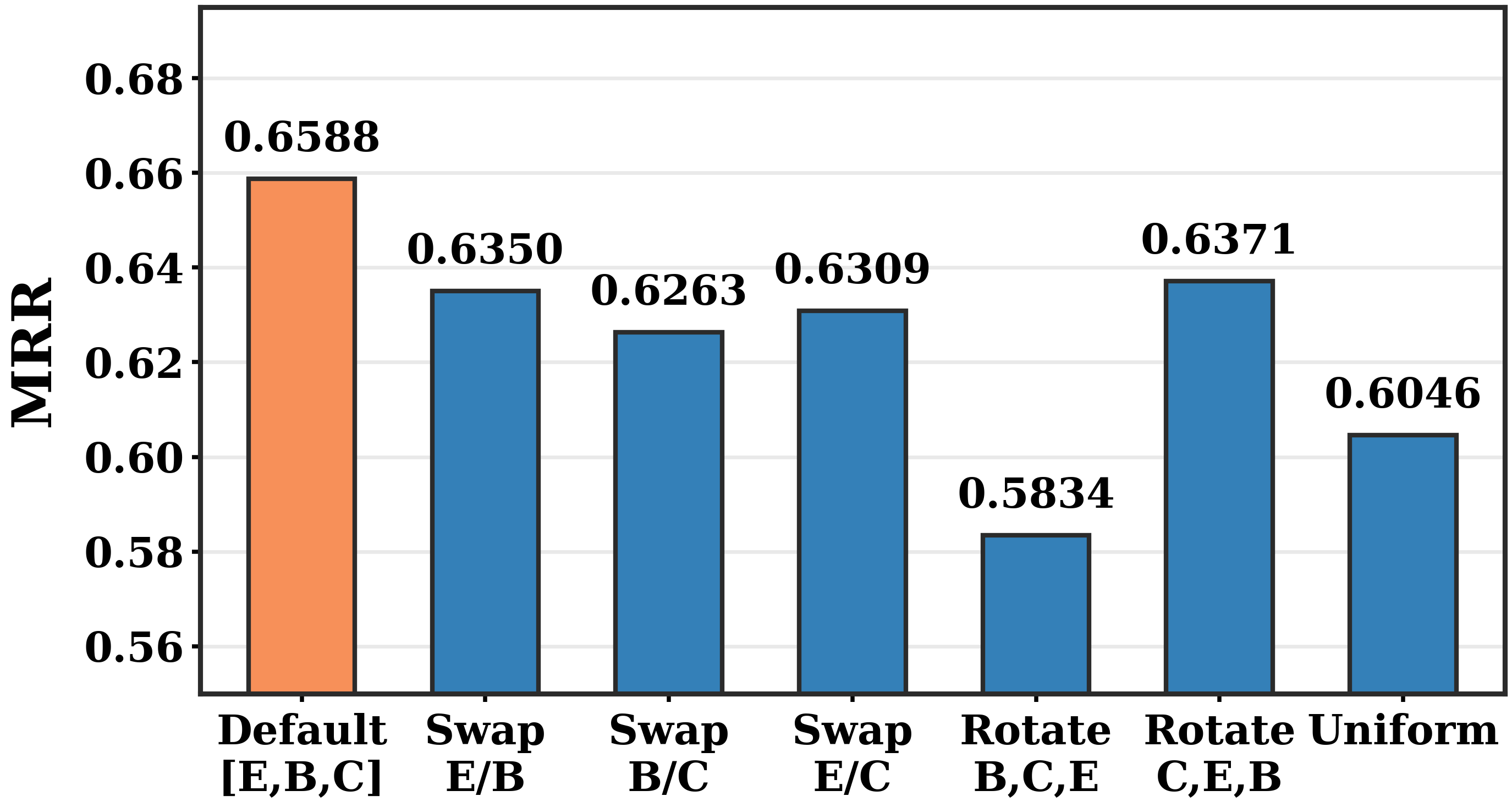
Figure 7: Sensitivity of overall MRR to component-specific temporal decay assignments.
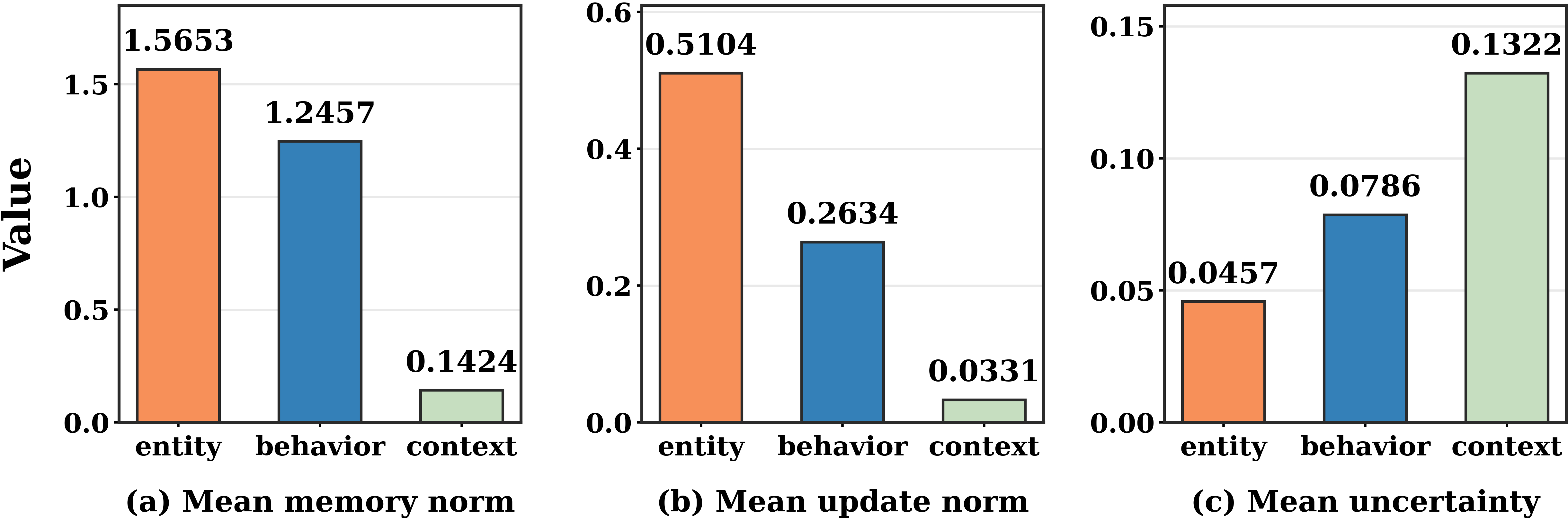
Figure 8: Entity, behavior, and contextual memory state statistics showing averaged norms, update norms, and uncertainty.
Robustness to Poisoning Attacks
Robustness evaluations under CAT-style trust-oriented and GNN-oriented poisoning attacks demonstrate that TCHG maintains superior absolute attacked MRR for both observed-user and unobserved-user cases, even as relative degradation varies with attack type and split. The conditioned propagation and component memory modules impart additional resilience to local trust manipulation and contextual graph perturbations.
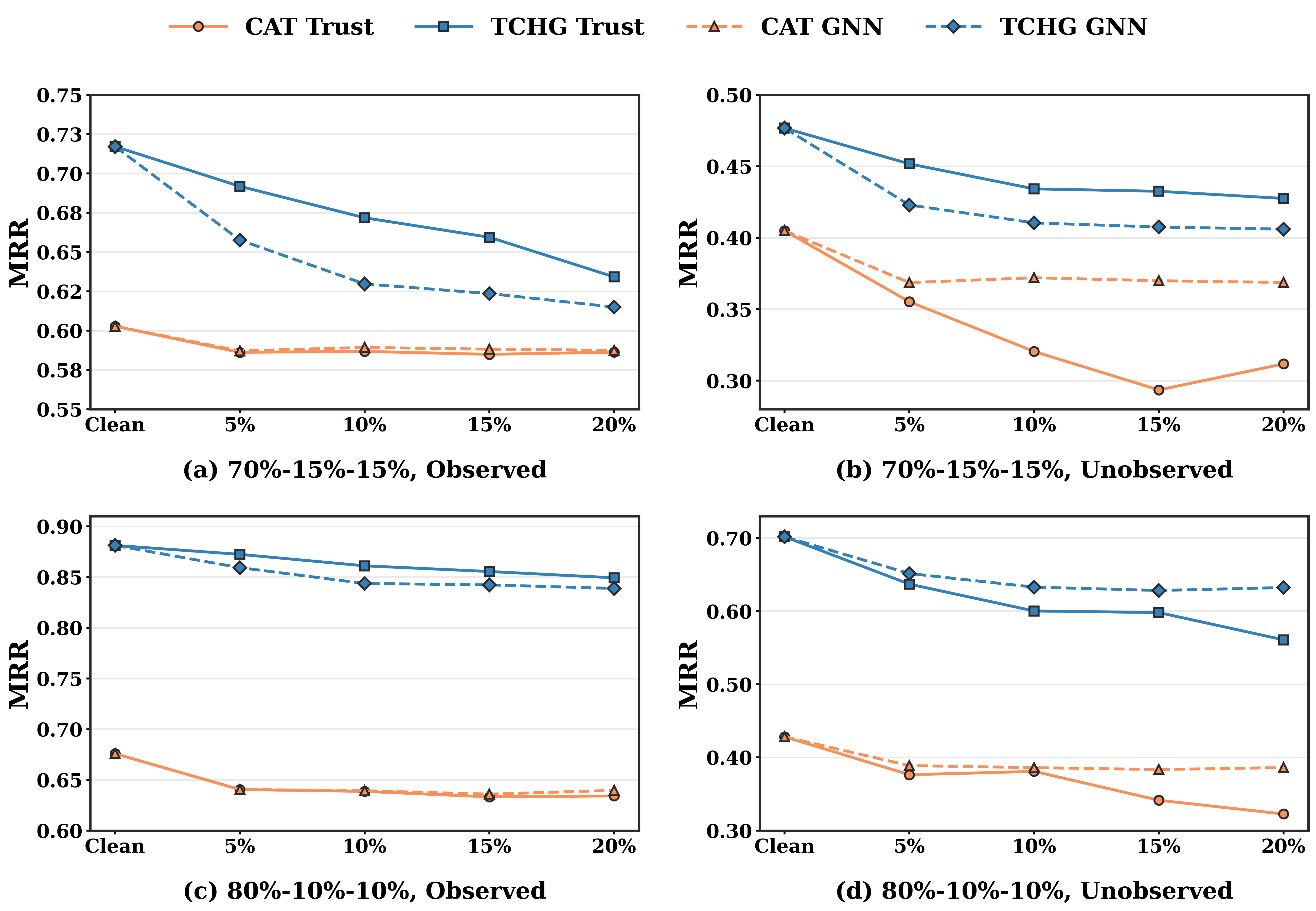
Figure 9: Robustness comparison under poisoning attacks, showing absolute and relative performance for TCHG and CAT across splits and task types.
Practical and Theoretical Implications
TCHG offers a principled mechanism for dynamic trust modeling both in timestamped and timestamp-free settings. By disentangling heterogeneous evidence and controlling propagation functionally, TCHG achieves reliable trust prediction with calibrated probabilities suitable for downstream risk-sensitive applications (filtering, recommendation, manipulation detection). The evidence-controlled approach generalizes to other relational prediction tasks where channel evidence plays asymmetric roles in information flow.
Algorithmically, TCHG demonstrates effective integration of evidence abstraction, dynamic propagation, asynchronous memory evolution, and uncertainty calibration within a unified heterogeneous graph architecture. The observed gains are not attributable to model scale or feature stacking, but to propagation-level functional control.
From an AI development perspective, TCHG previews a methodological trajectory for future trust-aware and evidence-modulated graph learning, especially in domains where dynamic context and entity behavior are critical.
Conclusion
TCHG advances trust prediction by decomposing evidence and integrating tri-trust conditioned propagation, component-decoupled temporal memory, and uncertainty calibration. It surpasses prior baselines in both ranking and probabilistic reliability, with strong robustness properties. The approach sets a precedent for channel-aware information control in dynamic heterogeneous graphs and opens pathways for rich multimodal trust modeling and adaptive robustness defense.