- The paper demonstrates that applying Clifford deformations enables zero-rate LDPC codes to achieve a theoretical 50% threshold under pure Z noise.
- It employs detailed phase diagram mapping and tile code case studies to validate performance improvements via controlled logical operator scaling.
- The study highlights practical implications for hardware-aware error correction and optimized decoding in quantum systems with biased noise.
Background and Motivation
Quantum error correction is fundamentally limited by the structure of physical noise in qubit systems. Many hardware platforms exhibit strongly anisotropic, dephasing-dominated noise, described by high Z-bias in Pauli error probabilities. Classical channel theory dictates that for purely dephasing (pure Z) stochastic errors, a 50% threshold forms the information-theoretic limit for reliable decoding. Historically, topological codes—especially surface codes with Clifford deformations—achieved thresholds close to this limit, but it was unclear whether this performance could be generalized to quantum LDPC codes with low rate.
This paper systematically characterizes Clifford-deformed zero-rate quantum LDPC codes that achieve 50% code-capacity thresholds under infinite Z bias, generalizing prior results for surface, color, and three-dimensional codes and making explicit connections to operator counting and logical operator basis structures.
Applying single-qubit Clifford unitaries to each qubit of a stabilizer code permutes local Pauli axes but preserves the overall code structure, creating a Clifford-deformed variant. Although trivial under unbiased noise, these deformations profoundly affect the alignment between dominant errors and code stabilizers under biased noise, enabling threshold enhancement.
The paper formalizes threshold bounds using a basis of logical operators (BLO): if the number of independent, pure-Z logicals grows subexponentially with system size and their minimal weight scales as Knα, then asymptotic logical failure under pure Z noise is exponentially suppressed and the code achieves the 50% threshold. The argument extends when a BLO is non-overlapping, or when overlaps are allocated according to partitioning schemes, provided the logical basis size and overlap growth satisfy specific scaling constraints (see Theorems in Section 2).
Tile Codes as a Concrete Case Study
The authors focus on the so-called "tile codes" [steffan2025tile, qv65-vmzr], planar LDPC codes with bounded-weight stabilizers and efficient parameters (kd2/n superior to surface codes). These codes admit both open and periodic boundary conditions and maintain constant logical dimension (typically Z0 or Z1).
The tile code structure is illustrated by the bulk and boundary stabilizer generators, emphasizing the geometric locality and bounded weights ideal for hardware implementation.
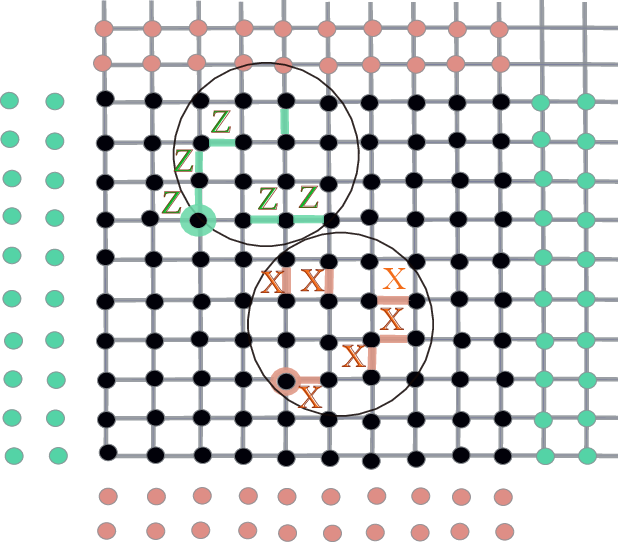
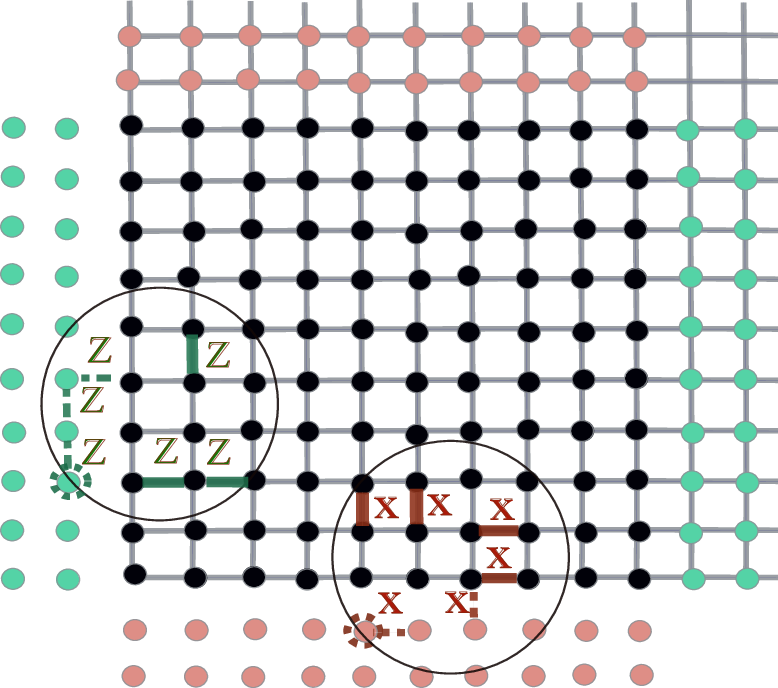
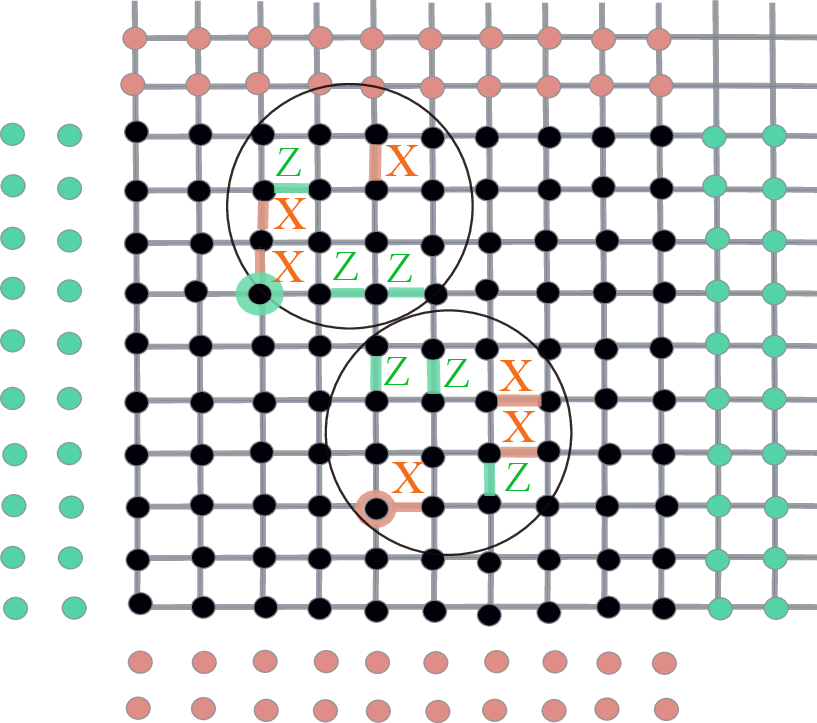
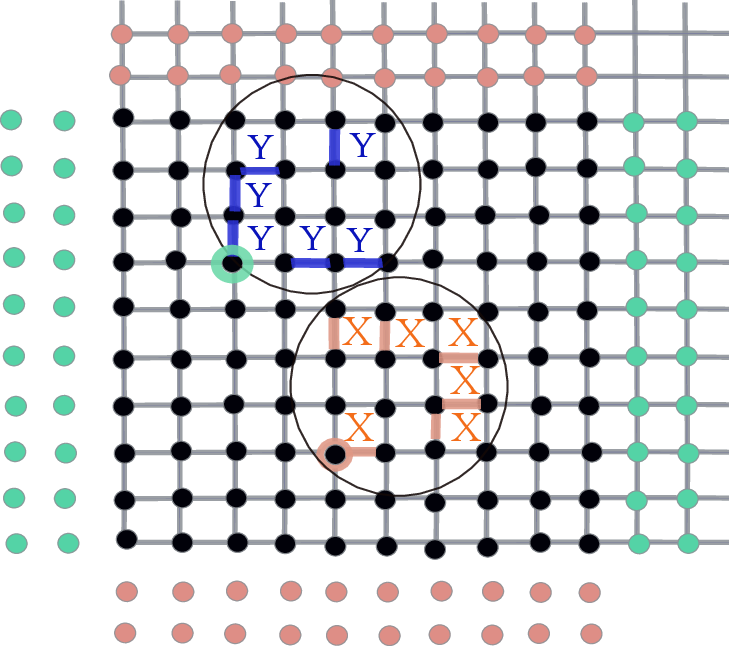
Figure 1: Bulk stabilizer generators (X and Z type) of the Z2 tile code.
Clifford deformations are applied in three modes: linear (Hadamard on all vertical bonds), XY (SH on all qubits), and translation-invariant (TI) with unit-cell periodicity matching phase diagram points.
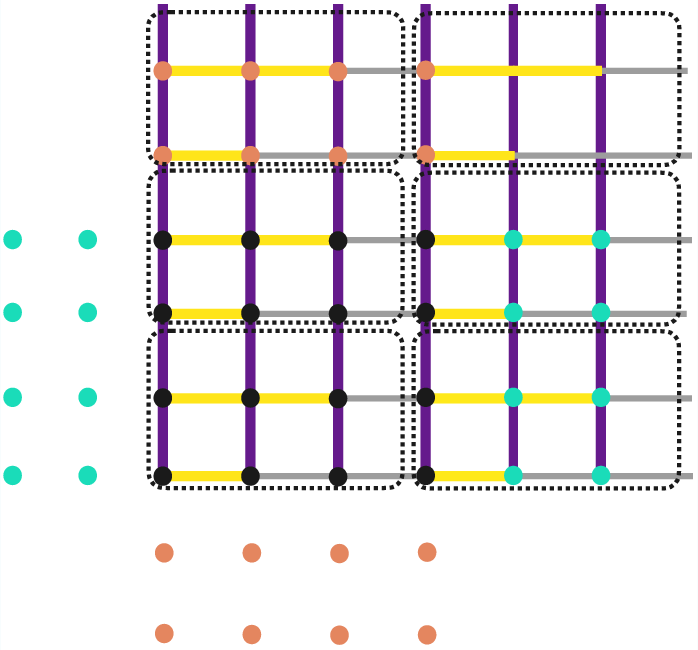
Figure 2: Translation-invariant realization associated with phase point Z3 for the open tile code Z4.
Phase Diagram and BLO Scaling Analysis
The phase diagram for random Clifford-deformed tile codes under infinite bias is mapped out by sampling local permutations: Z5 and Z6 swaps. It reveals a prominent rhombic region where thresholds empirically approach Z7, bounded by combinations of swap probabilities.
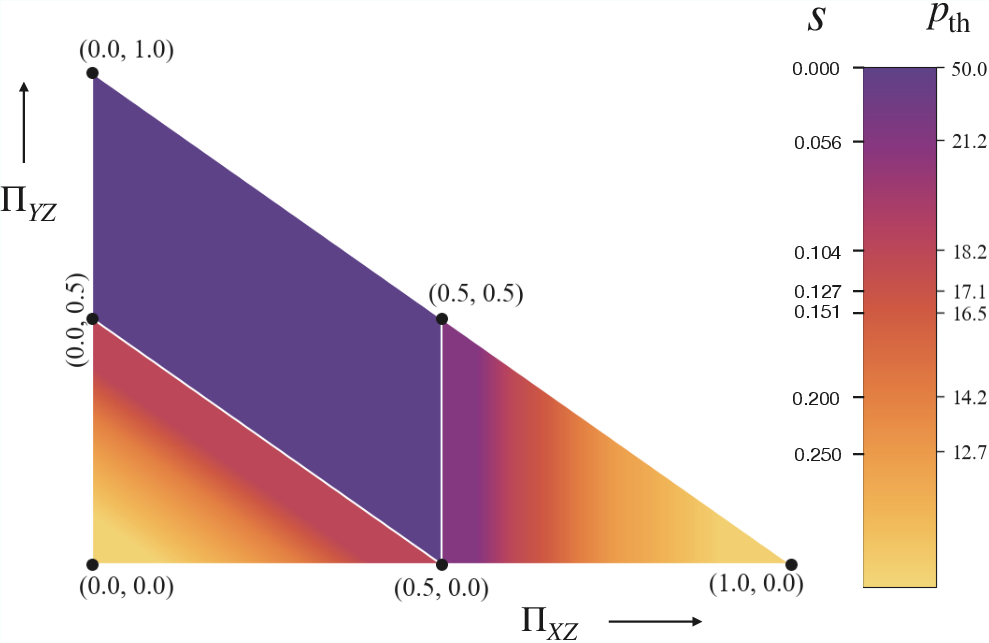
Figure 3: Phase diagram of periodic tile codes under random Clifford deformation; the rhombic region exhibits the 50% threshold.
Analyzing the scaling of BLOs in both random and TI settings, the authors show that inside the 50% threshold region, the number of BLO elements remains constant with system size, while the minimum weight grows linearly. Outside, the BLO size grows linearly, overlaps increase, and the threshold monotonically declines. Iso-threshold contour lines correspond to specific BLO scaling slopes, offering a direct structural diagnostic for threshold behavior.
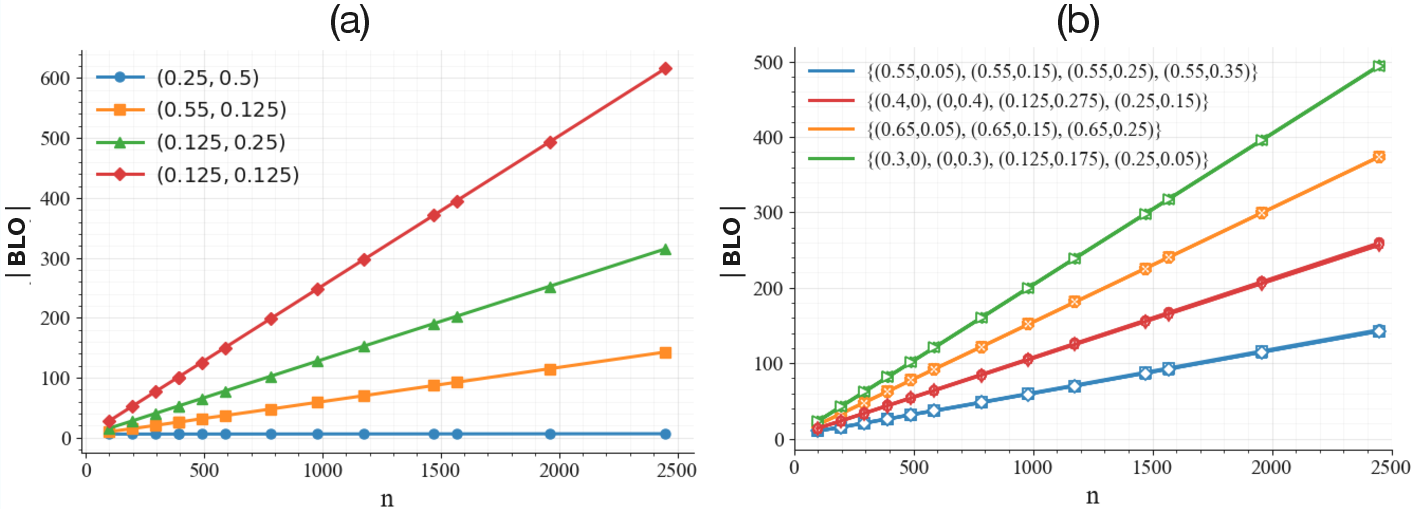
Figure 4: Monotonic growth of BLO size as the threshold decreases; scaling across iso-threshold contours.
The study continues by benchmarking four Clifford variants (CSS, linear, XY, TI) of tile codes under realistic, finite-bias Pauli noise. The threshold and logical error rate are shown to increase with bias parameter Z8, with TI codes (notably the Z9 point) consistently outperforming others in both threshold and sub-threshold scaling.
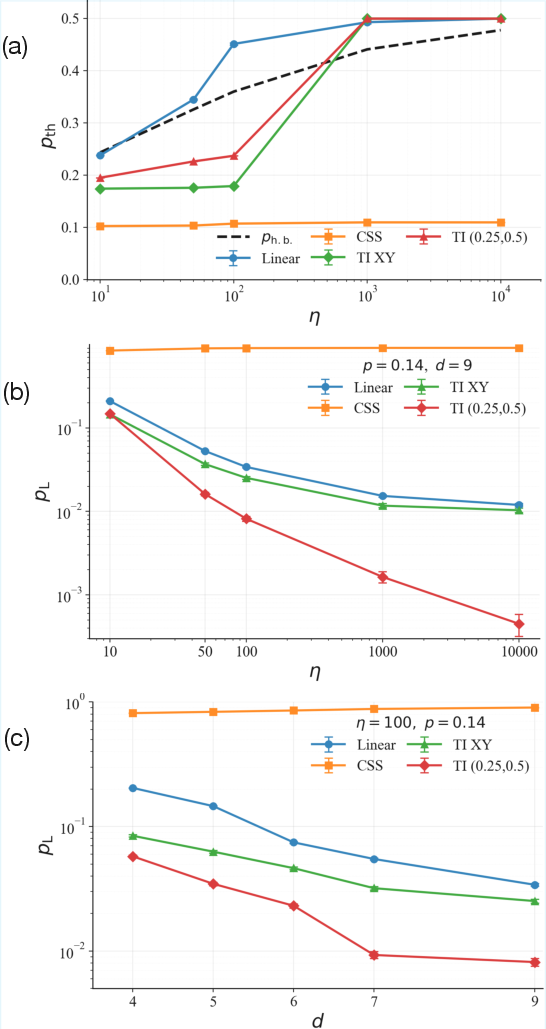
Figure 5: Performance under finite-bias code-capacity noise; TI (0.25, 0.5) achieves superior logical error suppression.
At the circuit level, thresholds drop due to bias renormalization from imperfect gates, demonstrating the need for hardware and compilation-aware optimizations. The authors quantify residual bias after syndrome extraction for several platforms (neutral atoms, superconductors, trapped ions), showing how effective bias and overall logical error rates degrade under realistic native gate sets.
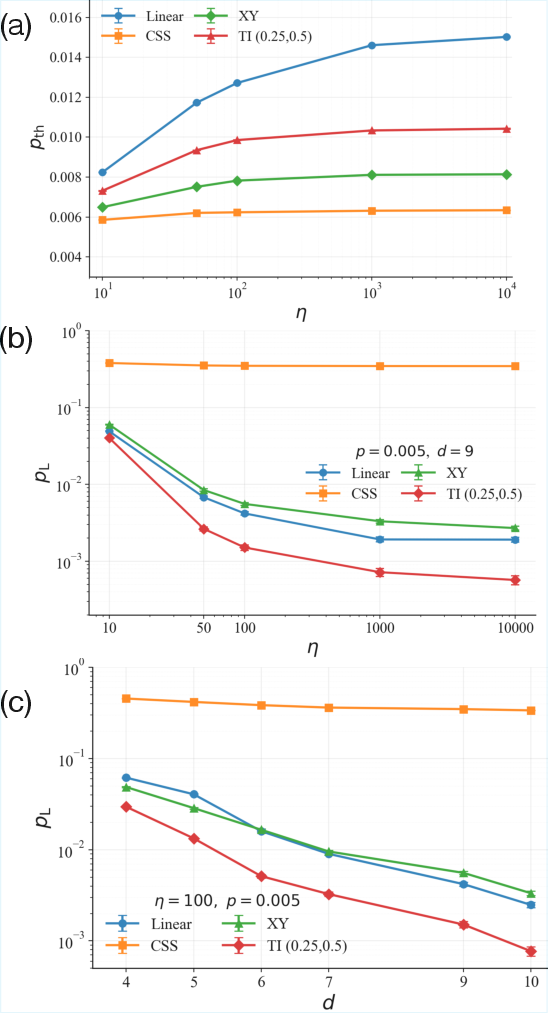
Figure 6: Circuit-level threshold versus bias 50%0 for four open tile code variants; TI codes maintain relative advantage.
They introduce a mapping via sampling Pauli error propagation through circuit layers, extracting effective single-qubit marginal statistics to estimate effective bias and error rate post-circuit (Algorithm in Appendix). Hardware-specific Pauli noise models, derived from Lindblad master equation simulations and PTM analysis, drive these realistic threshold projections.
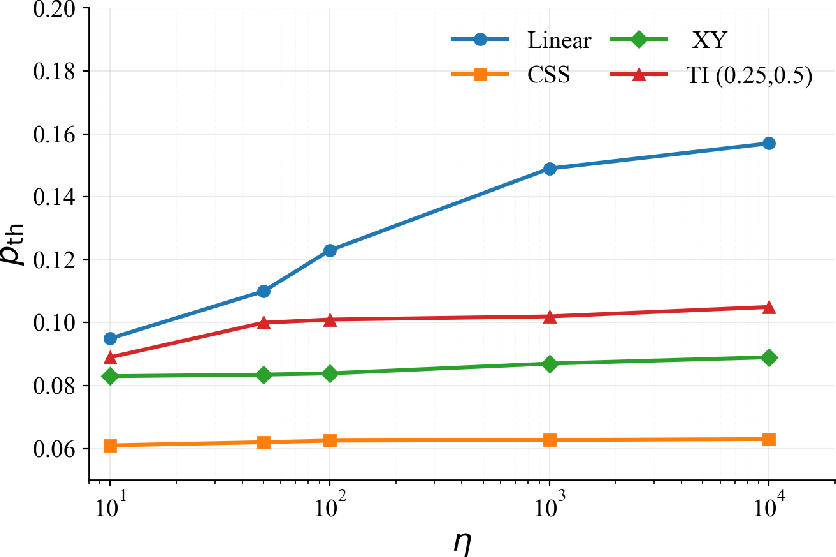
Figure 7: Phenomenological threshold as a function of bias 50%1, defining the boundary for effective post-circuit parameters.
(Table: Effective bias/results)
| Code |
Compilation |
Platform |
50%2 |
50%3 |
50%4 |
| CSS |
CX |
Trapped ions |
0.726 |
5.91 |
15.2e-3 |
| Linear |
CX |
Superconductors |
0.804 |
7.29 |
5.57e-3 |
| XY |
CZ |
Neutral atoms |
2.203 |
13.2 |
20.8e-3 |
| TI |
CZ |
Trapped ions |
1.775 |
12.8 |
5.61e-3 |
The table summarizes post-circuit effective error rates and biases, highlighting the practical impact on logical failure probabilities across platforms and code variants.
Utilizing the weight-reduction technique, the authors construct recursive materialized symmetry solutions for linear-deformed tile codes on periodic 50%5 lattices, with 50%6 in appropriate number-theoretic constraints. This recursive decoding reduces the problem to repetition codes with progressively shrinking weight, each exhibiting the 50% threshold per classical theory. The proof is rigorous and generalizes the threshold mechanism to this LDPC setting, illustrating how code structure enables optimal decoding even in high-dimensional systems.
Practical and Theoretical Implications
This work bridges information-theoretic threshold theory and practical code construction for quantum LDPC codes under strong bias. The phase diagram and BLO scaling diagnostic provide a general framework for future code discovery and optimization—including for hardware-driven architectures and large-scale fault-tolerance.
Practically, the results indicate that Clifford-deformed LDPC codes, especially tile codes with translation-invariant deformations, are promising candidates for quantum memory or logical computation in platforms with high dephasing bias and limited physical gate diversity. The mapping to effective phenomenological parameters enables direct assessment of compilation or hardware choices on code performance.
Theoretically, the operator counting approach and associated scaling bounds extend threshold analysis beyond topological families, opening the door to systematic threshold engineering in quantum LDPC architectures. The results suggest future directions toward optimizing code rate versus threshold trade-offs, as well as tailoring decoding strategies to complex error models arising from realistic, biased noise and circuit-level effects.
Conclusion
Clifford deformation provides a powerful tool for optimizing quantum LDPC codes against biased noise, establishing a rigorous 50% threshold for zero-rate codes and linking high-performance decoding to explicit properties of logical operator bases. Tile codes serve as a concrete demonstration, with both analytical and numerical evidence guiding practical implementation across hardware platforms and bias regimes. The phase diagram and BLO diagnostics are poised to inform ongoing code design, compilation strategies, and hardware integration in the pursuit of robust quantum error correction and scalable quantum computation.