- The paper demonstrates that factual verification consistently emerges before generation during knowledge acquisition, creating a clear GV-gap.
- It shows that verification maintains high accuracy under continual learning, while generation accuracy collapses under distributional shifts.
- The study reveals that fact updates induce a multi-verse state in verification, urging new evaluation protocols and training strategies.
The Factual Generation-Verification Gap: Training Dynamics and Implications
Taxonomy and Definition of the Generation-Verification Gap
"The Future of Facts: Tracing the Factual Generation-Verification Gap" (2605.27564) addresses a fundamental asymmetry in LLMs: the persistent superiority of factual verification over factual generation. This paper systematically distinguishes three classes of generation-verification gaps (GV-gaps) — factual, computational, and aesthetic — with a focus on the factual regime due to methodological tractability and direct relevance to knowledge interfaces.
In factual settings, GV-gap manifests as a model's higher accuracy verifying statements (e.g., "Is Paris the capital of France?") than generating answers (e.g., "What is the capital of France?"). Verification typically reduces to a discrete token classification (True/False), whereas generation must produce a sequence from the joint distribution over the entire vocabulary, compounding the learning difficulty. The paper formalizes generative and verification utilities and chance-corrected metrics, modeling both user-facing and self-improvement lenses.
Controlled Experimental Framework: Acquisition, Continual Learning, Updating
To interrogate the training mechanisms underlying factual GV-gaps, the study deploys synthetic single-hop facts (with paraphrased sentences, avoiding confounds from opaque pretraining data), across four open-source model families (Gemma 3, Qwen 3, Phi-4, Llama 3.2) at two scales each, tracing knowledge across three training phases:
- Acquisition: Fine-tuning on new facts until both generation and verification are learned,
- Continual Learning: Further training on unrelated factual data to induce distributional shift,
- Updating: Rewriting all paraphrases to reflect a new answer and observing adaptation.
Natural experiments on flagship frontier models (GPT 5.4, Gemini 3 Flash, etc.) complement the controlled setup by exploiting coverage variation in real-world datasets (S&P 500, NBA scores, Mega Millions, Billboard Hot 100).
Key Empirical Findings: Order, Robustness, Multi-verse Phenomenon
Verification Proceeds Generation During Acquisition
The first robust observation is that verification consistently emerges before generation during knowledge acquisition, across all architectures and scales. This produces an identifiable window (GV-gap) in which models reliably verify facts they cannot yet generate. Critically, the loss curve itself does not reveal this gap; standard training metrics are insufficient for diagnosing factual GV-gap emergence.
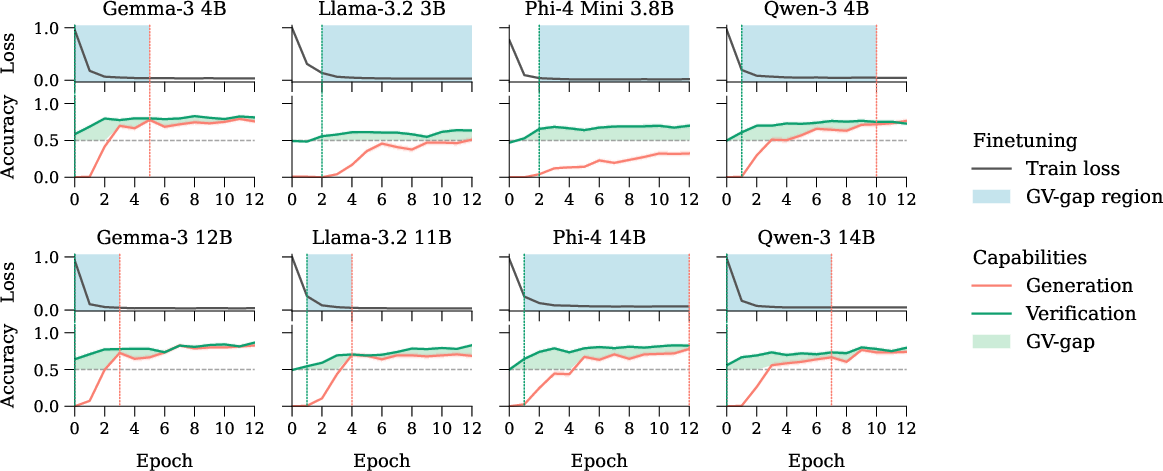
Figure 1: Verification consistently develops before generation, establishing a GV-gap whose location is invisible in the loss curve.
Verification Survives Continual Learning More Robustly
Under continual learning — training on unrelated factual data — verification degrades much more slowly than generation, stabilizing at a higher floor (further increased by scale and prior data exposure). Generation accuracy collapses under distributional shift, while verification retains significant utility even as loss on original facts rises.
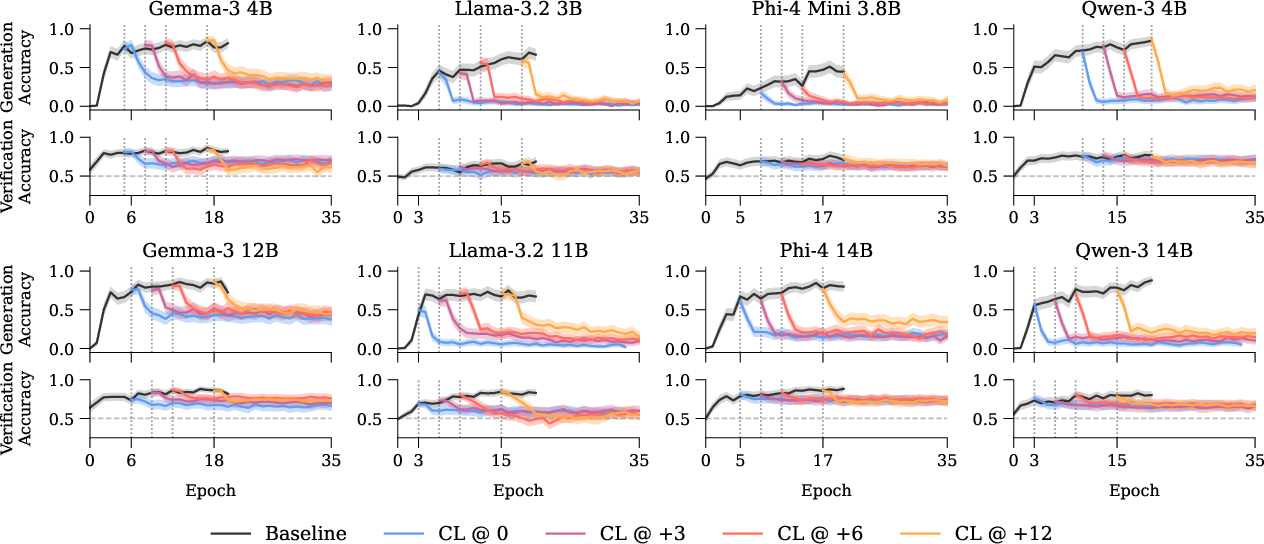
Figure 2: Continual learning robustly widens/reopens GV-gaps, with verification maintaining higher floors compared to generation.
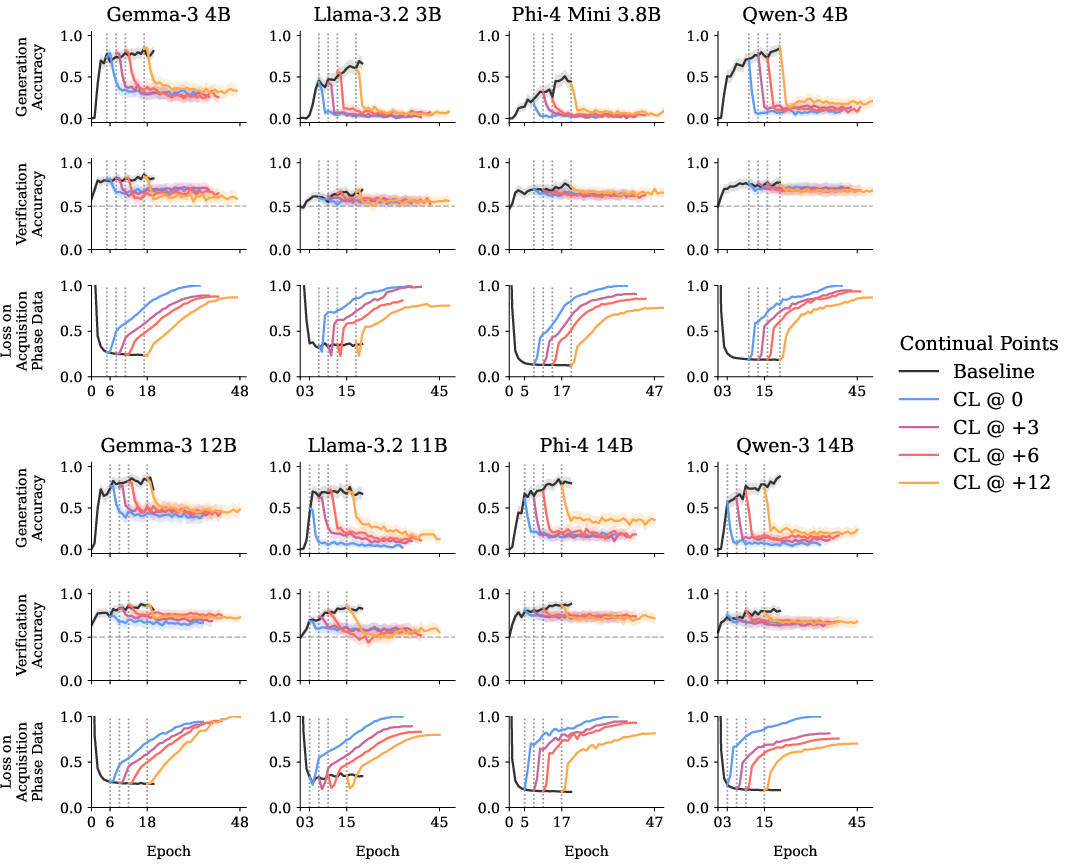
Figure 3: Verification abilities remain resilient during continual learning, even as generative accuracy and acquisition-phase loss deteriorate.
Updating Facts Yields Multi-verse Verification States
When a fact is updated (e.g., "A cures B" → "C cures B"), generation cleanly flips to the new answer. However, verification enters a "multi-verse" state — models simultaneously verify both the original and updated answers as correct. This results from lack of explicit negative data invalidating the superseded fact; practical factual updates rarely provide such invalidation, making this a prevalent real-world failure mode.
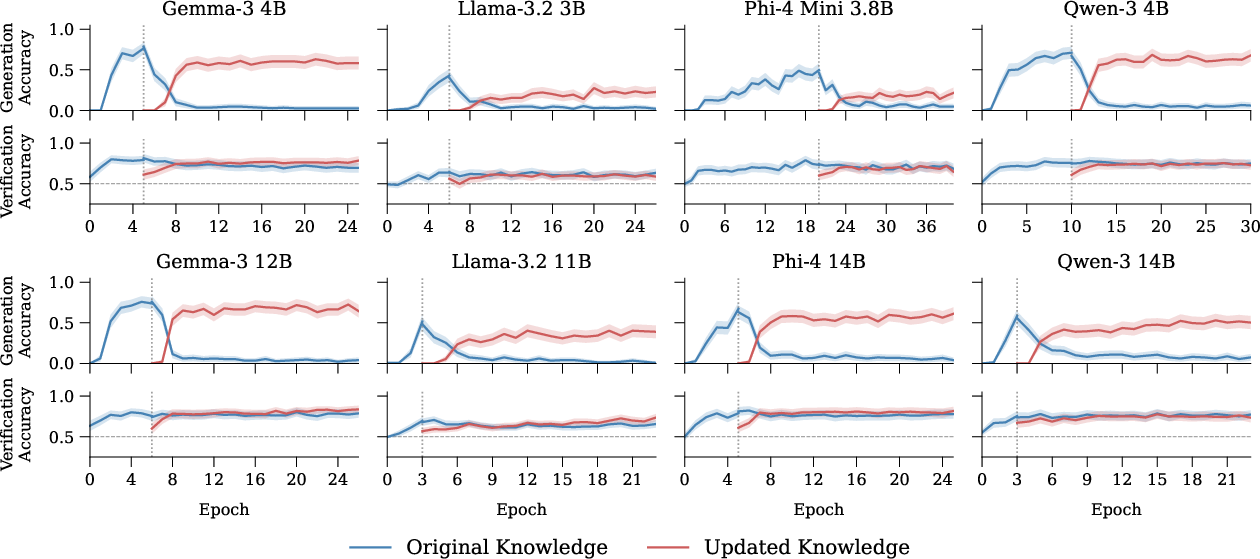
Figure 4: Updating yields a multi-verse regime, where verification affirms both original and updated facts despite generation shifting.
Real-World Coverage: Regimes and Residual Multi-verse State
Natural experiments on frontier models reveal three coverage-dependent regimes: (1) insufficient data—neither capability emerges, (2) verification threshold crossed, generation remains deficient (GV-gap), (3) convergence—both saturate, observed earlier for higher-coverage datasets. Residual verification biases and multi-verse states are evident, especially in datasets with dynamic answers (e.g., Billboard Hot 100 chart rotations).
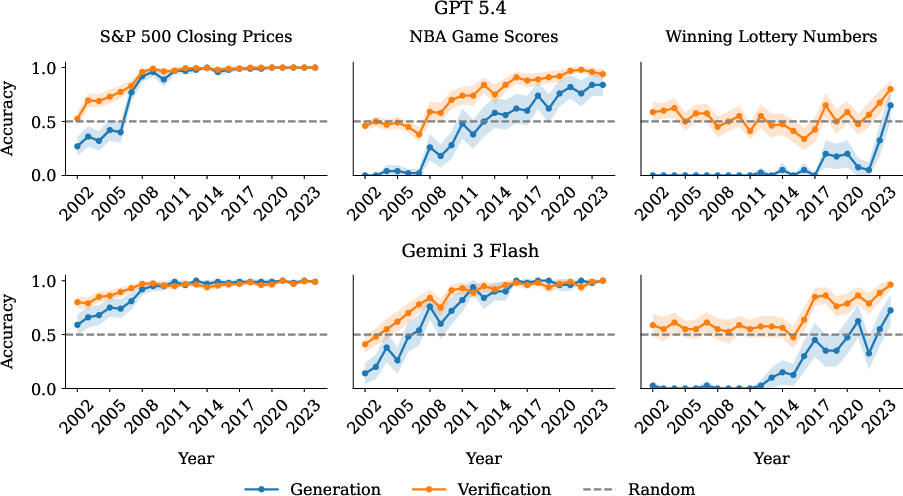
Figure 5: Real-world coverage gradient exposes GV-gaps and transitions through coverage-dependent learning regimes in frontier models.
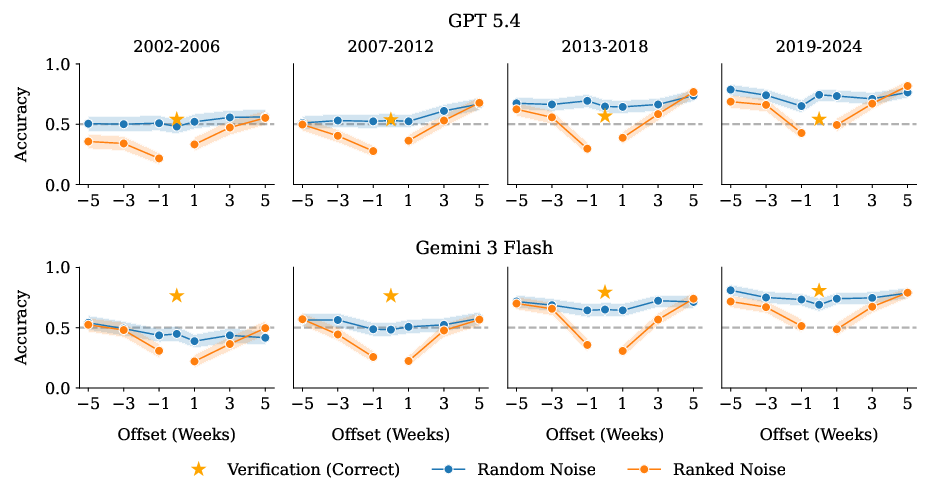
Figure 6: Residual multi-verse state: models reject ranked-noise queries less robustly, evidencing lingering verification over both past and present answers in Billboard song rankings.
Effects of Model Scale, Distillation, Reasoning Effort
Distillation consistently widens GV-gaps, especially as model scale decreases; generative subset violations (where smaller models surface new correct generative facts) are rare, indicating distillation acts as an approximate subset operation. Increased reasoning effort does not significantly enhance generative factual capabilities or overall verification utility but shifts verification bias composition (affirmation vs. rejection).
Implications: Structural Asymmetries, Evaluation, Development
The asymmetry wherein verification outpaces generation, and its resilience across continual learning and updates, has direct implications for the information environment as LLMs become dominant knowledge interfaces. If left unaddressed, the factual GV-gap and multi-verse verification can propagate through model-generated content, compounding informational fragmentation and enabling factual disputes — notably, the "quiet drift" in what models verify as true.
From a practical standpoint, mitigations such as retrieval-augmented generation (RAG) sidestep some limitations but rely on verification for candidate selection and are themselves shaped by prevailing verification biases. Abstention behavior is preferable for small models facing insufficient memory capacity but is rarely rewarded by current benchmarks, and models that refuse to attempt generation often still verify outdated facts.
The findings suggest evaluation protocols should treat factual generation and verification as separate competencies, with distinct learning thresholds and failure modes; training loss does not suffice to identify the gap, necessitating new testbeds for joint tracing of factual life cycles.
Speculation: Future Directions in AI Training and Evaluation
Theoretical accounts and empirical evidence indicate that GV-gaps are not permanent limitations of current transformer-based models but are induced by suboptimal data curation, training recipes, and curriculum structure. As model-generated data increasingly populates the training corpora for future models, rigorous strategies are needed to control verification biases, enforce negative sampling during fact updates, and revisit benchmarks to foster abstention and minimize confabulation.
Further mechanistic analysis, including probing for latent generalization failures and broader memory organization phenomena, will provide deeper insight into the source of GV-gaps. Addressing multi-hop factual reasoning and integrating explicit update signals into training will be essential to ensure factual coherence and to avoid ongoing epistemic drift.
Conclusion
This paper rigorously demonstrates that factual verification is learned earlier and is more robust than generation across model families, scales, and training regimes. Factual updates induce persistent verification of both superseded and current answers, revealing a multi-verse phenomenon that persists even in high-performing frontier models. The implications span data curation, curriculum design, and evaluation methodology, calling for a re-examination of how factuality is measured and taught. The open-source testbed provided is a valuable instrument for future studies dissecting factual GV-gaps and their propagation in LLMs.

