- The paper introduces Chat-ISV, a system integrating a traceable knowledge graph with multi-agent LLMs to deliver evidence-grounded decision support for VOC management.
- It outlines a robust data extraction and KG optimization pipeline that reduced isolated nodes from 57% to 4.08%, ensuring reliable multi-hop reasoning.
- Benchmarking demonstrates Chat-ISV outperforms commercial LLMs with 96.93% precision, offering extensible solutions for industrial environmental governance.
Knowledge Graph Reasoning and LLM-Assisted Decision Support for Steel Industry VOCs
Problem Statement and Motivation
Effective governance of volatile organic compounds (VOCs) in the steel industry necessitates synthesizing heterogeneous evidence from unstructured scientific literature to inform process-level interventions and control strategies. The fragmentation of environmental engineering data impedes reliable decision-support, while deploying general LLMs for low-frequency industrial queries incurs high hallucination risk due to inadequate domain grounding. The paper addresses these bottlenecks by proposing Chat-ISV, a multi-agent LLM system grounded in an optimized, traceable knowledge graph (KG) constructed from steel-industry VOCs literature, enabling robust question answering and decision support.
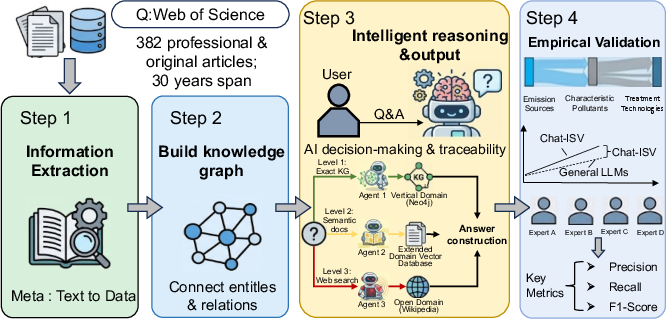
Figure 1: Chat-ISV pipeline: transforming domain-specific scientific literature into a structured knowledge graph and using graph-derived evidence for LLM-driven QA on VOCs governance.
Data Acquisition, Ontology, and KG Construction
The authors curated a domain-specific corpus comprising 382 full-text articles and supporting information spanning three decades, systematically mined for process, pollutant, and control-technology entities. A domain ontology with 9 entity types and 12 relation types was defined to capture production stages, emission sources, VOC species, abatement technologies, analytical methods, and more. Extraction leveraged prompt engineering and dual-track strategies: explicit relations required lexical triggers, while implicit ones were inferred via local co-occurrence and causal heuristics. The pipeline enforced source-text traceability via evidence spans and confidence scores.
Data cleaning applied structural repair and semantic normalization to resolve format inconsistencies and entity ambiguities. The normalized JSONL dataset was ingested into Neo4j, yielding a multi-relational graph with 27,180 nodes and 81,779 edges.
Topological Optimization and Evidence Traceability
Initial LLM-extracted graphs exhibited severe fragmentation (57% isolated nodes). Front-end semantic completion and back-end chunk-centered schema restructuring reduced the isolated-node ratio to 4.08%. Semantic completion injected rule-based and co-occurrence edges; chunk nodes acted as evidence hubs, linking entities through :MENTIONS relations, anchoring them in source literature. This star-topology enabled multi-hop query routing and ensured explicit traceability from retrieved entities to empirical evidence.
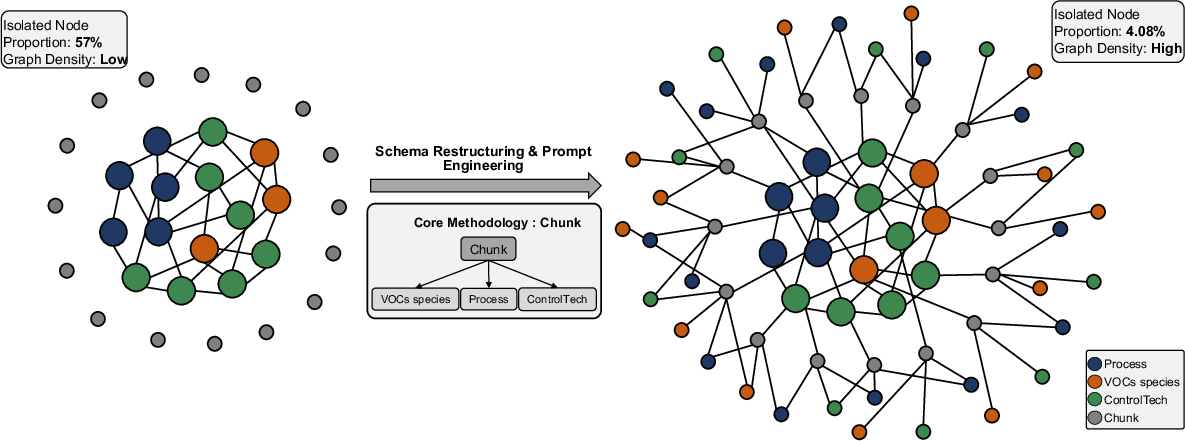
Figure 2: Comparative analysis of graph topology before and after optimization, illustrating connectivity improvements via chunk-centered grounding.
Multi-Agent Architecture for Question Answering
Chat-ISV integrates three agent tiers: (i) graph-reasoning agent for KG-based retrieval via Cypher queries and schema metadata, (ii) literature-retrieval agent for fallback to local semantic vector search, and (iii) open-domain knowledge agent for further fallback. A scheduling agent orchestrates routing, merges evidence, and controls prompt assembly. Evidence is injected into LLM prompts under source-backtracking constraints, maintaining hard factual boundaries.
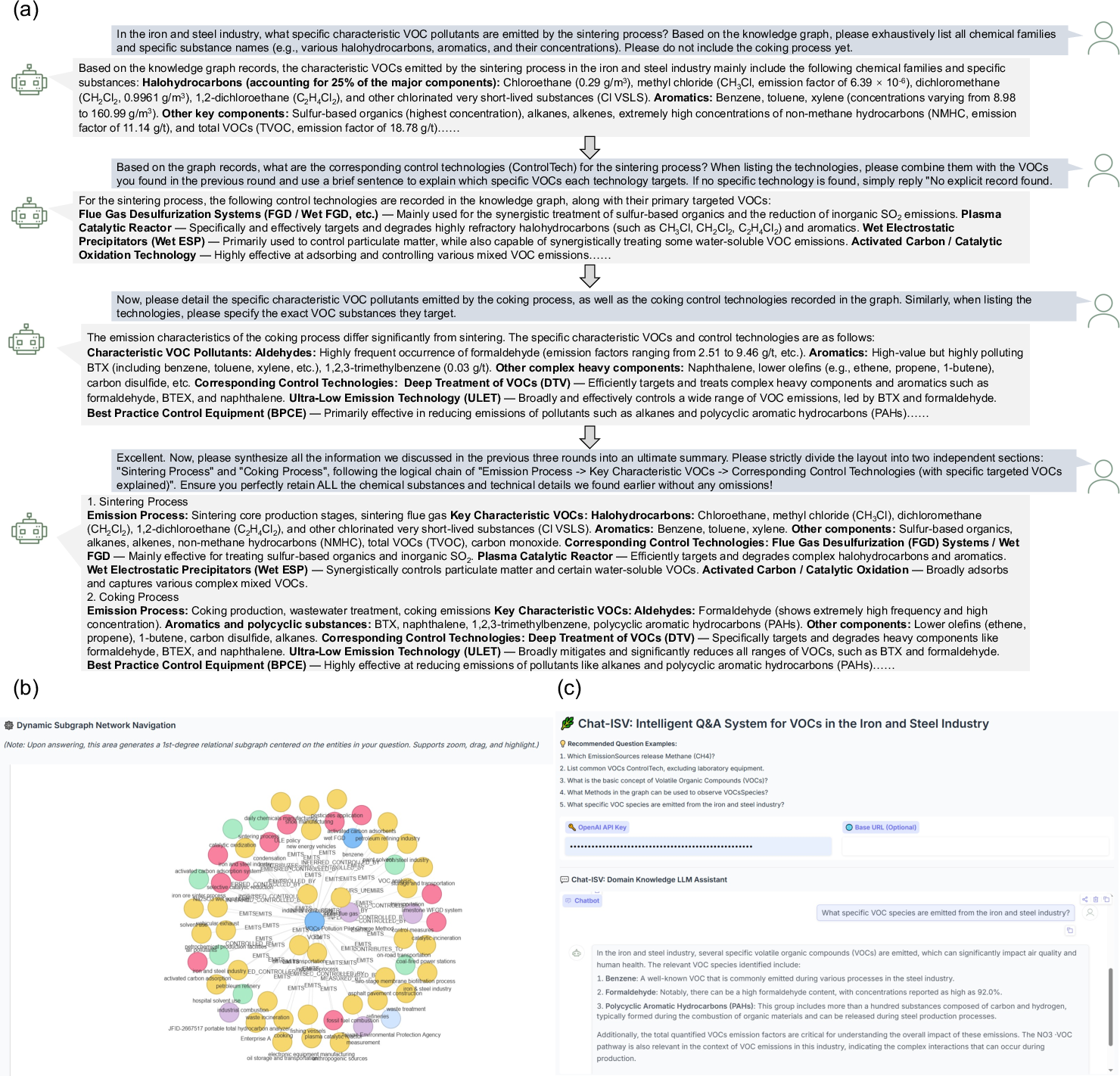
Figure 3: The system interface and subgraph visualization: progressive QA workflow from emission to key VOCs and control technologies, with interactive exploration of reasoning paths.
Knowledge Flow Analysis and Domain Insights
The bibliometric and KG-based Sankey diagrams reveal temporal and technical evolution in steel-industry VOCs research. Annual publications surged post-2018, reflecting increased regulatory focus and evidence accumulation. Multi-layer flows map emission contexts (sintering, coking), pollutant families (PAHs, aromatics, halohydrocarbons), and abatement technologies (catalytic treatment dominates, followed by adsorption and absorption). KG-reconstructed flows resolve semantic ambiguity and provide directional interpretability unattainable by conventional keyword-based co-occurrence diagrams.
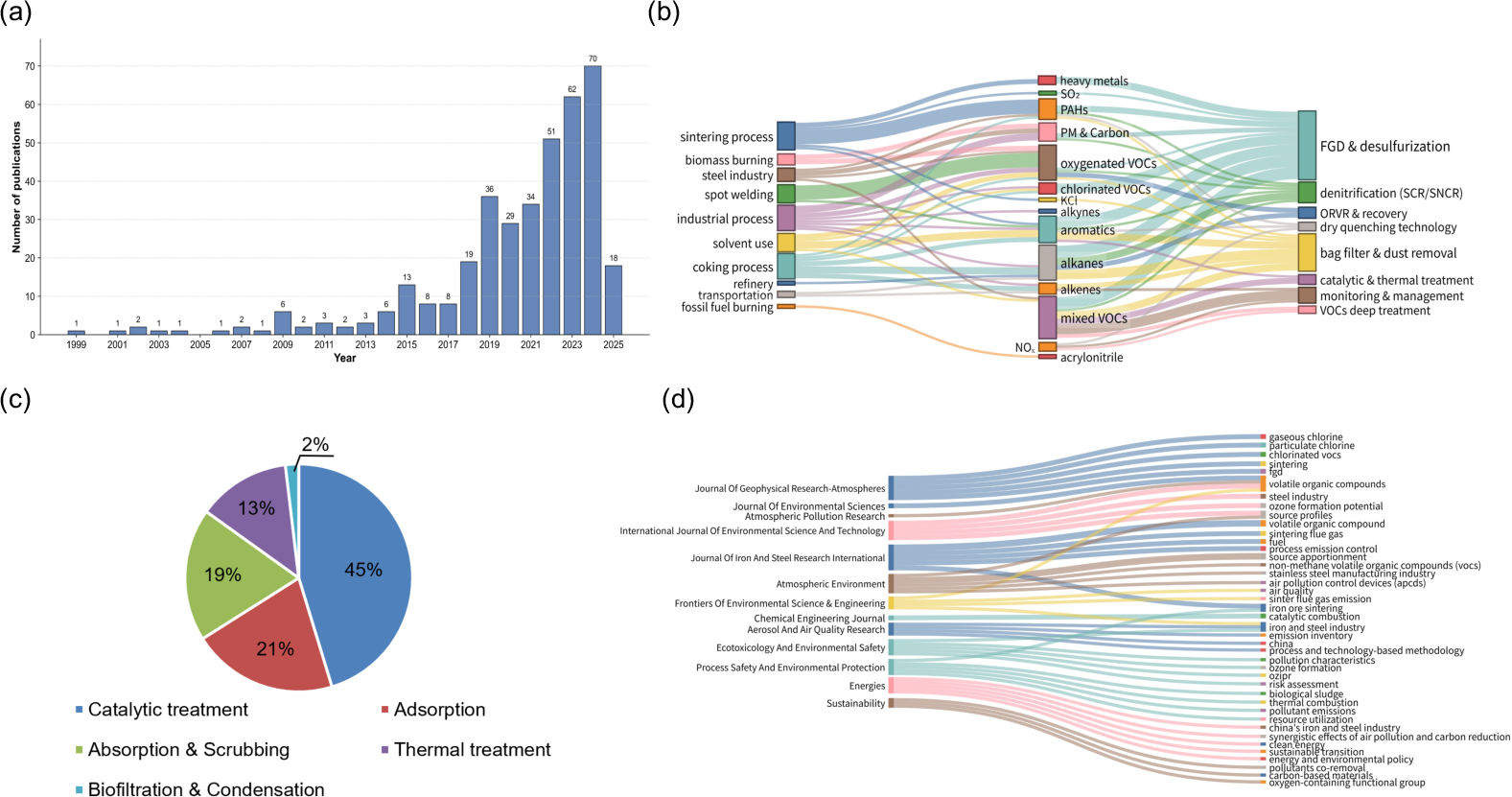
Figure 4: Publication trajectory and KG-driven Sankey diagrams: temporal trends, source-pollutant-control knowledge flows, technological distributions, and comparison with traditional literature mapping.
Benchmarking and Numerical Evaluation
Chat-ISV was benchmarked against state-of-the-art commercial LLMs on specialized VOCs queries. General-purpose models exhibited fluent but generic answers, with frequent factual hallucinations and misattribution of process-specific characteristics. Chat-ISV, by contrast, retrieved empirical evidence from literature chunks (e.g., exact emission factors), demonstrating precise answer grounding. The decoupled retrieval-generative workflow (multi-agent cascade routing) effectively mitigates hallucination by anchoring outputs in domain KG constraints.
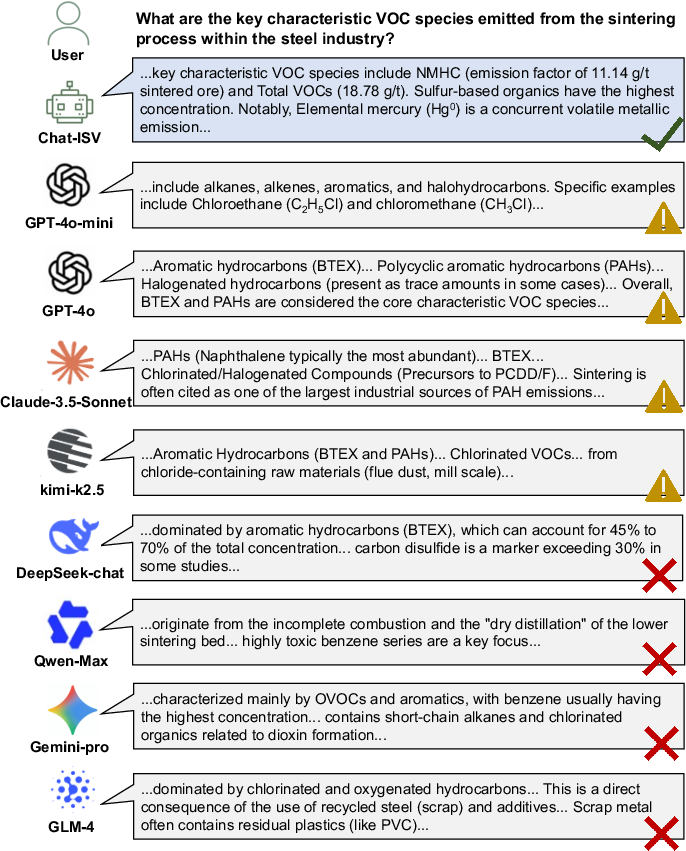
Figure 5: Cross-model comparison: Chat-ISV vs. commercial LLMs on industrial pollutant QA, showing the superior traceability and factual grounding of the KG-anchored system.
Blind Expert Evaluation and Consistency Analysis
Rigorous blind evaluation by four experts on 100 domain questions (400 ratings) mapped scores to IR metrics: True Positive (TP = 2), False Negative (FN = 1), False Positive (FP = 0). Chat-ISV achieved 96.93% precision, 72.63% recall, F1-score 0.830, with a mean score of 1.69/2.00. FP rates were minimal (9/400), and inter-rater Pearson correlations (0.57–0.77) confirmed consistency. Recall loss is attributed to conservative routing for peripheral long-tail queries. In generalization tests on a broader environmental corpus, precision remained robust (91.79%), indicating strong architecture portability.
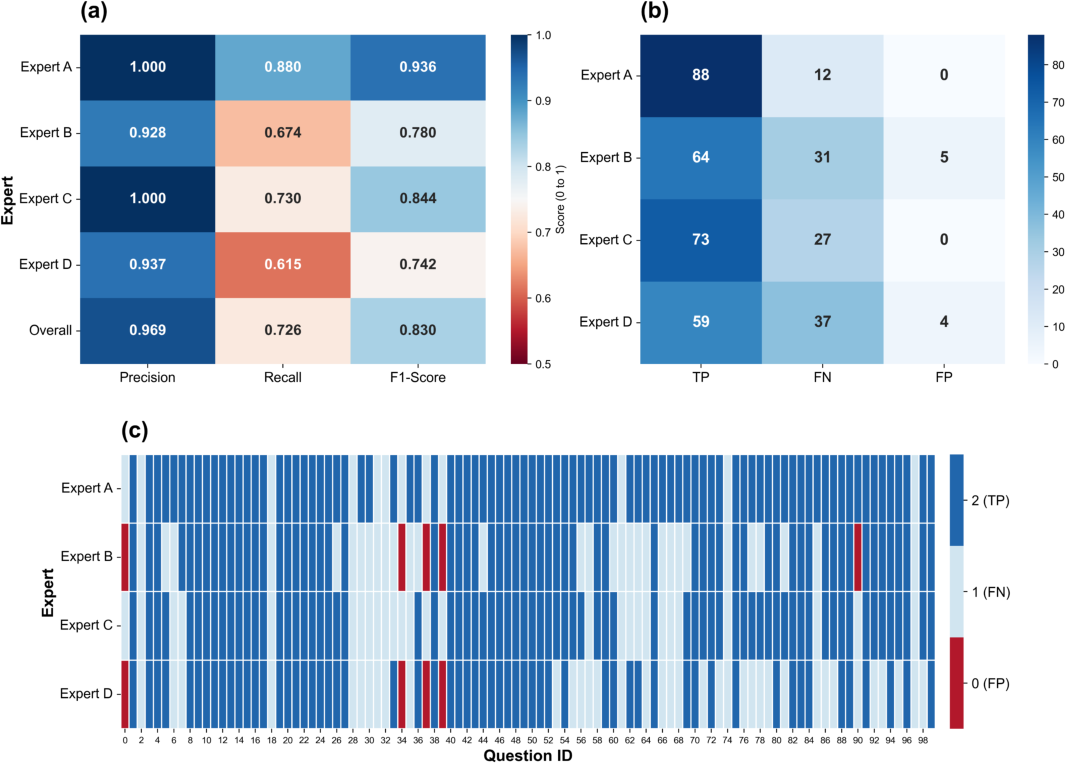
Figure 6: Quantitative performance metrics and expert-consistency analysis: precision, recall, F1-score, rating distributions, and inter-expert correlation for vertical-domain QA tasks.
Practical and Theoretical Implications
The system demonstrates that traceable KG-LLM integration enables robust, evidence-grounded decision support in knowledge-intensive, low-frequency industrial domains. Chunk-centered topology achieves connectivity and traceability, critical for multi-hop reasoning and retrieval. Multi-agent LLM workflows—decoupling retrieval and generation—substantially suppress hallucinations, aligning with recent literature on KG-enhanced LLMs [Pan2024TKDE], multi-agent reasoning [Wang2024AgentSurvey], and retrieval-augmented generation [Lewis2020RAG].
The practical impact is twofold: (i) domain experts gain access to high-fidelity answers grounded in empirical literature, enabling rigorous VOCs governance and process optimization; (ii) the architectural paradigm is extensible to other fragmented environmental-engineering verticals. Theoretical advances include methodological frameworks for topology-aware KG repair, explicit evidence-linking, and cascade agent orchestration for LLM QA in high-stakes domains.
Future Directions
To further expand the paradigm, dynamic KG updates and cross-industry integrations are needed, alongside real-time data fusion for process monitoring. Automated extraction schemas, continual agent routing optimization, and scaling to broader scientific domains will enable more robust knowledge infrastructure for intelligent industrial decision support.
Conclusion
Chat-ISV establishes a scalable KG-enhanced multi-agent LLM system for steel-industry VOCs governance, transforming fragmented literature into structured, queryable evidence. The optimized topology and multi-tier agent routing yield highly reliable factual answers, as evidenced by strong quantitative and expert-consistency metrics. This work exemplifies methodological advances in traceable KG-LLM integration and suggests broad applicability for decision support across specialized engineering domains (2605.27071).

