- The paper introduces a graph-assisted retrieval framework that converts LPBF literature into an evidence-linked knowledge graph for defect reasoning.
- It leverages both semantic and graph-based retrieval techniques to map process parameters to defect mechanisms with a nearly 97% recall rate.
- The study demonstrates practical implications for scalable, transparent defect analysis in additive manufacturing and industrial quality assurance.
Graph-Assisted Evidence Grounding for Defect Reasoning in LPBF
Introduction
The paper "Towards Agentic Defect Reasoning: A Graph-Assisted Retrieval Framework for Laser Powder Bed Fusion" (2604.04208) presents a domain-adapted knowledge extraction and retrieval framework for the additive manufacturing (AM) process of Laser Powder Bed Fusion (LPBF), focusing on the titanium alloy Ti–6Al–4V. The approach systematically transforms open scientific literature into a structured, evidence-linked knowledge base and enables transparent, interpretable reasoning about defect formation by leveraging both semantic and graph-based retrieval mechanisms. The framework is designed to address the challenges of distributed and inconsistently represented domain knowledge in LPBF, which impedes multi-step reasoning about how process parameters relate to defect mechanisms.
Data Curation and Preprocessing
A targeted corpus comprising 50 open-access publications centered on LPBF of Ti–6Al–4V was curated, intentionally restricting the scope to a single alloy system to facilitate focused relationship mining. Non-technical elements—such as references, tables, and figure descriptions—were stripped, leaving only the narrative technical content. Preprocessing was executed via standard Python libraries supporting document parsing, regex-based normalization, and sentence segmentation to yield a noise-reduced, context-preserving dataset suitable for downstream structured information extraction.
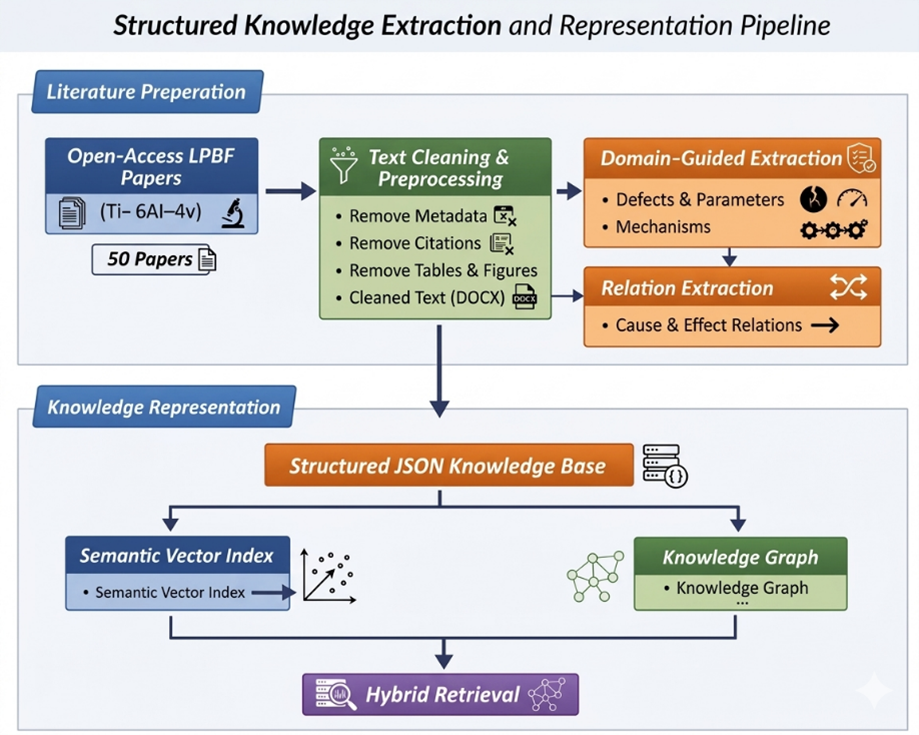
Figure 1: The data pre-processing pipeline produces clean, segmented text, facilitating robust knowledge extraction.
Structured Knowledge Extraction and Representation
Text was segmented into overlapping 220-word chunks to preserve contextual continuity. Using controlled vocabularies, the framework applied domain-guided, rule-based extraction of key entities—defects, process parameters, mechanisms, and consequences. Relation patterns such as causal and associative links (e.g., “leads to,” “results in”) were mined, extracting structured triples encompassing parameter–defect, parameter–mechanism, and mechanism–defect links. This extraction produced a unified JSON representation where every chunk could be traced back to its origin in the literature, ensuring evidence fidelity and interpretability.
Construction of the Evidence-Linked Knowledge Graph
Extracted relations were consolidated into a directed knowledge graph. Nodes represent normalized entities (e.g., laser power, keyhole, porosity) and directed edges encode relationship types, incremented for multiple evidentiary supports, with each edge tied to associated chunk identifiers from the corpus. This dual-purpose structure serves both as a semantic index and as a transparent evidence map, directly connecting graph traversals to citations in the literature.
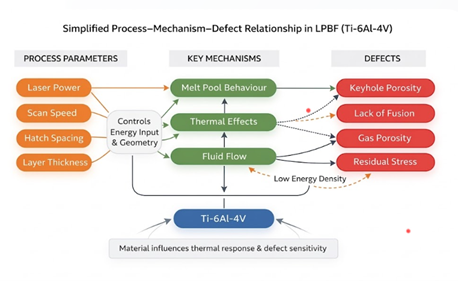
Figure 2: The knowledge graph encodes parameter–mechanism–defect pathways, preserving traceability to evidence.
Semantic and Graph-Assisted Retrieval Mechanisms
Semantic search leverages Sentence Transformers (all-MiniLM-L6-v2) to compute chunk embeddings, indexed via FAISS for efficient top-k retrieval in response to a given query. However, graph-based retrieval enhances this by normalizing queries against the graph vocabulary, identifying relevant nodes, and exploiting topological connections to collect supporting evidence chunks. If the graph offers promising candidates, semantic re-ranking is then constrained to this graph-derived subset; otherwise, the fallback is conventional embedding-based retrieval. This hybrid mechanism achieves a synergy of relational grounding and lexical similarity.
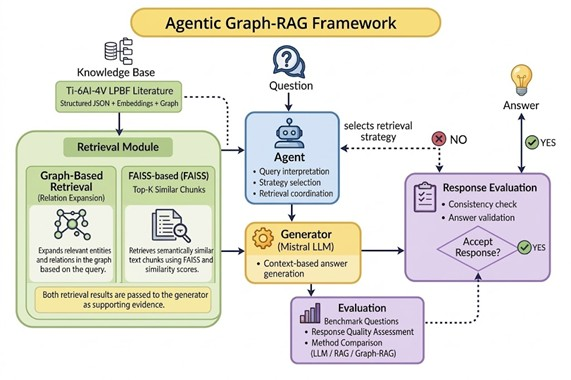
Figure 3: The agent-based reasoning layer coordinates semantic and graph-guided retrieval for robust defect reasoning.
Integration of Agentic Reasoning
The system incorporates a lightweight agentic reasoning layer responsible for interpreting queries, orchestrating retrieval strategy, aggregating and ranking evidence, constructing reasoning chains, and estimating confidence. Depending on the query (lookup, explanation, or comparison), evidence from graph and semantic searches is merged, frequently prioritizing graph-derived evidence. Structured reasoning chains are then generated, distilled from recurring evidence patterns or explicit graph paths, and grounded in the original literature context.
Numerical Evaluation
The framework was evaluated on a benchmark set of 10 domain-representative queries targeting defect mechanisms and parameter interactions. Key metrics reported were:
- Mean retrieval accuracy: 0.9667
- Defect label recall: 0.9667
- Defect label precision: 0.6167
- Parameter identification accuracy: 0.7222
- Mean response latency: 6.41 seconds
High recall demonstrates the efficacy of the graph-semantic hybrid retrieval in capturing relevant defect information, whereas the lower precision reflects the intrinsic presence of additional, often related, content within multidimensional literature chunks. The precision bottleneck primarily arises from domain literature complexity; process parameters are not always localized within the same text segment as defects.
The system produces explicit, interpretable reasoning outputs. For instance, on the query, “Why does high laser power lead to keyhole porosity in LPBF?”, the framework determines:
laser power → keyhole instability → porosity
grounded in multiple validated literature chunks.
Theoretical and Practical Implications
The integration of domain knowledge graphs with evidence-traceable retrieval augments both interpretability and transparency, addressing a core limitation in standard RAG pipelines that typically rely on unstructured semantic similarity. The graph-based augmentation permits explicit tracing of parameter-to-defect pathways, which is essential for trustworthy deployment of AI reasoning agents in manufacturing and scientific discovery.
Practically, this enables more reliable, interpretable, and scalable defect root cause analysis, supporting both research and industrial quality assurance workflows in additive manufacturing. The formal graphical structure also provides a foundation for downstream extensions, such as active learning or iterative multi-hop reasoning.
Theoretically, this work demonstrates that modular agentic layers operating on literature-derived, evidence-linked knowledge graphs can mediate interpretable causal reasoning in process engineering domains. The approach offers a path toward automated reasoning agents that avoid hallucination by grounding outputs in explicit, verifiable evidence chains.
Limitations and Avenues for Future Work
The extraction process remains rule-based, so complex or nuanced linguistic relationships may be missed. The framework was evaluated solely on a limited benchmark and on a single alloy system, which constrains broader generalizability. The current agentic layer performs only basic coordination and lacks true iterative or multi-step planning abilities.
Improvements may involve:
- Adoption of neural relation extraction models for richer, domain-adapted triple formation.
- Extension to cross-material and multi-domain corpora.
- Deployment of more advanced agentic architectures for deep multi-hop reasoning, uncertainty calibration, and counterfactual analysis.
Conclusion
The proposed graph-assisted, agentic retrieval framework demonstrates robust, transparent defect reasoning on LPBF literature with high retrieval accuracy and recall. By fusing semantic and relational retrieval with an evidence-linked knowledge graph, the system produces interpretable, literature-grounded reasoning chains. The implications for trustworthy, scalable, and interpretable AI in digital manufacturing are significant, and the methodology constitutes a modular blueprint for future studies targeting explainable scientific question-answering and interactive AI reasoning in other data-rich scientific domains.

