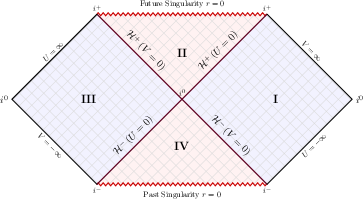
- The paper develops a canonical quantization framework for the massive Proca field in Schwarzschild spacetime using the Dirac bracket method.
- It systematically decomposes field modes via vector spherical harmonics and the FKKS ansatz, revealing parity-dependent master equations.
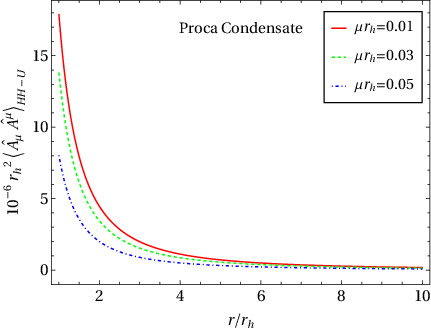
- Key results include polarization-dependent Hawking radiation spectra and significant vacuum polarization near the event horizon.
Canonical Quantization of the Proca Field in Schwarzschild Spacetime
Introduction
The paper "Canonical quantization of massive vector field in Schwarzschild black hole background" (2605.27047) rigorously develops a canonical quantization framework for the massive vector (Proca) field in the Schwarzschild spacetime using first principles. The Proca field, distinguished from scalar, fermionic, and electromagnetic counterparts due to its mass term and physical longitudinal polarization, presents unique challenges in constrained dynamics and quantum field theory in curved backgrounds. The authors’ approach involves the Dirac bracket formalism to treat the second-class constraints intrinsic in Proca dynamics, construction of the canonical commutator algebra, and a systematic derivation and analysis of Hawking radiation and vacuum structure for the Proca field.
Classical Field Structure and Mode Decomposition
The Schwarzschild line element is employed as the background spacetime. The Proca action, which breaks U(1) gauge invariance, introduces a physical longitudinal polarization. The field equations, together with the Lorenz condition, are decomposed using both vector spherical harmonics (VSH) and the Frolov--Krtouš--Kubizňák--Santos (FKKS) ansatz. The FKKS formalism is pivotal for separating the coupled system in the even-parity sector into decoupled master equations by introducing frequency-dependent separation constants. This enables classification of Proca modes in terms of parity and polarization: two even-parity branches (vector/e+, scalar/e-) plus an odd-parity sector (o).
Vacuum Structure and Canonical Quantization
Canonical quantization in curved spacetime for the Proca field is nontrivial due to the presence of second-class constraints (vanishing conjugate momentum for the timelike component). The paper applies the Dirac--Bergmann algorithm, which yields a consistent set of equal-time commutator relations:
[A^i(x),Π^j(y)]x0=y0=igijδ3(x−y)
with the temporal component determined via the Lorenz constraint, ensuring only physical, propagating degrees of freedom are quantized. The field is expanded over orthonormalized mode functions constructed from the FKKS basis, yielding direct mappings from field operators to annihilation and creation operators.
Three vacuum states are defined:
Hawking Radiation Spectrum for Proca Field
Hawking radiation is derived from the vacuum structure, specifically via Bogoliubov transformations between in-modes (defined on I−) and out-modes (defined on I+) in the Unruh vacuum. The spectrum for asymptotic observers is thermal, modulated by polarization-dependent greybody factors:
dωdN∼e2πω/κ−11−∣Rωℓ(λ)∣2
where Rωℓ(λ) is the reflection coefficient for each sector, and κ is surface gravity.
Strong numerical results:
- The Hawking flux for the longitudinal even-parity mode (e-) is considerably suppressed relative to the (e+) and (o) modes—an explicit signature of the Proca mass term’s effect on black hole evaporation.
- The e+ and [A^i(x),Π^j(y)]x0=y0=igijδ3(x−y)0 sectors remain almost degenerate even for finite mass, but the breaking of degeneracy by the mass term is observable and non-negligible at higher multipoles.
- All fluxes are exponentially suppressed for [A^i(x),Π^j(y)]x0=y0=igijδ3(x−y)1, consistent with classical expectations.
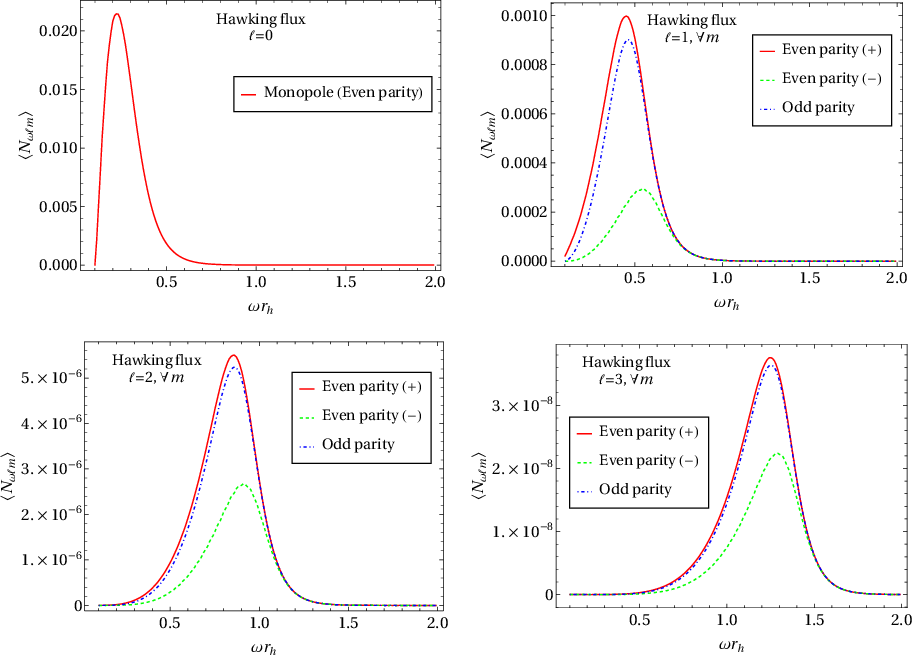
Figure 2: The Hawking spectrum has been plotted for different polarizations. Comparisons have been made between different [A^i(x),Π^j(y)]x0=y0=igijδ3(x−y)2 modes at [A^i(x),Π^j(y)]x0=y0=igijδ3(x−y)3.
Two-Point Functions and Proca Condensate
The quantum observables relevant for backreaction and semiclassical gravity are encoded in the two-point function and the associated Proca condensate:
[A^i(x),Π^j(y)]x0=y0=igijδ3(x−y)4
where [A^i(x),Π^j(y)]x0=y0=igijδ3(x−y)5 is constructed from mode functions in each vacuum.
Key results:
Implications and Prospects
The canonical quantization developed here enables computation of quantum observables for massive vector fields in curved backgrounds—previously inaccessible for Proca due to lack of gauge invariance and coupled equations. The results quantify the impact of the longitudinal degree of freedom on Hawking evaporation, vacuum polarization, and the quantum stress-energy tensor.
Theoretical implications:
- The absence of gauge symmetry fundamentally alters IR structure and horizon quantum information encoding. No soft-photon hair for massive fields.
- The mass threshold I−0 produces trapped, localized condensates, potentially relevant for black hole dark photon environments and ultralight vector dark matter scenarios.
- The orthonormalization procedure and separation formalism (FKKS) map directly to dual fields (e.g., Kalb–Ramond), opening avenues for string phenomenology analyses.
Practical implications:
- Observable corrections in Hawking spectra can serve as probes for Proca-type dark matter near black holes.
- Framework sets the stage for future calculations of renormalized stress tensors I−1 and cosmological backreaction.
- The methodology is extensible to rotating black holes, where superradiant instabilities and accretion effects are especially relevant.
Future directions:
- Expansion to Kerr (rotating) geometries—requires careful handling of superradiant modes and spectral analysis.
- Investigation of quantum states inside horizons, relevant for information paradox and firewall proposals.
- Application to interacting theory regimes and cosmological environments.
Conclusion
This work establishes a rigorous canonical quantization for massive vector fields in Schwarzschild spacetime, addressing both mathematical and physical subtleties arising from second-class constraints and gauge symmetry breaking. The derived Hawking spectra explicitly reveal the nontrivial polarization dependence and mass suppression in emission rates, while vacuum expectation values and condensates probe the quantum structure near horizons and at infinity. The framework provided here is foundational for further studies of massive vector fields in more general gravitational backgrounds and their role in black hole evaporation, dark matter phenomenology, and semiclassical gravity.