- The paper demonstrates that the interplay between Proca hair and scalar mass induces long-lived quasinormal modes in asymptotically de Sitter black holes.
- It employs high-order WKB expansion with Padé improvement alongside time-domain evolution to accurately extract fundamental and overtone frequencies.
- The results clarify the regimes for strong cosmic censorship, distinguishing Schwarzschild-like and de Sitter-like spectral branches, with implications for modified gravity.
Long-lived Quasinormal Modes of Asymptotically de Sitter Black Holes in Generalized Proca Theory
Theoretical Foundation and Motivation
The analysis provides a comprehensive investigation of massive scalar perturbations in asymptotically de Sitter black holes governed by generalized Proca theory. The underlying framework is a vector-tensor theory where the Proca field introduces three propagating physical degrees of freedom, a primary-hair sector, and a dynamically generated effective cosmological constant, enabling black-hole solutions with novel asymptotics and horizon structure. This setup, distinct from standard Einstein-Maxwell, permits a focused study of how primary hair and the Proca sector simultaneously affect both exterior geometry and the cosmological scale.
Massive scalar fields are a crucial probe, as their presence significantly alters quasinormal spectra and late-time evolution, introducing phenomena such as quasi-resonances and oscillatory tails. The work is motivated by the rich interplay among primary hair, horizon structure, and field mass, especially regarding the presence/absence of genuine quasi-resonances and implications for strong cosmic censorship in the charged multi-horizon sector.
Effective Potential Structure
The master equation governing massive scalar perturbations has an effective potential
V(r)=f(r)[r2ℓ(ℓ+1)+rf′(r)+μ2]
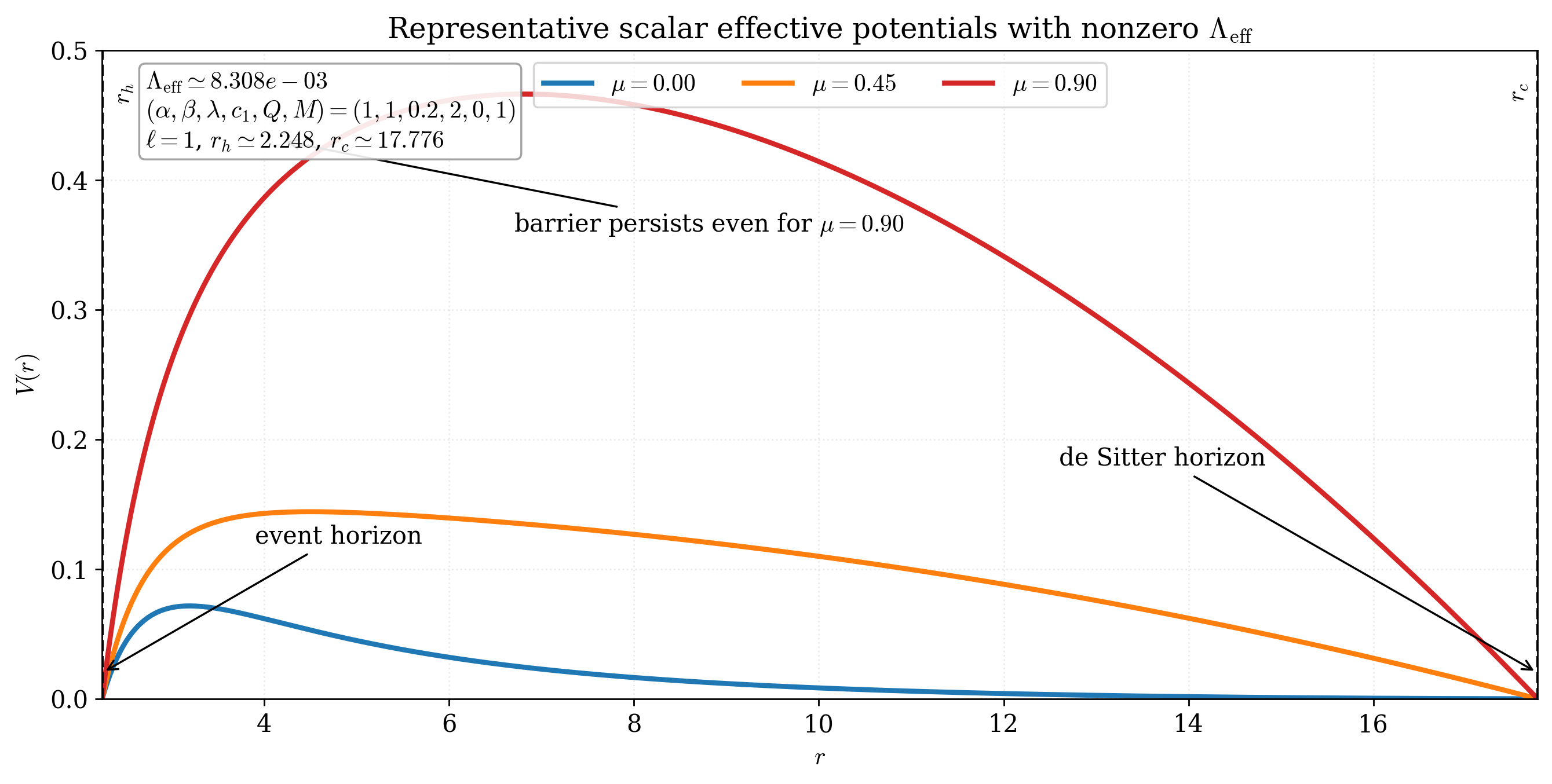
where f(r) is the metric function encapsulating black-hole and Proca parameters. The asymptotically de Sitter sector, unlike its asymptotically flat analogues, exhibits a potential vanishing at both event and cosmological horizons, maintaining a well-defined barrier even at large scalar mass. This structure persists across a substantial part of parameter space, with the primary hair parameter Q and couplings (α,β,c1,λ) tuning both horizon positions and barrier characteristics.
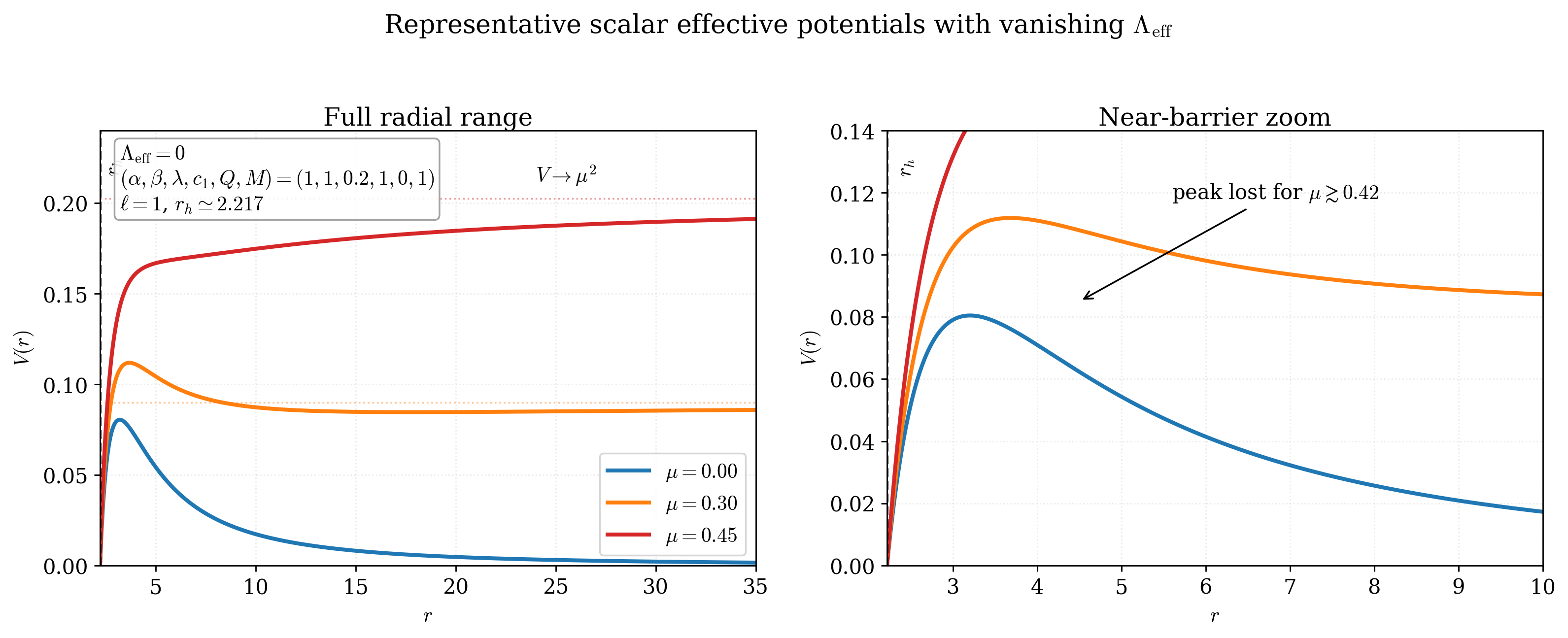
Figure 1: Representative effective potentials for the Λeff benchmark in Proca theory, showing the evolution and barrier structure as parameters vary.
In contrast, for Λeff=0, the massive field raises the asymptotic tail, and for moderate μ the potential peak disappears, indicating a transition in dynamical trapping and spectral regime.
The spectral analysis leverages both high-order WKB and time-domain approaches:
Numerical Results and Spectral Trends
Five benchmark backgrounds span neutral/charged, small/large black hole regimes. Tables provide fundamental and overtone spectra for 0≤μ≤10 and f(r)0. Key quantitative findings include:
- At fixed geometry, increasing f(r)1 raises f(r)2 and decreases f(r)3, rapidly approaching a background-dependent plateau.
- Quasinormal frequencies in the large black-hole regime show strong suppression of oscillation for the fundamental mode.
- The electric charge f(r)4 at fixed mass f(r)5 increases f(r)6 and decreases f(r)7.
- For large f(r)8, the damping rate attains a constant, independent of f(r)9 and Q0, explained by the large-mass asymptotics derived analytically.
Time-domain extractions corroborate the WKB values; three-mode Prony fits yield discrepancies below Q1 in Q2 and Q3 in Q4, confirming consistency.
Analytic Large-Mass Limit
For Q5, the potential peak and mode frequencies simplify:
Q6
with Q7 and Q8 explicit functions of geometric and Proca sector parameters, determined by the location and curvature at the maximum of Q9. The background determines the limiting damping; (α,β,c1,λ)0 and (α,β,c1,λ)1 drop out at leading order, yielding nearly degenerate spectra across angular sectors. Subleading corrections become relevant only for precise mode splitting.
Absence of True Resonances and Cosmological Implications
Despite strong suppression of damping for large scalar mass, the imaginary part does not vanish; genuine quasi-resonances are absent. The mechanism is traced to the effective potential’s behavior in the Proca-de Sitter backgrounds, which, unlike alternative spacetimes, does not develop infinitely long-lived modes.
The strong cosmic censorship bound is probed via the ratio (α,β,c1,λ)2. For small black holes, the de Sitter branch provides long-lived modes, ensuring (α,β,c1,λ)3, thus protecting SCC in this regime. However, as horizon parameters vary, especially near extremality, this bound is not universal—explicit calculation of dominant modes in the charged, three-horizon sector is required for firm conclusions.
Implications for Grey-Body Factors and Future Directions
The quasinormal spectrum derived here directly informs grey-body factor calculations via contemporary correspondence frameworks [Konoplya:2024lir, Konoplya:2024vuj]. Accurate spectrum for massive scalar fields in Proca-de Sitter backgrounds provides precise input for Hawking radiation, absorption cross-section, and observational modeling in beyond-Einstein gravity.
Further development will involve systematic parameter scans and focused analysis in the charged three-horizon sector, targeting SCC diagnostics and exploring strong-field effects. The analytic large-mass asymptotics invite comparison with other theories (e.g., Gauss-Bonnet, quantum-corrected metrics), probing universality and model dependence of quasinormal behavior.
Conclusion
The analysis establishes that, for asymptotically de Sitter black holes in generalized Proca theory, massive scalar perturbations produce long-lived—but not infinitely-lived—quasinormal modes. The interplay of primary hair and cosmological horizon maintains a spectral structure distinct from flat space. At large mass, quasinormal frequencies become nearly degenerate across angular momentum, controlled by geometric properties at the potential peak. Time-domain and frequency-domain results agree quantitatively, and analytic asymptotics illuminate the suppression mechanism. Strong cosmic censorship is protected in small black holes but not universally across parameter space. These findings enable precision modeling of wave propagation and quantum effects in modified gravity and lay the foundation for future explorations in gravitational field theory and black-hole phenomenology.