- The paper generalizes the HBAR framework by incorporating massive Proca fields in Schwarzschild spacetime, showing that the apparent thermality arises from a universal near-horizon redshift effect.
- It employs two detector models—current and electric-dipole couplings—and stationary-phase techniques to derive exact expressions for transition amplitudes, capturing polarization and mass threshold effects.
- The study demonstrates that Proca-specific features such as a hard mass threshold and enhanced longitudinal modes enter only via spectral prefactors, preserving the universal Planckian detailed balance.
Horizon Brightened Acceleration Radiation from Massive Vector Fields
Overview and Physical Context
The paper "Horizon Brightened Acceleration Radiation from Massive Vector Fields" (2512.08598) establishes a comprehensive quantum-optical analysis of acceleration (Unruh-like) radiation for radially infalling atoms in the Schwarzschild spacetime, where the exterior quantum field is a massive Proca (spin-1) field. This work generalizes the Horizon Brightened Acceleration Radiation (HBAR) framework, previously limited to the scalar case, to include the unique kinematic and interaction properties of massive vectors—specifically the presence of longitudinal modes, mass thresholds, and polarization-resolved greybody factors.
The central methodology adopts two operational detector realizations—current coupling and electric-dipole coupling—embedded in a cavity isolating a single outgoing Schwarzschild mode in the Boulware vacuum. The analysis leverages stationary-phase methods localized near the horizon, producing exact expressions for transition amplitudes and their thermal weights. The findings demonstrate that the apparent thermality of particle emission is not reliant on the field species; rather, it arises through a universal near-horizon redshift transformation, with model-dependent details entering only via smooth prefactors and kinematic thresholds.
Kinematic Structure and Universality
The infalling atom’s worldline in Schwarzschild geometry ensures that local measurements differ dramatically from those of asymptotic observers due to the intense gravitational redshift. For any outgoing mode of frequency ν, the comoving frequency measured by the infaller, Ω(τ,ν), diverges at the event horizon due to the combined redshift and Doppler effects:
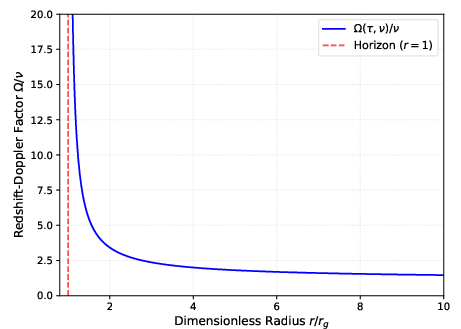
Figure 1: The comoving redshift-Doppler factor Ω/ν diverges as the radial coordinate r approaches the event horizon, rationalizing the dominance of the near-horizon segment in transition amplitudes.
This divergence guarantees that counter-rotating transitions—which are forbidden in inertial frames—become accessible near the horizon, permitting atom excitation accompanied by emission of a Proca quantum.
Proca Field Dynamics: Mass Thresholds and Polarization Specificity
The Proca field, characterized by three physical polarizations and a dynamical constraint (∇μAμ=0), engenders several distinctive spectral features:
- Hard mass threshold: Only modes with ν≥mV (the Proca mass) contribute to asymptotic flux.
- Axial/polar separation and greybody factors: Effective potentials for axial (ℓ≥1) and polar (ℓ≥0) channels dictate transmission to infinity, with varying suppression near threshold.
- Longitudinal mode enhancement: The current coupling model yields increased response for the longitudinal polarization near the horizon, due to the vector nature of the field.
Mode normalization and cavity selection ensure that the theoretical treatment isolates a single outgoing mode at unit flux, with the density of states sharply cut off below mV.
Detector Models and Amplitude Structure
Two distinct atomic detector couplings are considered:
- Charged-monopole (current) coupling: Interaction via the atom’s monopole moment and local field current, maximally sensitive to longitudinal polarization.
- Physical electric-dipole coupling: Interaction via the atom’s dipole and local electric field, preferentially coupling to transverse polarization.
Both mechanisms lead to worldline integrals along the infall trajectory, whose stationary-phase evaluation near the horizon yields a universal spectral kernel irrespective of spin, mass, or detector specificity.
Universal Thermal Kernel and Detailed Balance
The primary technical result is the extraction of a Laplace-type near-horizon integral in all scenarios. The squared modulus of this integral gives the universal thermal kernel associated with acceleration radiation:
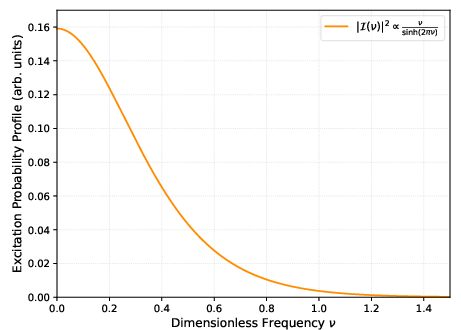
Figure 2: The universal thermal kernel ∣I(ν)∣2 as a function of frequency ν, displaying thermal decay governed by the near-horizon phase structure and independent of field spin or mass.
This kernel produces a Planck-like factor for the emission probability versus absorption:
Pexc(ν)/Pabs(ν)=e−4πν
—a detailed-balance ratio enforced by the near-horizon coordinate analyticity and identical to the scalar case. Strong claim: the Planck denominator and equilibrium ratio are completely independent of field spin, mass, polarization structure, or detector realization; modifications due to vector field properties enter only via the prefactors (rate, transmission coefficients, polarization sums).
Channel-Specific Rates, Master Equation, and Steady-State
Transition probabilities are converted to cavity-throughput rates using the channel-dependent greybody factors and normalized to the interaction time. The ensuing master equation follows the Lindblad form, with birth-death processes for the occupation number of the selected mode:
dtdρnn=−Γe[(n+1)ρnn−nρn−1,n−1]−Γa[nρnn−(n+1)ρn+1,n+1]
At steady-state, the mode population achieves a geometric distribution, yielding the mean occupation:
⟨n⟩ss=e4πν−11
Independent of vector mass, spin, or detector, the approach rate and overall emission flux are set by smooth channel prefactors and transmission factors.
HBAR Entropy Flux and Area Law: Proca Modifications
The entropy flux associated with escaping massive vector quanta is derived directly from the steady-state master equation, resulting in a simple proportionality between mode entropy flux and net particle flux:
dtdSp=4πkBνnˉ˙ν
Energy conservation connects this flux to the radiative change in black-hole area, yielding the universal area-entropy law:
dtdSp=4ℏGkBc3A˙V
where A˙V is defined by the escaping Proca emission power. All Proca-specific features—mass threshold, polarization sums, axial/polar transmissions—enter solely through the total net flux, leaving the coefficient of proportionality unchanged.
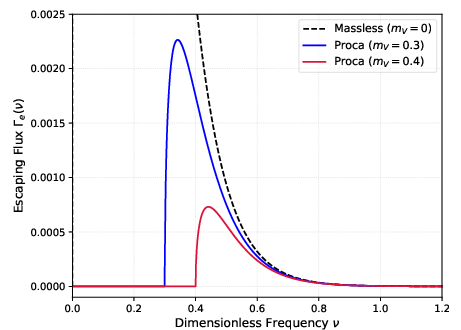
Figure 3: The escaping emission rate Γe(ν) for Proca fields with varying mV, illustrating the hard spectral threshold and universal high-frequency thermal tail.
Notably, the emission spectrum for massive vectors displays a sharp cutoff at ν=mV, a turn-on modulated by phase space and greybody transmission, and a high-frequency regime converging to the massless Planckian tail. This is the dominant observational signature distinguishing Proca from massless (scalar or photon) acceleration radiation.
Theoretical Robustness and Validity
The stationary-phase expansion provides strict control over the approximation, with corrections entering only at O(ν/ω) in the prefactor and leaving the thermal kernel intact. The Proca constraint dynamically enforces three degrees of freedom, avoiding gauge ambiguities, and the massless limit is regular at the observable level. The near-horizon mapping rationalizes the method as the curved-space analogue of Unruh-DeWitt detector response, with the same KMS-periodicity-induced thermal law.
Implications and Future Directions
Practical implications include the possibility of using horizon-brightened acceleration radiation to probe dark photon masses and vector field structure in strong gravity environments, offering a controlled spectroscopic channel for discrimination between scalar and vector low-mass dark sector candidates near black holes. Theoretical implications involve the robustness of the Planckian thermal law against model variations, with possible extensions to rotating backgrounds, superradiant dynamics, modified vacua (Unruh/Hartle-Hawking), and tailored detector engineering for longitudinal/transverse isolation.
The hard spectral threshold and polarization-dependent turn-on in the Proca case may serve as clear experimental signatures for massive vector fields in astrophysical or analogue gravity settings.
Conclusion
This work systematically extends the HBAR framework to massive spin-1 fields, demonstrating that acceleration-induced thermality is governed by universal near-horizon analytic structure, with model-specific features confined to spectral prefactors and kinematic thresholds. The results clarify the relationship between quantum optics, black-hole thermodynamics, and field-theoretic structure, imposing tight constraints on how massive vector emission modifies entropy laws and spectral distributions in the strong gravity limit. The formalism sets the stage for further explorations of field content, detector design, and horizon physics in both theoretical and experimental contexts.