- The paper introduces the PANDA algorithm, a penalty-augmented NI descent–ascent method for resolving bilevel reinforcement learning with LL saddle-point Markov games.
- It establishes near-optimal convergence, demonstrating an ε-stationary point in O(ε⁻¹) iterations with a sample complexity of O(ε⁻³) even in nonconvex–nonconcave setups.
- Empirical results in synthetic tasks and gridworld environments validate PANDA's superior performance over baselines while effectively enforcing the LL Nash equilibrium.
Bilevel Optimization over Markov Game Saddle Points: Summary and Technical Analysis
The paper "Bilevel Optimization over Saddle Points of Zero-Sum Markov Games" (2605.26654) introduces a rigorous framework and algorithmic advances for bilevel reinforcement learning (BRL) when the lower-level (LL) problem is a regularized min–max zero-sum Markov game (MMZSMG), addressing a gap in prior work which mostly considers single-agent MDPs in the LL. The work proposes the penalty-augmented Nikaido–Isoda descent–ascent (PANDA) algorithm, a policy-gradient-based bilevel optimizer designed to handle the coupled nonconvex–nonconcave structure of multi-policy zero-sum games in the LL, and establishes near-optimal convergence and sample complexity guarantees in the stochastic regime.
Bilevel RL models environments in which an upper-level (UL) controller selects environment or incentive parameters while the LL comprises a learning process—here, a two-player zero-sum Markov game—whose equilibrium response is a saddle point of a min–max objective. Unlike conventional BRL, which focuses on single-policy MDPs at the LL and therefore admits more direct optimization techniques, the min–max saddle point structure forces a strategic coupling: both LL agents adjust their nonstationary policies in response to the environment and each other, rendering hypergradient estimation intractable, especially in the sample-based (stochastic) regime.
Key properties of the MMZSMG setting analyzed:
- The LL admits a unique regularized Nash equilibrium (NE) due to the strong convexity–concavity of the regularization (typically entropy/KL).
- The UL objective is evaluated at the LL saddle-point equilibrium and is a generally nonconvex function of both UL parameters and the induced NE policies.
Algorithmic Contributions: The PANDA Method
PANDA is a first-order, double-loop, stochastic optimization method that leverages the Nikaido–Isoda (NI) gap to enforce LL equilibrium stationarity via a penalty construction, thereby circumventing the need for Hessian-based hypergradients or full implicit differentiation. The approach comprises:
- Best-Response Approximation: Using stochastic policy gradient ascent/descent steps to approximately solve the inner best-response problems defining the NI gap.
- Penalty-Subproblem Optimization: Alternating policy gradient-based updates to LL policy parameters on the penalized surrogate objective combining the UL loss and the LL NI gap.
- Hypergradient Step: Updating the UL parameters via a stochastic gradient estimate of the penalized single-level objective, based on the outcome of the LL penalized subproblem.
This structure is compatible with entropy/KL-regularized policy parameterizations and admits scalable Monte Carlo implementations based on trajectory samples.
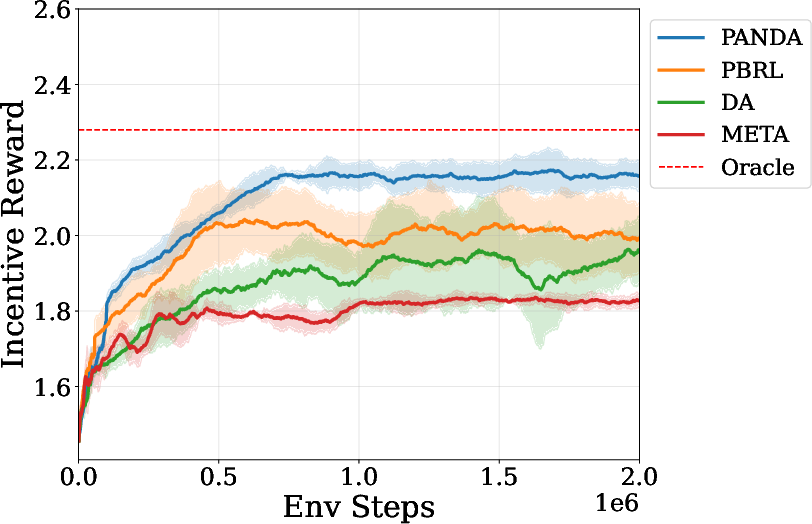
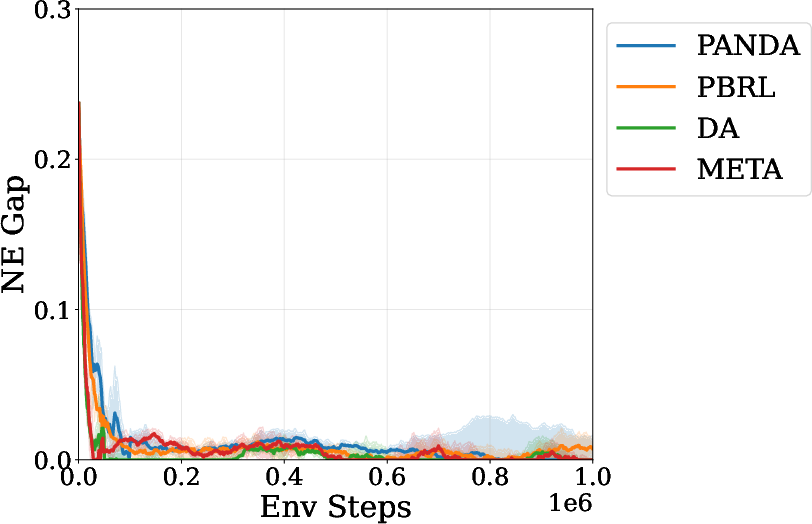
Figure 1: Performance of PANDA versus environment sample steps: (Left) UL incentive reward; (Right) LL NE gap.
Theoretical Results: Convergence Without Convexity
The principal theoretical contribution is the demonstration that PANDA achieves an ε-stationary point of the original bilevel problem in O~(ε−1) iterations with sample complexity O~(ε−3), where O~ hides logarithmic terms. These rates align with what is achievable in BRL with a single-policy LL under the Polyak–Łojasiewicz (PL) condition. Remarkably, this is achieved without strong convexity/concavity assumptions on either the UL or the LL objectives and in the stochastic, trajectory-sampled setting.
Key technical properties enabling these results:
- Proved strong structural properties for the NI function: non-uniform PL condition and Lipschitz continuity, which facilitate error-control and convergence analysis.
- Exploitation of the regularization-induced uniqueness of NE in MMZSMGs, enabling tractable penalization and dual-loop descent–ascent.
- Avoidance of hypergradient computation—no Hessian inversion or expensive second-order steps required.
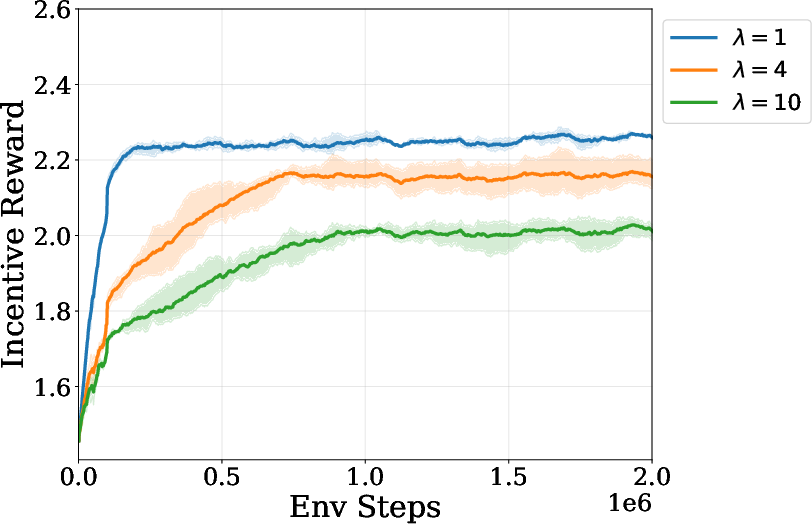
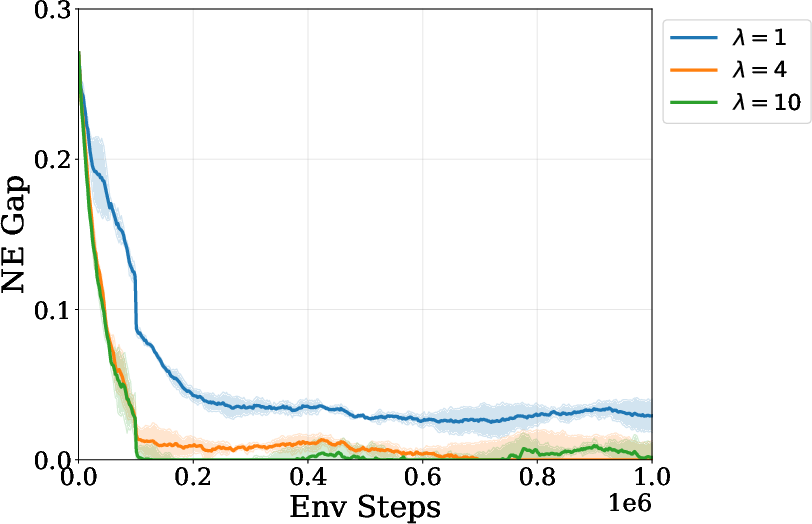
Figure 2: Ablation study: Effect of penalty parameter λ on (Left) UL incentive reward, (Right) LL NE gap.
Empirical Validation
Experiments demonstrate the superiority of PANDA over several recent competitive baselines, including heuristic meta-gradients and penalty-based approaches that either require strong side-information or lack theoretical guarantees:
- On a synthetic incentive-design task involving a randomly parameterized MMZSMG, PANDA consistently attains higher UL reward and lower NE gap than alternatives, closely matching an oracle with access to dynamic programming solutions (Figure 1).
- A detailed ablation (Figure 2) confirms the tradeoff controlled by the penalty parameter λ: smaller λ trades off slower convergence to NE for faster UL progress, while larger λ enforces more accurate LL equilibrium at the cost of UL reward suboptimality.
- In the complex Sentinel-Intruder environment (Figures 3 and 4), including high-dimensional gridworlds, PANDA achieves a lower UL loss (e.g., minimizing the sentinel's visits to restricted areas) while guaranteeing the LL equilibrium constraint is tightly enforced, with robust performance as the problem scales.
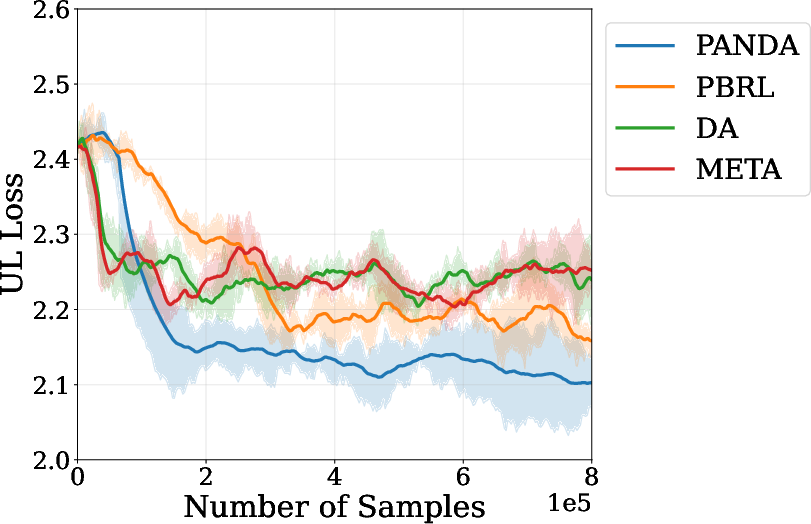
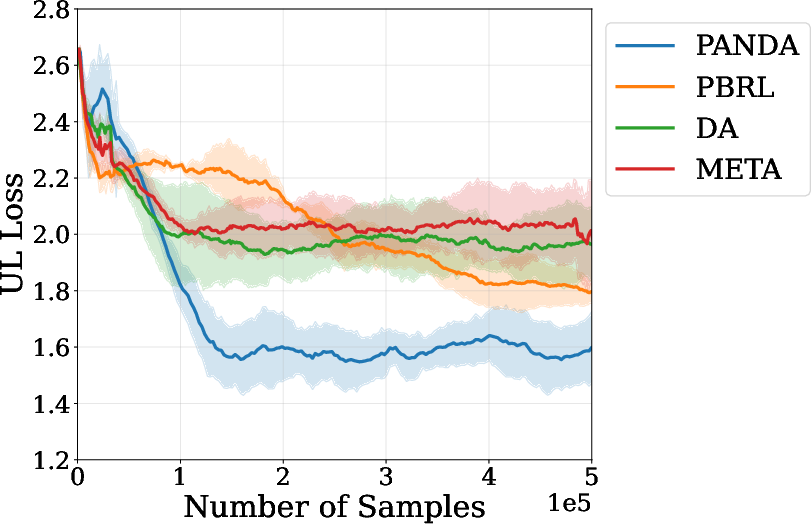
Figure 3: PANDA performance on the Sentinel-Intruder game: (Left) 5×5 grid UL loss; (Right) 20×20 grid UL loss.
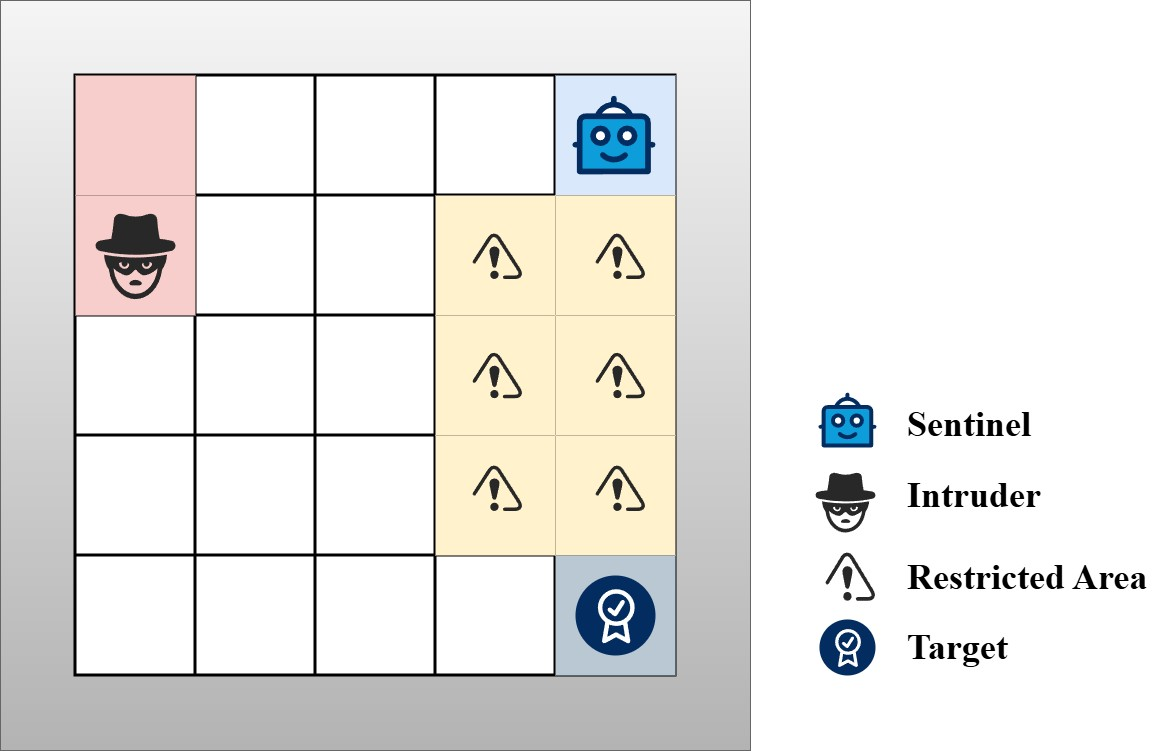
Figure 4: Sentinel-Intruder game schematic—sentinel seeks to intercept while avoiding yellow restricted regions.
Theoretical and Practical Implications
The formal and empirical findings have several implications for theory and applications of multi-agent RL:
- Scalability: The established sample complexity allows practical deployment of bilevel optimization for problems with large state/action spaces and with coupled multi-agent equilibria.
- Generalization: The penalty-augmented NI gap framework can be ported to other regularized multi-agent game-theoretic RL and RLHF settings, including preference learning for LLM alignment.
- Algorithmic Modularity: By structuring the LL update as a generic penalty-subproblem, PANDA can flexibly incorporate more advanced off-policy/batch RL oracles for further scalability.
- Limitations and Extensions: While current results require regularization for uniqueness and smoothness, it is plausible that future developments can relax this to broader classes of multi-agent games (e.g., general-sum, non-regularized).
Future Outlook
Potential research avenues opened by this work include:
- Extending the penalty-based NI descent–ascent methodology to general-sum Markov games and nonzero-sum multi-agent RL.
- Devising single-loop PANDA-like algorithms with reduced variance and sample efficiency, using advances in variance reduction for stochastic policy gradients.
- Applying this bilevel optimization framework to RLHF and mechanism design with multiple learning agents and equilibria.
Conclusion
This paper resolves several open technical challenges in bilevel RL involving zero-sum Markov games by introducing a first-order, sample-based algorithm with robust theoretical guarantees and validated empirical superiority. It broadens the applicability of BRL to realistic multi-agent and adversarial environments, setting the stage for further advances in scalable multi-agent reinforcement and incentive design.
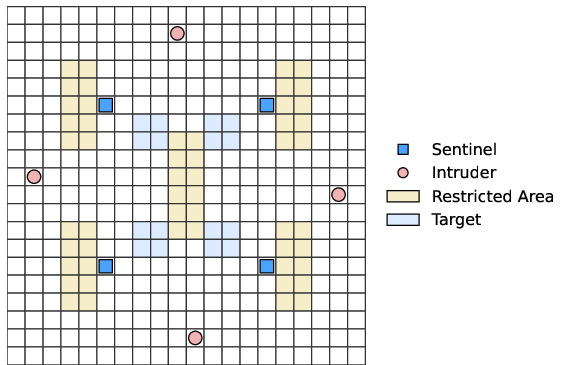
Figure 5: O~(ε−1)0 grid setup for the Sentinel-Intruder game—the environment for the scalability experiments.
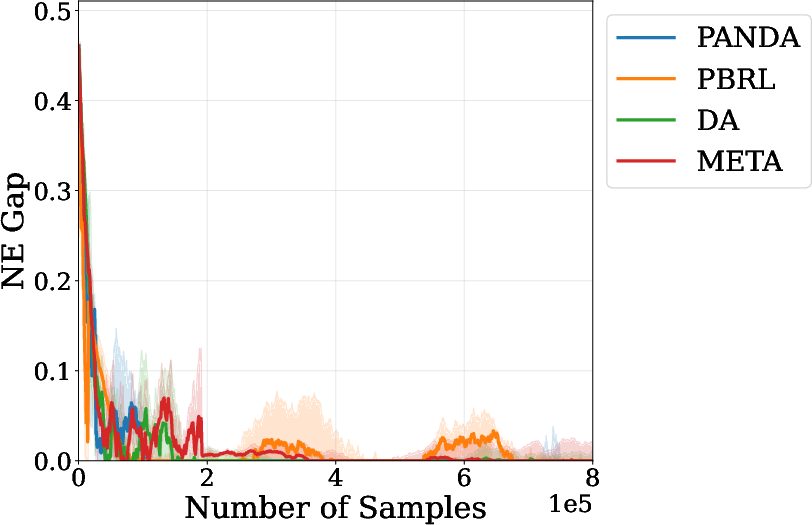
Figure 6: O~(ε−1)1 grid Sentinel-Intruder: (Left) UL loss versus trajectories; (Right) LL NE gap versus trajectories.
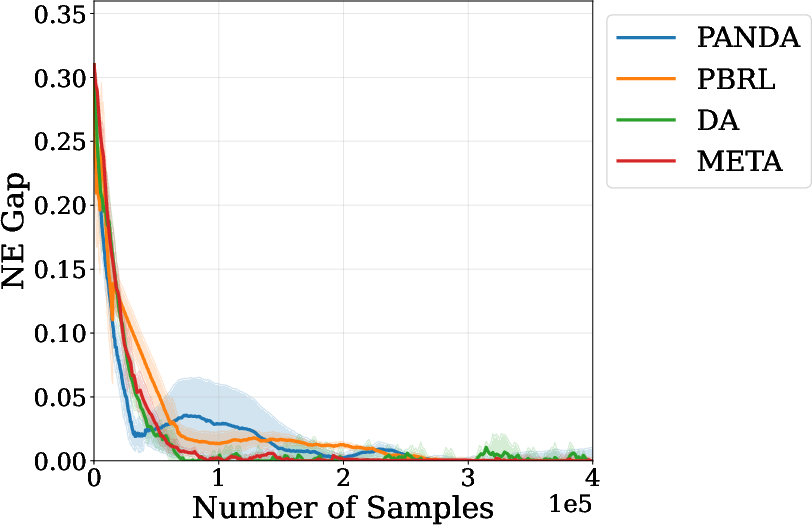
Figure 7: O~(ε−1)2 grid Sentinel-Intruder: (Left) UL loss versus trajectories; (Right) LL NE gap versus trajectories.

