- The paper establishes a comprehensive hierarchy of stationarity conditions (S, B, M, C, W) using KKT and value-function reformulation.
- It introduces a penalty-based reformulation that yields convergent first-order algorithms (PG-MAD and NA-PG-MAD) with iteration complexity O(ε⁻³ log(ε⁻¹)).
- Applications in power systems, adversarial machine learning, and transportation highlight the practical impact of the theoretical advances.
Optimality Conditions and Algorithms for Minimax Bilevel Optimization Problems
This essay presents an in-depth technical review of "Optimality Conditions and Numerical Algorithms for a Class of Minimax Bilevel Optimization Problems" (2604.23487), which addresses bilevel problems characterized by a minimax structure bridging theory, algorithmic innovation, and practical relevance to applications in power systems, adversarial machine learning, and robust transportation.
The paper analyzes a general minimax bilevel optimization problem of the form: x∈Xminy∈Y,λ∈Λmaxf(x,y,λ)s.t.y∈argz∈Yming(z,λ)
where f is nonconvex-nonconcave and g is convex in z. The feasible sets X, Y, and Λ are convex and compact.
The authors rigorously develop necessary optimality conditions for such minimax bilevel programs by recasting the lower-level optimization via its KKT conditions as well as by value-function reformulation. This yields a detailed hierarchy of stationary points, including:
- Minimax-Strong (S) Stationary: Satisfies KKT for both upper and lower levels, including complementarity constraints.
- Minimax-Bouligand (B) Stationary: Relaxes tangent cone requirements.
- Minimax-Mordukhovich (M), Clarke (C), Weakly (W) Stationary: Represent successively weaker necessary conditions.
The relationships between these stationarity concepts are formally established, mapping the landscape of generalized stationarity in the context of minimax bilevel structure.
This is complemented by optimality conditions drawn from the value function approach, further connecting with hypergradient-based optimality as seen in differentiable bilevel programming. The inclusion of hypergradient stationarity acts as a theoretical bridge to practical first-order solution methods.
To establish numerical tractability, the authors introduce a penalty function framework that converts the bilevel problem into a single-level min-max-min problem: x∈Xminy∈Y,λ∈Λmaxz∈Yminf(x,y,λ)−ρ(g(y,λ)−g(z,λ))
for penalty parameter ρ>0. As ρ→∞, this penalty method asymptotically enforces the lower-level solution constraint. Rigorous mathematical analysis guarantees that limit points of the solution sequence yield global minimax points for the original bilevel problem under standard regularity assumptions.
First-Order Algorithms: PG-MAD and Nesterov-Accelerated Schemes
Recognizing the challenge posed by the nonconvex-nonconcave structure, the paper develops two practical first-order algorithms:
- Projected Gradient Multi-Step Ascent Descent (PG-MAD): Decomposes the penalized formulation into alternating projected gradient steps for minimization and maximization variables, incorporating multi-step updates for the inner maximization.
- Nesterov Accelerated PG-MAD (NA-PG-MAD): Enhances the asymptotic rate of convergence in the inner maximization via Nesterov acceleration, leading to a reduction in the iteration constants, particularly within the inner loop.
Both schemes leverage value-function regularization for smoothness and apply a multi-level projected gradient architecture. The theoretical contribution includes explicit non-asymptotic complexity bounds: both methods return an f0-KKT solution in f1 iterations under classical smoothness, convexity, and compactness assumptions.
This is significant as the iteration complexity improves upon prior results for related minimax bilevel structures, which typically scale as f2 or worse.
Strong empirical and theoretical claims include:
- Iteration complexity improvement to f3.
- PG-MAD family algorithms outperform ADMM-type baselines on challenging linear and strongly convex bilevel benchmarks.
- Robustness of the framework to both linear and quadratic upper-level objectives.
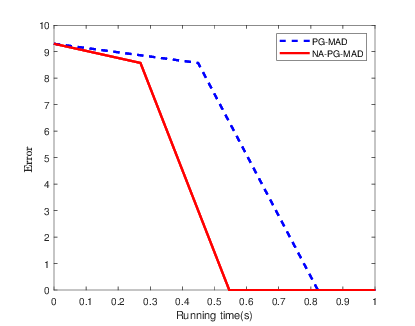
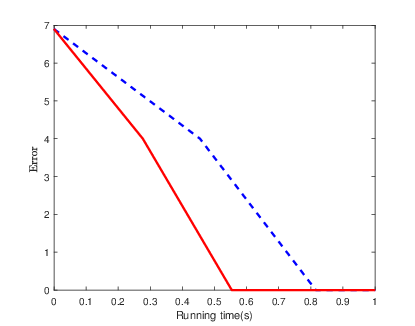
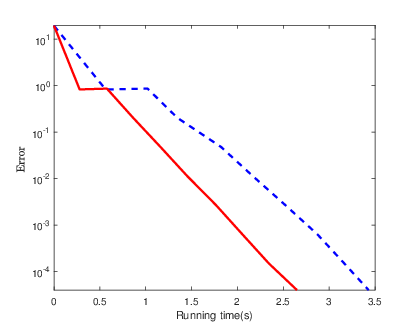
Figure 1: The performance of PG-MAD and NA-PG-MAD for Examples 1–3, showing convergence speed and error metrics across canonical synthetic problems.
Applications in Power Systems, Machine Learning, and Transportation
The generality of the framework is demonstrated by applications in three domains:
- Stackelberg Market Clearing in Power Systems: Bilevel formulations model interactions between distribution systems and microgrids. The pessimistic bilevel minimax captures adversarial or robust operational settings with Lagrange dual pricing.
- Adversarial Training in Machine Learning: Distributionally robust adversarial training is mapped to the minimax bilevel architecture, allowing for explicit modeling of worst-case perturbation distributions.
- Robust Signal Setting in Transportation: Road-network signal optimization under uncertain user performance preferences is formalized as a minimax bilevel problem where Nash/Wardrop equilibria arise in the lower level.
For each application, the proposed algorithms enable directly solving the bilevel model with theoretical convergence guarantees, avoiding restrictive assumptions on convexity or single-valuedness for the lower-level solution map.
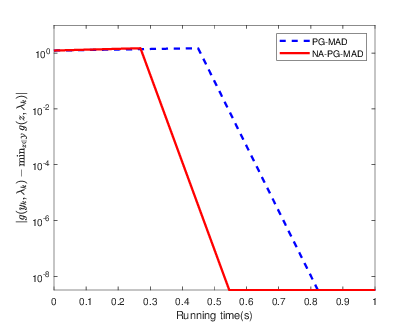
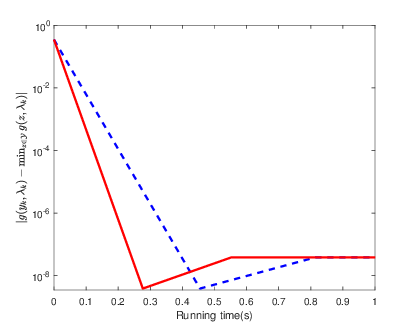
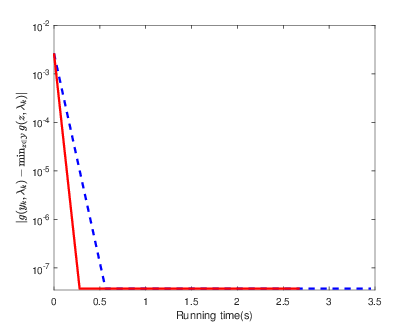
Figure 2: The performance of PG-MAD and NA-PG-MAD for Examples 1–3, further illustrating convergence on synthetic benchmarks with strongly convex lower-level structures.
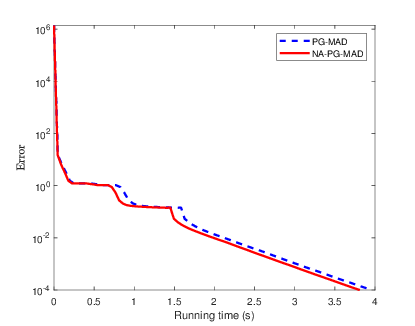
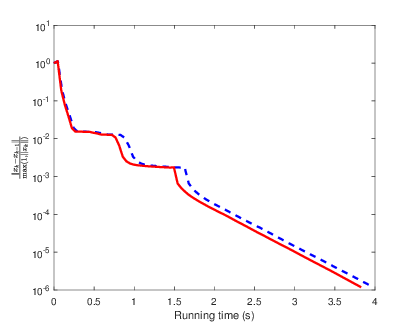
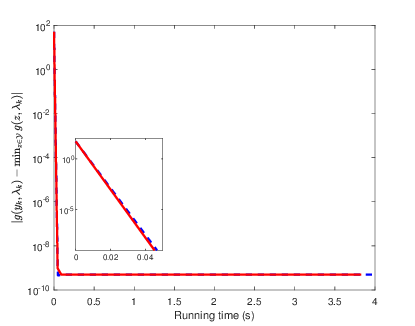
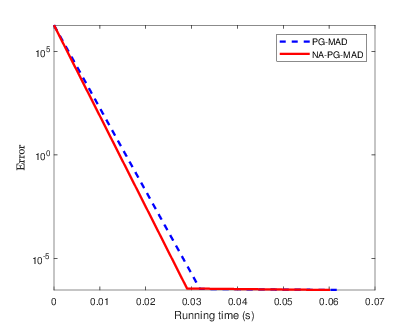
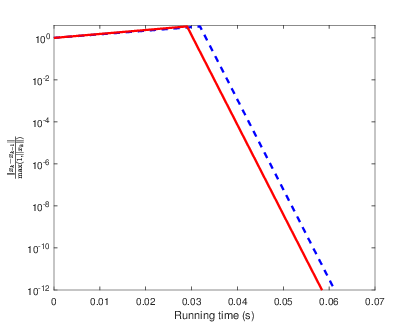
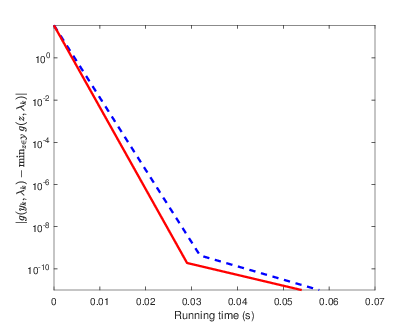
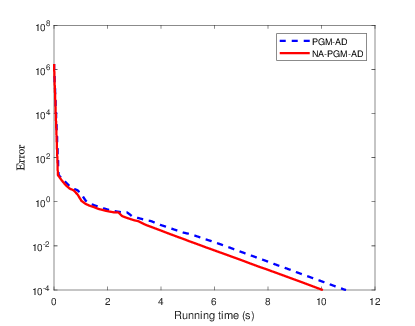
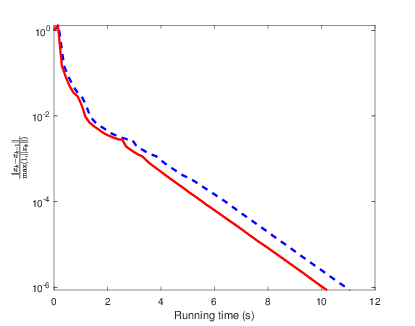
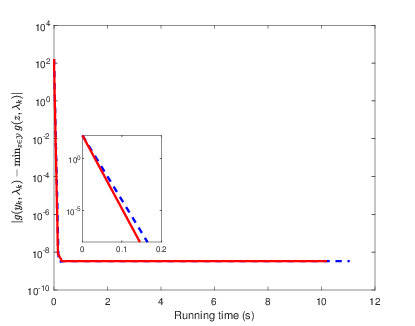
Figure 3: The performance of PG-MAD and NA-PG-MAD for a large-scale linear bilevel instance, demonstrating scalability and comparative algorithm analysis.
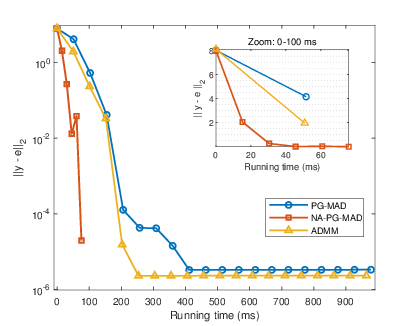
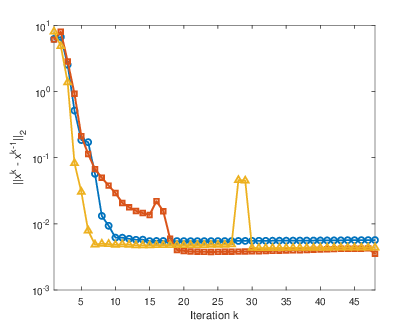
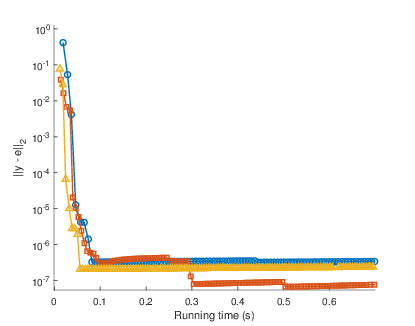
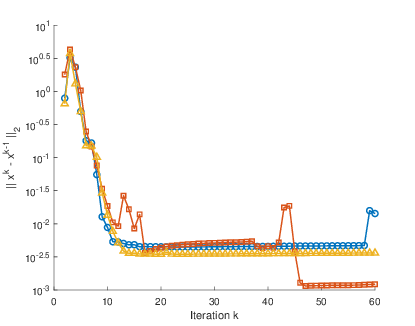
Figure 4: Comparison of PG-MAD, NA-PG-MAD, and ADMM on a market clearing model with a quadratic upper-level objective, highlighting superior convergence and constraint enforcement by the new methods.
Implications and Outlook
The stationarity hierarchy and penalty formulation for minimax bilevel problems developed in this work provide a comprehensive theoretical basis for future research in robust and adversarial planning, control, and learning. The complexity bounds set a new benchmark for the field and establish a rigorous foundation for scalable, convergent algorithms in settings where robustness to lower-level agent or environment responses is critical.
On the practical side, the algorithms and models support robust optimization in power grids, adversarial model training in machine learning, and traffic management in uncertain environments. The accelerated variants and penalty strategies are directly applicable to large-scale and high-dimensional bilevel problems that arise in emerging engineering and economic systems.
Possible future directions include improving the iteration complexity orders further, extending the analysis to stochastic or infinite-dimensional settings, and developing tailored versions for specific application domains such as distributionally robust learning and energy markets with market power.
Conclusion
This paper provides a rigorous optimality and algorithmic toolkit for minimax bilevel optimization, bridging foundational stationarity analysis with provably convergent, scalable first-order methods. The results advance the state of the art in both theory and computation for robust bilevel decision-making and establish a new standard for generality and performance in minimax bilevel optimization (2604.23487).

