- The paper establishes that increased stochasticity in the Markov transition kernel corrects accumulated sampling errors, despite slower convergence.
- The authors introduce DCRS, a training-free inference algorithm that interleaves deterministic updates with stochastic churning for effective error correction.
- Empirical results on image datasets demonstrate that DCRS improves sample quality (e.g., lower FID scores) under reduced function evaluations.
Error-Correcting Effects of Stochasticity in Discrete Diffusion
Problem Statement and Theoretical Analysis
Discrete diffusion models have proven highly effective for generation in discrete domains, including text and images. However, sampling efficiency is fundamentally limited by the need to balance speed (i.e., number of function evaluations, NFE) and quality. The central thesis of "On the Error-Correcting Effects of Stochasticity in Discrete Diffusion" (2605.26582) is that the degree of stochasticity in the Markov transition kernel directly governs this tradeoff. Highly deterministic transitions (such as Discrete Probability Flow, DPF) allow rapid convergence but are susceptible to error accumulation, while stochastic transitions (such as τ-leaping) converge more slowly but possess a mechanism for error correction.
The authors rigorously characterize this phenomenon through information-theoretic analysis utilizing contraction properties in both KL divergence and TV distance. Redundant transitions—which symmetrically swap probability mass between state pairs—can contract distributional errors (Figure 1). The paper establishes that stochasticity contracts accumulated sampling errors and mitigates sensitivity to model approximation errors, but at the expense of slower mixing and increased discretization error, especially at low NFE.
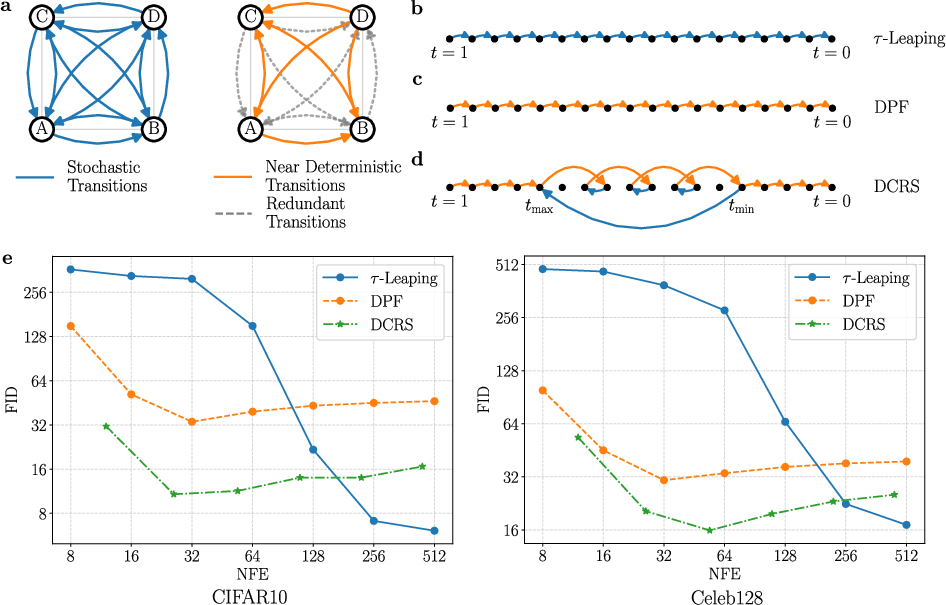
Figure 1: Stochasticity induces error correction in discrete diffusion, enabling an improved speed-quality tradeoff.
Theoretical results include tight characterizations of contraction coefficients for masking and uniform corruption processes, demonstrating that uniform diffusion achieves strictly stronger contraction than masking in small state spaces. Crucially, reverse-time transitions also exhibit contraction, with stochasticity (controlled by νt) provably improving robustness to perturbations. However, elevated stochasticity amplifies model approximation errors in later iterations, formalizing the empirical speed-quality tradeoff.
Controlled Experiments and Empirical Validation
The paper validates theoretical predictions in 1D controlled settings, isolating sampling dynamics from model error using analytically derived posteriors. Results show that, under exact scores, near-deterministic DPF samples converge faster due to reduced stochasticity. When the score function is perturbed to simulate model error, stochastic τ-leaping achieves lower final error, substantiating the error-correcting effect of stochasticity (Figure 2).
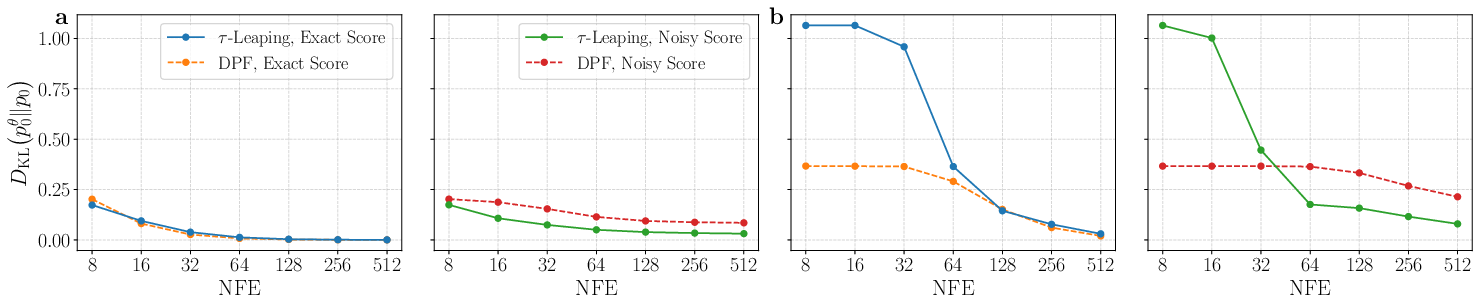
Figure 2: Controlled 1D experiments illustrating the speed-quality tradeoff and error-correcting effect of stochasticity.
Empirical KL divergence between generated and ground-truth distributions reveals that the gap is more pronounced with geometric noise schedules, which weaken the DPF contraction mechanism near the noise distribution and accentuate benefits of stochastic mixing.
Discrete Churn and Restart Sampling (DCRS): Algorithmic Innovations
Building on this analysis, the authors introduce Discrete Churn and Restart Sampling (DCRS), a training-free inference algorithm that interleaves deterministic reverse CTMC updates with strategically injected stochasticity. DCRS consists of two mechanisms:
- Restarting: Periodically resets the sampling trajectory using forward-process noise, efficiently introducing stochasticity for global error correction with no extra neural net evaluations.
- Churning: Locally injects stochasticity within restart windows, counteracting error accumulation via forward-reverse perturbations.
Optimal hyperparameter selection (restart interval, iteration count, churning magnitude) directly governs the speed-quality tradeoff. Experiments demonstrate that restarting is most effective where discretization steps are coarsest, and excessive restart iterations incur diminishing returns due to discretization error.
Large-Scale Experiments and Comparative Evaluation
Image Generation
On CIFAR10 and CelebA, DCRS achieves competitive sample quality with an order-of-magnitude fewer sampling steps relative to standard stochastic samplers, especially at low NFE. FID scores indicate the best balance between quality and efficiency is achieved with DCRS, outperforming both DPF and τ-leaping in the low NFE regime (Figures 5, 6, 7, 8, 9).
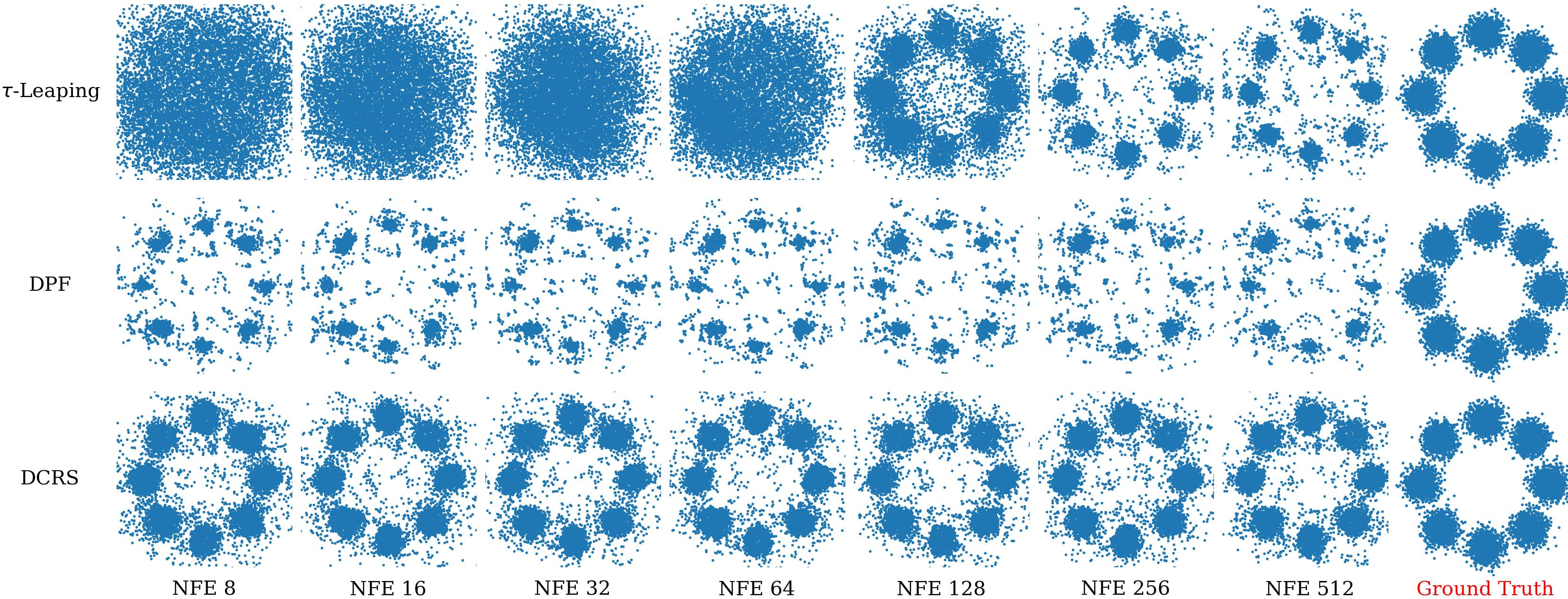
Figure 3: Generated samples using increasing NFE show DCRS achieves the optimal speed-quality balance on high-dimensional quantized Gaussians.
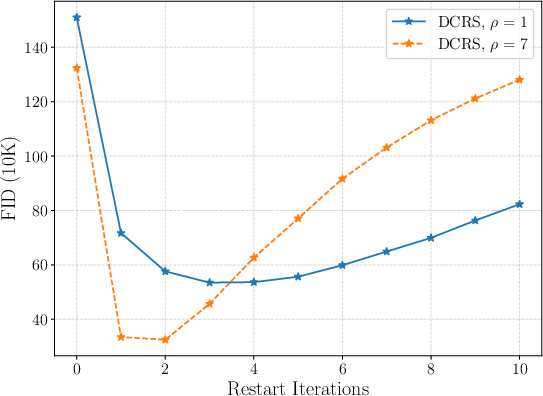
Figure 4: Multiple restart iterations improve FID up to a point, after which performance degrades due to compounding errors.

Figure 5: DCRS with trapezoidal solver mitigates catastrophic error amplification seen in naive higher-order schemes.
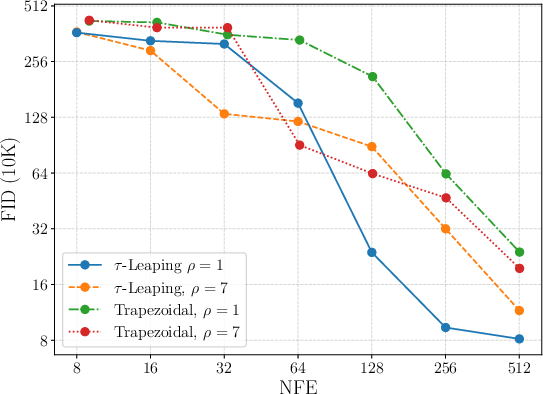
Figure 6: Non-uniform discretization schemes and higher-order solvers with τ-leaping marginally improve low-NFE performance; DCRS is more resilient.
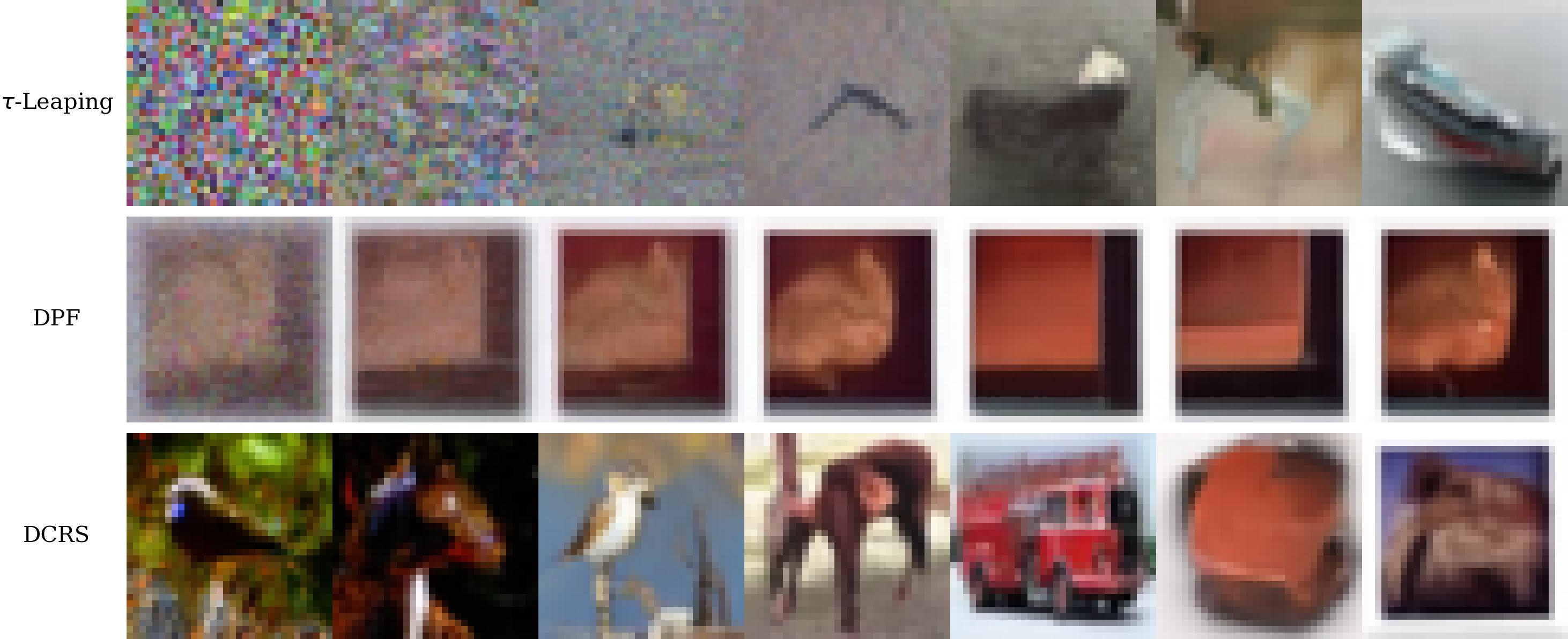
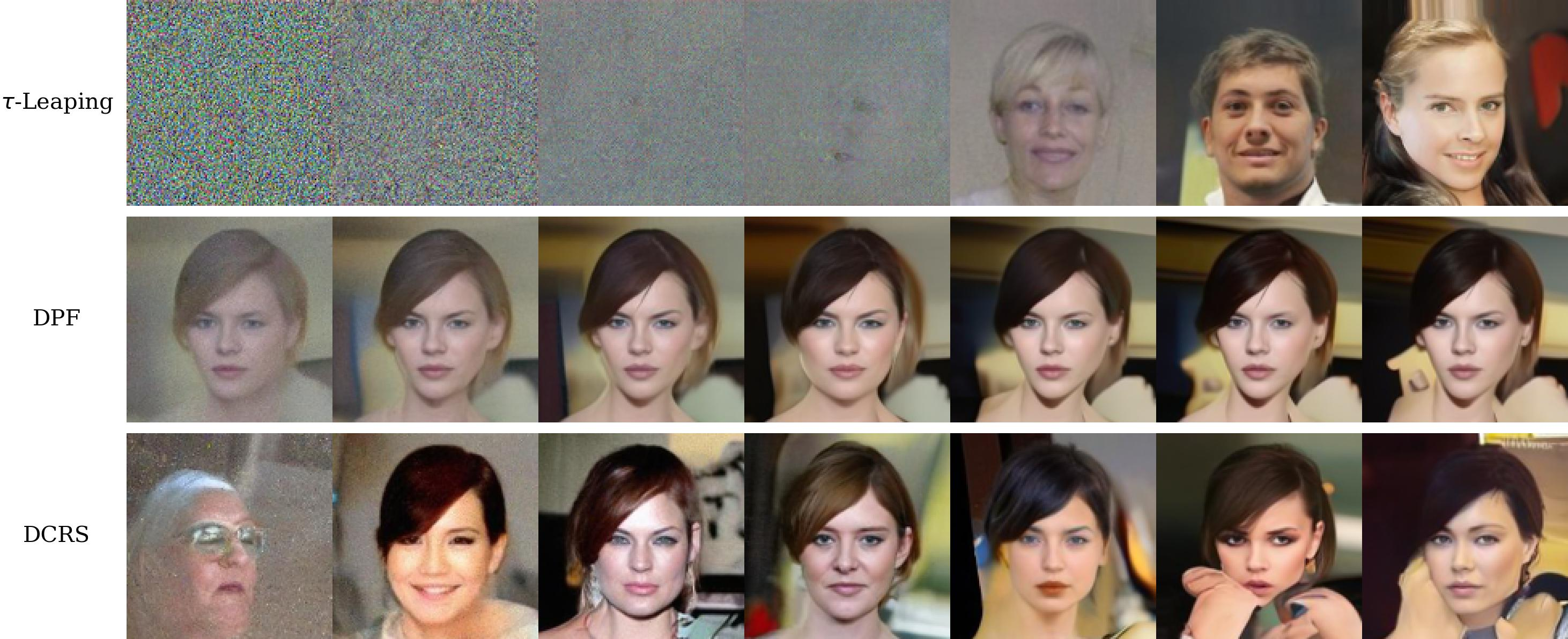
Figure 7: DCRS enables efficient generation of realistic samples as NFE increases, outperforming naive samplers.
Language Generation
Contrary to image models, adding stochasticity does not universally improve sample quality in language tasks, with deterministic and stochastic samplers yielding similar performance. The analysis suggests that parallel decoding errors—unique to discrete diffusion—dominate, and simply increasing stochasticity is insufficient. More explicit transitions across dimensions may be required for robust error correction in text diffusion models.
Synthetic Mixture of Gaussians
On quantized high-dimensional mixtures, DCRS restores mode coverage and achieves improved speed-quality tradeoff by balancing fast convergence and error correction. The empirical Wasserstein-1 distance between samples and ground-truth is minimized when using DCRS (Figure 8).
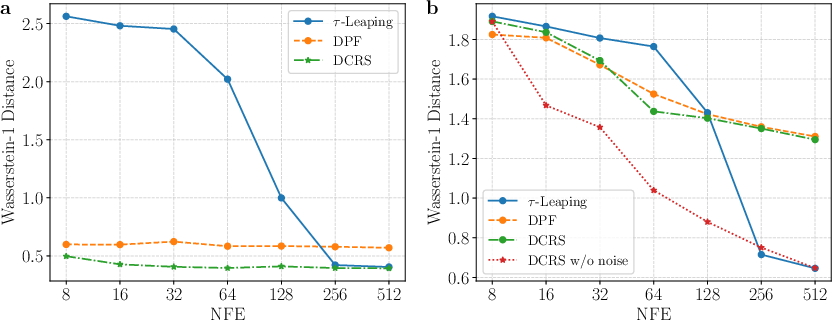
Figure 8: DCRS achieves optimal sample generation for high-dimensional quantized mixtures, outperforming standard stochastic and deterministic samplers.
Practical and Theoretical Implications
The paper offers a principled framework for understanding and controlling stochasticity in discrete diffusion inference. The rigorous characterization of contraction coefficients, dependence on corruption process, and explicit tradeoff bounds provide actionable insights for algorithmic design. DCRS exemplifies how training-free inference methods can achieve strong speed-quality tradeoffs by controlling stochasticity.
Practically, DCRS enables efficient high-quality sampling in generative tasks over discrete spaces, especially for image generation. The theoretical analysis points to future directions in optimizing stochasticity schedules, adaptive error correction, and information-theoretic formulations of optimal sampling rates. For language diffusion, improvements likely require new mechanisms beyond marginal stochasticity injection.
Conclusion
This work systematically characterizes the role of stochasticity in discrete diffusion models and establishes its fundamental error-correcting effect. The DCRS algorithm exploits this principle, demonstrating substantial improvements in the speed-quality tradeoff for image generation, with nuanced effects in language domains. The results underscore stochasticity as a critical, controllable parameter in discrete generative sampling, with broad implications for future research on adaptive inference methods and optimal corruption schedules.

