- The paper introduces fermionic antiflatness (FAF) as a reliable quantitative measure for non-Gaussian correlations in fermionic systems.
- It develops two efficient protocols—a two-copy Bell measurement with O(n²/ε²) shots and a single-copy bilinear matching scheme—to distinguish Gaussian from non-Gaussian states.
- The study proposes a noise-resistant, purity-corrected witness for mixed states and discusses key implications for quantum cryptography and device benchmarking.
Practical Tests and Witnesses of Fermionic non-Gaussianity
Background and Motivation
Efficient simulation and certification of quantum many-body systems frequently rely on the characterization of fermionic Gaussian states (FGS), which can be efficiently described by their covariance matrices and simulated classically. When quantum states exit this regime—by acquiring correlations non-reproducible by quadratic Majorana Hamiltonians—they attain fermionic non-Gaussianity, a resource that enables quantum advantage and underpins strongly correlated physics. Reliable, scalable detection and quantification of non-Gaussianity is essential for benchmarking quantum devices, certifying magic resources for computational advantage, and exploring phenomena in condensed matter and high-energy physics.
Fermionic Antiflatness (FAF): A Covariance-Based Measure
This work introduces a practical approach for quantifying fermionic non-Gaussianity based on the concept of fermionic antiflatness (FAF). FAF is defined via the singular values νj of a state’s Majorana covariance matrix Γρ, as FAF1(ρ)=n−∑j=1nνj2 for n modes, with higher-order generalizations FAFk. Pure FGSs yield FAF1=0, whereas deviations from Gaussianity produce positive FAF values. Importantly, a tight two-sided bound relates FAF1 to the trace-distance separation from the Gaussian manifold, making it a reliable indicator of non-Gaussian correlations.
Efficient Estimation Protocols: Two-Copy and Single-Copy Schemes
The paper develops two complementary protocols for scalable estimation and testing of FAF:
1. Two-Copy Bell Measurement Protocol:
Bell measurements on pairs of system copies allow direct measurement of commuting involutions Ga=γa⊗γa (Majorana operators), yielding an unbiased estimator for FAF1. Analytical results show that O(n2/ϵ2) two-copy shots suffice to distinguish pure Gaussian states from those Γρ0-far in trace distance from the Gaussian set. This sample complexity represents a significant improvement over prior approaches.
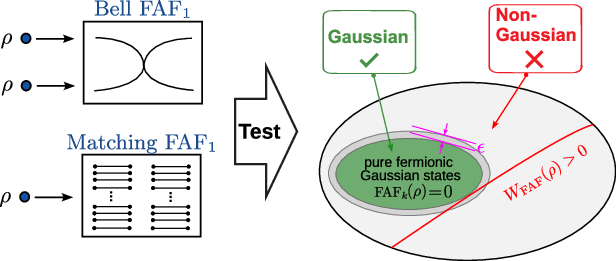
Figure 1: To test whether a given state Γρ1 is fermionic Gaussian or not, two-copy Bell measurements or a single-copy scheme based on grouping matching bilinears are used to estimate fermionic anti-flatness (FAF).
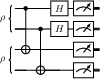
Figure 2: Bell measurement for the two-copy Γρ2 estimator, Γρ3 modes per copy. Measured bits are post-processed to obtain eigenvalues for the FAF estimator.
2. Single-Copy Bilinear Matching Scheme:
When only single-copy access is available, the protocol partitions Majorana bilinears Γρ4 into maximal commuting sets and averages squared measurement outcomes, achieving Γρ5 sample complexity—still polynomially improved relative to previous single-copy approaches.
Mixed-State Witness and Robustness Analysis
While FAF is faithful for pure states, mixed states can exhibit nonzero FAF without true non-Gaussianity. To address this, a purity-corrected witness Γρ6 is introduced, which is strictly positive only for genuinely non-Gaussian mixed states. This witness, measured directly from the same Bell data, is highly noise resistant: it remains nonzero for any non-Gaussian pure input subjected to global depolarizing noise below full mixing.
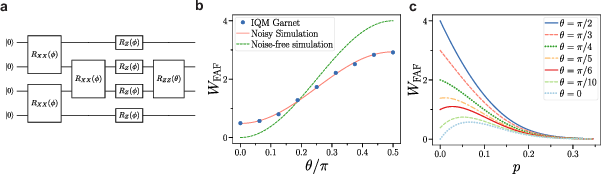
Figure 3: Experimental measurement of fermionic non-Gaussianity witness Γρ7 on IQM Garnet quantum computer.
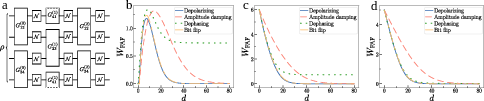
Figure 4: Fermionic non-Gaussianity witness Γρ8 behavior under circuit parameter and noise variation.
Experimental results on IQM hardware, corroborated by noisy simulations, show that noise can both enhance and suppress non-Gaussianity depending on the circuit’s non-Gaussian gate parameters, with stable witness values under moderate noise.
Cryptographic Implications: Pseudorandom-State Generation
Examination of pseudo non-Gaussianity for quantum cryptographic applications reveals an important asymmetry: unlike entanglement, magic, or coherence where Γρ9 resources suffice for computational indistinguishability from Haar-random states, pseudorandom state generation requires nearly maximal fermionic non-Gaussianity. Subset-phase constructions achieve FAF1(ρ)=n−∑j=1nνj20, forcing FAF1(ρ)=n−∑j=1nνj21 local non-Gaussian gates for polynomial-time indistinguishability, precluding any substantial pseudo-resource gap.
Comparative Analysis with Prior Approaches
A precise sample complexity comparison is provided across various Gaussianity testers, including matchgate shadows, joint measurement strategies, covariance tomography, and convolution-based witnesses. The Bell measurement achieves the lowest proven complexity for pure-state testing, employs only Clifford operations, and is naturally suited to early fault-tolerant quantum hardware. Single-copy measurement scaling shows substantial improvement over random sampling, though remains less efficient than the Bell protocol.
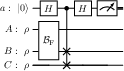
Figure 5: Three-copy convolution test schematic with SWAP-test for distinguishing fermionic non-Gaussianity.
Theoretical and Practical Implications
The protocols developed establish fermionic non-Gaussianity as an efficiently measurable, quantifiable resource and provide scalable tools for its detection and benchmarking. The purity-corrected FAF witness enables robust certification on noisy devices, even in deep circuits where noise sustains non-Gaussianity. The efficient estimability of FAF explains the lack of pseudo-non-Gaussianity gaps, in contrast to measures based on entropic quantities.
Experimentally, these tests have immediate applicability in probing strongly correlated phenomena, certifying magic resource injection, and benchmarking quantum processors. The theoretical insight that efficient FAF estimation precludes pseudo-resource gaps has implications for quantum cryptography, circuit complexity, and fault-tolerant resource counting.
Conclusion
This paper introduces scalable and robust protocols for the detection, quantification, and witnessing of fermionic non-Gaussianity based on covariance-matrix analysis, with the two-copy Bell measurement offering superior sample complexity and operational simplicity. The findings clarify the structural properties of fermionic resources versus entropic resource measures and demonstrate that efficient estimation strictly limits pseudo-non-Gaussianity gaps. The work provides accessible tools for both foundational studies and practical benchmarking of quantum devices, with significant implications for quantum information, condensed matter, and quantum cryptography.

