- The paper introduces a parameterized family of positive semidefinite Hermitian operators whose unique ground state is the targeted GKP qubit.
- It demonstrates that operator expectation values correlate linearly with twice the logical infidelity, providing a precise fidelity benchmark.
- The study validates its approach via numerical convergence in truncated Hilbert spaces, reducing reliance on full quantum state tomography.
Efficient Characterization of General Gottesman-Kitaev-Preskill Qubits
Introduction
This work presents a formalism for the efficient characterization of arbitrary logical qubit states encoded in the Gottesman-Kitaev-Preskill (GKP) code. The necessity for advanced analysis methods in continuous-variable (CV) quantum information processing is acute, particularly as experimental protocols for GKP state preparation and manipulation scale in complexity. The conventional reliance on full quantum state tomography is incompatible with realistic experimental and numerical workloads due to its exponential resource scaling. This paper introduces a construction that addresses these challenges by generalizing the nonlinear squeezing paradigm and formulating a family of positive semidefinite Hermitian operators whose ground states systematically target arbitrary GKP-encoded logical qubit states.
Operator Construction for Arbitrary GKP Logical States
The main technical contribution is the explicit construction of a parameterized family of operators O^GKP(u), each associated with a unique point u on the logical Bloch sphere. The defining criterion is that each operator is positive semidefinite and has, as its unique ground state, the corresponding (possibly non-physical) ideal GKP logical qubit. The operator is constructed as:
O^GKP(u)=O^1+1^−(uxO^x+uyO^y+uzO^z).
Here, O^1 enforces the logical GKP code space subspace penalty, and the O^k correspond to Hermitian versions of GKP stabilizers for k∈{x,y,z}. The resultant operator's ground state is an ideal GKP qubit at the specified Bloch vector u. Critically, the expectation value of this operator in any state living in the logical subspace yields twice its logical infidelity relative to the target qubit. This establishes a rigorous and operationally meaningful connection between operator expectation values and logical state fidelity.
Physical Approximations in Truncated Hilbert Space
Given the nonphysical nature of ideal GKP states, the methodology proceeds by restricting to the truncated N-dimensional Fock subspace and defining the physical operator O^GKP[N]. The ground state of this operator in finite dimension converges to the ideal logical state as N→∞. The approach provides a systematic and scalable numerical pathway for generating and benchmarking experimentally relevant, physical GKP resource states.
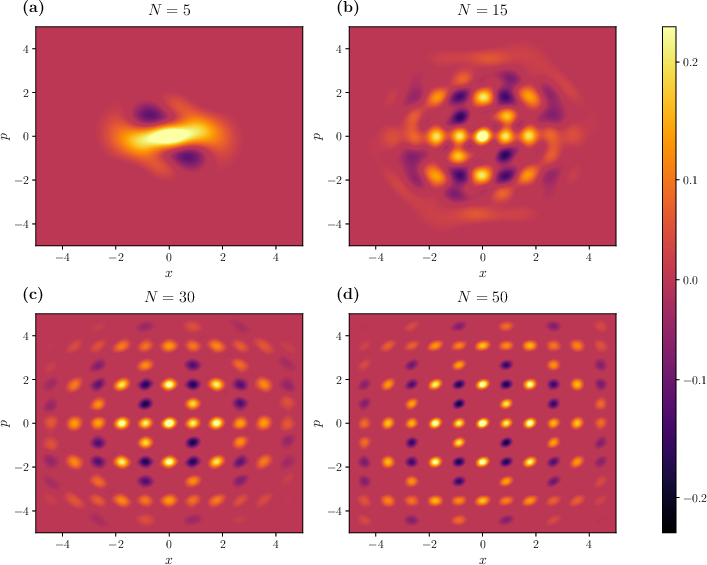
Figure 1: Wigner functions of the ground state of u0 for the logical u1-type magic state, depicted for increasing cutoff dimension u2, demonstrating convergence toward the phase-space structure of the target logical state.
Validation and Numerical Analysis on the Logical Bloch Sphere
A key aspect of the validation is an extensive numerical analysis covering the logical Bloch sphere via dense Fibonacci lattice sampling. For every sampled logical state, the corresponding operator is constructed and diagonalized in the truncated Hilbert space. The expectation values of each operator are computed across all generated ground states, yielding a matrix of overlaps encoding the relationships among all target states.
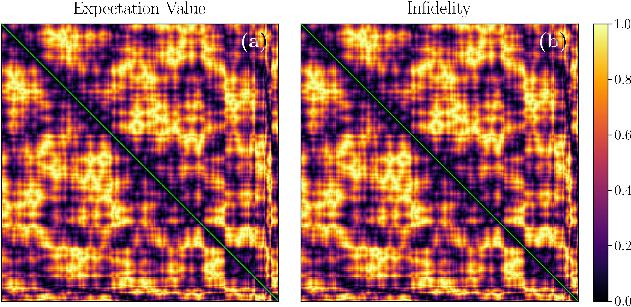
Figure 2: Comparison of operator expectation values (left heatmap) and logical infidelities (right heatmap) for ordered sets of states spanning the logical Bloch sphere; diagonal structure reflects the correspondence between ground state minimization and target state.
This dataset empirically confirms that u3 is minimized if and only if u4, i.e., the operator's ground state matches the targeted logical state.
Crucially, the observed expectation values and the logical infidelities u5 across this dataset exhibit a strong linear relationship for increasing u6, numerically converging to:
u7
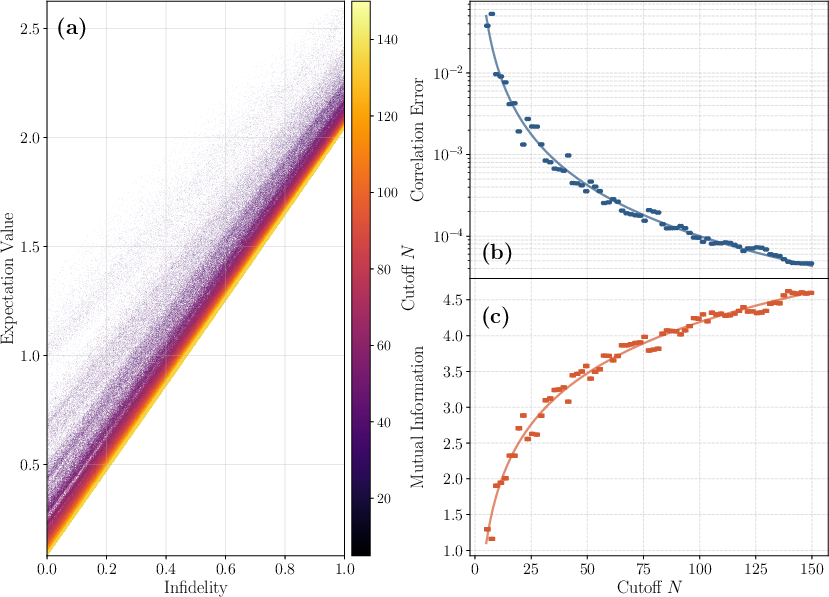
Figure 3: The convergence of operator expectation value to twice the logical infidelity, with vanishing residual error and saturating mutual information as the cutoff u8 increases.
This establishes the operational equivalence of minimizing u9 and maximizing state fidelity, which is essential for both experimental benchmarking and numerical optimization.
Sampling and Coverage of the Logical Bloch Sphere
The paper details efficient algorithms for uniformly sampling the logical Bloch sphere and establishing ordering heuristics for systematic traversal, critical for exhaustive numerical studies and for constructing resource state libraries.
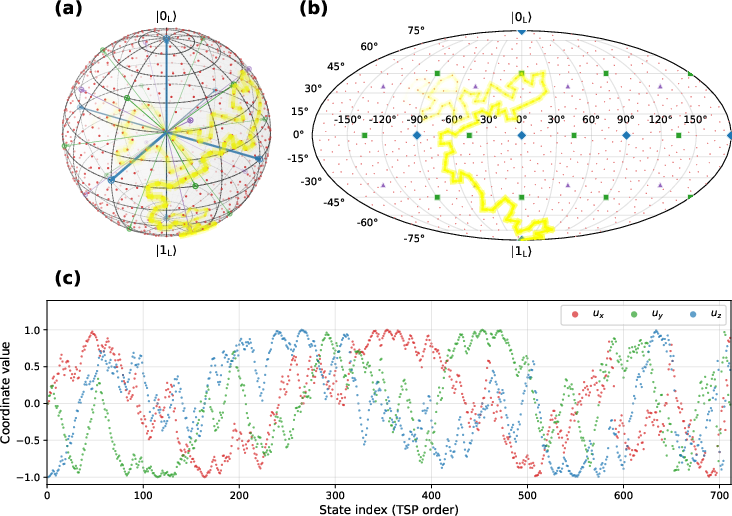
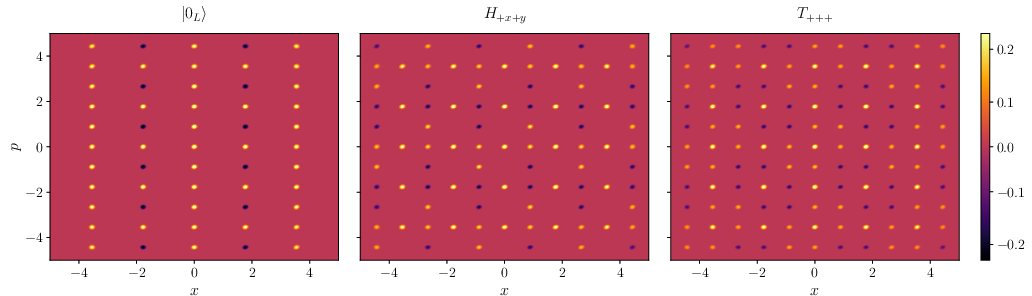
Figure 4: Orthographic and Mollweide projections illustrating the uniform sampling of the logical Bloch sphere, highlighting the placement of core stabilizer, O^GKP(u)=O^1+1^−(uxO^x+uyO^y+uzO^z).0-type, and O^GKP(u)=O^1+1^−(uxO^x+uyO^y+uzO^z).1-type states and the sequence of the ordering heuristic.
Non-Gaussianity Witness and Gaussian State Bound
An important theoretical implication is the generic role of O^GKP(u)=O^1+1^−(uxO^x+uyO^y+uzO^z).2 as a non-Gaussianity witness. For the set of all pure Gaussian states, the operator admits a nontrivial lower bound:
O^GKP(u)=O^1+1^−(uxO^x+uyO^y+uzO^z).3
with O^GKP(u)=O^1+1^−(uxO^x+uyO^y+uzO^z).4 the infinity norm of the target Bloch vector. This result guarantees that the operator cannot be minimized below this threshold unless genuine non-Gaussian GKP structure is present, thus providing a practical criterion for experimental certification of non-Gaussian resource states.
Experimental Implications
Unlike full state tomography, which requires a prohibitive number of measurement settings, the expectation values of the constructed operators can be accessed using only three types of quadrature measurements, corresponding to the Hermitian GKP stabilizers. This efficiency makes the approach highly relevant for near-term photonic and CV superconducting hardware, where sample complexity and operational overhead remain a bottleneck. The construction unifies existing approaches to logical GKP state certification, generalizes to all pure qubit superpositions, and provides a robust framework for resource state validation.
Theoretical and Practical Outlook
The construction systematically subsumes and extends previous analyses (e.g., logical basis witness, magic state characterization) to the full logical Bloch sphere. The connection to infidelity scaling provides a rigorous metric for benchmarking preparation circuits or error correction routines. Experimentally, the reduction to three quadrature settings is significant for the optimization of preparation protocols in CV architectures, notably in platforms utilizing bosonic modes of light or microwave fields.
A remaining open challenge is a general proof of global positive semidefiniteness for all O^GKP(u)=O^1+1^−(uxO^x+uyO^y+uzO^z).5 outside the logical subspace, i.e., the existence of a noncommutative sum-of-squares decomposition for arbitrary target state parameters.
Conclusion
This paper establishes a comprehensive and operationally efficient protocol for the characterization of arbitrary GKP logical qubits, both ideal and physical, framed by the construction of parameterized, positive semidefinite Hermitian operators. The approach connects operator expectation values to logical infidelity, serves as a non-Gaussianity witness, and streamlines the experimental analysis of CV quantum states. These results provide both theoretical insight and immediate applicability for resource state benchmarking in scalable fault-tolerant bosonic quantum computing platforms.

