- The paper derives a universal, state-independent threshold for entanglement generation under bilinear interactions amidst white thermal noise.
- It employs Gaussian state analysis and GKSL dynamics to extend the separability criteria for multimode coupled systems.
- The findings inform experimental designs for gravity-induced entanglement, emphasizing noise reduction over complex state engineering.
Universal Bound for Entanglement Generation in Bilinearly Coupled Systems
Overview
The paper "Universal Bound for Entanglement Generation" (2605.26215) presents a rigorous analysis of entanglement generation under general bilinear interactions in the presence of white thermal noise. Through Gaussian state analysis and Gorini-Kossakowski-Sudarshan-Lindblad (GKSL) dynamics, the authors prove a universal, state-independent threshold for entanglement generation that cannot be lowered by the choice of initial states or mediator subsystems. This work establishes a separability-preserving criterion for coupled noisy systems and demonstrates its direct implications for gravity-induced quantum entanglement experiments.
Formalism and Main Results
The primary scenario involves two (possibly multimode) quantum subsystems A and B interacting via a rank-1 or general bilinear Hamiltonian of the schematic form
H^=21ξ^TGξ^+bath terms+system-bath coupling
where ξ^ is the collective canonical vector, G is the coupling matrix, and each subsystem is subject to independent white thermal noise.
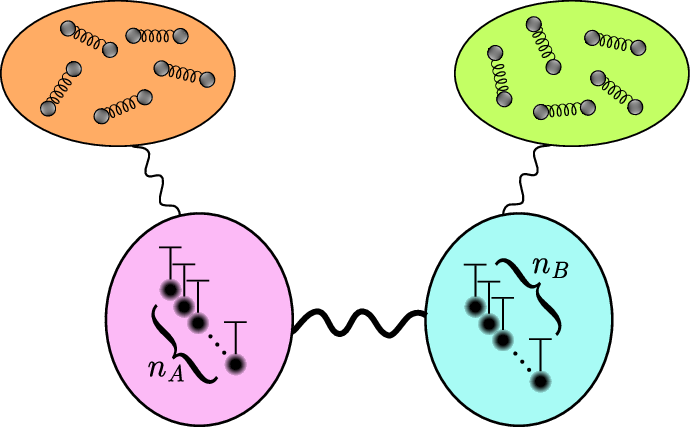
Figure 1: Rank-1 configuration: n oscillators in subsystem A (pink) couple to n oscillators in subsystem B (blue) via a bilinear interaction, with thermal baths attached to each subsystem.
The analysis first considers multimode Gaussian states, extending the Peres-Horodecki PPT criterion to derive a sufficient condition for separability preservation during dynamical evolution: SAthSBth≥Kg2
where Kg is the bilinear coupling strength and SAth,SBth are the thermal noise powers for subsystems A and B.
If cross-correlations between baths are present, the separability threshold becomes: SAthSBth≥Kg2+(SABth)2
This result holds regardless of the system's initial state or introduction of mediator subsystems.
The generalization to arbitrary bilinear interactions leads to the matrix inequality: (QAthQG QGTQBth)⪰0
where QG encapsulates the coupling and ξ^0 are the local bath noise matrices.
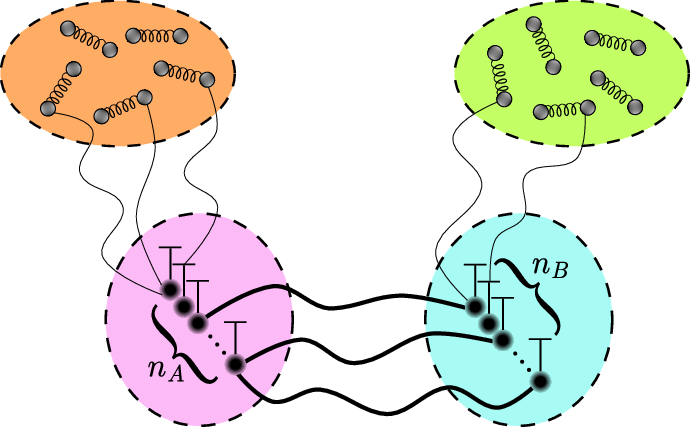
Figure 2: General bilinear interactions: Each oscillator in A or B couples to baths and to oscillators in the other subsystem via generic bilinear coupling matrices.
These bounds are proven explicitly via covariance matrix dynamics in the perturbative regime and via construction of LOCC protocols matched to the GKSL dissipator for arbitrary separable input states.
Gravity-Induced Entanglement: Experimental Implications
Application to gravitationally mediated entanglement experiments yields a stringent requirement: for two masses ξ^1 separated by ξ^2 undergoing Gaussian (optomechanical-like) dynamics, the gravitational coupling must satisfy
ξ^3
where ξ^4 is Newton's constant, ξ^5 is dissipation rate, ξ^6 is temperature, and ξ^7 is Boltzmann's constant.
This bound is numerically demanding; realistic solid densities and low damping still require sub-nanoKelvin temperatures and ultra-high quality factors. Recent proposals to optimize oscillator geometry or employ massive mediators enhance entanglement amplitude but do not modify the generation threshold.
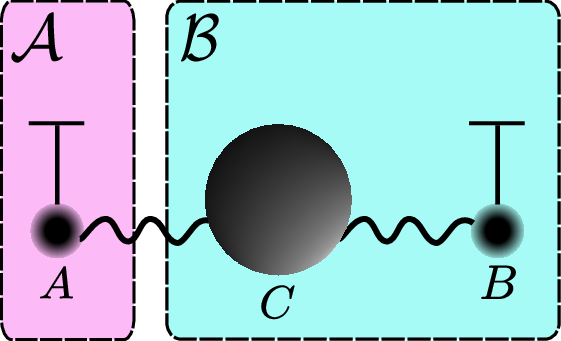
Figure 3: Tripartite system: Entanglement between A and B is mediated by C; upon forming composite subsystems, the separability condition applies between A and BC.
The universal bound applies to systems involving mediators—for example, tripartite setups with two masses (A, B) and a central massive oscillator (C) acting as a mediator. The separability-preserving threshold remains determined by the coupling and thermal noise across the chosen bipartition, independent of internal entanglement among mediators. Amplification of entanglement can occur above threshold, but generation across thermal noise cannot.
Theoretical and Practical Implications
The principal implication is the existence of a state-independent, protocol-independent threshold for entanglement generation in bilinearly coupled noisy systems. This threshold cannot be relaxed via state engineering, non-Gaussianity, multipartite mediation, or bath correlations. The competition between coherent coupling and environmental decoherence fundamentally determines the onset of entanglement.
This result provides a critical constraint for quantum gravity tests employing massive quantum probes and clarifies the roles of system design, mediator enhancement, and bath engineering in practical setups. In theoretical quantum information, the universality strengthens the interpretation of gravity-induced entanglement as a robust witness for the quantumness of gravity, unambiguously protected against protocol loopholes.
Future Directions
The bounds derived suggest avenues for further experimental optimization—primarily through reduction in thermal noise and dissipation, rather than architectural complexity or state preparation. Extensions to systems with colored noise spectra, time-dependent couplings, or high-frequency baths could sharpen separability criteria. Furthermore, the methodology generalizes to other physical channels (electromagnetic, optomechanical, spin) where decoherence competes with entanglement.
The connection to dynamical LOCC protocols and the explicit construction in GKSL dynamics invite broader applications in open quantum systems, quantum thermodynamics, and nonclassicality tests.
Conclusion
The paper provides a rigorous, universal separability-preservation bound for entanglement generation under bilinear interactions and white thermal noise, applicable to multimode systems and arbitrary initial states. The bound quantifies the fundamental limitation in noisy environments and supports gravity-induced entanglement protocols as robust tests distinguishing quantum from classical mediation. Amplification of entanglement is possible with mediators, but the threshold for generation remains unaltered. This work constitutes a central reference for quantum gravity experimental criteria and theoretical analyses of noisy quantum channels.