- The paper demonstrates that pulsed optomechanical protocols can generate and amplify gravity-induced quantum entanglement by leveraging nonclassical optical states.
- It establishes a universal threshold where entanglement occurs only if gravitational coupling exceeds twice the product of the mechanical damping rate and thermal occupancy.
- The study reveals that measurement losses and environmental decoherence dictate optimal squeezing and detection strategies for observing the generated entanglement.
Amplification and Bounds of Gravity-Induced Entanglement in Pulsed Optomechanics
Introduction and Motivation
The paper "Amplification and generation bounds of gravity-induced entanglement in pulsed optomechanical systems" (2605.26240) presents a rigorous investigation of quantum entanglement generation between optical fields in two pulsed optomechanical systems, where the mechanical masses interact via Newtonian gravity. The primary motivation is to address foundational questions regarding quantum gravity, specifically whether low-energy experiments can reveal quantum signatures through gravity-induced entanglement—a phenomenon that cannot be explained by classical gravity-mediated interactions. Optomechanical systems are particularly promising due to their capability to engineer nonclassical mechanical states and enable efficient optical readout.
Protocol Architecture and Core Model
The proposed protocol consists of three stages:
- A first optical pulse prepares each mechanical oscillator in a nonclassical state via optomechanical state transfer.
- The two masses interact through mutual gravitational coupling over a duration tG, intended to generate quantum entanglement.
- A second optical pulse maps the mechanical entanglement back onto outgoing optical fields for direct optical detection.
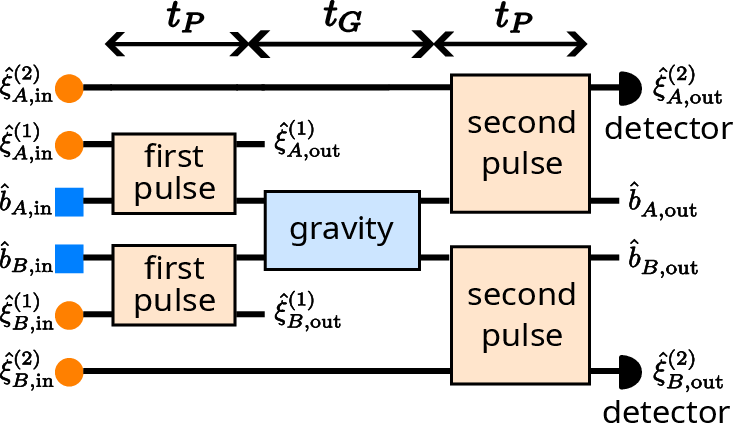
Figure 1: Schematic of the pulsed protocol, highlighting the preparation, gravitational interaction, and optical readout stages.
Each optomechanical system operates in the red-detuned regime, allowing for beam-splitter-type Hamiltonian dynamics and state swaps between optical and mechanical modes. The gravitational interaction is treated within the rotating-wave approximation (RWA), resulting in an effective bilinear coupling for the two mechanical modes.
The protocol's flexibility permits the injection of highly nonclassical optical states (e.g., squeezed states or Fock states) onto the mechanical modes. This enhances the subsequent gravity-induced entanglement, quantified via entanglement negativity. For Gaussian squeezed states, the gravitational beam-splitter transformation optimally entangles the outgoing optical fields if the squeezing axes are aligned. For Fock state inputs, the generated negativity increases with photon number in the entangling regime.
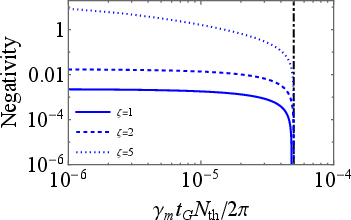
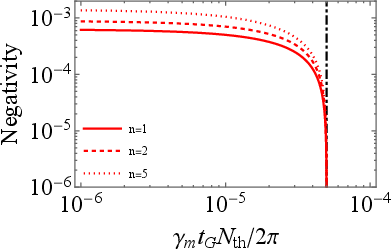
Figure 2: Entanglement negativity versus thermal noise, showing enhancement with squeezing or Fock number.
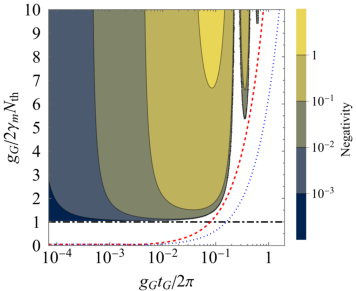
Figure 3: Entanglement negativity for squeezed inputs in the (gGtG/2π,gG/2γmNth) parameter plane, demonstrating amplification and threshold effects.
Fundamental Bounds: Thresholds for Entanglement Generation
A key result is the identification of an universal threshold for gravity-induced entanglement: entanglement can be generated only if the gravitational coupling satisfies gG>2γmNth, where γm is the mechanical damping rate and Nth the thermal occupation. This threshold is independent of input state nonclassicality—no choice of Gaussian or Fock-state input can lower the boundary between entangling and non-entangling dynamics.
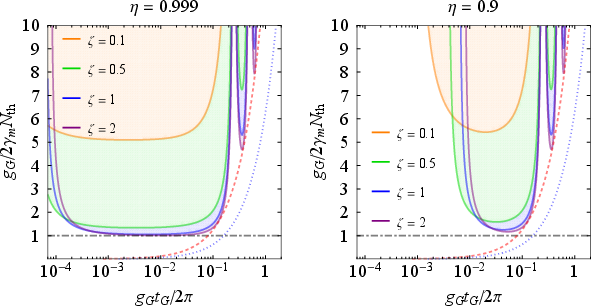
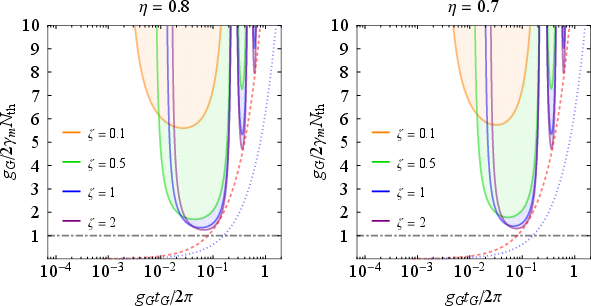
Figure 4: Entanglement region highlighting universal and loss-modified thresholds for varying squeezing and efficiency.
The analysis extends to entanglement-annihilating (EA) and entanglement-breaking (EB) regimes. EA channels (thermal noise destroys all Gaussian entanglement) and EB channels (separability with ancillary systems) arise when thermal decoherence injects O(1) phonons during tG, independent of gG.
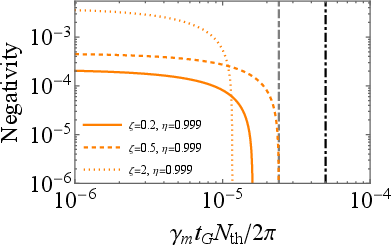
Figure 5: Entanglement negativity as a function of measurement loss, illustrating EA and EB boundaries.
Detection and Measurement Loss Effects
The paper rigorously models measurement losses using local Gaussian attenuation channels. Imperfect detection modifies the separability threshold: vacuum noise introduced by loss tightens the bound and enhances sensitivity to input squeezing. Contrary to the lossless regime, optimal squeezing becomes finite and measurement efficiency–dependent in the presence of loss. Excessive squeezing amplifies vacuum noise contributions, limiting the observable negativity.
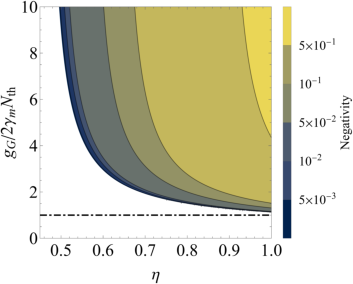
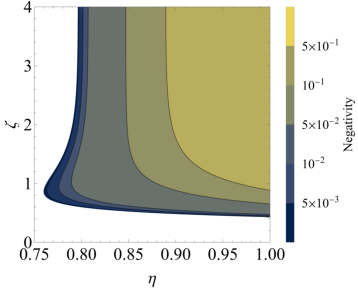
Figure 6: Measurement loss effects on observable entanglement negativity, showing optimal squeezing regions and dependence on detection efficiency.
Practical and Theoretical Implications
Practically, the results establish stringent requirements on mechanical Q-factors and cryogenic environments to suppress thermal noise and enable observable entanglement. Experimentally feasible parameter regimes are delineated for optical detection post-loss. Theoretically, the bounds reinforce that quantum signatures of gravity—operationally witnessed as entanglement—can only emerge above a decoherence-limited threshold. These findings have direct bearing on interpretations of quantum gravity proposals, distinguishing quantum from classical gravitational mediation at low energies.
Future Directions
The framework can be extended to multimode and non-Gaussian settings, including advanced protocols for discriminating quantum and semiclassical gravity or exploring highly macroscopic entanglement regimes. Further research may integrate more complex environmental models, optimize readout strategies, and test foundational quantum gravity hypotheses in tabletop systems.
Conclusion
This paper provides a comprehensive and quantitatively precise account of the amplification and fundamental bounds of gravity-induced entanglement in pulsed optomechanical systems. While nonclassical inputs enhance the amount of entanglement, the universal generation threshold imposed by thermal decoherence remains unaltered. Measurement losses further constrain detectable entanglement, dictating optimal squeezing strategies and efficiency requirements. These results strongly inform both experimental design and theoretical analyses of quantum gravity signatures in macroscopic quantum systems.