- The paper analytically derives a novel four-dimensional AdS black string solution incorporating perfect fluid dark matter via a logarithmic deformation.
- It rigorously examines causal, geometric, and thermodynamic properties, including horizon structure, curvature singularities, and the role of the Lambert W function.
- The study reveals that exotic PFDM regimes (α > 0) induce phase transitions and local instability, while conventional regimes (α < 0) ensure consistent thermodynamic stability.
Exact AdS Black String Solutions Immersed in Perfect Fluid Dark Matter
Introduction
The paper "Black string immersed in perfect fluid dark matter" (2605.26198) constructs an exact four-dimensional black string solution within anti-de Sitter (AdS) spacetime incorporating perfect fluid dark matter (PFDM). This study fills a gap in the literature by analytically deriving the metric deformation introduced by PFDM via a logarithmic term and thoroughly analyzing the causal, geometric, and thermodynamic features of such a system. The investigation leverages the structure of cylindrically symmetric AdS black strings as introduced by Lemos and extends them through an anisotropic PFDM source, revealing novel phase behavior and stability regimes.
Black String Solution in PFDM–AdS Geometry
The authors solve the Einstein equations for a static cylindrically symmetric spacetime with a negative cosmological constant and a PFDM energy-momentum tensor. The resultant metric function is
f(r)=ℓ2r2−r2M+rαln(∣α∣r)
with ℓ the AdS length scale, M the mass parameter, and α an integration constant characterizing the PFDM density. The equation of state is specified as p=ρ/2, where the sign of α controls violation or satisfaction of the weak energy condition. For α>0, the density and pressure are negative, representing exotic matter; for α<0, they are positive and conventional.
Horizon Structure and Curvature Singularities
The horizon radius r+ is obtained by solving the condition f(r+)=0, leading to a transcendental equation involving logarithmic terms. The roots are expressed analytically using the Lambert ℓ0 function, admitting distinct branches for different ℓ1 signs. The curvature properties are examined through the Kretschmann scalar, confirming a central curvature singularity at ℓ2, hidden within the horizon for admissible parameters.
Thermodynamic Properties and Phase Structure
The Hawking temperature associated with the horizon is given by
ℓ3
which explicitly depends on the PFDM parameter ℓ4 and the horizon radius ℓ5. The heat capacity,
ℓ6
exhibits a divergence at ℓ7 for ℓ8, marking a thermodynamic phase transition associated with a change in local stability.
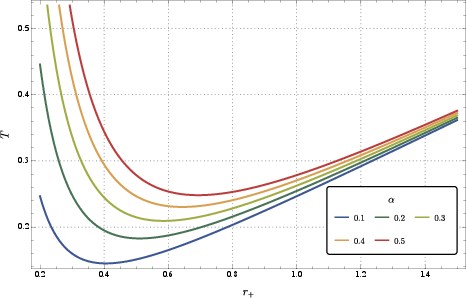
Figure 1: Hawking temperature ℓ9 versus event horizon radius M0 for selected values of M1.
The phase transition is absent in the M2 case, as the heat capacity remains strictly positive for all admissible horizon radii. This leads to an extremal configuration at a minimum radius where the temperature vanishes, with all physical horizons above this point being locally stable.
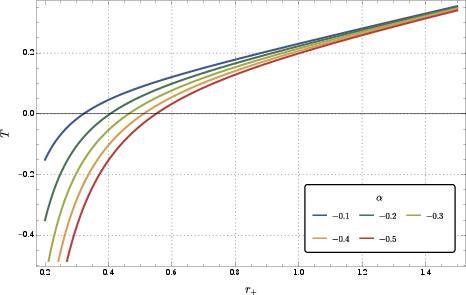
Figure 2: Hawking temperature M3 versus event horizon radius M4 for selected values of M5.
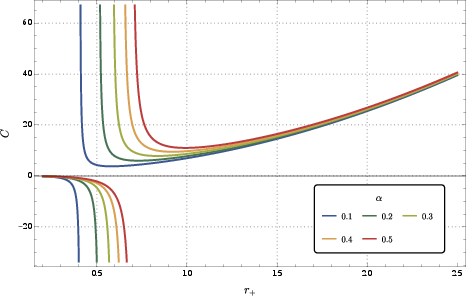
Figure 3: Heat capacity M6 versus event horizon radius M7 for selected values of M8.
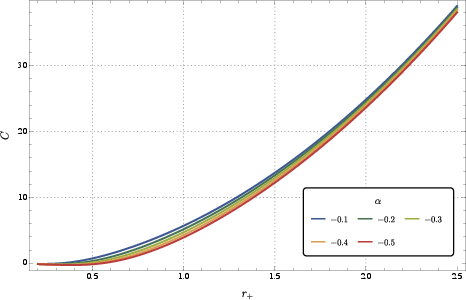
Figure 4: Heat capacity M9 versus event horizon radius α0 for selected values of α1.
These thermodynamic and phase characteristics are tightly linked to the PFDM-induced modifications to the geometry and energy conditions.
Implications and Prospects
The analytic results demonstrate that PFDM leads to qualitatively distinct black string behavior in AdS backgrounds, including phase transitions for exotic matter regimes and robust stability for conventional matter. The use of the Lambert α2 function in horizon determination extends applicability to other PFDM-coupled systems, as recently explored in black hole contexts (Hamil et al., 2024, Hamil et al., 2024, Xu et al., 2016), and supports further study of horizon branching in modified gravity settings.
The violation of the weak energy condition in the α3 sector, and its link to phase transitions, raises questions regarding self-consistent embeddings of PFDM and its macroscopic thermodynamic effects. The results have relevance for AdS/CFT scenarios where horizon branching and thermal instabilities may influence dual field theory features, and for analogue gravity models where the causal and thermodynamic structure is closely tied to matter content.
Potential future directions include the extension to charged and rotating black strings, the incorporation of PFDM in higher-dimensional and scalar-tensor models, and the probing of dynamical stability and perturbative spectra. The analytic tractability of the solution is conducive to generalization to α4 modified gravity and other exotic backgrounds (Santos et al., 24 Feb 2026), as well as to more complex matter couplings.
Conclusion
This paper provides a comprehensive analytic framework for PFDM-immersed AdS black strings, delineating the role of dark matter parameters in controlling horizon structure, singularity formation, and thermodynamic phase behavior. The existence of phase transitions and stability regimes intimately tied to energy condition violations highlights the rich phenomenology arising from PFDM sources in extended objects and motivates further investigation into their astrophysical and holographic implications.

