- The paper introduces Q-LEAK, a framework that integrates Grover’s algorithm into verifying leakage in side-channel countermeasures.
- It compiles leakage CNFs into reversible quantum oracles, achieving quadratic speedup compared to classical exhaustive search.
- Experimental evaluation on simulators and IBM hardware confirms its effectiveness despite challenges in scalability and oracle depth.
Quantum-Based Leakage Verification for Side-Channel Countermeasures
Background and Motivation
Power side-channel attacks remain a critical threat to cryptographic hardware, exploiting correlations between power consumption and internal states to recover secret keys. Masking and related countermeasures are widely incorporated in hardware designs, but ensuring the final synthesized circuit remains truly leak-resistant after synthesis demands exhaustive verification under explicit leakage models. Formal verification methods encode the cipher, its masking logic, and the leakage predicate as a Boolean satisfiability problem (usually in conjunctive normal form, CNF), then search for assignments violating the security requirement. Classical CDCL SAT solvers and SMT-based verifiers exhibit exponential worst-case behavior due to the massive assignment space and heavy utilization of XOR logic and time-unrolling. This scaling constraint motivates the integration of quantum search methods—specifically Grover's algorithm—into the leakage verification pipeline.
Q-LEAK Framework
Q-LEAK is introduced as a quantum-based formal verification system targeting the scalability bottlenecks of classical methods in side-channel countermeasure analysis. The framework compiles two-trace, bit-level leakage CNFs into reversible quantum oracles and applies amplitude amplification across the variable qubits using Grover/BBHT search. The quantum search explores all assignments in superposition, applies a phase flip to those violating the security property, and amplifies their probability amplitude via constructive interference.
An explicit analysis shows that Q-LEAK achieves complexity Θ(ρn2n/2) (Fig. 2), where ρ is the clause density and n is the number of variables. Classical exhaustive search scales as 2n, making the quantum approach dominant above a density-dependent crossover n⋆. In practical terms, once CNF encoding reaches a threshold (n∼17 for typical densities), Q-LEAK's search cost becomes exponentially more favorable compared to classical enumeration, despite the additional overhead from oracle construction and ancillary qubits.
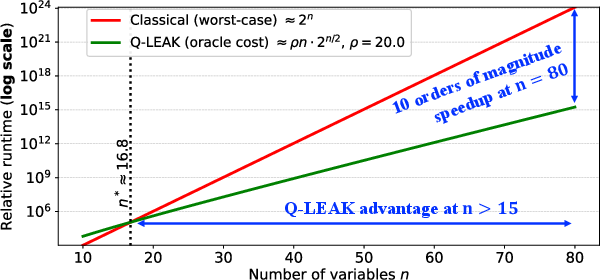
Figure 1: Asymptotic scaling of search cost versus variable count n; classical worst-case scales as 2n, Q-LEAK achieves ρn2n/2, showing exponential separation for large n.
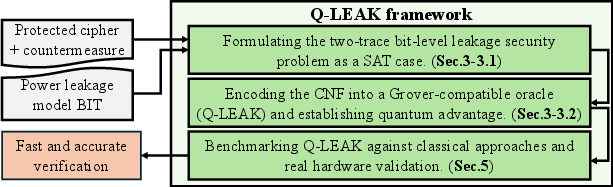
Figure 2: Overview of Q-LEAK’s main contributions, including CNF-to-oracle compilation, quantum search, and practical resource modeling.
Quantum Circuit Methodology
The central innovation is the circuit-level SAT oracle construction (Fig. 5). Per-clause violation bits are computed using multi-controlled Toffoli gates; violations are aggregated into a single CNF flag, and a controlled-phase flip is applied if and only if no clause is violated, i.e., the assignment satisfies the CNF. BBHT-style Grover search, which randomizes the iteration count for unknown solution cardinality, is used for practical robustness. Statistical evaluation of measurement histograms enables both SAT and UNSAT verdicts: sharp amplitude peaks correspond to leakage witnesses, while flat distributions evidence leak-free instances.
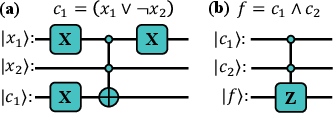
Figure 3: Circuit sketch for SAT-oracle building blocks; clause violation bits are aggregated into a CNF flag for phase-flip control.
Experimental Evaluation and Numerical Results
The experimental benchmarks involve minimal but representative templates (single-bit state, one unrolled time step, BIT leakage model) to validate the framework's correctness and resource modeling.
In noise-free quantum simulations, Q-LEAK consistently finds violating assignments within 1–4 tries and amplifies marked bitstrings with over 20% probability, while non-solutions remain near background. The assignments returned match those from classical Kissat SAT solver.

Figure 4: Q-LEAK results on power side-channel CNF benchmarks: sharp SAT spikes for cases with two solutions, uniform outcomes for UNSAT control, averaged over 10 runs.
On real quantum hardware (IBM Marrakesh, 156 qubits), Q-LEAK recovered at least one classically verified SAT assignment per case, with reduced amplitude separation and some false-positive peaks attributed to device noise—demonstrating robustness but revealing hardware limitations.
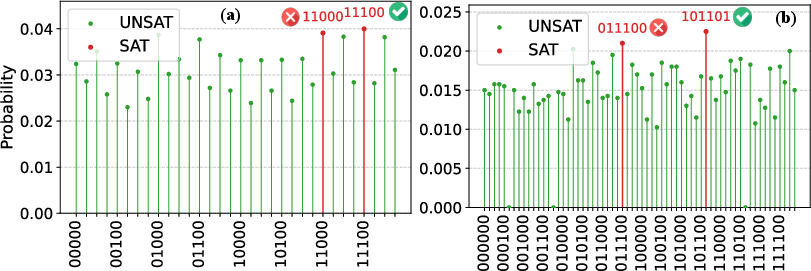
Figure 5: Hardware evaluation of Q-LEAK on IBM Marrakesh; correct SAT assignments recovered, noise causes spurious peaks, average over five runs.
Projected Resource Scaling and Practical Implications
A detailed resource model projects logical qubit and operation counts for hard residual CNF instances. Q-LEAK's quantum logical operation count ρ0 becomes competitive when the residual classical scaling exponent ρ1 exceeds a threshold ρ2 (Fig. 9). For example, at ρ3, with clause density ρ4, Q-LEAK's search exponent is halved compared to classical methods, but the absolute cost remains substantial due to oracle depth growth.
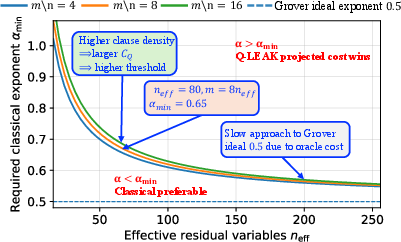
Figure 6: Projected threshold for quantum advantage; Q-LEAK’s logical cost beats classical only for hard residuals with exponent ρ5.
The benefits are conditional: classical preprocessing should reduce the CNF to independent hard blocks where residual entropy justifies quantum search, and Q-LEAK is meaningful only in those regions. For denser CNFs (higher ρ6), oracle overhead increases, raising the threshold for quantum advantage.
Limitations and Future Directions
The current evaluation is restricted to small templates (BIT leakage, ρ7, ρ8). Scaling to realistic cryptographic circuits (AES, multi-cycle unrolling, HW/HD models) will demand oracle compression, error mitigation, and hybrid decomposition strategies. The main bottleneck remains oracle construction: required logical qubits and operation depths grow rapidly with circuit complexity and leakage model sophistication. Addressing these issues for broader industrial applicability will require novel quantum circuit synthesis and hybrid classical–quantum integration.
Conclusion
Q-LEAK demonstrates the feasibility of quantum-assisted formal verification for power side-channel countermeasures, offering quadratic speedup in SAT search via Grover-style amplitude amplification. The methodology successfully maps leakage-aware CNF encodings to quantum oracles and produces interpretable, sharply peaked measurement spectra aligned with security verification needs. The framework achieves correctness parity with classical solvers in small benchmarks and recovers valid witnesses even under noisy hardware conditions.
Scalability is constrained by oracle depth and ancillary qubit growth, emphasizing the need for future work in oracle synthesis and classical–quantum hybridization. Theoretical projections support the existence of a density-dependent threshold for quantum advantage in hard residual CNF cases. Q-LEAK constitutes a concrete step toward integrating quantum computing into practical hardware security verification workflows, potentially enabling more efficient validation of advanced masking and countermeasures as quantum technology matures.