- The paper introduces a direct quantum leakage removal (DQLR) technique that decreases leakage to below 1×10⁻³ in QEC circuits using superconducting transmon qubits.
- The authors employ a distance-3 surface code and a distance-21 bit-flip code on a Sycamore processor to robustly demonstrate the efficacy of the DQLR method.
- Experimental results and simulations reveal that mitigating leakage aligns the logical error performance with uncorrelated Pauli errors, advancing QEC scalability.
Overcoming Leakage in Scalable Quantum Error Correction
The paper "Overcoming leakage in scalable quantum error correction" (2211.04728) addresses the critical challenge of leakage in quantum error correction (QEC) circuits, particularly when using superconducting transmon qubits. This leakage refers to the deviation of quantum information from computational to higher energy states, which undermines the error-correction's fundamental assumption of uncorrelated error. The authors demonstrate a novel approach on a Sycamore quantum processor implementing a distance-3 surface code and a distance-21 bit-flip code to contain and mitigate leakage, which they accomplish by employing a direct quantum leakage removal strategy.
Characterizing the Spread of Leakage
Leakage in transmon qubits significantly impacts QEC by distributing errors across qubits involved in multi-qubit interactions, complicating the standard assumption of error independence central to effective QEC.
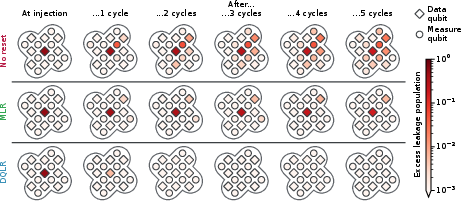
Figure 1: Leakage in a structured QEC circuit.
The study focuses on the diabatic CZ gate within the Sycamore architecture which is prone to leakage between qubit states during operation. The authors explore how a full 1→2 rotation injects leakage, allowing for an examination of its lifecycles, verifying that leakage can persist across multiple QEC cycles (exponential decay constant approximately 4.4 cycles).
Suppressing Leakage Populations During a QEC Circuit
Three leakage removal strategies were explored: No Reset, Multi-Level Reset (MLR), and Data Qubit Leakage Removal (DQLR). The study found that the DQLR strategy significantly decreased leakage levels to below 1×10⁻³ and maintained this stability over multiple cycles through an innovative combination of reset and targeted qubit interactions, essentially curbing the leakage dynamics to single-cycle events.
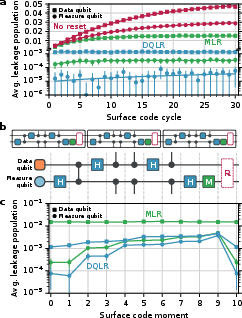
Figure 2: Leakage population during surface code execution.
Utilizing leakage removal strategies significantly impacts QEC performance. Employing a distance-21 bit-flip code, the authors demonstrated that DQLR mitigates the effects of leakage such that it is on par with uncorrelated Pauli errors, thereby advancing logical error probability behavior closer to purely classical errors.
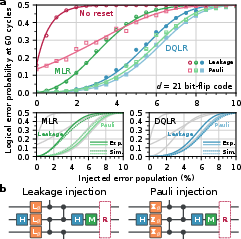
Figure 3: Bit-flip code logical performance and dependence on injected errors.
In contrast to No Reset and MLR, DQLR stabilizes the logical performance of the QEC over prolonged cycles, as evidenced in experimental data and simulations with low decoherence and logical error rates.
Implementation and Practical Implications
The findings from the paper illustrate critical advancements in the scalability of QEC for practical quantum computing. The implementation of DQLR showcases an achievable strategy that eases the traditionally complex task of leakage suppression in qubit architectures, confirming the viability of large, interconnected transmon qubit arrays as a sustainable framework for robust quantum computation.
Conclusion
"Overcoming leakage in scalable quantum error correction" (2211.04728) presents a pragmatic and detailed method for addressing one of the significant obstacles to QEC scaling. By integrating a comprehensive leakage removal approach like DQLR, quantum hardware can maintain error suppression over long durations, thereby supporting quantum architectures capable of executing more complex and lengthier algorithms with minimized errors in realistic conditions. This achievement bridges a crucial gap toward fault-tolerant quantum computing on an industrial scale.