- The paper demonstrates that a free-space optical delay line preserves photonic hyperentanglement with fidelities up to 99.5% and maintains high visibilities (above 93.9%).
- The authors utilized spontaneous parametric down-conversion and nested Herriott cell configurations in the FSODL, achieving a recoupling efficiency of 73.9% and minimal dispersion.
- The results indicate that FSODL architectures can serve as efficient, room-temperature quantum memories for synchronized, multiplexed quantum networking over an ultra‐broad bandwidth.
High-Fidelity Preservation of Hyperentanglement in a Free-Space Optical Delay Line
Introduction
Photonic hyperentanglement, defined as simultaneous entanglement across multiple degrees of freedom (DOFs) such as polarization and energy-time, provides enhanced information capacity and functionalities for quantum communication, networking, and multiplexed key distribution. The practical deployment of hyperentangled photon pairs in quantum networks is contingent on preserving multi-DOF quantum correlations during synchronization and delay operations. Traditional solid-state memories for entanglement storage suffer from efficiency limitations and narrow bandwidth, particularly with cryogenic requirements. This paper addresses the preservation of hyperentanglement using a broadband, highly efficient free-space optical delay line (FSODL) based on nested Herriott cells, validating its compatibility with complex photonic quantum states and the integrity of both polarization and energy-time correlations after a fixed temporal delay (2605.25609).
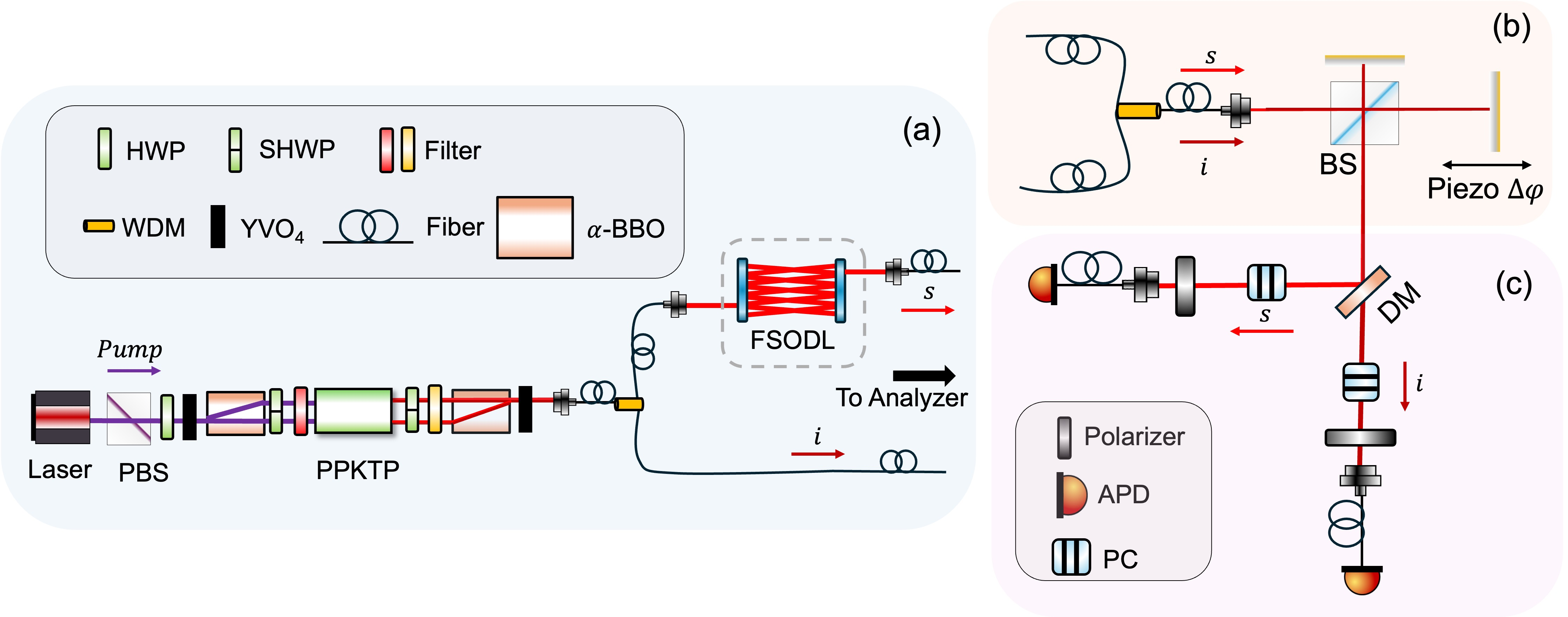
Figure 1: Experimental setup for generation, propagation, and characterization of hyperentangled photon pairs in a free-space optical delay line (FSODL).
Experimental Configuration and State Preparation
Hyperentangled states were engineered via spontaneous parametric down-conversion (SPDC) in a periodically poled KTP crystal, generating photon pairs at 780.0 nm and 842.6 nm. Energy-time entanglement utilized a continuous-wave pump for extended coherence and frequency anti-correlations, analyzed via an unbalanced Michelson interferometer for Franson-type interference. Polarization entanglement was achieved with a beam displacement interferometer, implementing a maximally entangled Bell state. The full state was represented as a tensor product of polarization and energy-time basis, yielding a hyperentangled two-photon quantum state.
Propagation through the FSODL involved 160 mirror reflections, imposing a well-defined delay of 647 ns. The optical design offered minimal chromatic dispersion and polarization distortions, exploiting reflective geometry to preserve both time-bin and polarization properties over a ∼30 THz bandwidth. A recoupling efficiency of 73.9(3)% was realized for the delayed signal photon.
Energy-Time Entanglement Characterization
Coincidence histograms before and after FSODL propagation unambiguously demonstrated the preservation of energy-time entanglement. Interferometric phase scans yielded high-visibility two-photon interference fringes, quantified at 94.3(2)% (pre-delay) and 93.9(3)% (post-delay) under constructive interference, with negligible visibility reduction attributed to the intrinsic nondegeneracy and analysis interferometer contrast limitation.
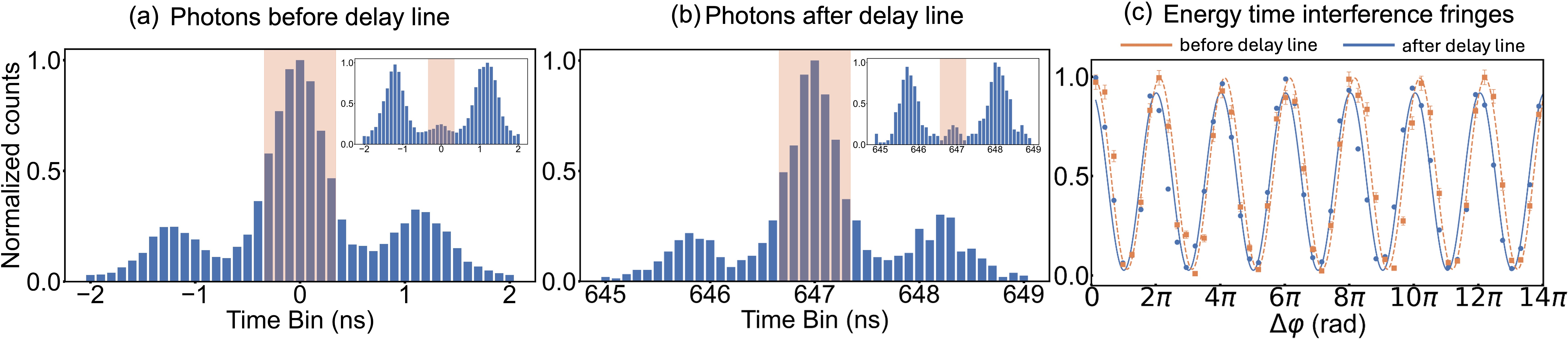
Figure 2: Time-bin-resolved coincidence measurements confirm energy-time entanglement preservation after FSODL delay.
Complementary polarization projections (HsHi and DsDi) retained visibilities above 93.8%, excluding polarization-dependent decoherence in the energy-time channel. The estimated fidelity from visibility, FE=21+V, was 97.2(1)% (pre-delay) and 97.0(2)% (post-delay), establishing robust temporal coherence post-propagation.
Polarization Entanglement Characterization
Polarization analysis post-FSODL confirmed the retention of polarization correlations with visibilities of 97.6(1)% (post-delay) and 94.3(2)%0 (pre-delay) in H/V and D/A bases, indicating negligible perturbation from delay line propagation. Fiber-induced polarization rotations were compensated in situ.
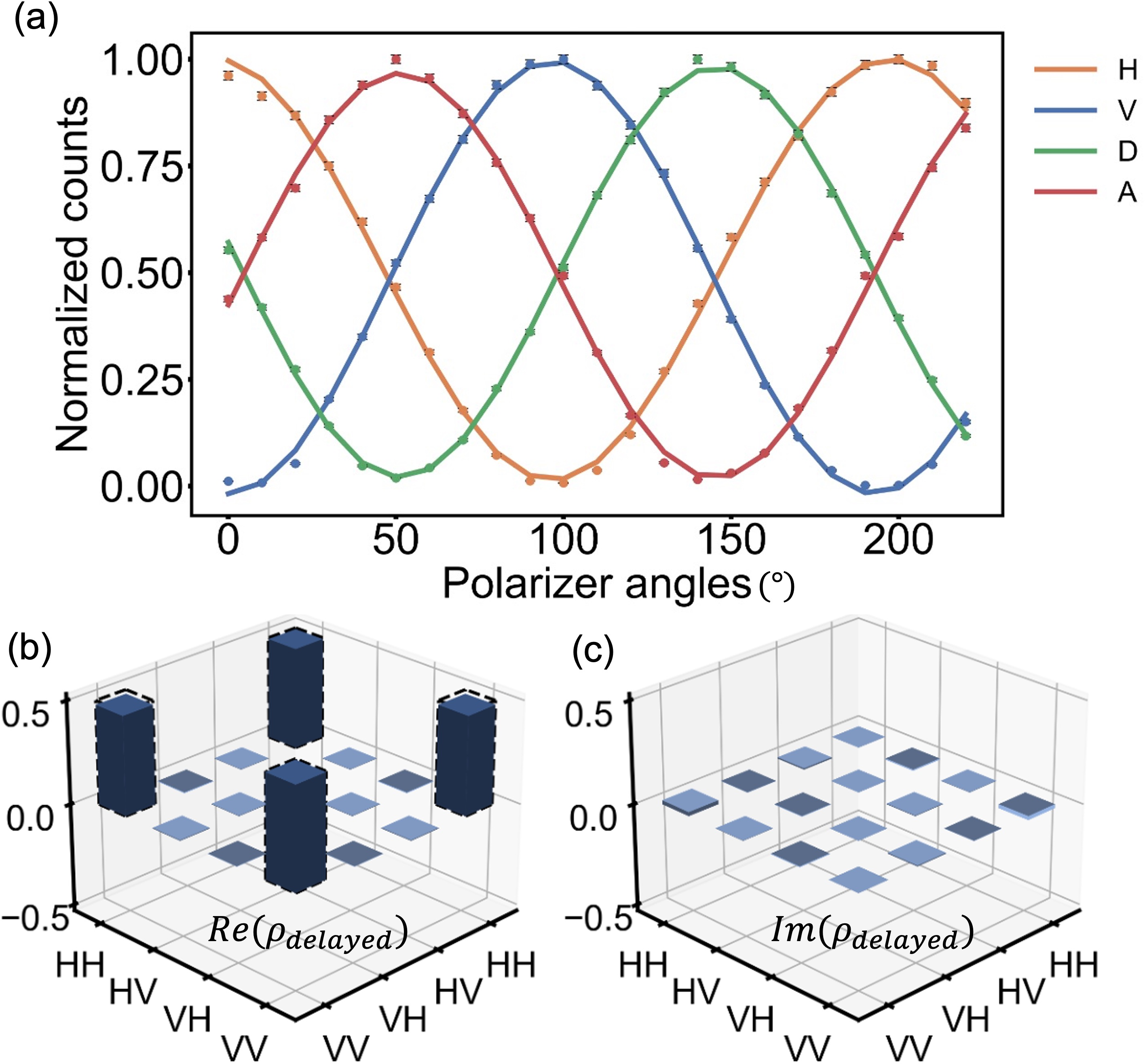
Figure 3: Polarization correlation fringes and density matrix tomography illustrate high-fidelity preservation of polarization entanglement after FSODL delay.
Maximum likelihood quantum state tomography yielded a density matrix fidelity of 94.3(2)%1 between pre-delay and post-delay measurements, with the dominant diagonal and coherence terms confirming retention of Bell state structure. Nonlocality in polarization DOF was validated via CHSH value, with 94.3(2)%2 (pre-delay) and 94.3(2)%3 (post-delay), well above the classical bound.
Implications and Future Directions
The results represent a strong validation for deploying FSODL architectures as delay-based photonic quantum memories, offering compatibility with complex multi-DOF states and enabling synchronization, multiplexing, and adaptive routing in quantum networks. The all-reflective, broadband optical design supports scalable integration with low-loss optical switching for actively controlled storage and retrieval, addressing probabilistic photon arrival and network timing [guo2026highly]. Preservation of energy-time and polarization entanglement under delay conditions directly supports high-dimensional time-bin encoding schemes, multiplexed quantum key distribution, and multi-node quantum networking.
Theoretical implications include potential extension toward higher-dimensional hyperentanglement (e.g., polarization–orbital angular momentum), deployment in quantum repeater protocols, and integration with field-deployed fiber/FSODL hybrid quantum memories [wang2022field, fook2024fiber]. Practically, the FSODL enables robust multi-DOF entanglement transmission at room temperature and ultra-broad bandwidth, bypassing limitations inherent to solid-state storage.
Conclusion
This paper demonstrates that nested Herriott cell-based FSODL reliably preserves both polarization and energy-time entanglement in photonic hyperentangled states following a fixed time delay. The high visibilities, fidelities, and Bell violations indicate minimal decoherence and disturbance, confirming its suitability for advanced quantum networking and memory tasks. Continued development toward fast, low-loss switching and integration with quantum protocols will broaden the practical utility of FSODL-enabled architectures for scalable quantum information processing and communication.