Dual wavelength source of entanglement for space quantum communication
Published 21 May 2026 in quant-ph | (2605.22339v1)
Abstract: We report the demonstration of a bulk, intrinsically phase-stable source of polarization- and time-energy-entangled photon pairs at 810nm and 1550nm, directly coupled into single-mode optical fibers. This highly non-degenerate wavelength combination is well suited for hybrid quantum communication networks, enabling low-loss transmission in optical fibers at 1550nm while maintaining efficient free-space propagation and detection at 810nm. The source is based on spontaneous parametric down-conversion in a periodically poled lithium niobate crystal embedded in a polarization Sagnac interferometer, providing inherent stability and dual-degree-of-freedom entanglement. We measure a spectral brightness of B = 4800 pair/s/mW/GHz, with fiber coupling efficiencies exceeding 0.48 at both wavelengths. The entanglement quality is characterized by high-visibility two-photon interference, yielding net visibilities of 0.995 in the polarization basis and 0.991 in the energy-time basis. These performances demonstrate a compact and robust entanglement source compatible with hybrid fiber/free-space quantum key distribution architectures, and suitable for future ground-to-satellite quantum communication links.
The paper introduces a dual-degree-of-freedom entanglement source based on a polarization Sagnac interferometer using a PPLN crystal.
The system achieves high visibilities (above 99%) in both polarization and energy-time bases with heralding efficiencies up to 55%.
The design supports hybrid quantum links by seamlessly coupling 810 nm free-space photons and 1550 nm fiber photons, enabling robust QKD.
Dual-Wavelength Entanglement Source for Hybrid Space-Fiber Quantum Networks
Introduction
The implementation of scalable quantum networks requires sources producing entangled photon pairs at disparate wavelengths, suitable both for low-loss optical fiber transmission and for robust free-space propagation and detection. The work reported in "Dual wavelength source of entanglement for space quantum communication" (2605.22339) addresses this gap by realizing a bulk, intrinsically phase-stable, dual-degree-of-freedom entanglement source based on a polarization Sagnac interferometer with a periodically poled lithium niobate (PPLN) crystal. The system generates entangled photon pairs at 810 nm and 1550 nm, directly coupled to single-mode optical fibers, targeting interoperability between terrestrial fiber networks and free-space (including ground-to-satellite) quantum links. The source produces high-quality polarization and energy-time entanglement simultaneously, with metrics optimized for hybrid QKD deployments.
Source Design and Implementation
The core architecture utilizes a single-frequency 532 nm laser, polarization-controlled and mode-filtered, to pump a 10 mm-long MgO: PPLN crystal embedded in a Sagnac interferometer. Phase matching is obtained at 80.1°C for the targeted SPDC process yielding 810 nm (signal) and 1550 nm (idler) photon pairs. The Sagnac loop—enabled by an achromatic periscope, Glan-Thomson polarizer, and dichroic mirrors—ensures inherent passive phase stability and spatial indistinguishability, facilitating simultaneous generation of polarization and energy-time entanglement.
The dual outputs are efficiently injected into standard single-mode fibers (SMF-28 for telecom, 780HP for visible), achieving heralding efficiencies of 48% (1550 nm) and 55% (810 nm), a direct result of focusing parameter optimization. The resultant biphoton state is hyperentangled:
Brightness, Coincidence-to-Accidental Ratio, and Bandwidth
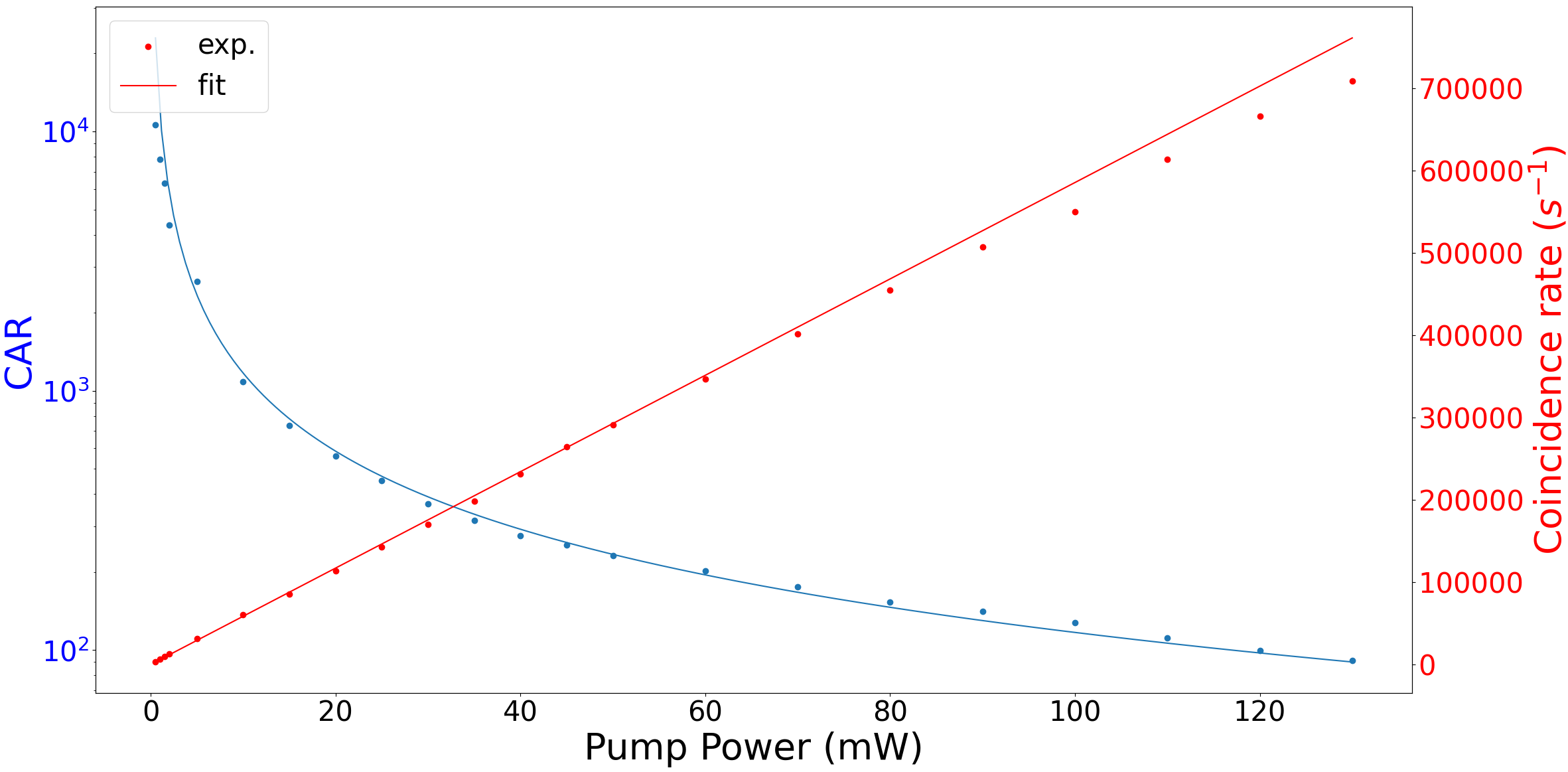
The photon pair spectral brightness is 4.8×10³ pairs·s−1mW−1GHz−1. The 1550 nm photons have a measured bandwidth of 2.3 nm (290 GHz); the signal photons at 810 nm inherit the same spectral width in frequency, yielding a 0.63 nm bandwidth. The stringent performance in low accidental to true coincidence ratio (CAR) is maintained across the full range of available pump powers: for a maximum of 125 mW, accidental coincidences constitute only 1.1% of total counts.
Figure 1: Coincidence-to-accidental ratio and coincidence rate as functions of pump power, with CAR inversely scaling with pump intensity.
This control of multiphoton events is crucial for suppressing QBER in entanglement-based QKD protocols, securing the linkage between source characteristics and secure transmission rates.
Degree-of-Freedom Entanglement Quality
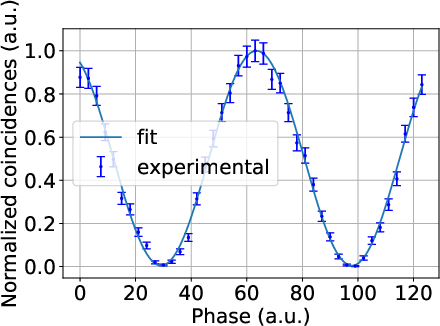
Energy-Time Entanglement: Characterized via a Franson-type interferometric setup, the system demonstrates a two-photon interference visibility of 99.1% at 35 mW pump power.
Figure 2: Energy-time entanglement interference fringes from the Franson experiment, indicative of near-perfect two-photon coherence.
The interferometers’ free spectral range (2.5 GHz) ensures adequate filtering relative to the single-photon bandwidth and is much broader than the pump laser bandwidth, guaranteeing negligible pump-induced frequency correlations and phase drifts. Such performance is at the threshold of closing the detection loophole for Bell tests in energy-time observables.
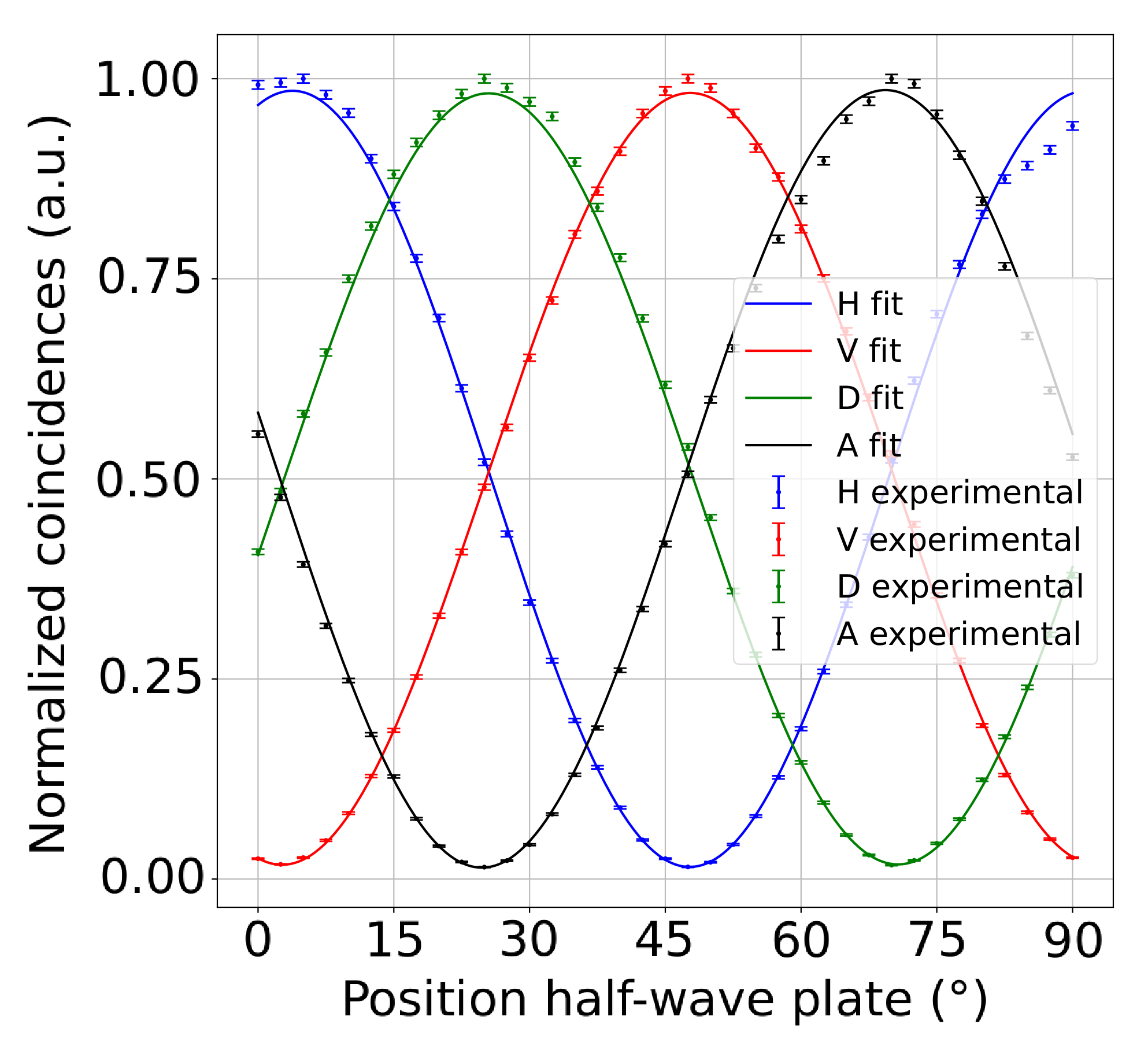
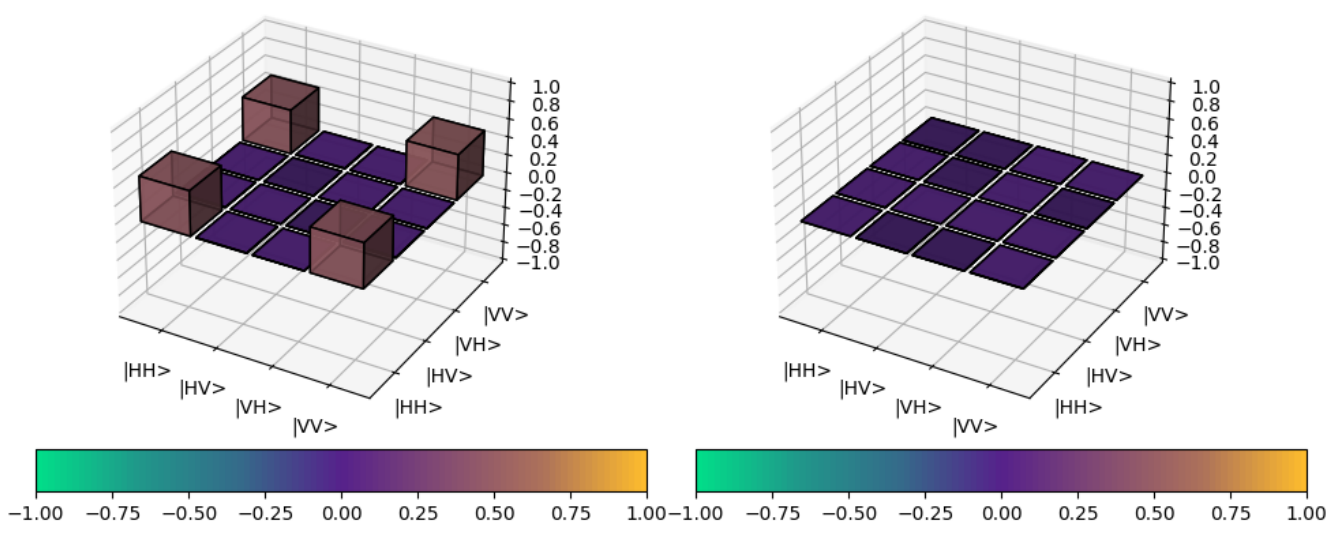
Polarization Entanglement: Polarization state characterization yields visibilities of 99.5±0.1% (H/V basis) and 99.3±0.1% (D/A basis). Full quantum state tomography produces a reconstructed density matrix with a purity of 98.1% and a fidelity of 99% to the maximally entangled Bell state ∣Φ+⟩.
Figure 3: Top: Polarization visibility fringes for H, V, D, A projections. Bottom: Real and imaginary components of the reconstructed two-photon polarization density matrix.
The limitations are attributed solely to alignment uncertainties and waveplate errors; no evidence suggests decoherence originating in the source architecture or bulk nonlinear medium.
Hybrid Link Applicability and QKD Simulation
The dual-wavelength, hyperentangled source architecture is matched to hybrid links composed of a free-space segment (2.5 km, 810 nm) connecting to a fiber segment (50 km, 1550 nm). Simulating system loss (15 dB per segment), both SKR and QBER are modeled as functions of pump power. The data predict a QBER in the optimal Z basis saturating at 5% for pump powers near 900 mW, with experimental hardware currently achieving secure key rates exceeding 100 bps even at lower pump settings. This offers practical validation for ground-to-satellite QKD and integrated metro-scale/freespace quantum networking experiments, and ties the source's internal statistics directly to end-to-end link performance.
Implications and Future Directions
The demonstrated architecture, with its intrinsic phase stability, high heralding efficiency, and robust performance in both primary entanglement observables, is directly suitable for deployment in hybrid quantum networks. The modularity and small physical footprint (1 m2 breadboard) enhance its suitability for transport and fielded scenarios, including ground station/satellite interfacing. While the current brightness is limited by the bulk nonlinear crystal, adoption of thin-film lithium niobate platforms is projected to enhance brightness by over two orders of magnitude, as reported in related recent demonstrations, without compromising entanglement quality.
The results validate the practical utility of bulk Sagnac-type sources in intermediate QKD distances and highlight clear paths forward for scaling brightness while maintaining phase stability and wavelength flexibility. System-level analyses that include link dynamics, real-time loss, synchronization, and security constraints are the logical next step. Integration of advanced sources with real quantum network testbeds will further clarify practical thresholds and trade-offs.
Conclusion
This work establishes a dual-degree-of-freedom, dual-wavelength entanglement source leveraging a bulk Sagnac interferometer with a periodically poled lithium niobate crystal. The source achieves high heralding efficiency (up to 55%), polarization and energy-time visibilities exceeding 99%, and state purity/fidelity at the top of the field. The architecture directly supports hybrid quantum link deployments connecting fiber and free-space channels, and experimental results affirm suitability for entanglement-based QKD across high-loss links. Future improvements in brightness and integration of thin-film nonlinear platforms have strong potential to expand both transmission rates and application spaces for space-based and terrestrial quantum communication networks.
“Emergent Mind helps me see which AI papers have caught fire online.”
Philip
Creator, AI Explained on YouTube
Sign up for free to explore the frontiers of research
Discover trending papers, chat with arXiv, and track the latest research shaping the future of science and technology.Discover trending papers, chat with arXiv, and more.