- The paper introduces dissipative protocols employing continuous-time Lindbladian and discrete quantum channel dynamics to uniquely prepare injective tensor network states.
- It demonstrates rapid mixing and robust convergence from arbitrary initial states, achieving state preparation in logarithmic time relative to system size.
- The study highlights practical benefits for quantum simulation, error correction, and scalable state engineering across analog and digital quantum devices.
Dissipative Preparation of Injective Tensor Network States
Introduction
The efficient preparation of tensor network states is essential in quantum simulation, variational quantum algorithms, quantum error correction, and quantum metrology. Matrix Product States (MPS) and their higher-dimensional generalization, Projected Entangled Pair States (PEPS), provide an efficient representation of complex many-body entangled states through local tensors, supporting crucial applications in the simulation and control of quantum systems. Despite the efficacy of tensor networks in state description, their preparation on quantum platforms remains challenging: the relevant tensors do not directly correspond to physically implementable unitary gates. Existing approaches based on quantum circuits, adaptive measurement, or adiabatic evolution are limited in robustness and scalability, particularly in higher dimensions and for general graph topologies.
This work presents rigorous, efficient protocols for preparing injective tensor network states using engineered dissipation—both in continuous-time (Lindbladian dynamics) and discrete-time (quantum channels)—that are robust to initialization errors and exhibit rapid mixing properties. The schemes uniquely target the desired tensor network as the sole steady state in time scaling logarithmically with system size under realistic assumptions, yielding exponential or polynomial improvements over prior dissipative and unitary protocols for a wide class of injective MPS and highly injective PEPS.
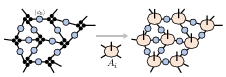
Figure 1: Projected entangled pair state (PEPS) on an arbitrary graph, constructed from local tensors with one physical and several virtual indices.
Tensor Network State Construction and Injectivity
The formalism considers PEPS defined on arbitrary bounded-degree graphs G=(V,E), where N=∣V∣ and each vertex hosts a local tensor Ai. Entangled pairs of dimension D are placed on each edge, and the local tensors act on the virtual indices from incident edges into the physical space of dimension d. The injectivity condition requires every Ai to be invertible on its range, ensuring that the PEPS is the unique ground state of a frustration-free parent Hamiltonian and satisfies an entanglement area law. Injective tensor network states encapsulate typical states in tensor-network space and are paradigmatic for non-topological gapped Hamiltonians.
Dissipative Preparation Protocols
Continuous-Time Lindbladian Construction
The first protocol constructs a local Lindbladian L whose unique steady state is the injective tensor network. Each term of the Lindbladian consists of (i) single-site dissipators that project the local state into the correct physical subspace and (ii) two-site dissipators which drive the local state into the correct entangled-pair configuration, effectively undoing and re-applying local tensors to enforce pairwise projections. The spectrum of L is shown to have no other purely imaginary eigenvalues, excluding nontrivial steady states or persistent oscillations, guaranteeing convergence to the target state independently of initialization.
Mixing Time and Rapid Mixing Results
A central result is that under a high-injectivity condition (quantified by δ=maxi∥Ai†Ai−I∥ below a graph-dependent threshold), both the Lindbladian and the discrete channel constructions exhibit rapid mixing. For all injective MPS, even not initially highly injective, this condition can always be achieved by blocking a constant number of sites, as shown via an explicit construction. For highly injective PEPS, preparation time to trace-norm error ε is N=∣V∣0, which is exponential improvement over previous dissipative protocols (N=∣V∣1 for MPS [verstraete2009quantum]), and matches the scaling of optimal local quantum circuit constructions [malz2024], but with strictly enhanced robustness.
For PEPS in higher spatial dimensions or on general bounded-degree graphs, the protocol yields either polynomial or exponential speedup over state-of-the-art unitary methods for state preparation (adiabatic or circuit-based), specifically scaling polynomially in N=∣V∣2 for geometric lattices and logarithmically for expander graphs, conditions under which unitary methods are otherwise polylogarithmic or worse [Ge_2016].
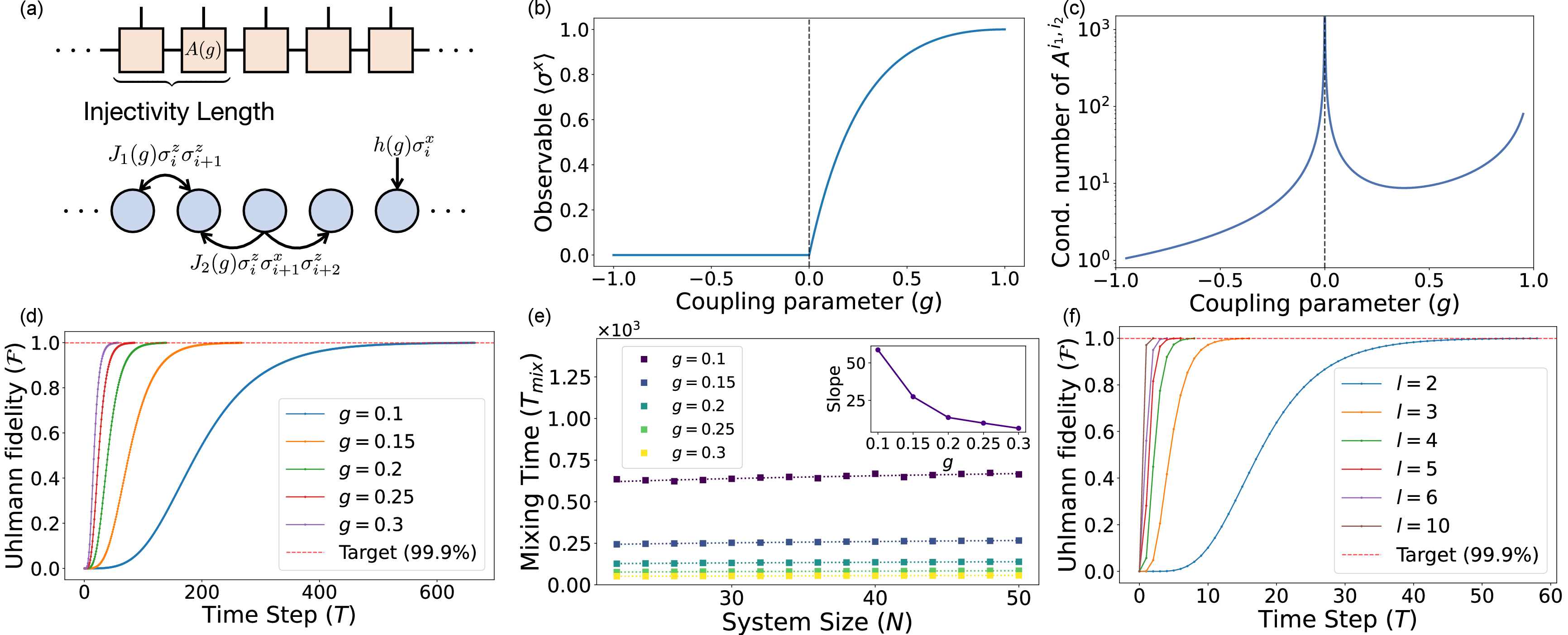
Figure 2: (a) Schematic of the 1D local chain showing parent Hamiltonian interactions. (b) Magnetization N=∣V∣3 vs. coupling N=∣V∣4, with a quantum phase transition at N=∣V∣5. (c) Tensor condition number diverges at criticality, indicating loss of injectivity. (d–f) Numerical results confirm exponential convergence in fidelity and logarithmic mixing time scaling over the system size even near phase transitions.
Discrete-Time Quantum Channel Protocol
A parallel discrete-time protocol defines a sequence of geometrically local quantum channels using local Kraus operators analogous to the Lindblad jump operators. Edge partitioning by graph coloring ensures that non-overlapping edge channels can be applied in parallel, minimizing circuit depth and facilitating implementation on digital quantum devices. The discrete protocol is constructed to have the same unique fixed point as the continuous Lindblad generator and, crucially, inherits the rapid mixing properties under the same injectivity thresholds.
Numerical experiments on translationally invariant MPS families reveal that the discrete channel achieves logarithmic scaling of mixing time with system size and is empirically robust even when the theoretical high-injectivity requirement (N=∣V∣6) is violated, e.g., close to quantum phase transitions where tensors become nearly singular (condition number diverges). These results provide strong evidence for the practical applicability of the protocol well beyond strict theoretical constraints.
Implications, Robustness, and Future Directions
The dissipative protocols introduced here fundamentally alter the regime of feasible tensor network state preparation, offering unique advantages:
- Robustness to Initialization and Device Noise: Rapid mixing guarantees convergence from arbitrary initial states and resilience to local noise and model errors [cubitt2015stability].
- Drastic Runtime Improvements: Time complexity for preparing injective MPS or highly-injective PEPS is exponentially or polynomially improved over the best available dissipative and unitary methods, especially for non-geometric graphs.
- Hybrid Analog-Digital Applicability: Both continuous and gate-based schemes are covered, making the protocol relevant for analog quantum simulators, noisy intermediate-scale quantum (NISQ) processors, and error-corrected architectures.
- Scalability to Arbitrary Graphs: The preparation time depends only logarithmically or polylogarithmically on system size and is insensitive to geometric constraints so long as degree remains bounded—critical for e.g., quantum LDPC code states [breuckmann2021ldpc, hastings2021ldpc].
Practical implementation avenues include superconducting qubits with engineered dissipation, cold atoms with tunable interactions, and solid-state spin arrays. Theoretically, extensions to non-injective and topologically ordered PEPS, general matrix product density operators, and integration with fault-tolerant error correction and measurement-based feedback are natural directions.
Conclusion
This work establishes provably efficient dissipative protocols—both Lindbladian and discrete-channel—for preparing injective tensor network states with unique rapid-mixing properties and logarithmic-time convergence across broad classes of graphs. The approach yields exponential or polynomial speedups over previous methods and imparts inherent noise resilience vital for scalable quantum simulation and computation.
The main open challenges include extending the analysis to non-injective PEPS and generalizing the class of quantum many-body states amenable to such dissipative preparation, as well as optimizing circuit architectures for concrete hardware platforms. The protocols developed here provide a foundation for robust and scalable quantum state engineering required by next-generation quantum technologies.
(2605.25089)

