- The paper demonstrates a novel dissipative protocol using engineered auxiliary atoms to prepare correlated quantum states in dipolar arrays.
- It utilizes energy-selective, nonreciprocal transitions via 'source' and 'sink' atoms to robustly stabilize both ground and excited states.
- Numerical simulations and spectral filtering validate the method’s scalability and its applicability to various many-body quantum systems.
Introduction and Motivation
The paper "Dissipative Preparation of Correlated Quantum States in Dipolar Rydberg Arrays" (2604.18542) addresses the persistent challenge of quantum state preparation in many-body systems. Conventional adiabatic state preparation protocols suffer from limitations associated with phase transitions, gaps, and heating, particularly in programmable quantum platforms such as Rydberg atom arrays. The authors introduce a dissipative protocol leveraging engineered energy-selective, nonreciprocal transitions via auxiliary "source" and "sink" atoms. The protocol enables robust stabilization of ground and excited states across the many-body spectrum without requiring explicit knowledge of the system Hamiltonian. This represents a scalable pathway for quantum state engineering, with direct relevance to emerging quantum technologies.
Protocol Architecture and Theoretical Foundation
At the core of the protocol is a dissipation engineering scheme wherein two classes of auxiliary atoms are optically addressed to serve as nonreciprocal channels for excitation (source) and de-excitation (sink) of system particles. The auxiliary atoms are coupled to the many-body system through resonant and detuned dipolar interactions. Their transition frequencies are dynamically controlled with local AC Stark shifts, allowing the system to perform a directed walk in Hilbert space toward desired target states. The auxiliary dissipation is implemented by coupling Rydberg states to short-lived intermediate levels producing tunable decay rates, thereby enforcing irreversibility and directionality.
In the rotating frame defined by the critical energy ωc, transitions below ωc are selectively driven by source atoms, while those above are dominated by sinks. This arrangement induces a flow that minimizes the effective energy
Enrot=λn−nωc
across particle number sectors, with the optimal filling determined variationally. Crucially, the framework is agnostic to the underlying many-body Hamiltonian, as the energy-selective process does not require spectral knowledge.
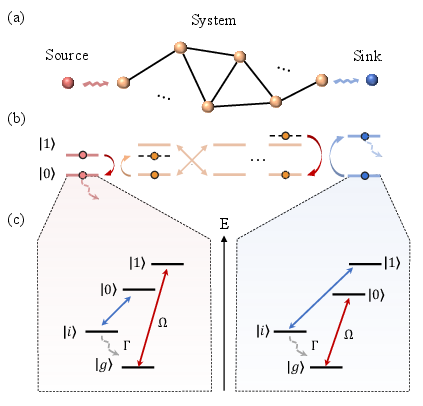
Figure 1: Engineered dissipation protocol: Source and sink atoms act as excitation and de-excitation channels, with state-selective decay and optical control enabling energy-resolved transitions.
Dissipative Ground-State Preparation
Ground-state stabilization proceeds via spectral engineering of auxiliary detunings. By controlling the detuning coverage of source and sink atoms, transitions are energetically filtered, so that the system probabilistically flows to the ground state at a targeted particle filling. The protocol supports two operational modes: slow rastering of detuning for a single auxiliary or static dispersion among multiple auxiliaries, the latter offering improved preparation efficiency.
Numerical simulations in a hexagon dipolar XY model validate protocol efficacy. Fidelity evolution demonstrates rapid convergence to the ground state at desired fillings (n=1,2,3), with auxiliary dispersion accelerating convergence. The protocol generalizes to fermionic and bosonic Hamiltonians, including fractional quantum Hall-like states.
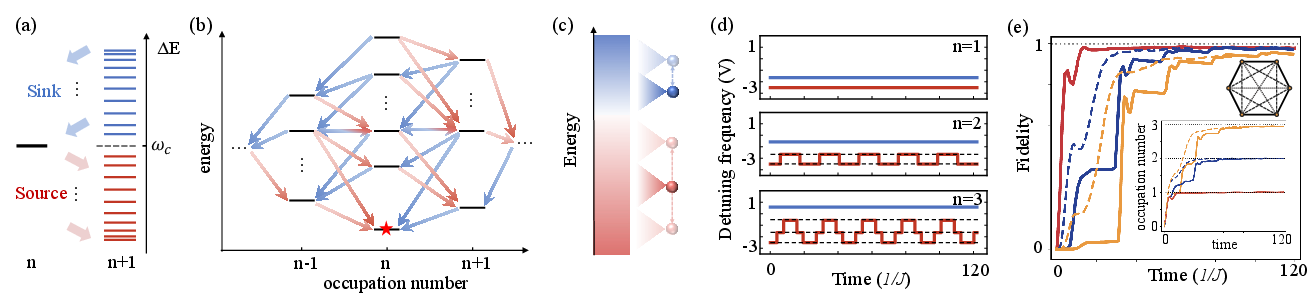
Figure 2: Dissipative ground-state preparation: Energy-selective pumping and depumping (a), auxiliary detuning protocols (c–d), and fidelity/time evolution for different fillings (e).
Stabilization of Excited and Non-Ground States
The protocol extends beyond ground-state preparation to stabilization of excited many-body states. By inverting or tailoring the spectral coverage of source and sink auxiliaries, intermediate energy windows can be targeted. Bidirectional spectral filtering directs the system dynamics toward selected windows, enabling stabilization of non-ground steady states.
For quadratic models, excitation and de-excitation can be analyzed in quasiparticle basis. For generic interacting systems, numerical trajectories reveal successful targeting of distinct excited states. This capability enables investigation of spectral structure, ETH, many-body localization, and mobility edges in complex systems.
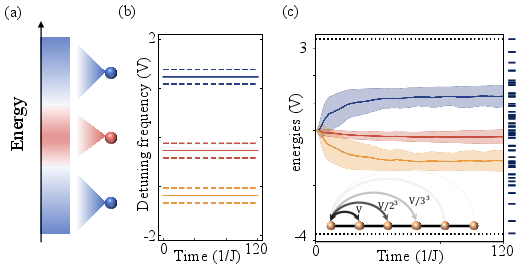
Figure 3: Dissipative preparation of non-ground steady states: Spectral filtering of auxiliary detunings and engineered trajectories targeting intermediate excited-state windows.
Experimental Feasibility and Implications
State-selective dissipation is engineered optically by coupling Rydberg states to rapidly decaying intermediate levels, compatible with single-species or multi-species arrays via local optical addressing or Förster resonance. Detuning ranges and temporal modulation are implemented with spatially resolved AC Stark shifts. Auxiliary geometries are flexible: planar embedding, layered arrangements, or multi-strip configurations are feasible.
The protocol is broadly adaptable, not only to Rydberg arrays, but also polar molecules and dipolar spins in solids. It translates to programmable architectures supporting excitation-exchange interactions, including trapped ions (with motional cooling). Its relevance is compounded by the capability to prepare states robust to Floquet heating and criticality, supporting scalable quantum simulation.
Conclusion
This work presents a scalable, flexible dissipative stabilization protocol for correlated quantum state preparation in dipolar spin systems. Auxiliary "source" and "sink" atoms implement energy- and direction-selective population transfer, enabling robust ground and excited state engineering without a priori spectral knowledge. The approach generalizes across quantum platforms, providing broad access to many-body phenomena including localization, thermalization, and non-equilibrium dynamics. Its implications span both practical quantum technology and foundational studies in quantum statistical mechanics.

