- The paper demonstrates that CAPES significantly improves forecast skill by integrating high-resolution numerical simulations with AI ensemble expansion across 1-km to 15-km scales.
- The study details a three-level parallelization and memory optimization strategy on the exascale LineShine supercomputer to enhance computational efficiency.
- The approach yields marked improvements in operational flood forecasting, achieving up to 8.52× speedup and establishing systematic scaling laws for ensemble performance.
Exascale Hybrid Numerical-AI Ensembles for Flood-Season Forecasting in East Asia
Scientific Motivation and Problem Definition
Skillful operational flood-season forecasting is a central challenge for hydroclimate risk management in East Asia, owing to the spring predictability barrier, weak large-scale signals at 3-6 month lead times, and nonlinear convective extremes. The 2020 Yangtze floods highlighted the limitation of current state-of-the-art numerical ensembles, notably the systematic underestimation and poor reliability of high-precipitation events by ECMWF-SEAS5. Addressing this requires a coupled regional ESM with high resolution and physically realistic multi-sphere dynamics, but also scalable ensemble capability to quantify regional risks and extremes.
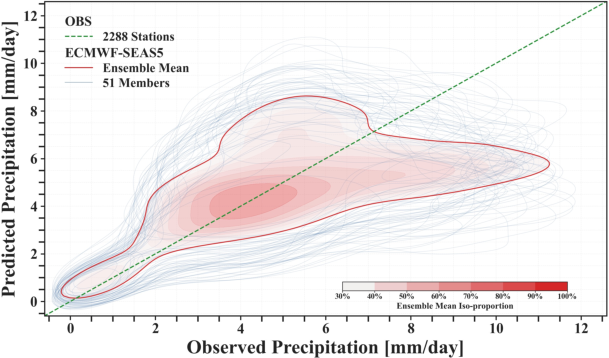
Figure 1: Comparison between observed and ECMWF-SEAS5 hindcast summer precipitation in 2020, showing systematic ensemble mean underestimation for extreme precipitation.
CAPES Hybrid Forecasting System Architecture
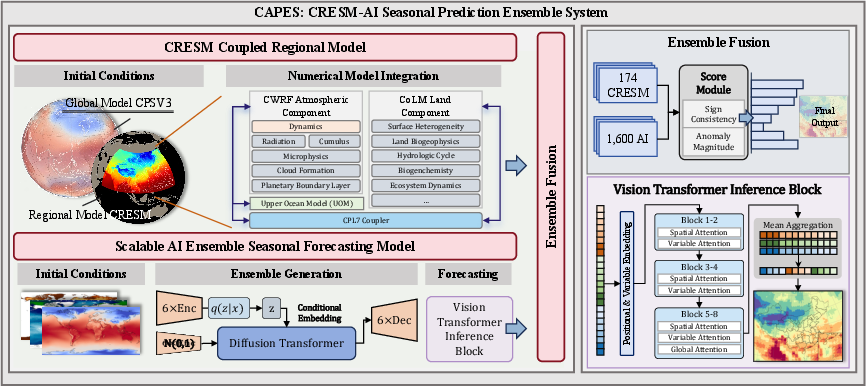
CAPES (CRESM-AI Seasonal Prediction Ensemble System) is designed to fuse kilometer-scale physical simulation with scalable AI ensemble generation. The workflow integrates:
This architecture targets scaling physical fidelity, ensemble size, and throughput simultaneously, leveraging the exascale LineShine supercomputer.
Numerical Model Optimization and Parallelization
CRESM leverages ARW-based nonhydrostatic dynamics and advanced land-surface parameterization. To fully utilize LineShine's 304-core processors and SVE/SME vectorization, a three-level parallelization is implemented:
- MPI domain decomposition;
- Thread-level workload partitioning with vendor-specific pthreads;
- SIMD vectorization through SVE/SME intrinsics.
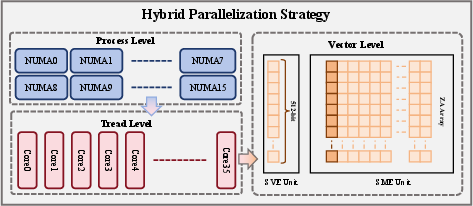
Figure 3: Three-level hybrid parallelization strategy for CRESM on LineShine, mapping domain decomposition, threading, and SIMD.
Global memory layout transformation (single-column vs. multidimensional data alignment) is applied for efficient HBM usage, mitigating cache misses and memory latency.
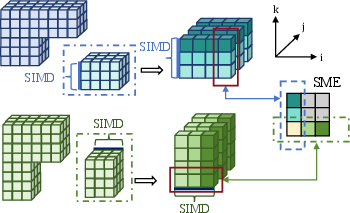
Figure 4: Memory-layout transformation enabling data locality alignment with HBM and vector width in CRESM.
Communication bottlenecks in CWRF's halo exchanges are addressed with topology-aware message routing and computation-communication overlap, using dynamic task queues for latency hiding.
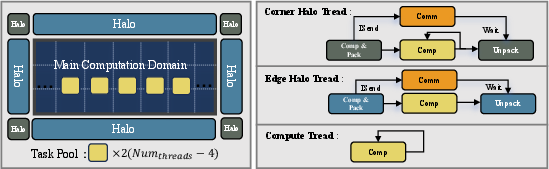
Figure 5: Computation-communication overlap in CWRF, assigning threads to concurrent internal computation and asynchronous halo exchange.
AI Track: Multimodal Ensemble Expansion
The AI module processes day-scale to year-scale reanalysis atmospheric, oceanic, and land data, with a multimodal generative backbone:
- Multi-stream VAEs encode uncertainty in initial conditions;
- Diffusion Transformer samples from latent atmospheric attractor;
- Forecast backbone is a custom tri-level attention ViT, enabling efficient modeling of spatial, inter-variable, and global teleconnections across 777,600-tokens input.
Memory footprint is reduced and throughput increased via sequence-wise variable organization in PCA-compressed input, and SVE/SME optimized operators.
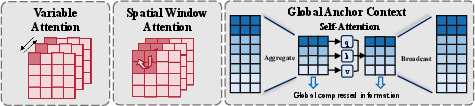
Figure 6: Customized tri-level attention architecture with windowed spatial, cross-variable, and global anchor context for efficient earth system forecasting.
Ensemble Design, Fusion, and Operational System Integration
Numerical members (174) are generated via start dates, physics combinations, and parameter sweeps. AI members (1,600) arise from VAE/DiT initial perturbations and inference-time latent noise. Adaptive fusion combines sign consistency and anomaly magnitude metrics for operational post-processing, yielding a unified probabilistic forecast.
System-level concurrency on LineShine allows full-machine execution modes, mapping both numerical and AI workloads to more than 23,000 nodes.
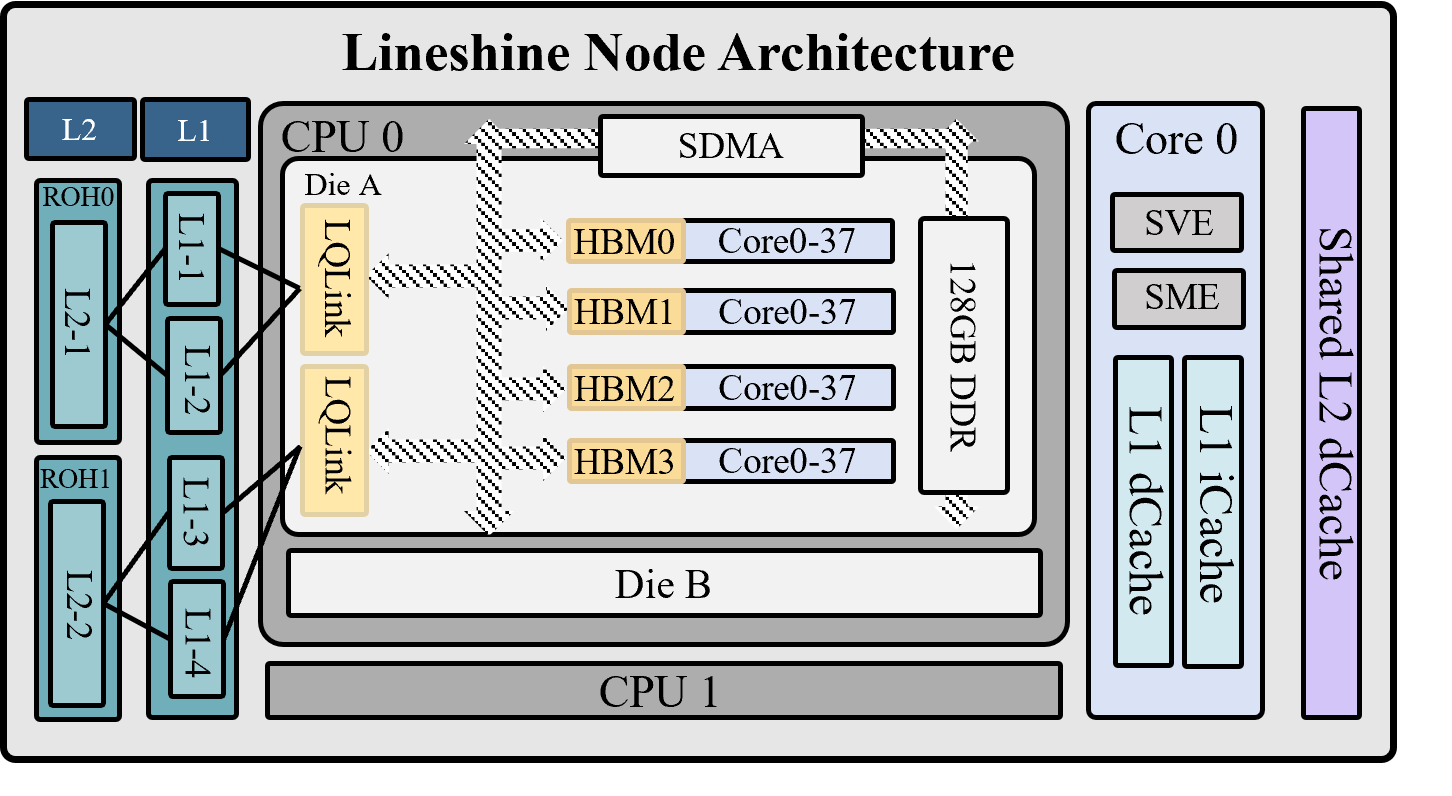
Figure 7: LineShine supercomputer structure supporting concurrency across simulation and AI tasks.
Strong and weak scaling evaluations demonstrate high parallel efficiency for CRESM at 15-km and 1-km, with coupled model attaining 74.2% strong-scaling efficiency at 1-km, enabling six-month 1-km runs in seven days with 512 nodes. Optimization via parallelization, memory layout, communication, and operator vectorization achieves up to 8.52× speedups and substantial reduction in cache misses.
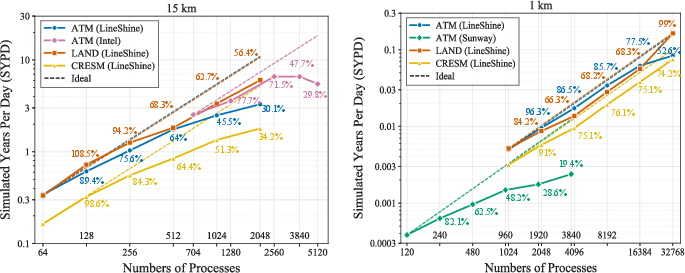
Figure 8: Strong scalability of atmosphere, land, and CRESM coupled models at multiple resolutions on Intel, Sunway, and LineShine.
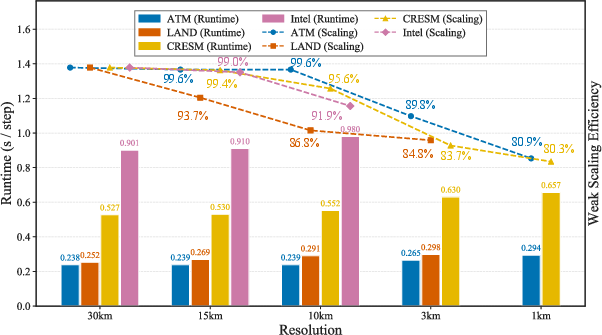
Figure 9: Weak scalability of atmosphere, land, and CRESM coupled model from 30 km to 1 km, confirming efficiency retention across problem scales.
Kilometer-scale Simulation Capability
CRESM at 1-km resolution successfully models extreme weather such as Typhoon Saola, reproducing vortex structure, eyewall, spiral rainbands, and storm trajectory with fidelity matching observations and IMERG data.
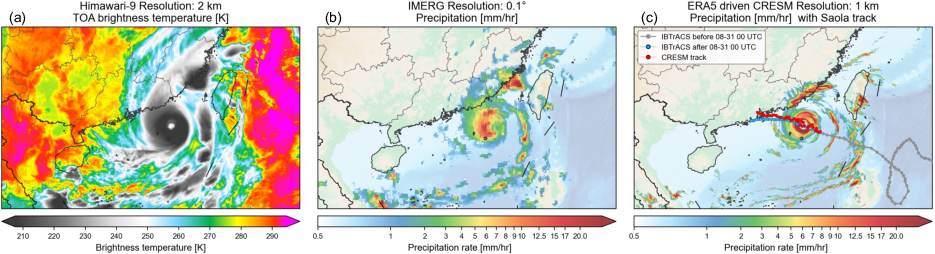
Figure 10: Structures of Typhoon Saola from Himawari-9 satellite, IMERG precipitation, and 1-km ERA5-driven CRESM simulation.
AI Model Effectiveness
Sequence-wise ViT+PCA+Seq. formulation outperforms standard ViT and ViT+PCA in precipitation skill and anomaly correlation, demonstrating the benefit of variable-wise tokenization and tailored attention architectures.
Ten-Year Hindcast Results and Forecast Skill Scaling
Ten-year (2016–2025) hindcasts confirm that the 174-member CRESM ensemble outperforms major operational models. CAPES, with 1,774 members (numerical + AI), further increases mean PS from ECMWF’s 71.8 to 75.9, delivering major gain in skill. Empirical ensemble scaling relationship is established: forecast skill rises systematically with ensemble size at fixed numerical-to-AI member ratios.
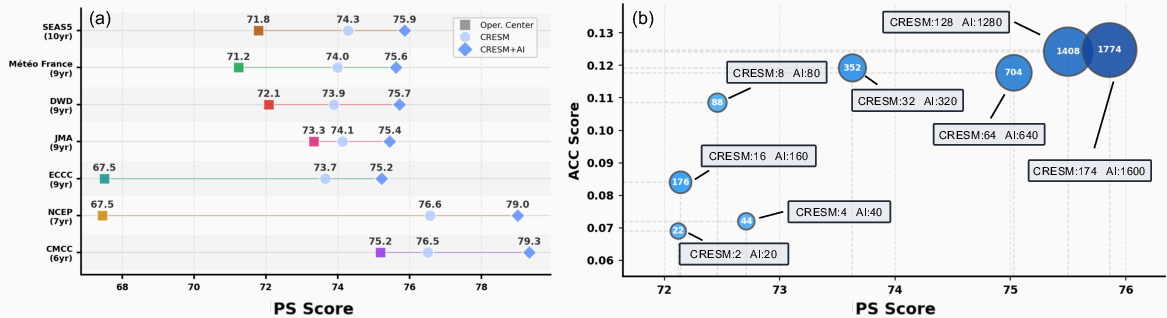
Figure 11: Hindcast skill comparison and scaling with ensemble size between CAPES, CRESM, and operational systems.
Decadal campaigns are executable within 14.6 hours under full-machine concurrency, validating both method iteration speed and scalability.
CAPES forecast for summer 2026 incorporates 1,774 ensemble members for operational delivery to CMA.
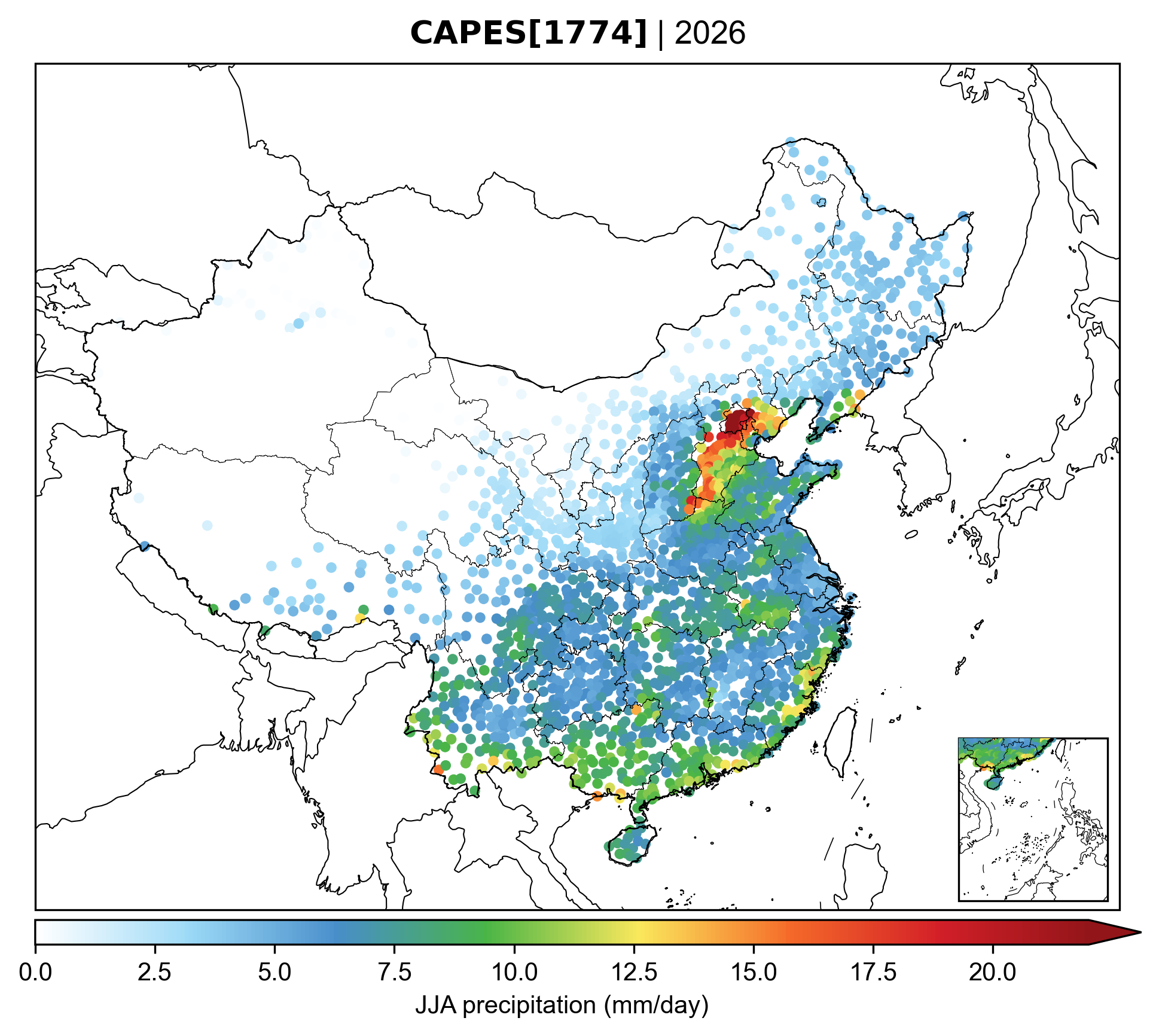
Figure 12: CAPES forecast of summer precipitation in 2026 with full ensemble.
Case studies (e.g., 2020 rainfall) show substantial correction of spatial rainbelt organization and improved anomaly representation versus ECMWF and CRESM alone.
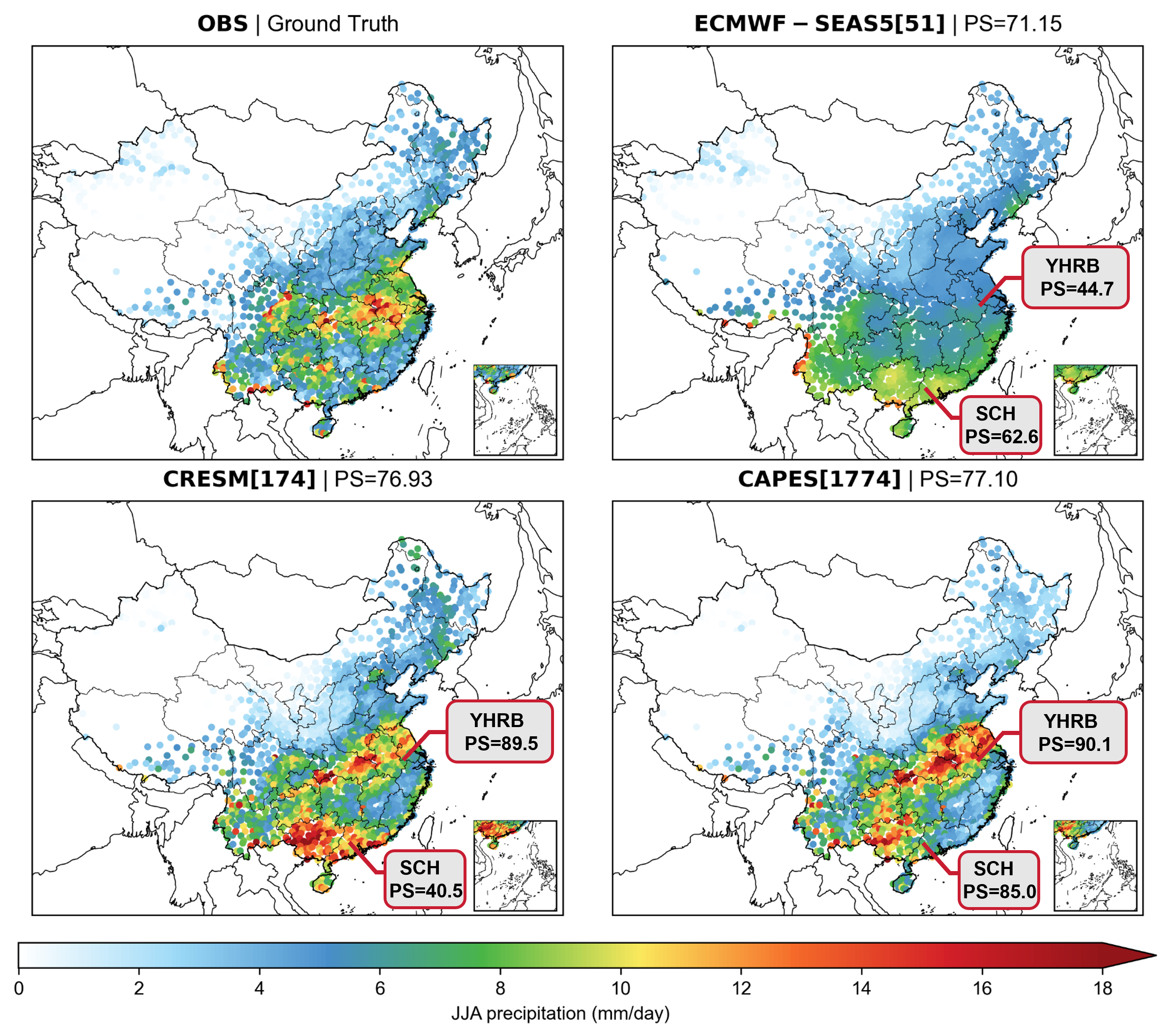
Figure 13: Comparison of summer precipitation hindcasts in 2020 from ECMWF, CRESM, and CAPES against observed rainfall.
Implications and Future Directions
CAPES demonstrates that hybrid numerical-AI workflows, integrated for ensemble fusion and deployed at exascale, relax the traditional constraint among physical fidelity, ensemble size, and operational cost for seasonal flood forecasting. Beyond forecast skill improvement, the approach enables structured uncertainty analysis, causal chain probing, and interpretable science from AI-black-box components. LineShine’s HPC-AI co-driven paradigm illustrates the direction for future scientific software and platforms, generalizable to domains needing fusion of structured simulation and heterogeneous data assimilation.
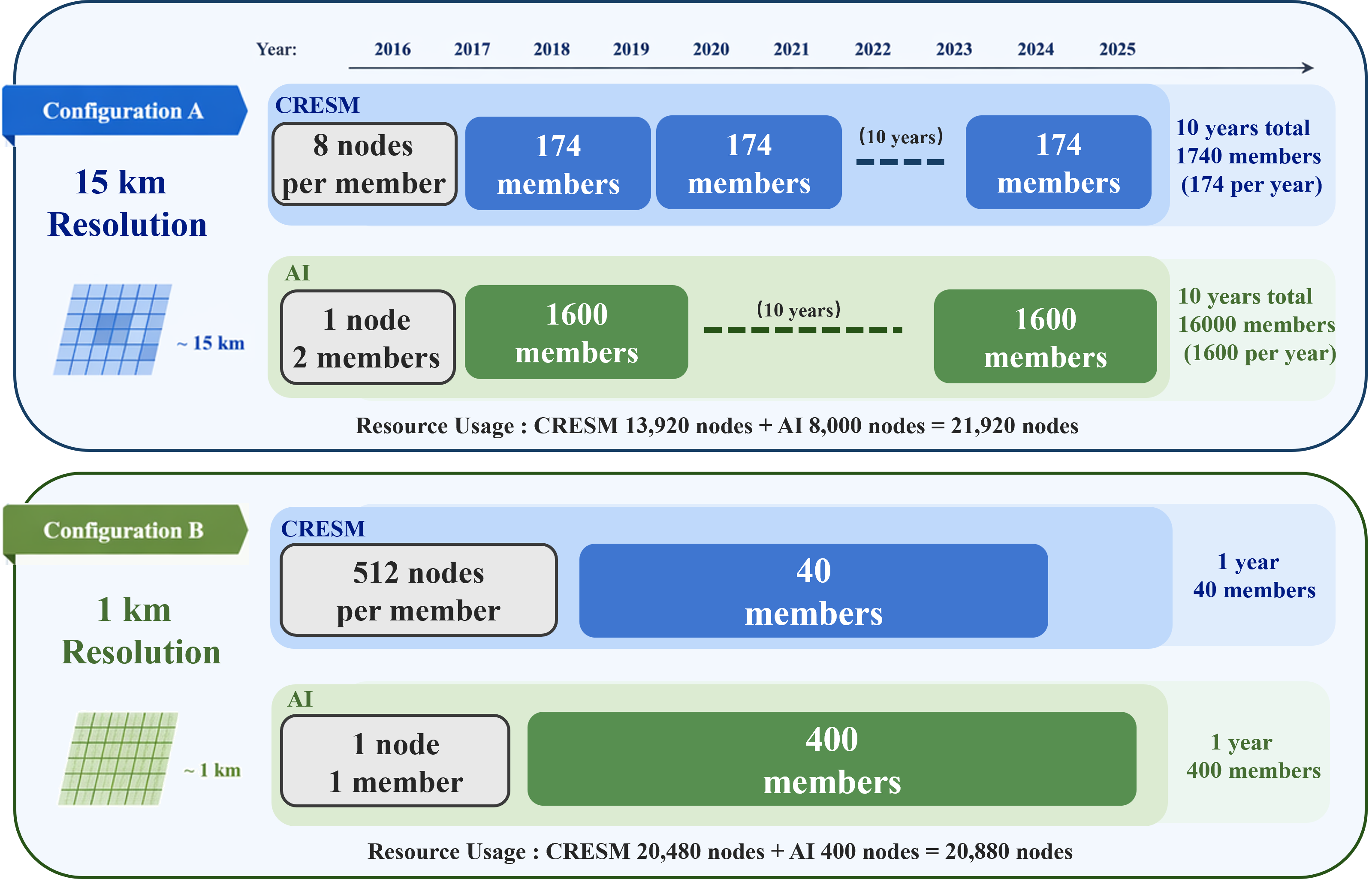
Figure 14: Full-machine concurrent execution modes for decadal and operational forecasting using CAPES on LineShine.
Conclusion
"Exascale Hybrid Numerical-AI Ensembles for Operational Flood-Season Forecasting in East Asia" (2605.24896) presents a technically rigorous, systemically optimized approach to operational flood-season forecasting. By fusing coupled high-resolution physical simulation with AI-driven ensemble expansion, and leveraging exascale computational resources for hybrid workflow concurrency, CAPES attains improved forecast skill, uncertainty quantification, time-to-solution, and regional anomaly fidelity. The results suggest the emergence of practical scaling laws for forecasting capability, as well as broader prospects for accelerated scientific discovery and paradigm shift in Earth system modeling and prediction.