- The paper demonstrates that fine-tuning state-of-the-art SR and T2I diffusion models with native-4K data significantly enhances image fidelity and perceptual quality.
- The dataset is meticulously curated using automated filtering and human inspection, yielding 129,484 diverse 4K images across categories like nature, urban, and CGI.
- Empirical results reveal substantial gains in PSNR and SSIM metrics, establishing 4KLSDB as a critical benchmark for ultra-high-resolution restoration and synthesis.
4KLSDB: A Comprehensive Native-4K Visual Benchmark for Image Restoration and Generation
Motivation and Dataset Construction
The advent of high-resolution imaging demands datasets that match the scale and complexity required for modern restoration and generative models, particularly for tasks such as SR and T2I diffusion. Existing resources, including DIV2K, LSDIR, and DiffusionDB, either lack native-4K resolution, are limited in size, or do not provide paired or captioned data that are essential for benchmarking and training state-of-the-art models. 4KLSDB directly targets these deficiencies by providing a large, diverse, meticulously curated corpus of 129,484 native-4K images spanning nature, urban environments, people, food, CGI, and artwork, with additional validation and test splits for fair assessment.
The dataset construction employs a rigorous multi-stage pipeline combining automated filtering (resolution constraints, quality scoring, texture assessment) and human inspection for final selection. Images are sourced from LAION-2B, Photo Concept Bucket, and PD12M, leveraging both geometric criteria and vision-language annotation to ensure coverage and diversity. Quality control leverages Q-Align for aesthetic scoring, followed by Laplacian and Sobel-based texture analysis to eliminate low-information and artifact-prone samples, culminating in manual vetting for residual errors.
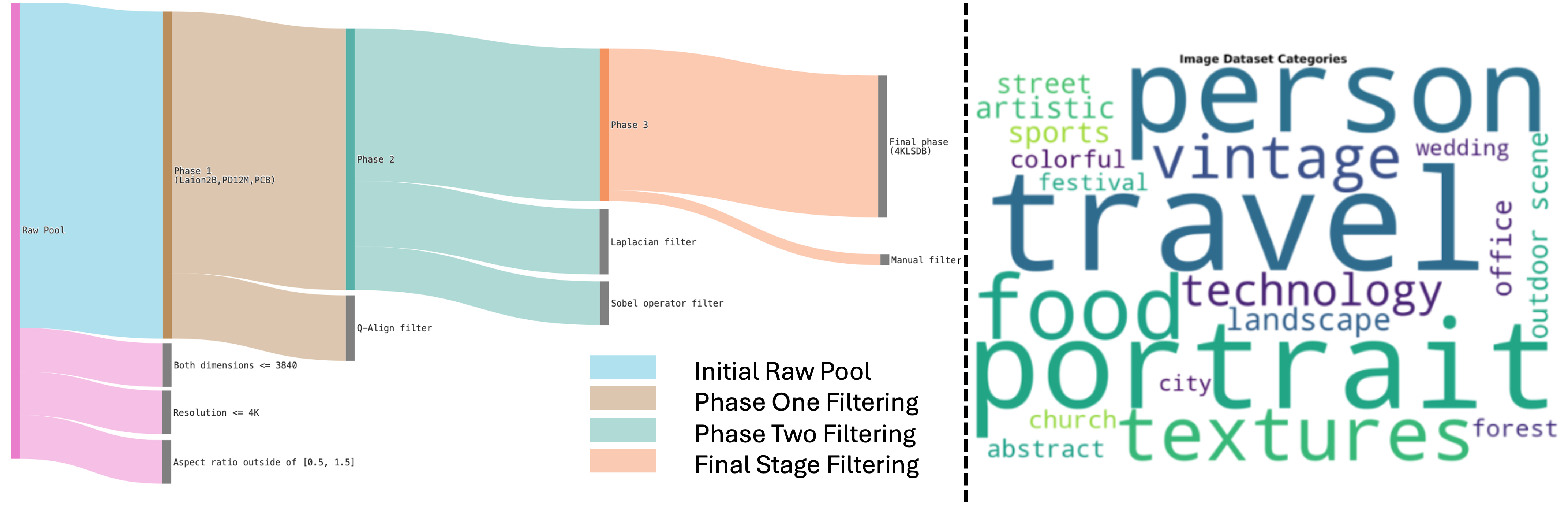
Figure 1: The 4KLSDB pipeline progressively refines a raw image pool with automated filters and manual inspection, achieving high dataset quality and balanced category representation.
Benchmarking: Super-Resolution and Text-to-Image Generation
Classical and Real-World Super Resolution
Robust evaluation is performed with leading SR architectures—HiT-SR, SwinIR, and MambaIR—at upscaling factors {×4,×8,×16}. Fine-tuning these models on 4KLSDB yields consistent gains across PSNR and SSIM metrics relative to traditional lower-resolution datasets. For HiT-SR, improvements are substantial: e.g., PSNR increases by +4.77 dB for ×4 and +4.22 dB for ×16 on 4KLSDB, and similar trends are seen cross-domain on DIV8K. SwinIR and MambaIR also exhibit marked improvements, confirming the value of native-4K priors for high-frequency detail reconstruction and generalization outside the training distribution.
For real-world blind SR, OSEDiff and SeeSR are employed using a scale-guided hyper-network degradation pipeline. Fine-tuning with 4KLSDB improves both distortion-oriented (PSNR, SSIM) and perceptual metrics (LPIPS, DISTS, FID). For SeeSR, PSNR increases from $27.009$ to $28.249$ at ×4, while LPIPS and FID decrease, indicating improved structural fidelity and realism under challenging degradations.
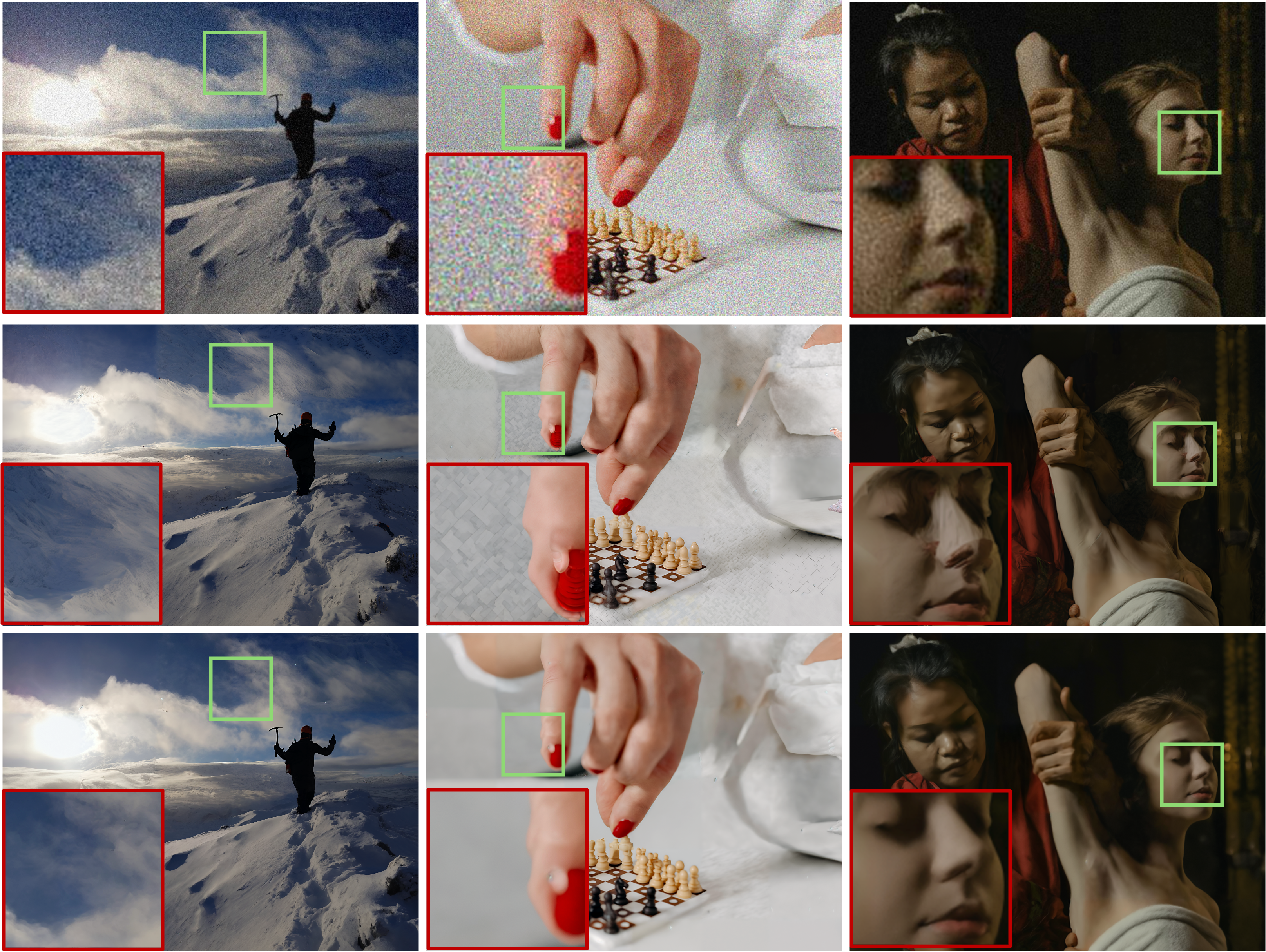
Figure 2: SeeSR fine-tuned on 4KLSDB recovers sharper structures and more realistic textures compared to the baseline, with improvements highlighted in critical regions.
Ultra-High-Resolution Generation
To probe generative capabilities, the T2I diffusion model Sana is fine-tuned on 4KLSDB's aligned image-caption pairs. Automatic patch-based evaluation (pCLIPScore for alignment; pNIQE for perceptual quality) and double-blind human studies establish that 4KLSDB fine-tuning produces significant improvements: pCLIPScore rises from $28.62$ to $29.27$, and pNIQE drops from +4.770 to +4.771. Human preference rates favor the fine-tuned Sana in 57% of cases overall, with stronger wins in detail (60.9%) and realism (74.3%).
Qualitative comparisons show sharper boundaries, cleaner local textures, and improved structural coherence in outputs from the fine-tuned Sana, particularly under zoomed-in inspection.
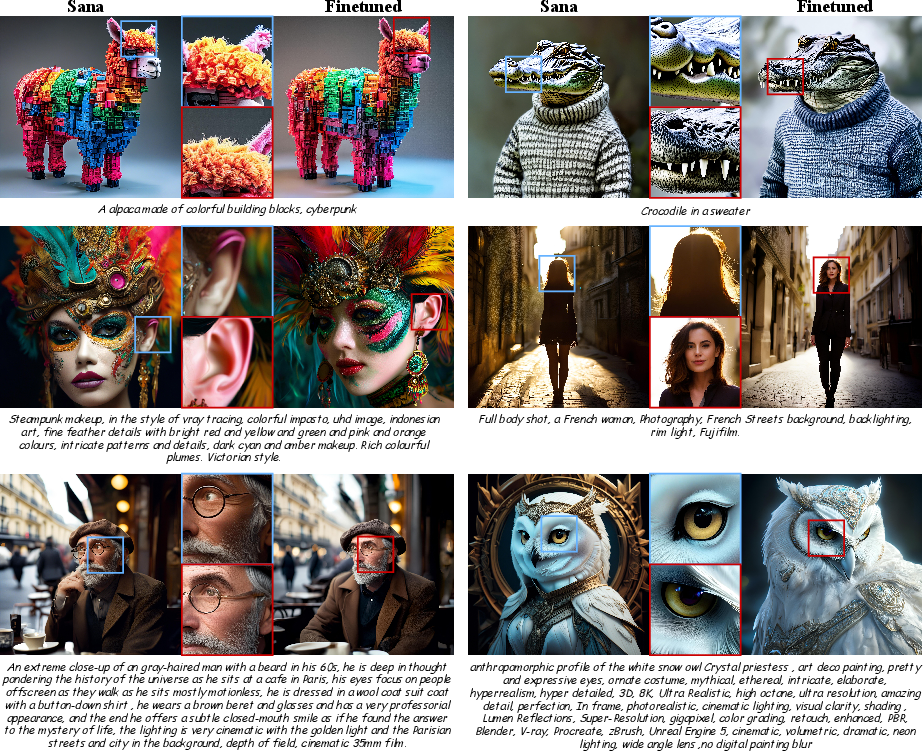
Figure 3: 4KLSDB fine-tuned Sana produces superior high-frequency textures and more coherent structures compared to the baseline model, under identical prompts.
Practical and Theoretical Implications
The empirical results underscore the necessity of genuine native-4K supervision for both restoration and synthesis. High-resolution datasets enable SR and T2I models to learn robust priors for local structure and visual fidelity, critical for downstream applications such as agentic editing, UHD video generation, and multimodal reasoning at scale. The curation methods, combining automated LMM- and edge-based filtering with human oversight, serve as a blueprint for scalable, quality-centric dataset assembly in vision.
4KLSDB's comprehensive annotation (category, shot scale, captions) makes it extensible for multimodal representation learning, captioning, VQA, and region-aware generative modeling. By providing reliable benchmarks at 4K resolution, 4KLSDB facilitates rigorous evaluation of artifacts, perceptual failures, and semantic alignment that are often overlooked in lower-res datasets.
Future Directions
The availability of 4KLSDB is expected to catalyze advances in visual fidelity and multimodal synthesis, driving new research in high-resolution representation learning, region-level object detection, ultra-high-res editing, and fine-grained captioning. Its open test and validation splits ensure reproducibility and fair comparison across models and algorithms. Future extensions may leverage the dataset for complex multimodal reasoning, high-resolution VQA, and region-to-text grounding.
Conclusion
4KLSDB fills a critical gap in high-resolution visual data, providing a scale, diversity, and annotation quality unmatched by prior public datasets. Its comprehensive benchmarks demonstrate quantifiable improvements in restoration fidelity, perceptual quality, and generative realism when models are trained with native-4K data. The dataset's design and empirical findings define a new standard for ultra-high-resolution vision research, with broad applicability to restoration, generation, and multi-task multimodal systems.
(2605.24762)

