- The paper demonstrates that foundation models can match or exceed specialist performance in periodic and cold-start regimes.
- It rigorously benchmarks models across diverse domains using metrics like MASE, sMAPE, and RMSE to reveal regime-dependent trade-offs.
- It proposes a Complexity Router hybrid framework that optimizes model selection, reducing inference costs by 70% while maintaining accuracy.
Assessing the Operational Viability of Foundation Models for Time Series Forecasting
Introduction
The paper "Assessing the Operational Viability of Foundation Models for Time Series Forecasting" (2605.24381) provides a comprehensive empirical and operational analysis of Foundation Models (FMs) in time series forecasting. It contrasts FMs against specialist supervised models, focusing on their comparative performance, cost, and practical deployment constraints across a variety of real-world forecasting regimes. The study advances the field by dissecting when, why, and how FMs offer value over classical methods and proposes a hybrid deployment framework to optimally balance accuracy and resource overhead.
Foundation Model and Specialist Architectures
Distinct architectural approaches underpin the FM and specialist paradigms for time series forecasting. TimesFM, as a representative foundation model, employs patch-based continuous value aggregation and operates in pure inference-only mode, leveraging large-scale pre-training to enable zero-shot forecasting. By contrast, models like Chronos discretize the temporal signal via tokenization, aligning with LLM-based architectures, while Moirai employs any-variate attention for flexible multivariate modeling (Figure 1).
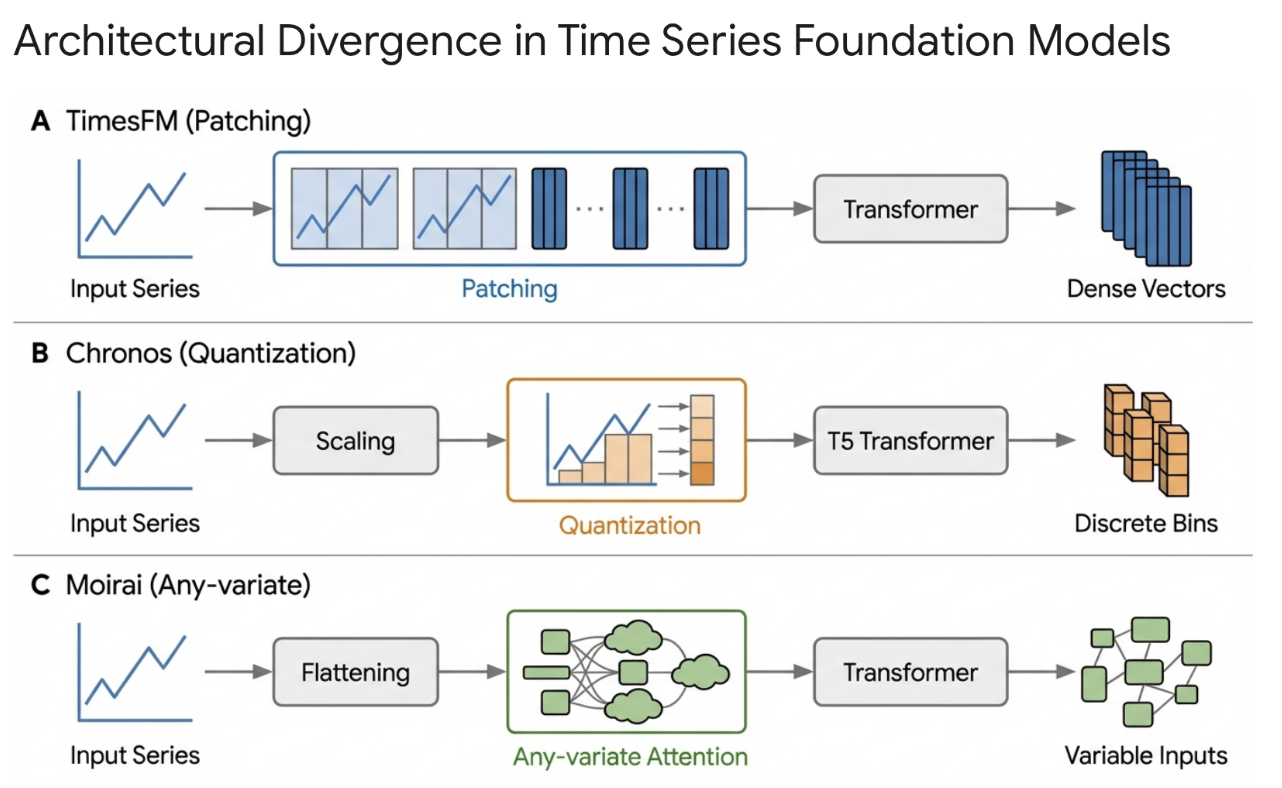
Figure 1: Architectural Divergence in time series foundation models: (A) TimesFM (patch-based), (B) Chronos (quantization), and (C) Moirai (any-variate attention).
Specialist baselines such as XGBoost and LSTM are highly tuned for their domain, with heavy reliance on explicit feature engineering and repeated task-specific retraining. PatchTST and DLinear serve as modern deep learning baselines; PatchTST leverages Transformer-style patching, while DLinear uses localized linear projections and moving average decomposition.
Experimental Protocol and Domains
The study rigorously benchmarks model classes on four datasets, each exemplifying a distinct data-generating regime: periodic traffic flows, physically constrained energy processes, highly stochastic financial time series, and the heterogeneous M4 demand forecasting benchmark. Evaluation is performed both in aggregate and per-regime, using MASE, sMAPE, and RMSE metrics for fine-grained error analysis.
A central finding is the empirical confirmation of a regime-dependent trade-off between FMs and specialists. Performance is not uniformly determined by model class, but by underlying statistical properties such as periodicity, entropy, and the presence of physical constraints (Figure 2). FMs are competitive, and often superior, in domains with strong periodicity and human-centric patterns, such as traffic forecasting and certain M4 subsets. Specialist models, particularly XGBoost, retain a decisive advantage in regimes dominated by site-specific constraints, such as physical energy systems, where explicit inductive biases can be encoded via feature engineering.
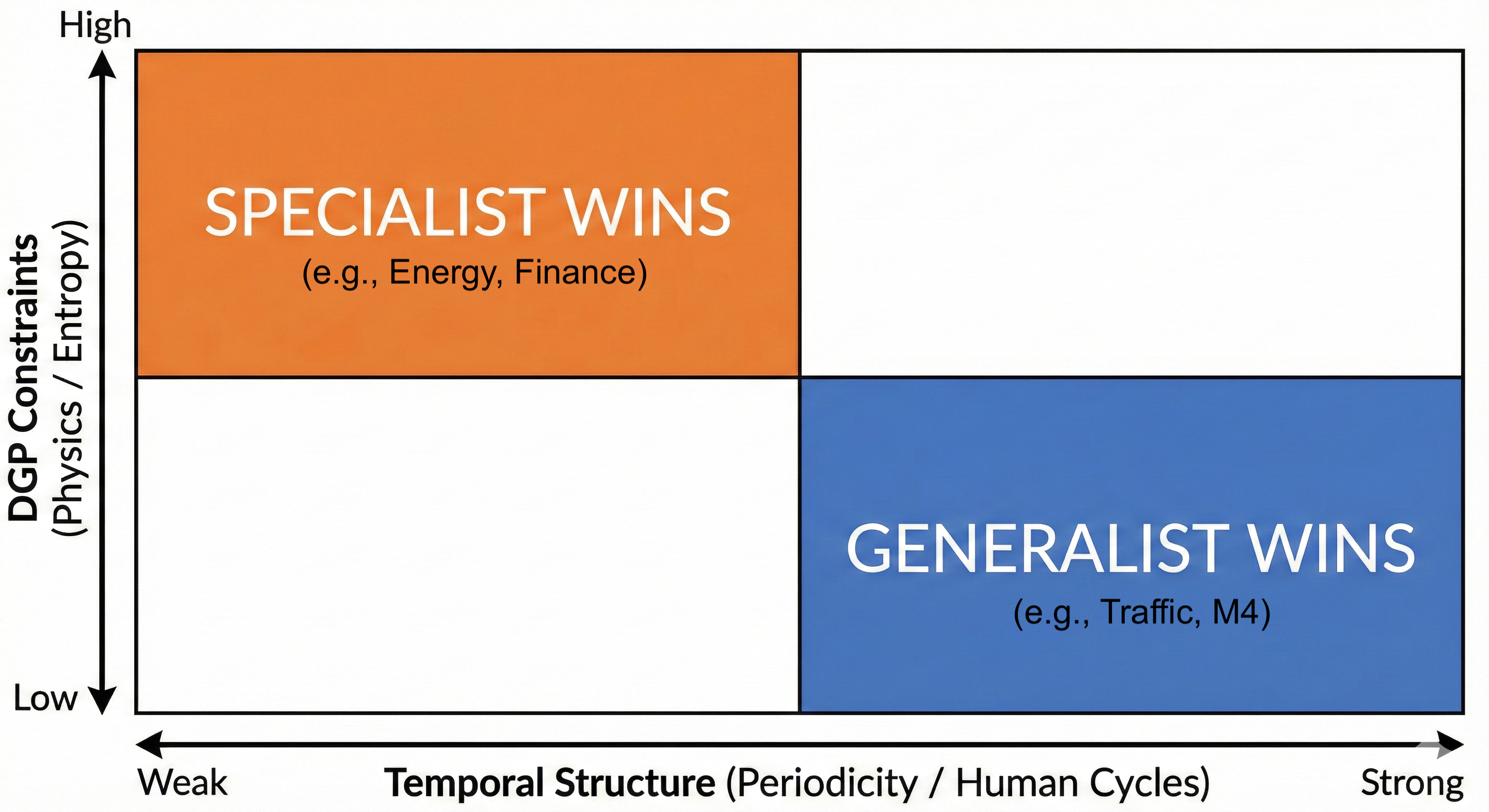
Figure 2: Generalist vs. Specialist regime map—a taxonomy of operational domains guiding optimal model selection.
Quantitative results indicate that TimesFM 2.0 and successor variants outperform or match leading specialists in traffic and M4, with MASE reductions of up to 44% versus LSTM. In energy forecasting, XGBoost demonstrates dominant performance, with MASE substantially lower than all FMs, reinforcing the hypothesis that domain-specific feature memory is irreplaceable in certain contexts. Interestingly, latest-generation FMs (e.g., TimesFM 2.5) close or overturn the specialist gap in high-entropy domains such as exchange rates, evidencing rapid evolution in FM architecture.
Qualitative Model Behavior
The paper provides detailed qualitative analyses highlighting architectural differences in prediction behavior. In the traffic regime, TimesFM 2.0 more accurately captures double-peak rush hour phenomena—attributable to its rich episodic memory for canonical periodic structures—while XGBoost tends to underestimate extreme values (Figure 3).
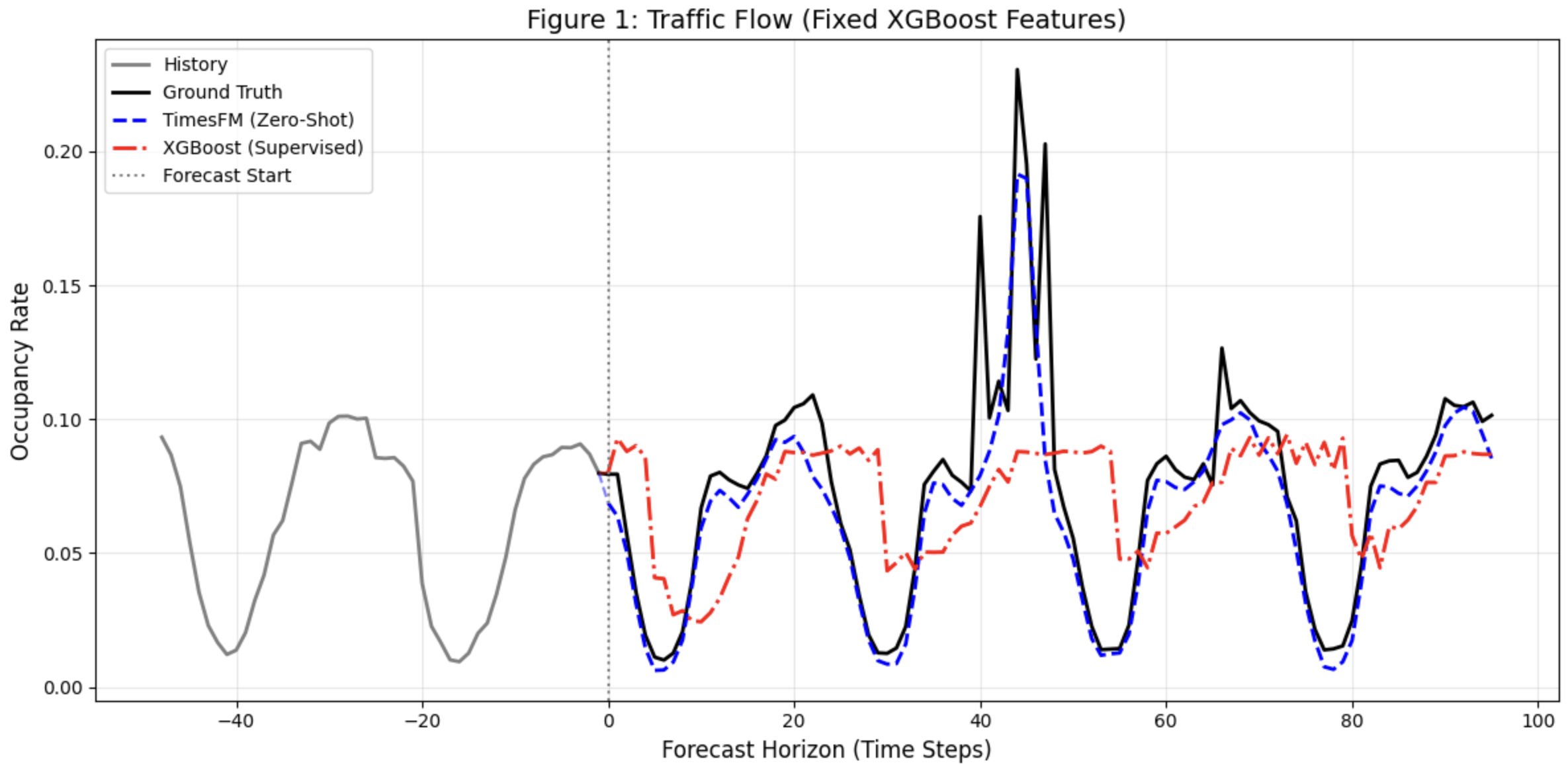
Figure 3: Fine-grained traffic double-peak structure captured by TimesFM 2.0 but underestimated by XGBoost.
For energy forecasting, FMs display recency bias, over-adapting to local anomalies due to limited global context, whereas specialist models such as XGBoost enforce robust mean reversion leveraging global historical memory (Figure 4).
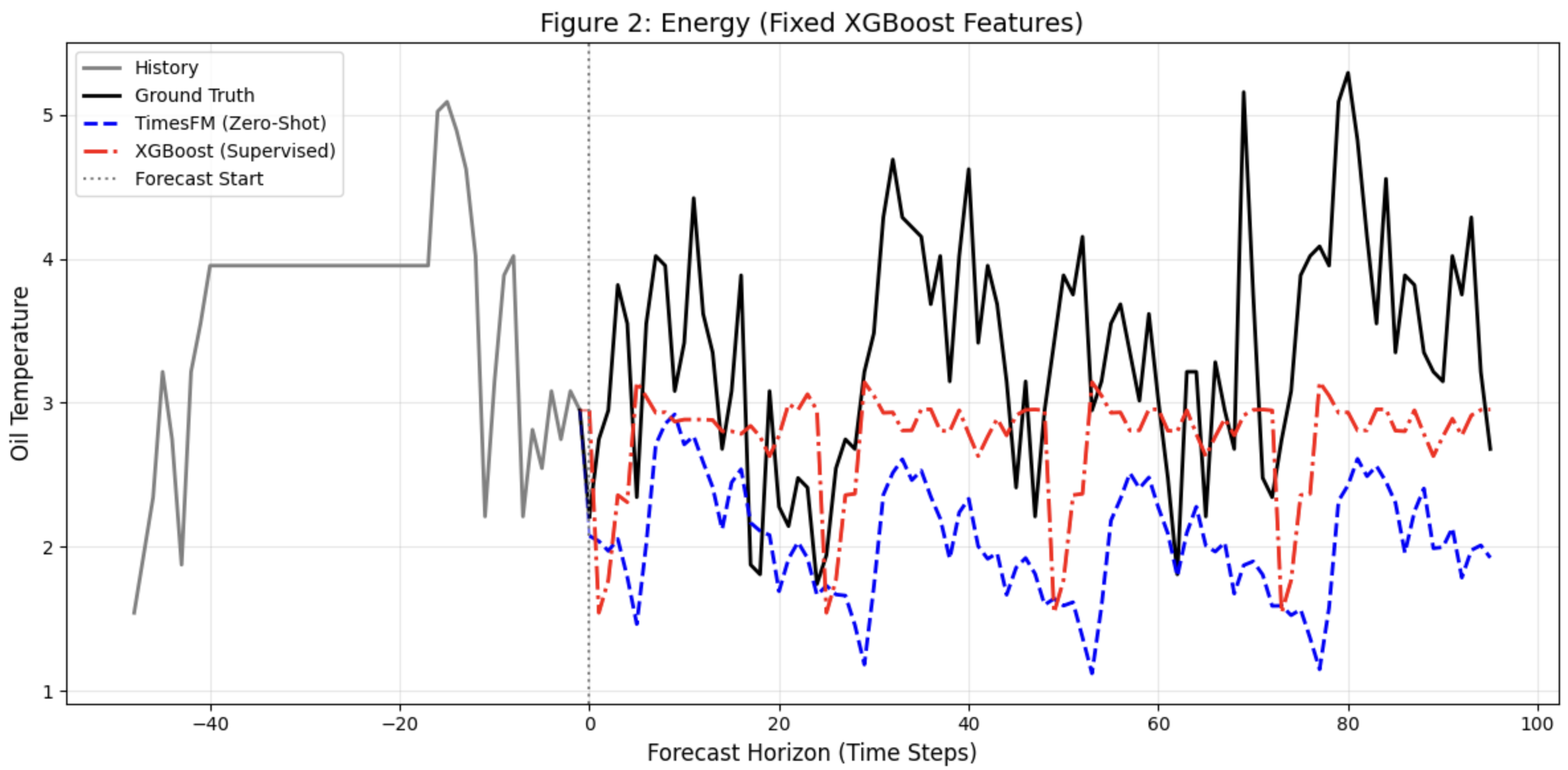
Figure 4: Mean reversion versus recency bias. XGBoost aligns with long-term context, TimesFM 2.0 overshoots on local discontinuities.
Operational Constraints: Efficiency, Cold-Start, and Privacy
A significant contribution is the assessment of practical deployment constraints. FMs impose orders of magnitude higher inference costs, running on GPUs with ∼1000x the latency of specialist decision trees that operate in microseconds on CPUs. This "Throughput Gap" severely limits FM applicability in edge or real-time production environments.
Nonetheless, FMs are uniquely advantageous in cold-start scenarios or the "long tail," such as rapid deployment to unseen sensors or SKU-level demand forecasting with insufficient history. Their ability to transfer pre-learned structural priors enables robust forecasts when supervised models fail due to feature starvation (Figure 5).
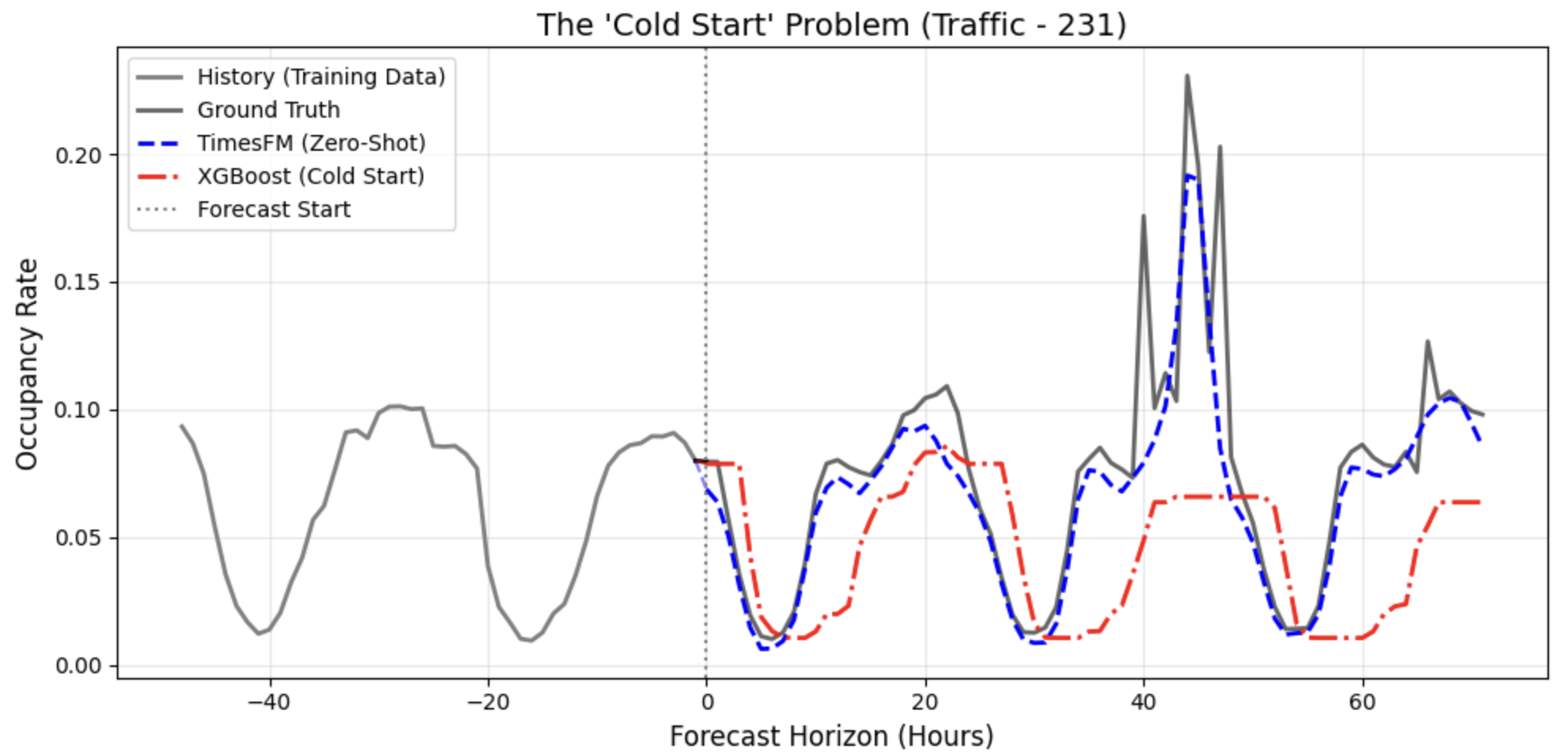
Figure 5: Cold-start prediction—TimesFM 2.0 infers daily periodicity from minimal context, while XGBoost fails without engineered lag features.
Additionally, issues of inference rigidity and data sovereignty are raised: FMs are "frozen" post-deployment and must be rerun to adapt to drift, while specialists permit incremental retraining. FM computational density also complicates compliance for privacy- or latency-critical on-prem deployment.
Complexity Router: Hybrid Deployment Framework
Informed by empirical analysis across 5,089 series, the authors design a Complexity Router—a practical architecture that routes each series to an FM or specialist based on four computed features: spectral entropy, coefficient of variation, seasonal autocorrelation, and trend strength (Figure 6). Thresholding on these features optimizes expected accuracy and compute cost.
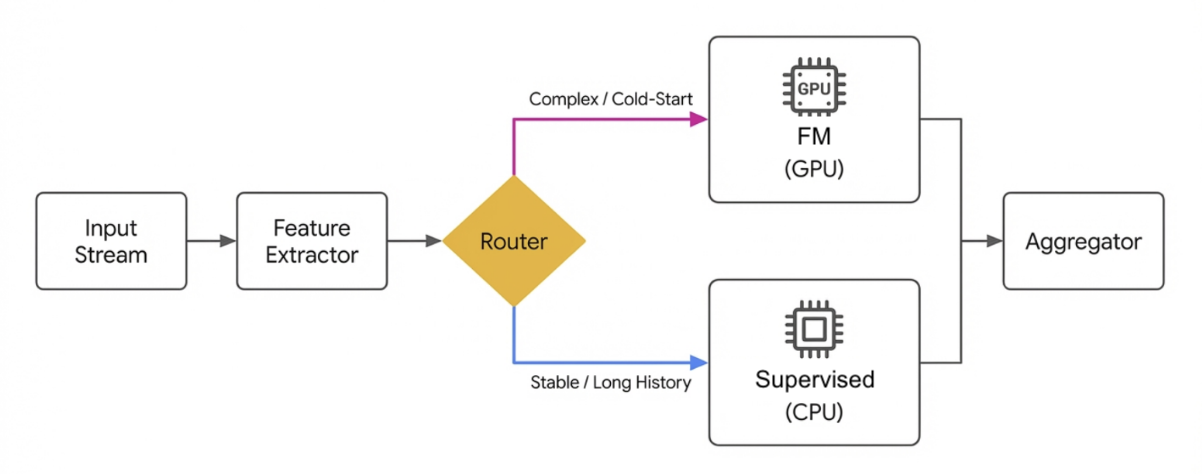
Figure 6: Hybrid deployment architecture; Complexity Router allocates series based on statistical complexity to FM or specialist endpoints.
The empirical routing analysis demonstrates that FM win rates correlate positively with spectral entropy and volatility, and that the router's Pareto-optimal operation is achieved by routing the top 30% of series to FMs and the rest to specialists (Figures 7 and 8). This mixed regime sharply reduces FM inference cost by 70% while exceeding the accuracy of both pure FM and pure specialist deployments.
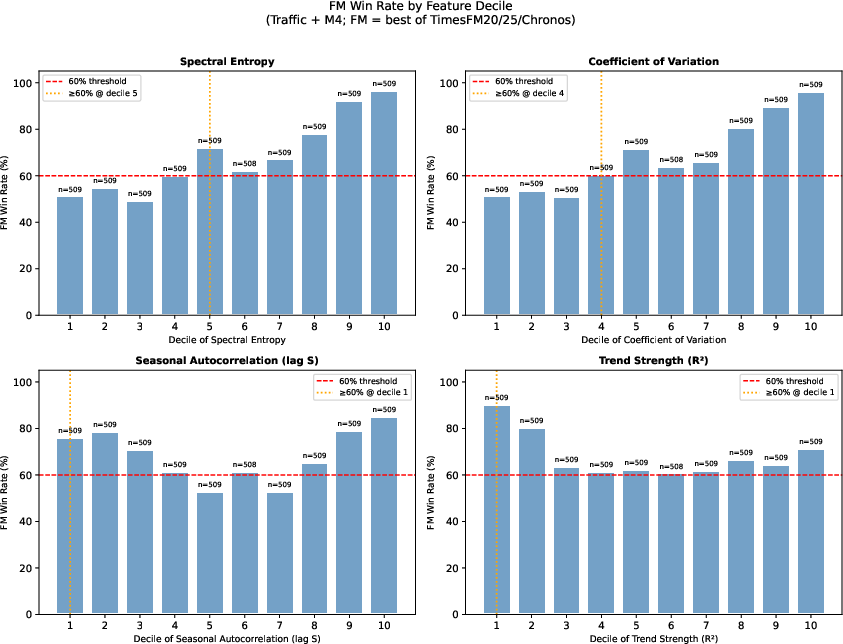
Figure 7: Per-feature empirical FM win rate. FM advantages manifest in high entropy, high volatility, and weak trend/strong periodicity.
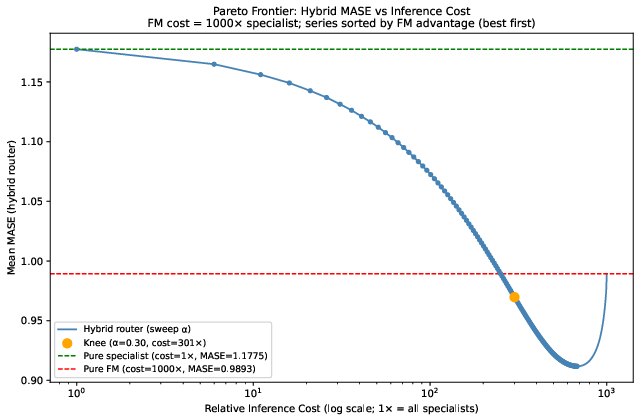
Figure 8: Cost-accuracy Pareto frontier for hybrid deployment—optimal trade-off at 30% FM utilization.
Implications and Future Directions
The study has several key implications:
- Model selection must be explicitly regime-dependent. No universal dominance—FMs and specialists are complementary, not mutually exclusive.
- FMs are best deployed where their pre-trained structural priors fill gaps due to lack of historical data, limited feature availability, or broad heterogeneity. In cost/latency-sensitive or heavily regulated domains, specialists still prevail.
- Complexity-based hybrid architectures are operationally superior—quantitatively balancing accuracy and resource expenditures at scale.
- Continued progress in FM architectures (e.g., context expansion, improved normalization) is rapidly shifting previously specialist-dominated regimes toward parity or FM advantage.
The paper identifies several promising future directions, including time series retrieval-augmented generation (RAG) to mitigate the local-global memory trade-off, and the injection of long-term distributional anchors into FM input representations for improved robustness against recency bias.
Conclusion
This work provides an empirically rigorous operational analysis of FM deployment in time series forecasting. FMs have demonstrated a clear edge for periodic and cold-start regimes and exhibit rapidly improving performance in high-entropy domains as architectures mature. However, critical operational bottlenecks—namely inference latency, retraining rigidity, and privacy constraints—anchor specialist models as indispensable components. Hybrid architectures, such as the Complexity Router, formalize an optimal regime for model class selection, enabling practitioners to systematize the trade-off between generalization and efficiency. Theoretical advances in contextualization and mixed-memory architectures are likely to further realign the frontier between generalist and specialist dominance in time series forecasting.