- The paper demonstrates that quantum-inspired encodings (amplitude, angle, basis) show no statistically significant advantage over strong classical baselines across diverse datasets.
- The study details encoding failure mechanisms such as magnitude collapse in amplitude encoding and redundant geometry in angle encoding, with 27 out of 30 QIE-dataset pairs underperforming.
- The results imply that genuine quantum advantages must stem from properties like entanglement and adaptive circuits rather than merely deterministic feature mapping.
Spectral Benchmarking of Quantum-Inspired Feature Maps
Motivation and Scope
Quantum machine learning posits that quantum systems are capable of encoding information into high-dimensional spaces inaccessible or inefficient to classical computations. One foundational element in this pipeline is the data-encoding map: amplitude, angle, and basis encodings are commonly invoked as "quantum-inspired" feature maps. This work rigorously evaluates the representational utility of these encoding maps in classical supervised learning, benchmarking them against strong classical feature engineering alternatives, under matched output dimensionality and computational conditions. By isolating the feature mapping step from the larger quantum computational context, the study investigates whether the geometry induced by these deterministic encodings alone confers learning advantages on classical datasets.
Methodology and Experimental Design
Amplitude encoding projects classical data onto the unit hypersphere, analogously to quantum state normalization, thereby discarding absolute magnitude information. Angle encoding maps each feature into trigonometric coordinates associated with single-qubit rotations, essentially doubling the input dimension but imposing periodicity. Basis encoding discretizes features into binary bit-strings, transforming the metric structure to a Hamming geometry.
Each encoding is evaluated as an explicit feature map on ten diverse datasets: small tabular, financial (imbalanced), image, high-energy physics, synthetic controls (parity, high-rank noise), and large-scale multiclass classification. Classical comparisons include standardized raw linear features, random Fourier features (RFF), polynomial expansions, PCA projections, RBF SVMs, and shallow MLPs, all tuned and matched by output dimension and computational budget. Predictive performance (accuracy, macro F1), spectral properties (effective rank, condition number), kernel alignment (CKA), timing, and memory overhead were analyzed across five to ten random seeds per dataset.
Across all datasets and encoding methods, no quantum-inspired encoding yields a statistically significant improvement over the strongest classical baseline. In fact, 27 out of 30 encoding-dataset pairs were significantly worse (paired t-tests, Wilcoxon signed rank, Cohen's d), with the remaining three near-ties showing negligible effect sizes.
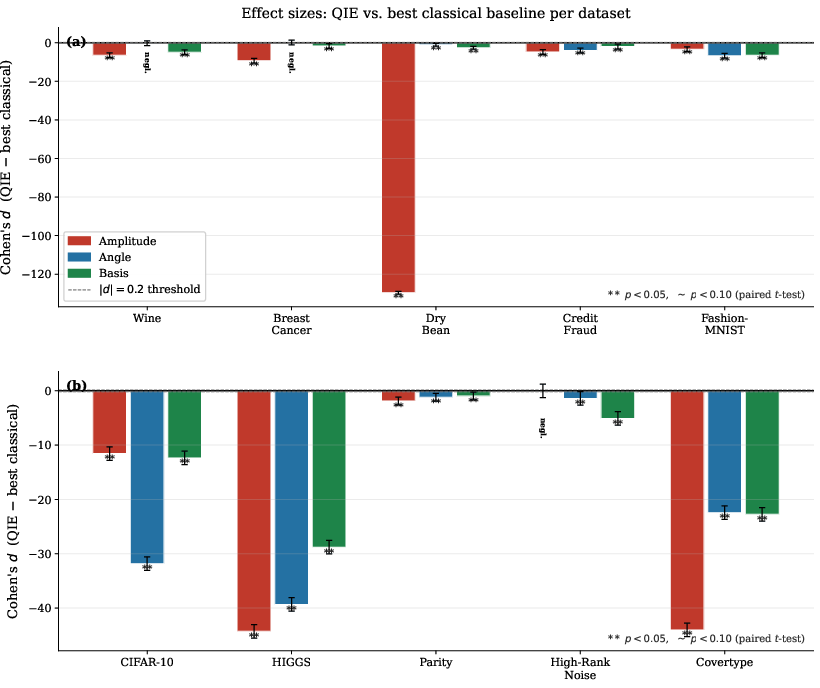
Figure 1: Forest plot of Cohen's d effect sizes for all 30 QIE versus best classical comparisons; negative values correspond to inferior QIE performance.
On representative datasets, amplitude encoding is unstable and often dramatically underperforms. It achieves near parity only on high-rank synthetic noise, where classical magnitude normalization aligns with quantum-inspired constraints. Angle encoding is competitive on small tabular sets but its representation is nearly identical to classical linear baselines (CKA > 0.95 on 7/10 datasets). Basis encoding is spectrally distinct but generally misaligned with underlying decision structure.
Macro F1 analysis further refines these results: ostensible parity in accuracy on imbalanced tasks (e.g., Credit Card Fraud) masks substantial deficiencies in minority class performance.
Spectral Attribution and Failure Modes
A mechanistic investigation reveals three encoding-specific failure mechanisms:
- Amplitude Encoding: Projects all data onto the hypersphere, thereby collapsing effective rank when magnitude contains class-relevant information. On Dry Bean, erank=1.04, log10κ=9.76, accuracy deficit of −0.67 versus best classical baseline.
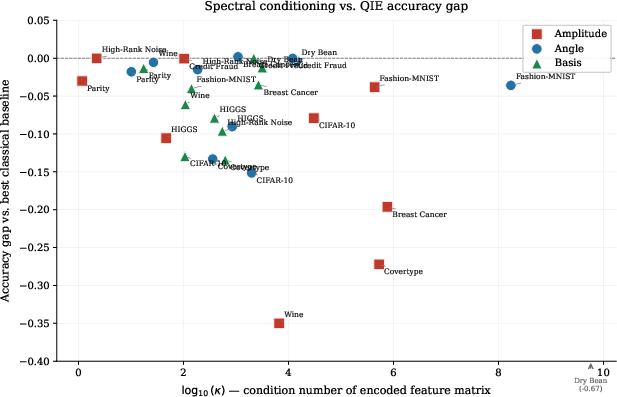
Figure 2: Condition number (log10κ) versus accuracy gap across QIE encodings. High condition number strongly correlates with amplitude encoding failure.
- Angle Encoding: Imposes a geometrically redundant transformation; CKA values show substantial Gram matrix similarity with linear representations, indicating negligible spectral innovation.
- Basis Encoding: Alters data geometry to Hamming space, which is poorly aligned with the smooth, continuous nature of most benchmark tasks. Despite being spectrally healthy (moderate effective rank/conditioning), this geometric mismatch impairs predictive utility.
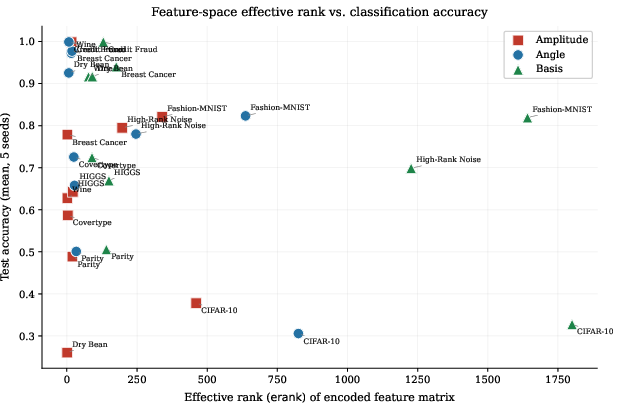
Figure 3: Normalized effective rank versus accuracy relative to raw linear baseline; amplitude encoding only approaches parity on high-rank synthetic noise.
The high-rank synthetic noise dataset serves as a crucial control: when data already populate the amplitude encoding output space nearly uniformly, loss of magnitude information does not impair utility. Otherwise, this uniform normalization is destructive.
Practical Overhead
Encoding runtime and memory overheads were systematically analyzed. Amplitude and angle encoding are computationally negligible relative to polynomial features or classical neural baselines. Overhead is therefore not a limiting factor; representational misalignment dominates as the primary cause of QIE inferiority.
Theoretical and Practical Implications
These results sharpen the distinction between the role of data loading geometry and other quantum advantages (e.g., entanglement, quantum kernels, trainable circuits). In classical settings, expanding dimensionality, periodic rescaling, or binary discretization via quantum-inspired maps does not constitute a meaningful mechanism for superior generalization or classification. Effective representations require alignment between feature geometry and task structure, an axiom repeatedly confirmed through spectral and kernel alignment analyses.
For quantum machine learning, the findings imply that future claims should attribute advantage specifically to quantum mechanisms distinct from deterministic encoding geometry. This negative result is not a broad indictment of quantum learning—it is a clarification of what does not contribute meaningfully. Quantum advantage could still arise from data generated by quantum processes, entanglement, adaptive circuits, or hardware-specific algorithms.
Limitations and Future Directions
The benchmark restricts analysis to deterministic, parameter-free encodings injected into classical learners. Scenarios not tested include quantum hardware, variational circuits, data re-uploading, hardware noise, and inherently quantum problem domains (e.g., quantum chemistry, quantum cryptography). Expansion to non-classical datasets, trainable quantum architectures, or feature maps dynamically matched to quantum data distributions remains an open direction.
Conclusion
Fixed quantum-inspired encodings—amplitude, angle, basis—do not provide any statistically significant learning advantage over strong, matched classical baselines on classical datasets. Performance deficits stem from incompatibilities and redundancies in geometric structure and spectral content, not from computational overhead. The route to quantum advantage in machine learning thus lies beyond deterministic encoding geometry and demands a task-aligned approach involving quantum elements not considered in this benchmark.

