- The paper demonstrates that parameterized quantum circuits effectively embed PCA-reduced multispectral data into nonlinear Hilbert spaces for enhanced land-cover classification.
- It shows that quantum kernel SVM readouts outperform linear measurement heads, achieving nearly 95% macro-average test accuracy compared to classical baselines.
- Scaling experiments reveal that while increasing qubit count initially improves performance, gains saturate beyond 4 qubits due to representation bottlenecks.
Variational Quantum Circuits as Feature Maps for Multispectral Land-Cover Classification
Overview
The paper "Parameterized Quantum Circuits as Feature Maps: Representation Quality and Readout Effects in Multispectral Land-Cover Classification" (2604.26675) provides a rigorous empirical evaluation of variational quantum classifiers (VQCs) for multispectral land-cover classification using the EuroSAT-MS dataset. The study adopts a feature-map perspective, explicitly focusing on how parameterized quantum circuits (PQCs) embed classical input into nonlinear Hilbert space representations, and how these embeddings are exploited via different readout mechanisms. Key comparative analyses are performed against classical baselines—logistic regression, SVMs (linear and RBF), and shallow NNs—under identical PCA-based preprocessing and fixed data splits. The interplay between quantum representation capacity and the downstream (classical or quantum) decision functions is systematically dissected, including a comprehensive qubit-count sweep across all 45 class pairs.
Quantum Circuit Design and Feature Map Perspective
PQCs used in this work consist of repeated data re-uploading and entangling layers, with affine input-dependent rotation parameters per block and qubit. The architecture is designed for compact representation with linear scaling in parameters. After training, each circuit realizes a task-adapted nonlinear feature map, x↦∣ψθ(x)⟩, embedding classical inputs into 2nq-dimensional Hilbert space. The paper emphasizes that the effectiveness of this quantum representation is contingent on the method used to extract information for classification—either via linear measurement heads (Pauli-Z expectation values with a linear weight vector) or via quantum kernel SVMs utilizing fidelity between circuit-produced states.
Controlled Experimental Setup and Baselines
The evaluation uses the EuroSAT-MS multispectral dataset, conducting one-vs-one binary classification across all pairs of the 10 land-cover classes ((210)=45 pairs). Inputs are dimension-reduced via PCA (16 or 32 components), and the protocol employs fixed splits (train/validation/test) and five random seeds per model per pair. The classical baselines include L2-regularized logistic regression, linear/RBF SVMs (with scikit-learn SVC), and a shallow NN (two hidden layers, 177 parameters), all trained on the same PCA-normalized features.
For quantum models, a 4-qubit PQC (152 parameters) is compared against classical baselines, with extension to nq∈{1,…,7} in the qubit sweep.
Numerical Results and Analysis
VQC Representation Quality vs Classical Baselines
VQC achieves the best macro-average test accuracy across classes (94.79%), outperforming the linear baseline and matching the shallow NN, except for rare cases where NN prevails. VQC wins on 5 out of 10 classes (by per-class mean accuracy) and is within 1% of the best solution on 9 out of 10 classes, indicating robust nonlinear encoding of PCA-normalized spectral features.
(Figure 1)
Figure 1: Mean per-class test accuracy for logistic regression, shallow NN, and VQC, showing VQC's advantage on diverse land-cover categories.
Readout Effect: Linear Measurement Head vs Quantum Kernel SVM
A strong assertion is made: For a trained PQC, constructing a quantum kernel SVM using the fidelity kernel extracted from the same circuit ("SVM-QK (trained)") improves accuracy over the original linear measurement head. SVM-QK (trained) achieves a macro-average of 94.96%, consistently outperforming SVM-linear (92.26%), and closing much of the gap to SVM-RBF (95.89%). This demonstrates that the quantum circuit encapsulates richer similarities than can be exploited by a linear readout.
(Figure 2)
Figure 2: Mean per-class accuracy for SVM-linear, SVM-QK (trained), and SVM-RBF, highlighting quantum kernel SVM's substantial improvement over linear SVM.
Moreover, the linear head's performance is consistently improved upon by post-training the SVM-QK with the same learned feature map, indicating that the measurement-based readout underutilizes the quantum embedding.
(Figure 3)
Figure 3: Comparative mean per-class accuracy between VQC (linear readout) and SVM-QK (trained circuit), showing systematic improvement by quantum kernel SVM.
Scaling Behavior: Qubit-Count Sweep
Increasing the number of qubits in the PQC improves performance from 1-qubit (92.99%) up to 7-qubits (95.18%), with the largest performance gains at low qubit counts and saturation beyond 4 qubits. The exponential Hilbert space size, combined with only linear parameter scaling, results in diminishing returns—a phenomenon consistent with representation bottlenecks in variational circuits.
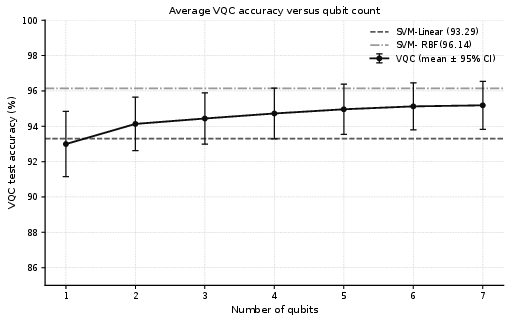
Figure 4: Average VQC test accuracy versus qubit count, averaged over all EuroSAT-MS class pairs, with performance gain saturating beyond 4 qubits.
Limitations
All results are obtained via noiseless classical simulation, not accounting for hardware-related noise, shot variability, or device constraints. The experiments employ PCA-reduced inputs, omitting spatial context; thus, the findings pertain strictly to spectral feature-map effectiveness in quantum and classical models.
Implications and Future Directions
The findings underscore that PQCs, under realistic size and parameterization constraints, provide meaningful nonlinear feature maps for classical multispectral data, consistently outclassing linear models and matching shallow NNs on compact representations. However, maximal utilization of quantum feature maps requires advanced (kernel-based) decision mechanisms; linear measurement-based readouts are suboptimal even for task-adapted circuits. The empirical saturation with qubit count highlights fundamental limits in expressiveness versus trainability for variational quantum models, given practical parameter scaling.
Practically, these results suggest that near-term quantum machine learning is more likely to augment classical pipelines (via quantum-inspired kernels) than to directly replace classical discriminative models. Theoretically, the research aligns with the interpretation that quantum models function as flexible nonlinear embeddings whose value proposition depends strongly on downstream exploitation via kernel methods.
Future research should address:
- Hardware-executed VQCs under noise and connectivity constraints
- Readout optimization and joint training for kernel-based quantum-classical hybrids
- Scaling to more expressive circuit architectures and full spatial-spectral inputs
- Systematic comparison to quantum-inspired classical models and geospatial foundation models
Conclusion
This paper demonstrates that the efficacy of variational quantum classifiers in multispectral land-cover classification is contingent upon both quantum representation quality and the classical or quantum mechanism used to interpret the embedding. Quantum kernel SVM exploits learned representations more effectively than direct linear measurement heads, a conclusion supported by systematic macro-average accuracy improvements. While increasing qubit count enhances performance initially, gains saturate due to parameterization limitations relative to Hilbert space size. The implications are twofold: quantum models are valuable as compact nonlinear feature maps augmenting classical decision rules, but their practical advantage is largely conditional on synergistic quantum-classical integration rather than standalone quantum superiority.

