- The paper introduces a novel, gauge-invariant formulation treating the shift vector as the intrinsic dipole of a single many-body correlated state.
- It recovers standard shift vector expressions in limiting cases, linking phase gradients to measurable excitonic shifts and nonlinear optical responses.
- The framework offers a robust method to probe many-body coherence, enabling precise predictions of spatial displacements and linear Stark effects.
Generalized Shift Vector as the Intrinsic Dipole of Many-Body Correlated Electronic States
Introduction
The shift vector is a geometric quantity central to nonlinear optical phenomena and transport in crystalline solids, particularly within the context of the bulk photovoltaic effect and the side-jump mechanism in anomalous Hall systems. Traditionally, the microscopic origin of the shift vector has been described in a transition-based framework—interpreting it as the charge-center displacement associated with inter-state transitions or scattering. The present work introduces a fundamentally different perspective, treating the shift vector as a property intrinsic to an individual many-body correlated electronic state. This generalization, derived directly from the many-body wave function, unifies the understanding of shift phenomena across a broad range of theoretical scenarios and consolidates previously disparate approaches.
Formalism: Generalized Shift Vector from Many-Body Wavefunctions
The key theoretical result is the identification and explicit construction of a generalized shift vector, X1S, as the branch-fixed intrinsic electric dipole of an arbitrary correlated electronic state ∣ΨS⟩. This is constructed for states with Ne electrons and N−Ne holes, where the wave function is expanded in a many-body Bloch-product basis:
∣ΨS⟩=Λ∑AΛS∣Λ⟩
Here, Λ labels the occupation configuration. The intrinsic dipole moment emerges as
PS=eX1S
with (excluding system edge effects):
X1S=Λ∑∣AΛS∣2j=1∑N∇kjargAΛS−⟨ΨS∣r^N∣ΨS⟩
where r^N is the position operator in the multi-particle Bloch basis, and the two terms respectively represent a phase-gradient contribution and the direct dipole in the single-particle Bloch basis.
A crucial aspect of this formulation is its explicit gauge invariance, stemming from the observable character of the electric dipole and maintained irrespective of smooth U(1) gauge transformations. This is distinct from previous shift vector constructs, where gauge invariance often requires ad hoc term addition. Furthermore, this construction admits a branch ambiguity typical of polarization in extended systems, but this can be physically fixed, especially for charge-neutral states, by appropriate convention (e.g., center-of-mass reference).
Physical Interpretation and Special Cases
The formalism elucidates several aspects that were only implicit or obscured in previous analyses:
- Single-State Nature: The shift vector is defined for a single correlated state—not as a property of a transition—which means it directly encodes the internal coherence of the many-body state.
- Not Tied to Specific Interactions: Since it relies only on the internal structure of the state, it is applicable to arbitrary correlated states, whether optically prepared, Coulomb-bound, or otherwise.
- Connection to Previous Results: In limiting cases, such as the two-body exciton (electron-hole pair) or the weak-hybridization/two-band regime, the formalism recovers well-known expressions for the shift vector.
For instance, in the two-band exciton limit, the generalized shift vector simplifies to:
∣ΨS⟩0
where ∣ΨS⟩1 is the exciton amplitude in momentum space, reflecting its internal phase structure.
Observable Manifestations
Real-Space Probability Density and Spatial Shift
The most direct physical manifestation of the generalized shift vector is in the real-space coarse-grained joint probability density of an electron-hole pair, where the maximum probability is spatially shifted by ∣ΨS⟩2 relative to the center-of-mass coordinate. This real-space displacement is gauge-invariant and provides an unambiguous, observable signature of the shift vector.
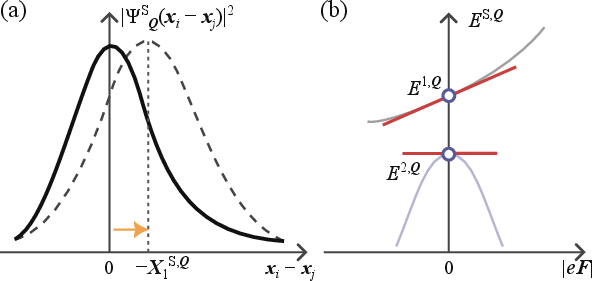
Figure 1: Manifestations of the exciton shift vector in real space (shift in maximum of probability density) and energetics (linear Stark effect with finite versus vanishing shift vector).
Energetics: Linear Stark Effect
A nonzero shift vector ∣ΨS⟩3 leads to a linear-order Stark effect in response to a homogeneous electric field ∣ΨS⟩4, with the energy modification ∣ΨS⟩5. This provides an alternative energetic probe, evident for instance in excitonic states in 2D semiconductors under electrical gating or field modulation.
Probing Interactions and Coherence
Because the phase-gradient term in ∣ΨS⟩6 directly encodes the internal state coherence, the shift vector becomes a powerful diagnostic for the nature of the interaction that generated the correlated state. For states produced by different mechanisms (e.g., optical transitions versus phonon-mediated processes), the difference in their shift vectors contains information on the phase coherence introduced by these interactions.
Benchmarks and Recovery of Known Phenomena
The framework recovers the standard shift-current and related nonlinear optical responses in appropriate limits, both for steady-state optically excited electron-hole pairs and for electron-phonon–mediated transitions. This provides a unified microscopic basis for all previously known formulations, and specifically connects the phase-gradient term in the shift vector to the coherence properties of the driven correlated system.
Quantitative application is illustrated via first-principles calculations for monolayer MoS∣ΨS⟩7, where excitonic states with nontrivial internal phase texture exhibit distinctly different shift vector characteristics:
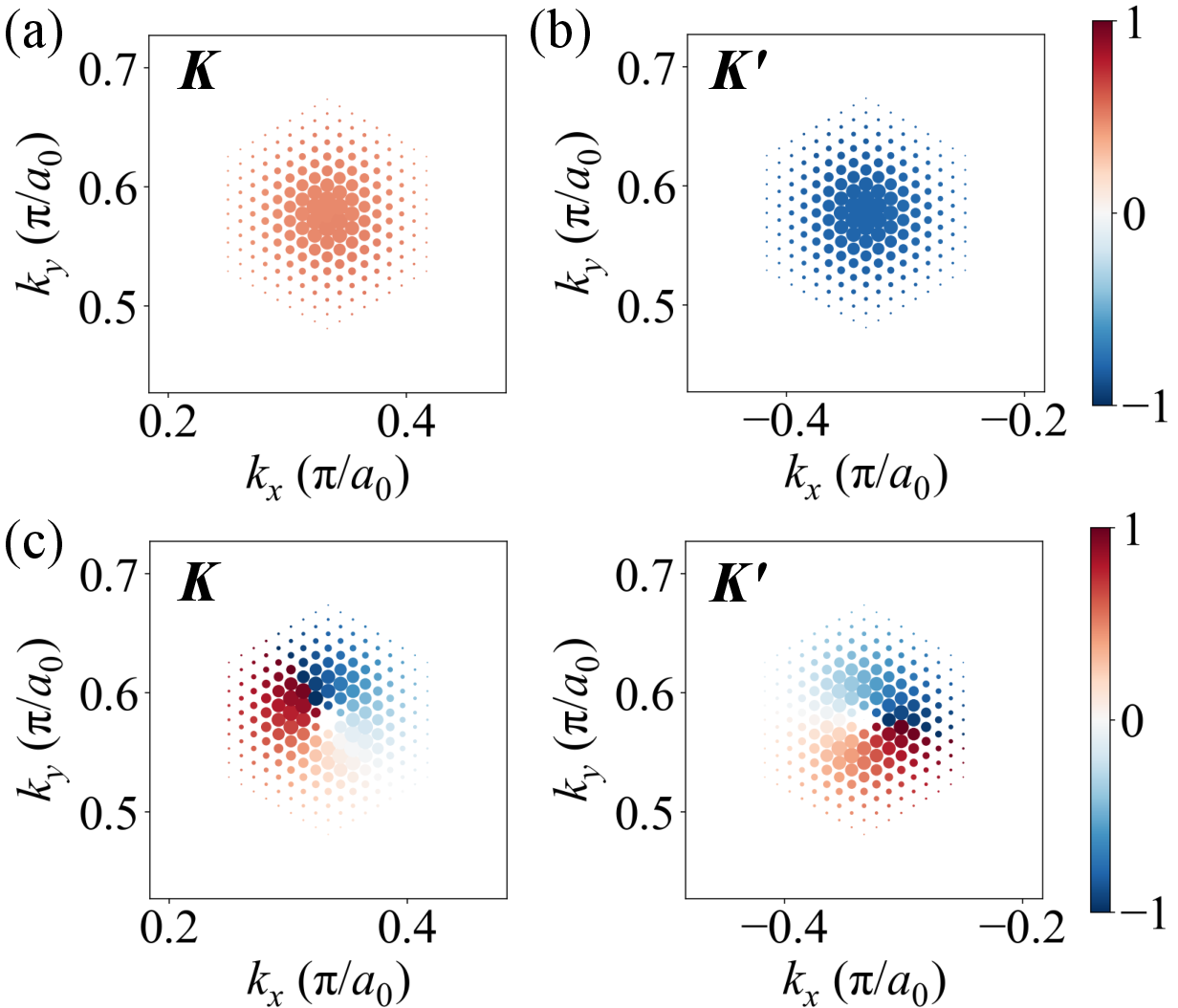
Figure 2: First-principles calculation for monolayer MoS∣ΨS⟩8 excitons: internal phase of the exciton dipole for select low-energy bright states, demonstrating trivial and nontrivial phase structure.
The formalism naturally generalizes to multi-particle correlations beyond standard excitons: higher-body excitonic complexes (e.g., trions, biexcitons), Cooper pairs, and other neutral or charged clusters. This opens pathways to studying the dipolar and spatial coherence properties of a wide variety of many-body states purely from their internal wave functions.
Implications and Future Developments
Practically, this framework enables the calculation of intrinsic dipole moments of correlated states in bulk, low-dimensional, and even strongly correlated electronic systems, via direct evaluation from Bethe-Salpeter, configuration-interaction, or other many-body eigenstates. It thus provides a pathway towards quantifying and controlling the real-space and energetic response properties of electronic excitations in diverse material platforms—ranging from transition metal dichalcogenides to topological quantum matter.
Theoretically, this single-state geometric perspective may facilitate studies of quantum geometric effects in exciton transport, nonlinear optics, and the design of materials for advanced optoelectronic or quantum applications. The explicit identification of the phase-gradient term as the key geometric contribution to observable electronic shifts sharpens the conceptual understanding of how many-body coherence manifests in measurable properties.
Anticipated directions include:
- Systematic mapping of shift vectors for myriad correlated states in atomically engineered systems,
- Exploration of interaction-driven modification of shift vectors in exotic phases (e.g., excitonic insulators, flat-band systems),
- First-principles prediction and experimental validation of spatial and energetic signatures in higher-order correlated excitations.
Conclusion
This work establishes the generalized shift vector as the branch-fixed intrinsic dipole of many-body correlated electronic states, providing a unified and gauge-invariant framework applicable to arbitrary correlated states. The formalism directly links phase coherence in the many-body wave function to observable dipolar shifts and electric-field responses, recovering and generalizing known results for optical and transport nonlinearities. This approach is both broad in applicability and immediately relevant for both theoretical analysis and the design of measurements probing quantum geometric properties of correlated excitations (2605.23431).