- The paper demonstrates that spinon excitations drive a nonlinear shift current mechanism in a 1D noncentrosymmetric quantum spin chain.
- It employs iTEBD simulations to extract both linear and second-order optical conductivity spectra, correlating spinon dynamics with DC photoconductivity.
- The findings suggest new terahertz photoresponse channels in quantum magnets, offering an alternative to traditional magnon-based bulk photovoltaic effects.
Spinon Shift Current in a Noncentrosymmetric Quantum Spin Chain
Introduction
This work investigates nonlinear photocurrent generation in a one-dimensional (1D) noncentrosymmetric quantum spin chain, focusing on emergent behavior driven by spinon excitations under light irradiation. Distinguishing itself from traditional electronic BPVE mechanisms, the study addresses the role of strongly correlated spin excitations—specifically, fractionalized spinons—in mediating shift current responses. The analysis concentrates on the XXZ chain with magnetoelectric coupling, employing infinite time-evolving block decimation (iTEBD) simulations to compute both linear and nonlinear (second-order) optical conductivity spectra and directly demonstrate DC charge current generation.
Theoretical Model
The antiferromagnetic S=1/2 XXZ chain serves as the underlying quantum system:
H^0=Jj∑(S^jxS^j+1x+S^jyS^j+1y+ΔS^jzS^j+1z),
where J>0 and Δ>1 selects the gapped, Néel-ordered regime. The coupling between the electric field and the spin chain originates from exchange striction: the polarization operator is proportional to the modulated exchange interaction, breaking inversion symmetry. The resulting Hamiltonian incorporates an electric field-driven term as −E(t)P^. The polarization and current operators are constructed to encapsulate these magnetoelectric effects, with the current operator acquiring a form analogous to scalar spin chirality.
Spinon excitations in this context are domain-wall quasiparticles—fundamental fractionalized carriers in quantum spin chains. In contrast to magnon-based pictures, these elementary excitations dominate the spectral and transport properties in the 1D limit, especially in the Ising-like regime.
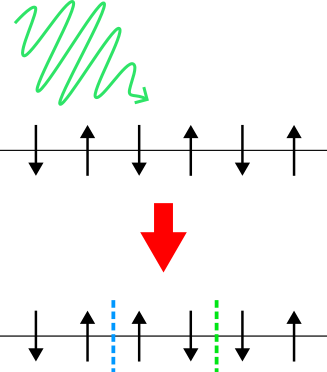
Figure 1: Schematic of spinon excitations in the XXZ spin chain, visualizing domain-wall excitations within the Néel-ordered phase.
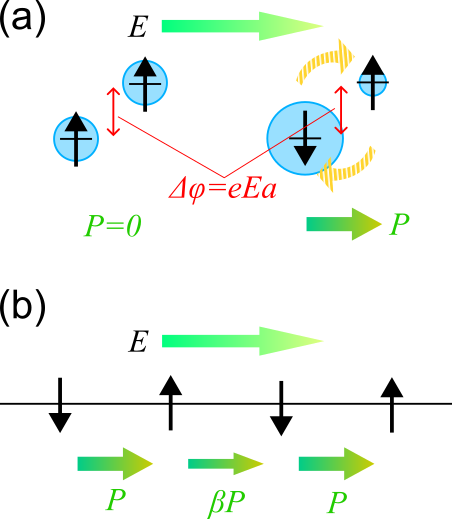
Figure 2: (a) Illustration of the exchange striction mechanism that couples external electric fields to spin pairs. (b) Depiction of the 1D multiferroic quantum spin chain with polarized bonds.
Simulation Methodology
iTEBD is utilized to obtain the real-time evolution of the spin chain state under time-dependent electric fields. The ground state is prepared via imaginary-time evolution, and a laser pulse is applied to drive the system out of equilibrium. The time-resolved expectation values of polarization and current enable extraction of both frequency-resolved linear and nonlinear responses. Weak-field simulations allow isolation of the second-order current response that underpins DC generation.
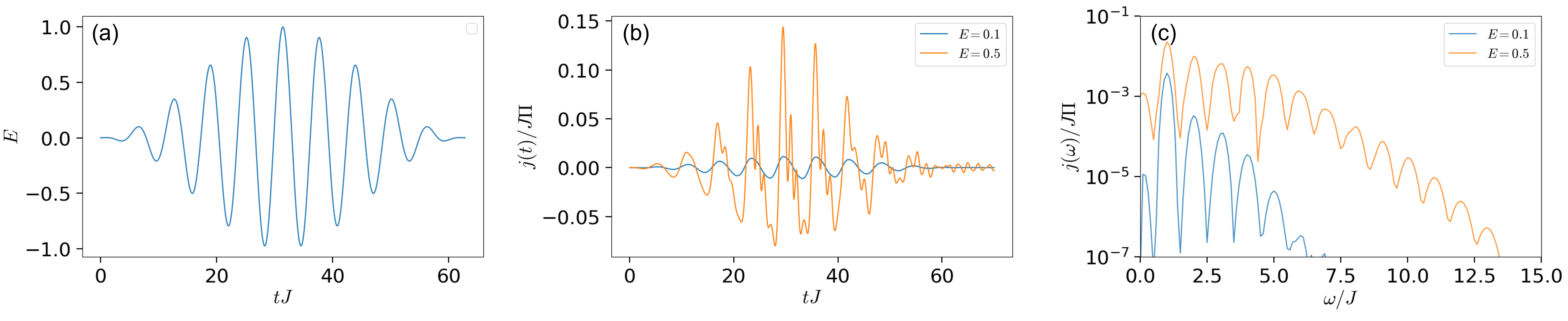
Figure 3: (a) Applied laser pulse profile; (b) Time evolution of the current; (c) Frequency spectrum, highlighting both DC and high-harmonic generation captured by iTEBD.
Results: Linear and Nonlinear Optical Conductivity
The primary numerical results elucidate the spectrum of both the linear conductivity σ(1)(Ω) and the second-order DC photoconductivity σDC(2)(Ω) across varied anisotropy parameters Δ and excitation frequencies.
Linear Response
The absorption spectrum, computed as Reσ(1)(ω), exhibits nonzero values in the window matching the two-spinon continuum. This is corroborated by comparing with the dynamical spin susceptibility χxx(k,ω), whose nonzero region maps precisely to the onset and cutoff of spinon-pair excitations.
Nonlinear (Shift) Current
The nonlinear H^0=Jj∑(S^jxS^j+1x+S^jyS^j+1y+ΔS^jzS^j+1z),0 response is finite across the spinon excitation band, generating a DC current despite the absence of free carriers. This establishes that the BPVE and optical rectification in these systems are driven by spinon-induced electric polarization—genuine shift current mediated by fractionalized quasiparticles. Notably, the energy window for DC generation tracks the two-spinon excitation threshold, and the overall magnitude remains approximately invariant for H^0=Jj∑(S^jxS^j+1x+S^jyS^j+1y+ΔS^jzS^j+1z),1.
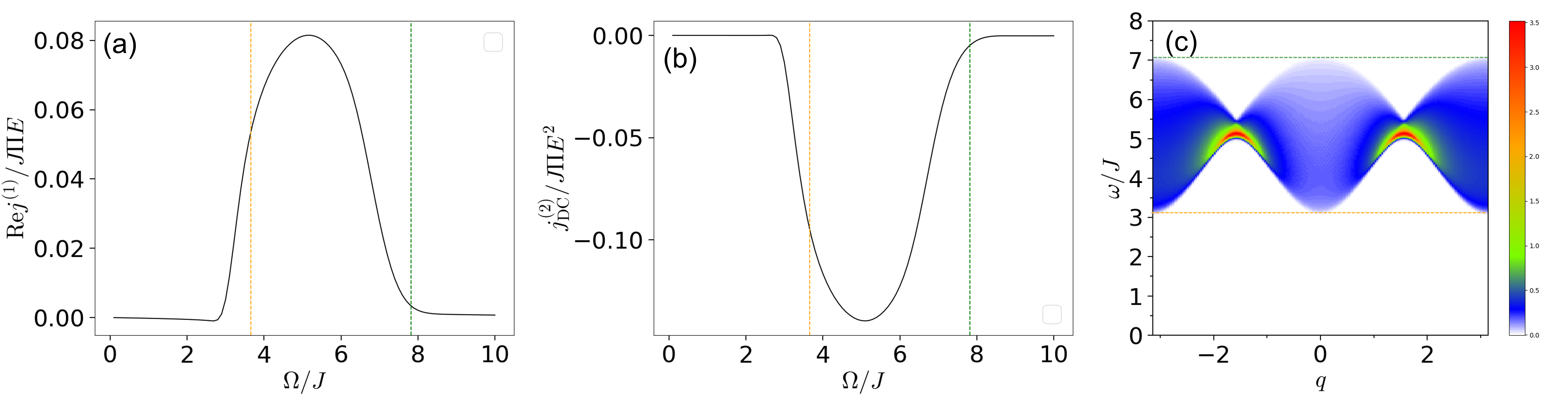
Figure 4: (a) Linear optical conductivity; (b) Second-order DC conductivity spectra; (c) Dynamical spin structure factor—demonstrating strong alignment between spinon excitation bands and photoconductivity.
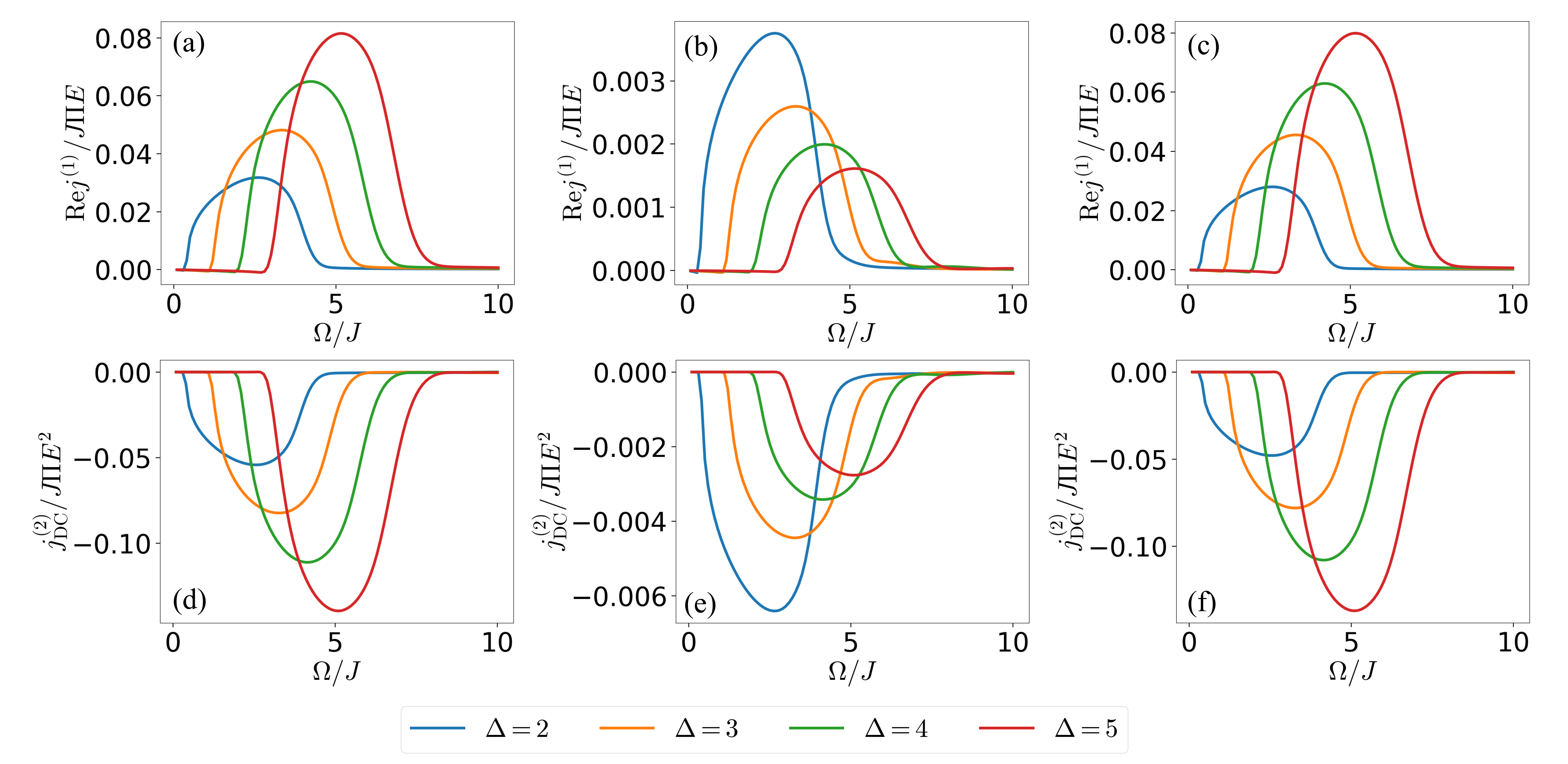
Figure 5: Laser frequency dependence of the current response for various H^0=Jj∑(S^jxS^j+1x+S^jyS^j+1y+ΔS^jzS^j+1z),2, showing the shift of peak position with spin chain anisotropy. Decomposition into H^0=Jj∑(S^jxS^j+1x+S^jyS^j+1y+ΔS^jzS^j+1z),3 and H^0=Jj∑(S^jxS^j+1x+S^jyS^j+1y+ΔS^jzS^j+1z),4 components reveals differing criticality dependence.
A decomposition between H^0=Jj∑(S^jxS^j+1x+S^jyS^j+1y+ΔS^jzS^j+1z),5 and H^0=Jj∑(S^jxS^j+1x+S^jyS^j+1y+ΔS^jzS^j+1z),6 contributions reveals a transition from H^0=Jj∑(S^jxS^j+1x+S^jyS^j+1y+ΔS^jzS^j+1z),7-dominated to isotropic scalar spin chirality as the system approaches the Heisenberg point (H^0=Jj∑(S^jxS^j+1x+S^jyS^j+1y+ΔS^jzS^j+1z),8), underscoring the nontrivial interplay between anisotropy and photocurrent generation.
Quantification of Spinon Dipole Response
The ratio of nonlinear to linear conductivity estimates the effective dipole moment carried by an optically excited spinon pair. Numerical evaluation shows H^0=Jj∑(S^jxS^j+1x+S^jyS^j+1y+ΔS^jzS^j+1z),9 is approximately constant as a function of J>00 within the examined range, implying a robust spinon polarization mechanism linked to the symmetry-breaking exchange striction mechanism.
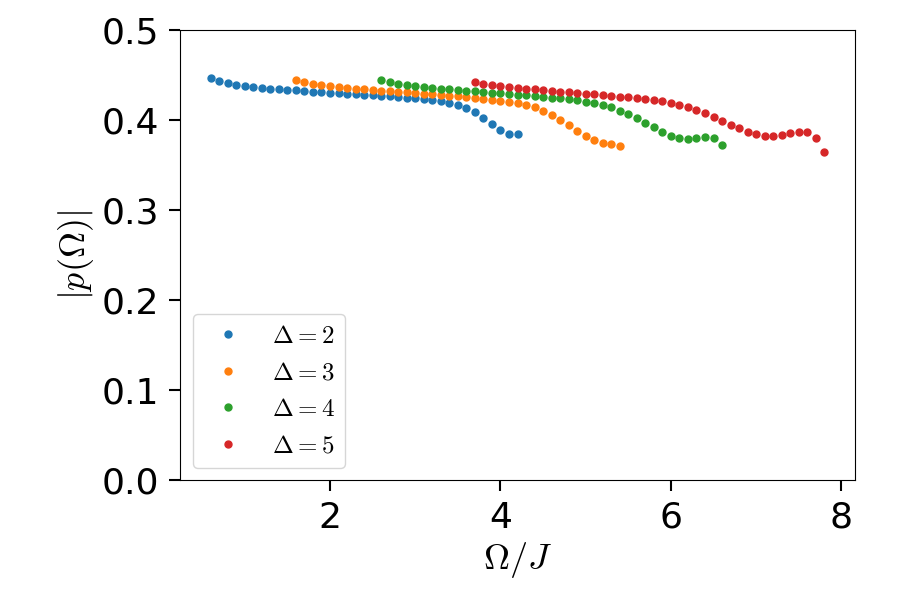
Figure 6: Dipole moment per spinon pair J>01, quantifying the polarization associated with fractionalized spinon excitations.
Theoretical and Experimental Implications
A key claim of the study is that shift current mediated by spinons constitutes a fundamentally distinct bulk photovoltaic response, absent of free carrier injection or ballistic current. This mechanism expands the scope of nonlinear optoelectronics in correlated insulators, introduces entirely new terahertz photoresponse channels, and motivates further exploration of fractionalized quasiparticle contributions to nonlinear transport in both quantum spin liquids and frustrated magnets.
Model calculations demonstrate that the magnitude of the shift current is directly comparable to those recently observed in multiferroic materials via magnon mechanisms, despite the absence of well-defined magnon excitations in this low-dimensional regime. The study further highlights the breakdown of magnon-based theory (Holstein-Primakoff expansion) in favor of exact descriptions via the Jordan-Wigner transformation.
The results point toward practical realization in quantum magnets under terahertz irradiation. Effective current densities and Glass coefficients are estimated and found to be within experimentally accessible regimes.
Conclusion
This work establishes the existence and quantitative characteristics of shift current in 1D noncentrosymmetric quantum spin chains, mediated by spinon fractionalized excitations. The findings rigorously demonstrate that strong correlations and broken inversion symmetry can produce emergent nonlinear photogalvanic effects outside the reach of conventional electronic or magnonic models. The work suggests fertile ground for further investigation of nonlinear optical phenomena in complex quantum magnets and potential device applications leveraging correlated-spin-driven bulk photovoltaic effects.