- The paper establishes a hidden quantum-geometric equivalence between injection and shift currents, unifying disparate nonlinear optical phenomena.
- It develops a framework based on Berry curvature and quantum metric dipoles to relate interband transitions in topological materials.
- Numerical validations in Weyl semimetals, strained graphene, and MnGeO₃ confirm the theory’s broad applicability and experimental relevance.
Emergent Quantum-Geometric Equivalence of Injection and Shift Currents
Introduction and Motivation
Injection and shift currents are two central nonlinear optical phenomena in quantum materials, conventionally understood as arising from disparate microscopic processes and exhibiting distinct polarization selection rules. Injection currents (IC) are attributed to momentum-space velocity asymmetries under circularly polarized light, while shift currents (SC) arise due to real-space displacement of photoexcited electronic wave packets under linearly polarized light. Historically, these effects have been treated as fundamentally unrelated, both in theory and in optical experiment design.
The present work formulates and establishes a general hidden quantum-geometric equivalence between IC and SC, demonstrated analytically and numerically across a range of topological materials—including Dirac and Weyl semimetals and strained graphene—where the relevant low-energy electronic dispersions are linear and virtual interband transitions are suppressed. This equivalence emerges from a unified framework grounded in the interband Berry-curvature dipole and quantum-metric dipole, fundamentally altering the interpretation of nonlinear optical responses and their underlying quantum geometry.
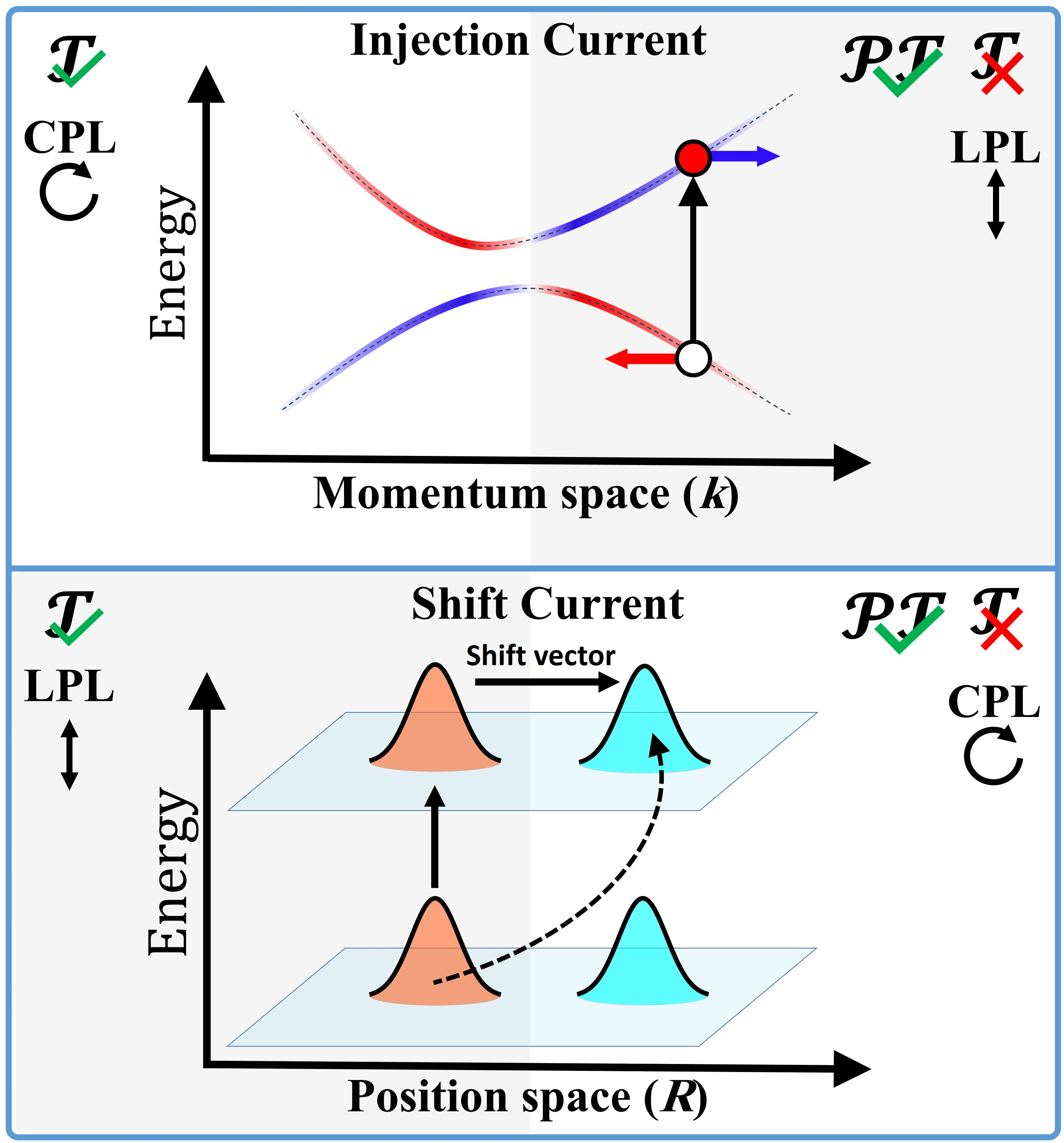
Figure 1: Comparison of injection and shift currents illustrates their distinct microscopic and experimental origins, yet the work reveals a deeper quantum-geometric connection.
The nonlinear DC current induced by optical fields at frequency ω is governed by second-order conductivity tensors:
Ja=σLabc(ω)Re[EbEc]+σCabc(ω)Im[EbEc]
Here, σL and σC capture the response under linearly and circularly polarized light, respectively. The injection current component σCICabc involves antisymmetrized (Berry curvature) products of interband Berry connections, while the shift current component σLSCabc incorporates symmetrized (quantum metric) products and additional Hamiltonian derivatives.
The authors demonstrate that, within the linearized band approximation and in the low-photon-energy limit, the shift current can be directly written in terms of the injection current, and vice versa:
σLSCabc≈−2τω1(σCICcba+σCICbca)
σCSCabc≈2τω1(σLICcba−σLICbca)
These relations reveal a robust functional equivalence, contingent upon negligible band warping and virtual transitions.
Quantum Geometry: Dipole Unification
The work rigorously recasts nonlinear optical responses in terms of quantum geometric dipoles:
- Berry curvature dipole Da;bc underpins the circular injection current (CIC) and linear shift current (LSC).
- Quantum metric dipole Qa;bc governs the linear injection current (LIC) and circular shift current (CSC).
Explicit formulations: Ja=σLabc(ω)Re[EbEc]+σCabc(ω)Im[EbEc]0
Ja=σLabc(ω)Re[EbEc]+σCabc(ω)Im[EbEc]1
Ja=σLabc(ω)Re[EbEc]+σCabc(ω)Im[EbEc]2
Ja=σLabc(ω)Re[EbEc]+σCabc(ω)Im[EbEc]3
This geometric formalism implies that experimental measurements of IC and SC in Dirac/Weyl materials and strained graphene are sensitive to unified quantum geometric properties, not to separate dynamical processes as previously believed.
(Figure 2)
Figure 2: Analytical and numerical confirmation of injection–shift current equivalence across Weyl semimetals, strained graphene, and MnGeOJa=σLabc(ω)Re[EbEc]+σCabc(ω)Im[EbEc]4. Band dispersions and conductivity spectra are shown.
Numerical and Material Validation
The equivalence is numerically validated in:
- Weyl semimetals: Both ideal (linear dispersion) and generic models (with tilt/warping) confirm the IC–SC correspondence.
- Strained twisted bilayer graphene: Linear dispersions near the Ja=σLabc(ω)Re[EbEc]+σCabc(ω)Im[EbEc]5 points and broken inversion symmetry yield ideal conditions, matching theory and computation.
- MnGeOJa=σLabc(ω)Re[EbEc]+σCabc(ω)Im[EbEc]6 antiferromagnetic Dirac semimetal: In Ja=σLabc(ω)Re[EbEc]+σCabc(ω)Im[EbEc]7-symmetric systems, LSC and CIC are symmetry-forbidden, but the LIC–CSC equivalence is observed, further corroborating the theory.
(Figure 2)
Figure 2: Material-specific injection–shift current relations demonstrate the universality of the quantum-geometric equivalence.
Physical and Theoretical Implications
This emergent equivalence reframes the interpretation of nonlinear photocurrents:
- Unified quantum geometry: Previously distinct nonlinear responses (IC, SC, second-harmonic generation) are seen as projections of a single quantum-geometric structure, specifically interband dipoles.
- Low-frequency divergence: The shift current, scaling as Ja=σLabc(ω)Re[EbEc]+σCabc(ω)Im[EbEc]8, diverges in metallic systems, indicating enhanced sensitivity to quantum geometry in low-energy optical experiments.
- Diamagnetic extraction: Combined IC and SC measurements allow experimental access to diamagnetic contributions otherwise inaccessible via conventional optics, relevant for quantifying Landau diamagnetism and superconductivity.
(Figure 3)
Figure 3: Schematic of the quantum-geometric equivalence: IC and SC (and SHG) are governed by dipole projections of Berry curvature and quantum metric, revealing their interconnected physical origin.
Expansion to Higher-Order Responses
Analysis of second-harmonic generation (SHG) shows that, in two-band models, SHG susceptibility decomposes into injection- and shift-current terms, further reinforcing the universality of the quantum-geometric framework for nonlinear optics in solids.
Future Directions
The theoretical framework suggests broader organizational principles for nonlinear optical phenomena in solids, especially in systems with nontrivial quantum geometry and topological properties. Experimental exploration across a wide variety of materials, including higher-order response functions and multi-band systems, stands to benefit from this geometric perspective. It may also provide new routes for engineering optoelectronic devices and probing fundamental aspects of quantum geometry.
Conclusion
The work rigorously establishes a quantum-geometric equivalence between injection and shift currents in quantum materials. Under appropriate conditions (linear low-energy dispersions, low photon energies), both responses are governed by the same interband quantum-geometric dipoles, collapsing disparate physical mechanisms into a unified geometric framework. Analytical expressions, numerical simulations, and material-specific validations confirm the generality and practical relevance of this equivalence. The implications span nonlinear optical diagnostics, quantum geometric engineering, and potentially reveal new organizing principles in the study of quantum materials (2605.08643).

