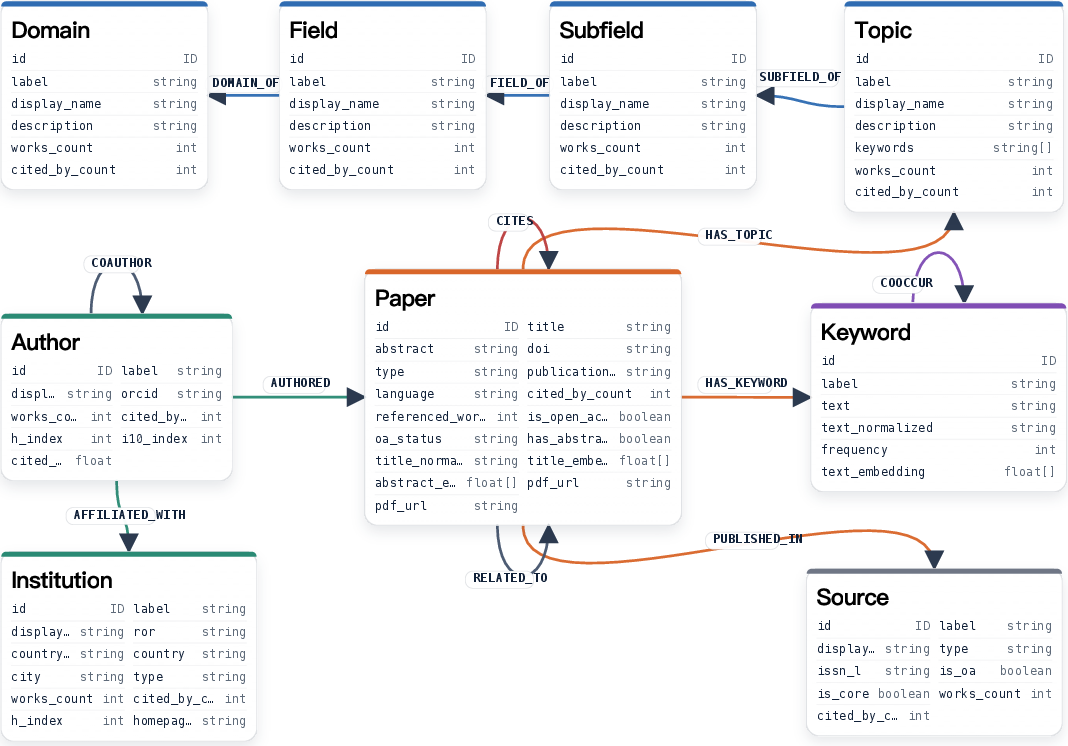
- The paper introduces a knowledge graph containing 43M papers, 157M entities, and 3B triplets to support deep interdisciplinary reasoning.
- It deploys a neuro-symbolic retrieval algorithm that combines textual, vector, and graph-based methods for fast, transparent discovery.
- The system underpins tasks like literature review, idea generation, and trend prediction, reducing logical hallucinations and enhancing automated research.
SciAtlas: A Large-Scale Multi-Disciplinary Knowledge Graph for Automated Scientific Research
Motivation and Context
The exponential escalation of global academic output has imposed significant challenges in structuring, retrieving, and integrating scholarly knowledge. Existing retrieval systems based on keyword matching or vector-space semantic similarities are insufficient for topological reasoning and fail to reveal complex inter-entity logic required for deep interdisciplinary synthesis. Agentic research frameworks relying on recurrent LLM search exhibit prominent logical hallucination and incur prohibitive inference cost. Addressing these limitations, "SciAtlas: A Large-Scale Knowledge Graph for Automated Scientific Research" (2605.22878) proposes a heterogeneous academic resource knowledge graph as a panoramic scientific evolution network, intended to serve as a logical substrate for automated scientific discovery, dismantling disciplinary barriers and enhancing both machine and human agent cognition.
Knowledge Graph Architecture
SciAtlas integrates 43M papers spanning 26 distinct academic disciplines, with 157M entities and 3B triplets. The schema is composed of nine major entity types (papers, authors, institutions, keywords, research fields, topics, subfields, domains, and sources) and twelve robust relational edge types including citations, authorship, co-authorship, keyword co-occurrence, and disciplinary hierarchy. The schema design enables four levels of organization:
Dataset Composition
SciAtlas achieves extensive coverage across diverse disciplines: Medicine (18.56%), Social Sciences (10.70%), Engineering (9.43%), Biochemistry, Genetics and Molecular Biology (6.44%), Computer Science (6.29%). Five domains collectively constitute 51.43% of paper volume, reflecting the concentration of scientific productivity. With 109.70M authors, 3.76M keywords, and billions of relational edges, the system supports fine-grained topological search, reasoning, and interdisciplinary integration.
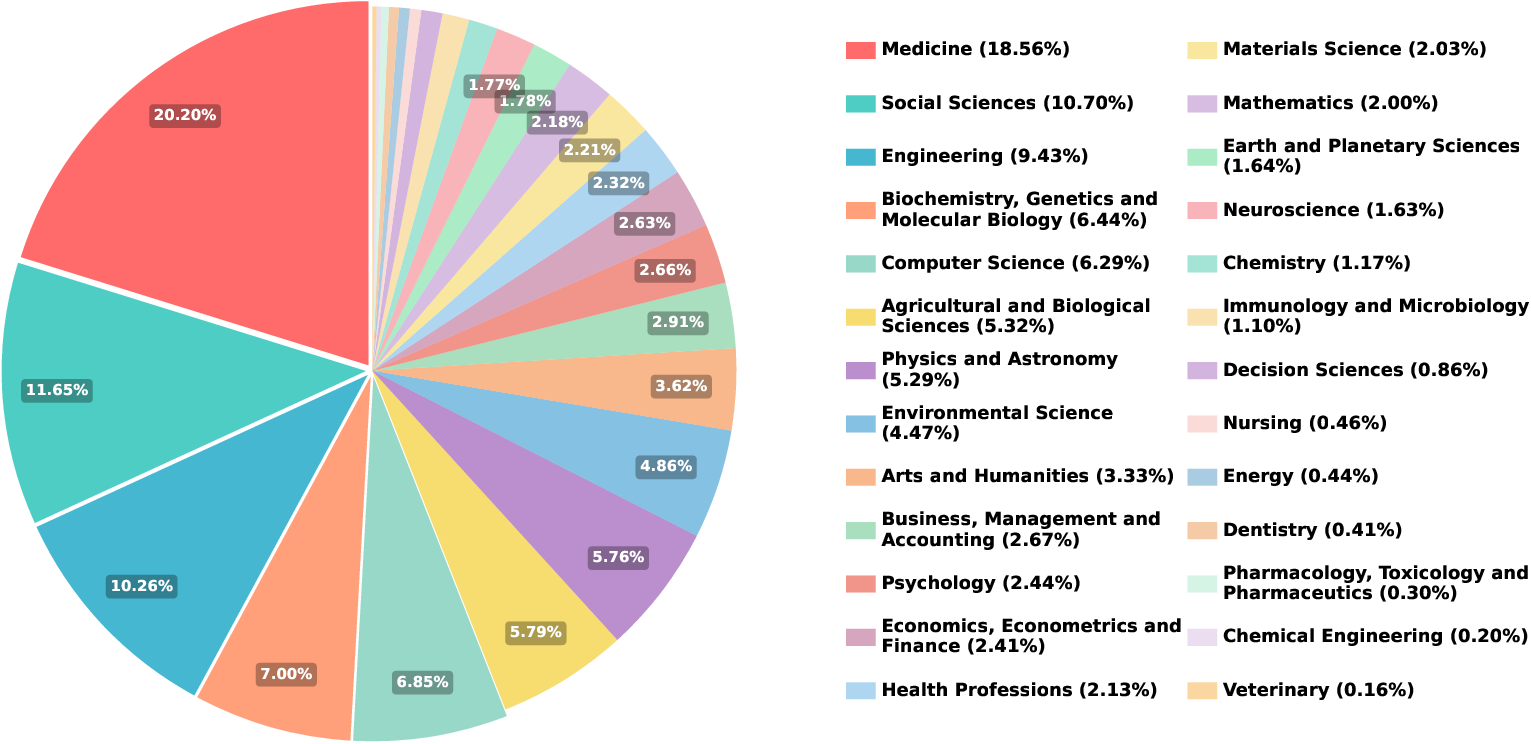
Figure 2: Discipline Distribution in SciAtlas highlighting dominant fields and broad academic representation.
Graph Construction and Updates
Raw data is harvested from OpenAlex, leveraging daily APIs and periodic changefiles for continuous schema evolution. Entity normalization and deduplication are performed for core attributes, excluding authors due to widespread synonymy. English-only, content-rich papers are retained. Keyword extraction is executed using instruction-tuned LLMs, focusing on reusable, domain-general concepts and explicitly filtering out paper-specific terminology and marketing language. Semantic vectors (bge-large-en-v1.5 embeddings) are additionally computed for titles, abstracts, and keywords to facilitate hybrid retrieval.
The database is deployed on Neo4j, with support for real-time updates via OpenAlex API and GROBID for missing entities, enabling dynamic augmentation and maintenance.
Neuro-Symbolic Retrieval Algorithm
SciAtlas advances retrieval beyond standard semantic matching by introducing a neuro-symbolic pipeline with tri-path collaborative recall and deep topological graph reranking—combining lexical matching, semantic vector retrieval, and graph propagation.
- Node Matching: For a query q, keywords are extracted via LLM and matched via textual and vector-based scores; papers are retrieved by embeddings, ranked via bge-reranker-large, and title-matching is augmented with fuzzy similarity metrics.
- Node Merging: Semantic and title matches are fused, normalized, and weighted; exact title matches are granted a substantial bonus.
- Edge Weighting: Relation-specific weighting schemes (HAS_KEYWORD, CITES, RELATED_TO, AUTHORED, COAUTHOR, COOCCUR) are used, leveraging citation counts, co-occurrence, and author-order for authority modulation. Edge weights are explicitly defined for each relation, controlling propagation.
- Random Walk with Restart (RWR): RWR is applied over the local subgraph with restart probability α and convergence tolerance ϵ, enabling deep exploration and reasoning over heterogeneous connections [rwr].
- Final Ranking: The topological reasoning scores, initial semantic scores, and citation-based importance are integrated via a linear combination with normalized gating, supporting transparent explanation of retrieval results and path-based interpretability.
The algorithm completes retrieval and deep reasoning within 2 minutes, considerably outperforming iterative LLM research agents in both speed and deterministic cognitive map construction.
Downstream Applications
SciAtlas's retrieval and topological reasoning mechanisms underpin a suite of downstream automated scientific research tasks:
- Literature Review: Supports venue, author, and institutional authority modulation in retrieval; compatible with LLM-based automated survey synthesis [autosurvey] [surveyforge] [surveyx].
- Idea Grounding and Evaluation: Enables multi-perspective idea grounding, evidence synthesis, and novelty/feasibility validation—facilitates both human and LLM-as-a-judge workflows [innoeval] [scholareval].
- Idea Generation: Retrieval supports combinatorial, diverse ideation, and interdisciplinary synthesis.
- Research Trend Predicting: Chronological/topical analysis, citation-weighted retrieval, and LLM-based summarization yield trajectory analysis and future direction proposals.
- Related Author Retrieval: Utilizes AUTHORED/COAUTHOR edge weighting for authoritative author ranking and collaborative network analysis.
- Researcher Background Review: Aggregates publication clusters, supports direction-wise LLM summarization for academic profiling.
The system is purpose-built for supporting agent-based scientific actors (e.g., LLM research agents), providing flexible CLI interfaces and integrated skills for routine automated intelligence workflows.
Limitations and Future Directions
Key limitations include dependence on Neo4j interface complexity, restricted scope to paper-centric entities (atomic facts, datasets, experimental protocols are not fully represented), lack of quantitative benchmarks for downstream tasks, and reliance on manual script-driven updates. Planned future work entails:
- CLI and agentic skill encapsulation for streamlined agent integration.
- Expansion to broader knowledge forms (datasets, code, standards, atomic facts) and more comprehensive logical association modeling.
- Dedicated benchmark development for quantitative downstream task evaluation.
- Systematic real-time dynamic update strategies.
Practical and Theoretical Implications
SciAtlas addresses critical obstacles in cognitive substrate formation for automated scientific discovery, providing structured topological representation and deterministic retrieval necessary for scaling agentic science. The neuro-symbolic retrieval pipeline demonstrates that hybrid deep reasoning over heterogeneous academic networks is feasible and efficient, reducing logical hallucinations in agentic workflows and supporting transparent multi-perspective synthesis.
Theoretically, the knowledge graph paradigm mitigates knowledge islanding and augments logical association discovery, highlighting the limitations of purely semantic retrieval in LLMs and underscoring the necessity of symbolic substrate for automated research reasoning. Practically, SciAtlas sets a new standard in the structuring, retrieval, and utilization of scholarly knowledge for both machine and human agents.
Potential for Future AI Developments
SciAtlas is poised to catalyze advances in agentic science, knowledge-based research assistance, and interdisciplinary synthesis. The comprehensive schema, scalable update mechanism, and explainable neuro-symbolic retrieval create opportunities for rigorous benchmarking, verifiable agent workflows, and robust scientific evaluation frameworks. As benchmark and downstream task modules mature, SciAtlas will be integral to general scientific intelligence systems, agentic hypothesis generation, and automated peer review.
Conclusion
SciAtlas delivers a large-scale, multi-disciplinary, heterogeneous academic knowledge graph, engineered for panoramic topological reasoning and cognitive mapping in automated scientific research. The system's neuro-symbolic retrieval algorithm accomplishes the transition from semantic matching to deterministic graph-based association discovery, dismantling disciplinary silos and accelerating both agentic and human scientific workflows, with explicit path-based explanations and substantially reduced reasoning costs. SciAtlas stands to be a core infrastructural component in future agentic AI for science.