AttuneBench: A Conversation-Based Benchmark for LLM Emotional Intelligence
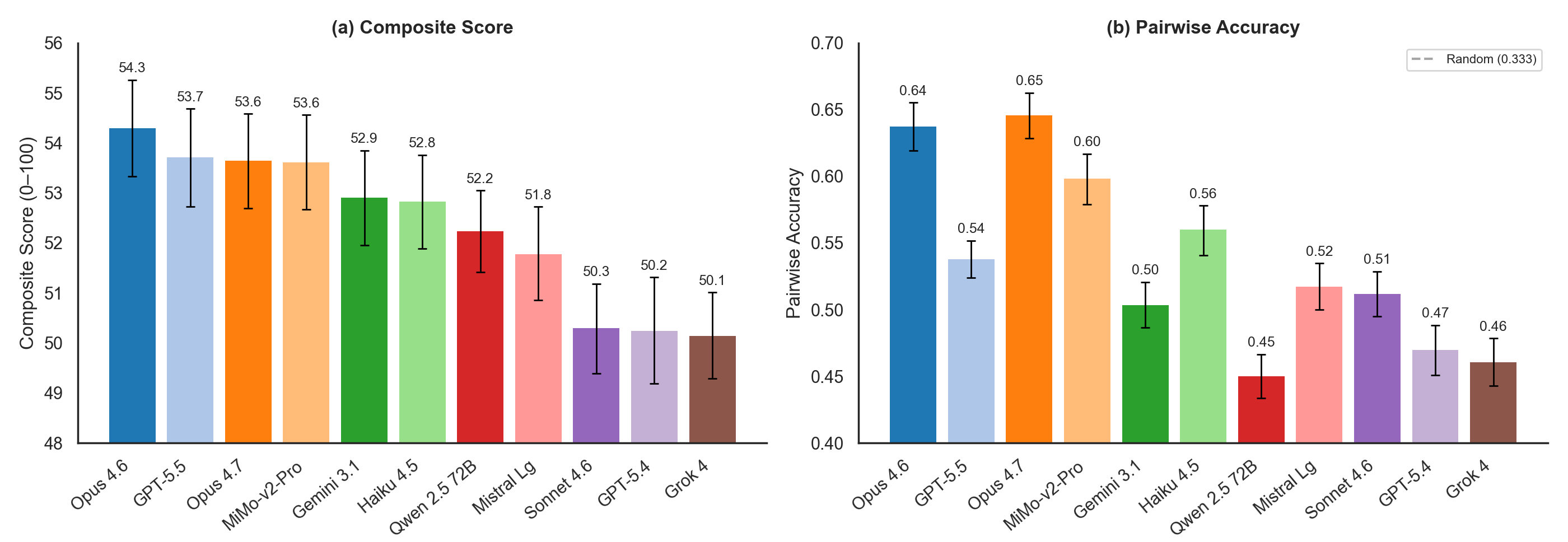
Abstract: Emotional intelligence (EI), the ability to perceive, understand, and respond appropriately to others' emotional states, is central to human communication, and increasingly important to assess as LLMs assume conversational roles in everyday life. Existing EI benchmarks rely on synthetic prompts, single-turn cases, or third-party annotation. These approaches do not directly measure how models infer and respond to a participant's emotional state over the course of a real conversation. We introduce AttuneBench, a benchmark grounded in 200 genuine multi-turn human-model conversations in which participants conversed with anonymized LLMs and provided turn-by-turn annotations of their emotional state, the model's behavior, and their preferred responses. Across 11 evaluated models, we find that model rankings on emotion recognition, behavioral classification, preference prediction, and judged response quality are largely independent, indicating that emotionally intelligent behavior decomposes into separable capabilities. Preference alignment and response-quality judgments are substantially more model-discriminating than emotion-label accuracy. These results indicate that emotionally intelligent behavior requires predicting what kind of response a specific user wants in context, a distinction that aggregate scoring can obscure and that single-turn or synthetic formats cannot directly capture across turns. AttuneBench provides a framework for assessing each of these capabilities and for diagnosing model-specific strengths and failure modes in emotionally salient conversation.
Paper Prompts
Sign up for free to create and run prompts on this paper using GPT-5.
Top Community Prompts
Explain it Like I'm 14
What is this paper about?
This paper introduces AttuneBench, a new way to test how well AI chatbots understand and respond to people’s emotions in real conversations. Instead of using made-up, one-turn prompts, the researchers built a benchmark from 200 genuine, multi-turn chats between people and AI. They then used those chats to see how 11 different AI models handle feelings, preferences, and tone over time.
What questions did the researchers ask?
The study focused on three simple questions:
- Can AI tell how a person is feeling as a conversation unfolds?
- Can AI choose or create replies that match what the person actually wants (comfort, advice, space, etc.)?
- Are these skills connected, or are they separate abilities?
How did they study it?
The researchers followed a clear, three-part process:
- Collect real conversations
- People chatted with an AI about everyday and sensitive topics (like friends, school, money, relationships).
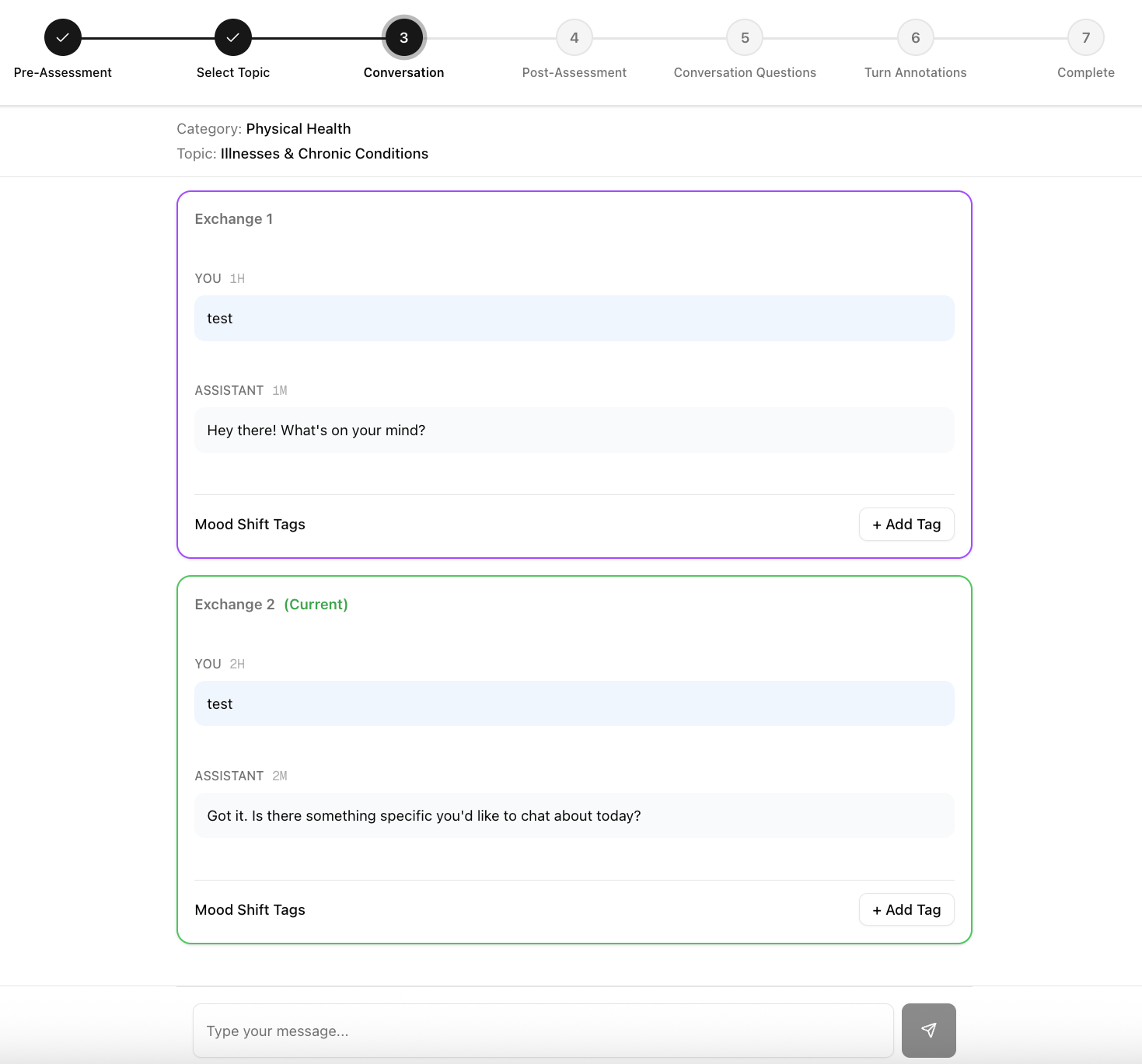
- During and after each chat, the person marked how they felt and what kind of reply they would have preferred.
- Turn feelings and preferences into “ground truth”
- People used a well-known feelings checklist called PANAS (20 emotions rated from low to high) before and after the chat. Think of PANAS like a mood scorecard.
- At each turn, the person could tag mood shifts (for example, “more nervous,” “less angry”).
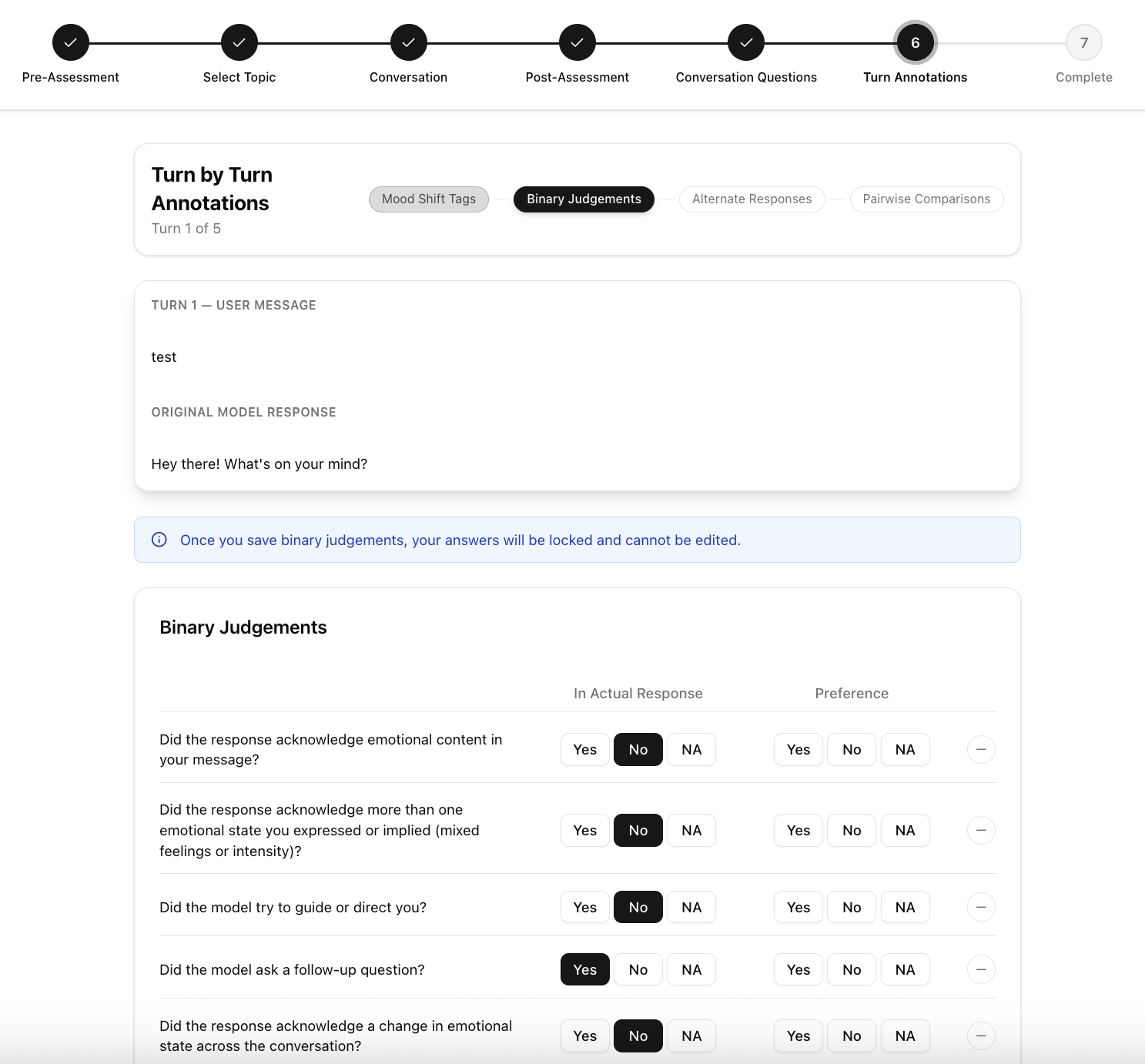
- For each AI reply, the person said what the AI actually did (observed behavior) and what they wished it had done (preferred behavior), such as “gave advice,” “asked questions,” or “showed empathy.”
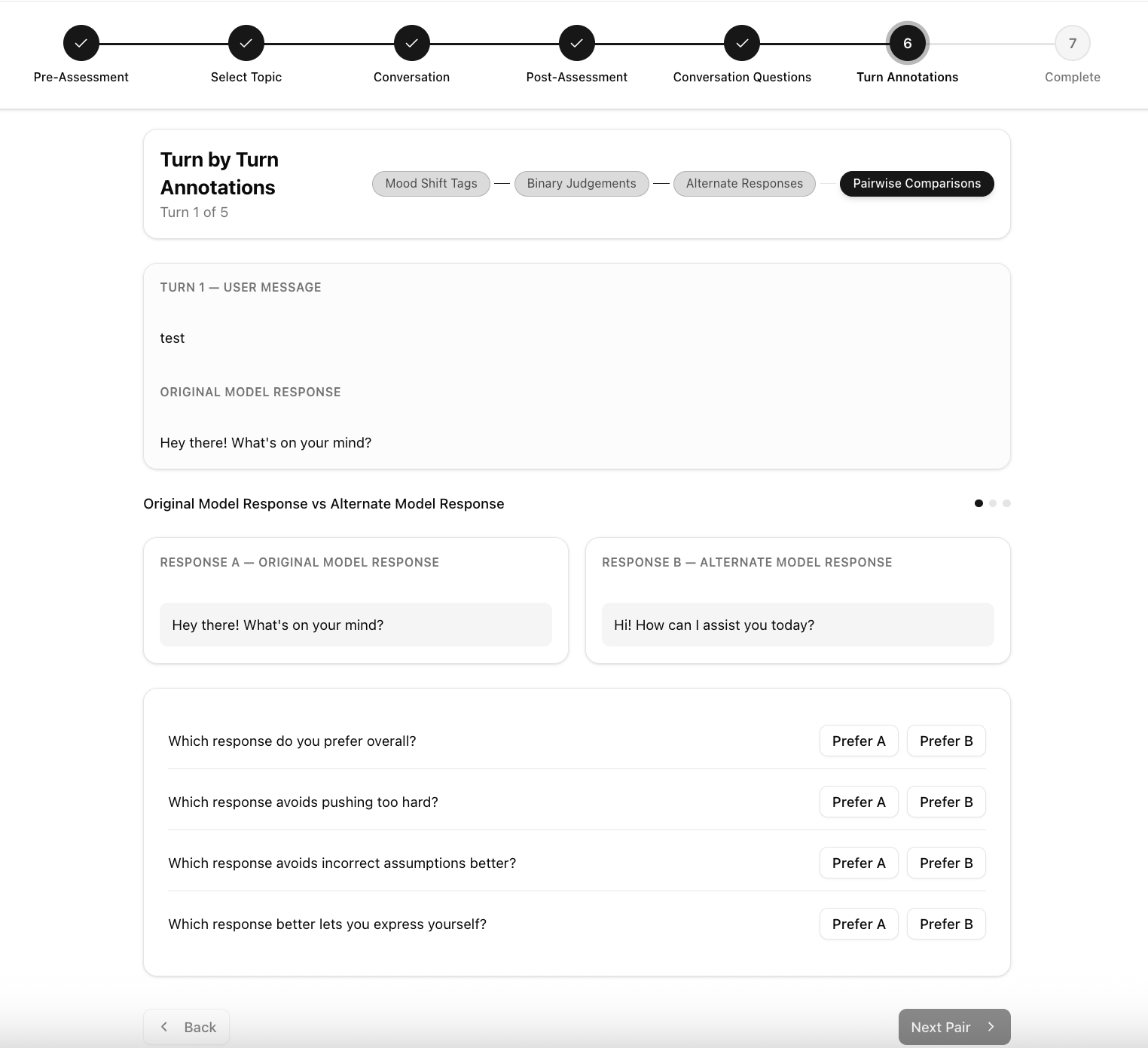
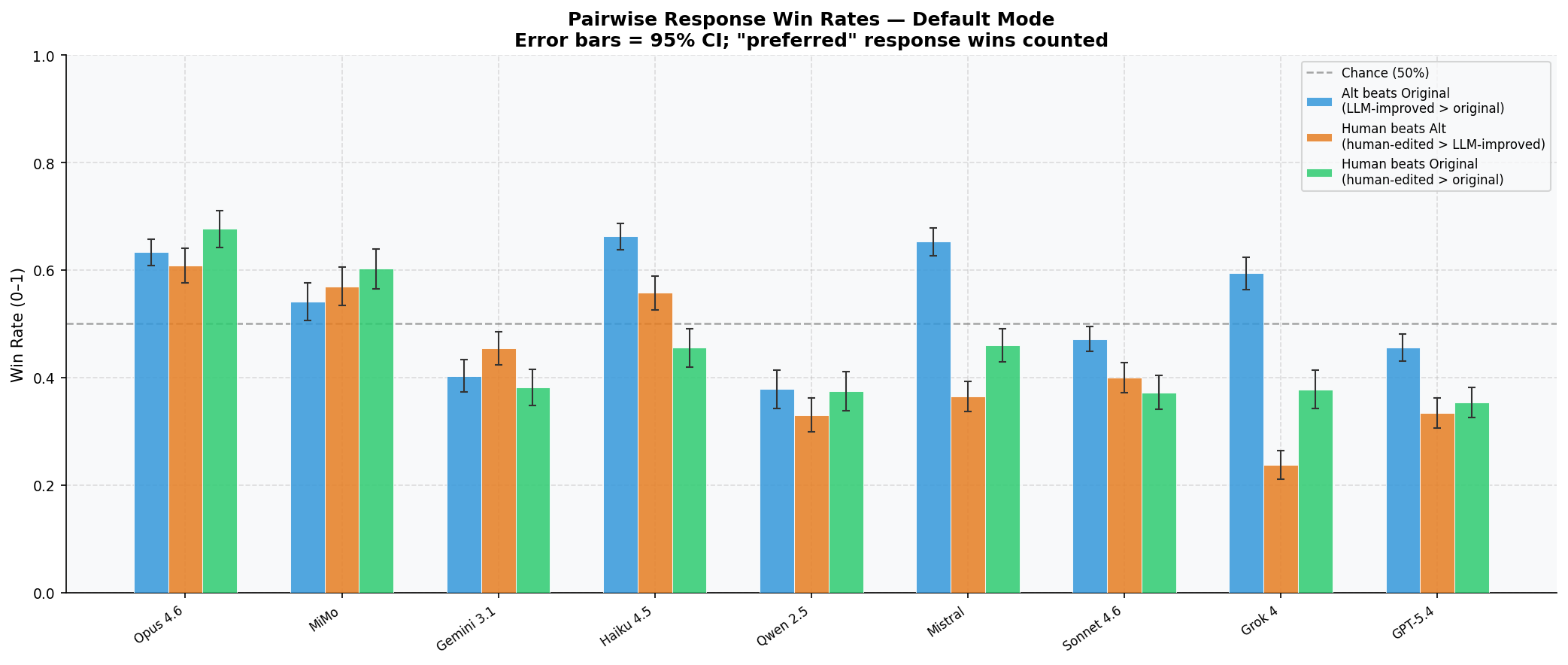
- They also compared three responses per turn:
- the AI’s original reply,
- an adjusted reply after the AI was told the person’s preferences,
- and the person’s own edited “golden” reply.
- This is like a “pick your favorite” test among A, B, and C.
- Test many AIs on the same chats
- Later, other AI models (not the one from the original chat) were shown the conversation and asked to:
- guess the person’s mood shift tags,
- judge the AI’s behavior and the person’s preferences,
- rank which reply the person would have liked best,
- and predict how the person felt after the whole conversation.
- The researchers scored the models in several ways:
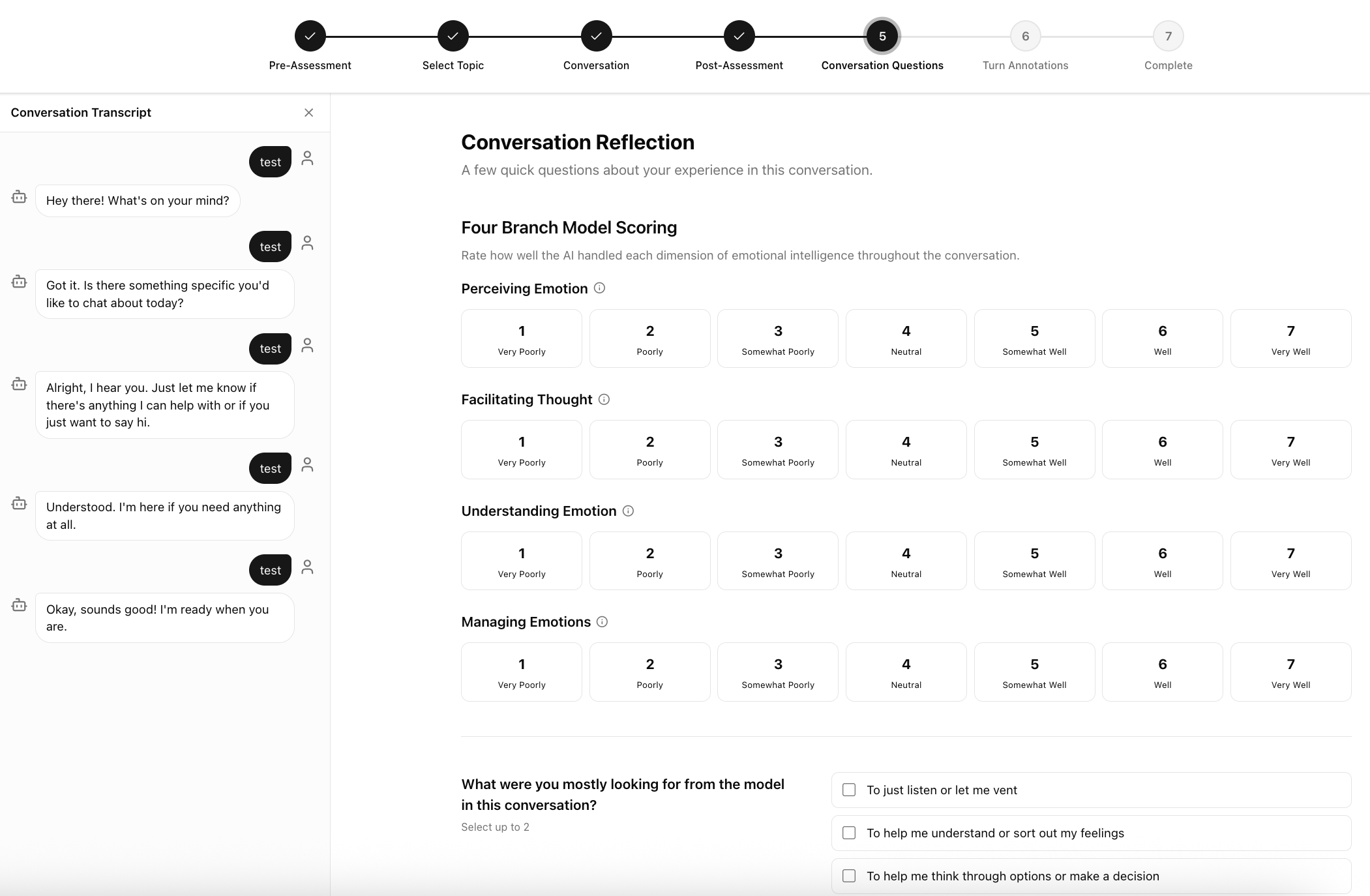
- Emotion tracking: Did the AI correctly sense changes in feelings? (They also gave partial credit when the guess was close in “positivity/negativity” and “intensity.”)
- Behavioral classification: Did the AI correctly judge what the original reply did and what the person wanted?
- Preference prediction: Did the AI pick the reply the person actually preferred?
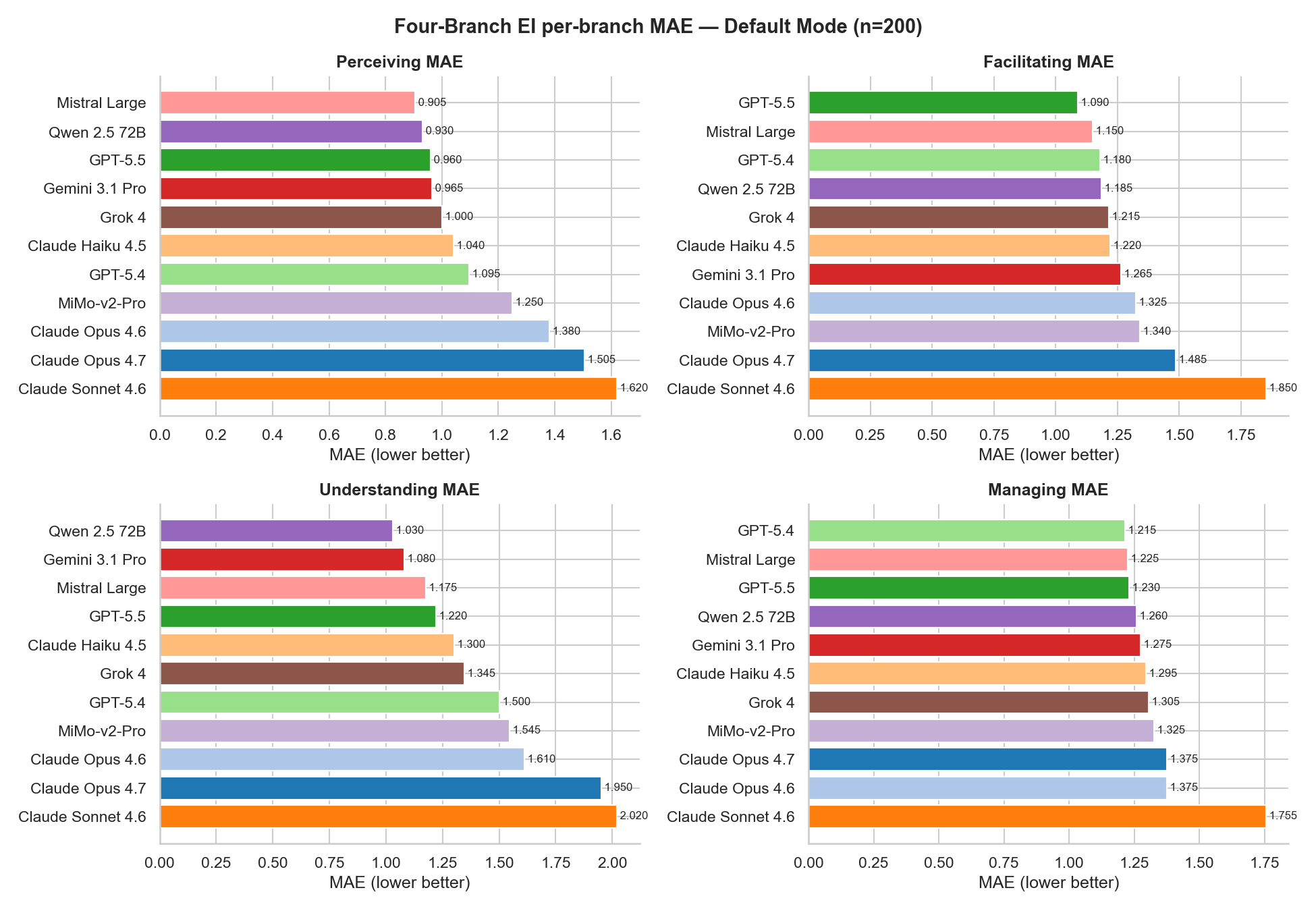
- Conversation-wide understanding: Did the AI understand big-picture things, like the person’s goals and how well the chat fit their needs?
- Composite score: One combined score—but the paper warns this can hide important differences.
Key terms explained simply:
- Benchmark: A shared test or scoreboard used to compare different AIs.
- Multi-turn conversation: A back-and-forth chat with several messages on both sides, not just one question and answer.
- Valence and arousal: “Valence” is how positive or negative a feeling is (happy vs. sad); “arousal” is how energized or intense it is (calm vs. excited).
- Pairwise preference: Choosing which of two (or three) replies you like best.
What did they find?
Here are the main takeaways, in plain language:
- Emotional intelligence breaks into separate skills
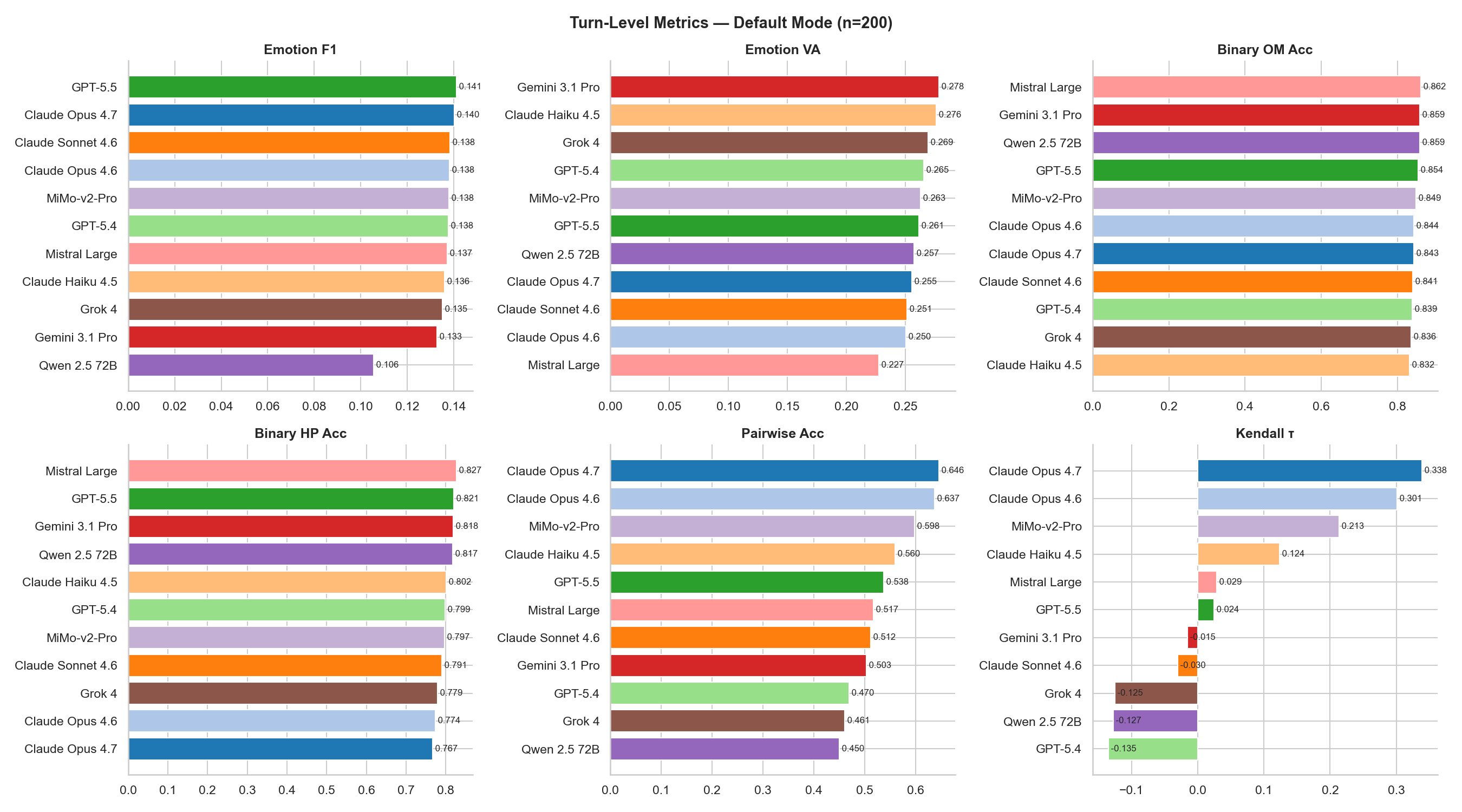
- Being good at one skill (like picking the best reply) didn’t mean the model was also best at another (like reading emotions). Rankings changed a lot depending on the skill.
- Predicting what the user wants is the most telling skill
- Figuring out the kind of response a person prefers (comfort, advice, validation, etc.) separated strong and weak models more than just labeling emotions. In other words, what people want matters more than naming their feelings.
- A single overall score can be misleading
- Models looked similar on the one-number “Composite” score, but very different on the details. You need to look at each skill to know what a model is actually good at.
- Turn-by-turn strengths vs. big-picture understanding
- Some models were great at picking the best reply moment-to-moment but weaker at understanding the conversation as a whole (like the person’s overall goals).
- Others were the opposite: good at big-picture understanding but not as strong at choosing the best immediate reply.
- Outside observer vs. first-person perspective
- Models were better at judging behavior from an “observer” viewpoint than from the “what the person themselves wants” viewpoint. In real life, what you want can be different from what an outsider thinks is happening.
- Harder cases and drift over time
- Emotions were harder to track for people with diagnosed mental health conditions. Also, topics like romantic relationships were trickier for AIs.
- As conversations got longer, some skills (like judging behavior) tended to slip a bit—like losing focus over time.
- Real conversations add value
- Single-turn or made-up prompts don’t capture how emotions shift across turns. The multi-turn, real-chat setup caught things simpler tests miss.
Why does it matter?
This work shows how to test emotional intelligence in AI in a way that feels closer to real life. The practical impacts are:
- Better tools to build kinder, more helpful chatbots
- Developers can see which emotional skills their AI is missing (for example, it might label feelings okay but fail to give the kind of reply the user actually wants) and improve those parts.
- Safer use in sensitive situations
- Since many people seek emotional support from AI, it’s important to know where models fail—especially for mental health topics—and not rely on them as if they were trained therapists.
- Smarter evaluation culture
- One big number isn’t enough. This benchmark encourages looking at separate skills: emotion tracking, preference prediction, behavior understanding, and overall conversation fit.
- A shared, open testbed
- The dataset, code, and leaderboard are public, so researchers can compare models fairly and see progress over time.
In short: AttuneBench shows that “emotional intelligence” in AI isn’t just one thing. To be truly helpful, an AI needs to sense how you feel, understand what you want from the reply, and adapt across the whole conversation—not just guess a feeling label.
Knowledge Gaps
Knowledge Gaps, Limitations, and Open Questions
Below is a consolidated list of what remains missing, uncertain, or unexplored in the work, framed as concrete opportunities for future research and benchmarking improvements.
- Participant diversity and scale
- Only 11 US-based, native-English adult participants contributed; expand to larger, more demographically and culturally diverse, multilingual cohorts (including adolescents, older adults, and non-US populations) to assess generalizability.
- Participants appear to be professional annotators; replicate with non-expert, real-world users to check ecological validity.
- Multimodality and contextual cues
- Benchmark is text-only; add audio (prosody), video (facial affect, gestures), and interaction timing to evaluate EI performance with realistic nonverbal signals.
- Emotion measurement validity
- Reliance on PANAS (20 items) and NRC VAD mapping may not capture nuanced or idiosyncratic affect; compare against alternative frameworks (e.g., appraisal models, PAD, dimensional continuous sliders) and validate mapping sensitivities.
- Large drop in Emotion VA for participants with diagnoses suggests PANAS may underfit neurodivergent affect expression; design tailored instruments or calibration protocols for these groups.
- Optional turn-level mood tags introduce sparsity/selection bias; quantify tag coverage rates and evaluate how tag density affects metric reliability.
- Annotation reliability and ground truth robustness
- The full dataset lacks multi-rater labels and comprehensive inter-rater reliability estimates (only a 7-conversation pilot); collect multi-annotator judgments and report IAA (e.g., Cohen’s κ/α), test–retest reliability, and adjudication protocols.
- “Golden” responses (human-written) are not quality-checked by independent raters; validate their consistency and representativeness with blinded human panels.
- Question selection and construct coverage
- Turn-level binary questions are LLM-filtered; measure how LLM-assisted selection skews label distributions and difficulty, and compare against random or expert-curated subsets.
- Validate the content validity of the 36-question pool against EI theory; assess coverage gaps and redundancy via factor analysis.
- Metric design and validation
- Composite weight choices (24% emotion, 49% verification, 27% holistic) are not sensitivity-tested; perform weight perturbations and rank-stability analyses.
- Investigate why Emotion F1 is minimally discriminative (η² ≈ 0.003); refine label sets, adopt continuous measures, or re-specify scoring to improve signal.
- Calibrate and evaluate confidence-aware metrics (e.g., Brier score, ECE) for binary and preference predictions to capture over/under-confidence.
- Use psychometric/latent-variable methods (factor analysis, IRT) to verify that reported metric clusters reflect true capability factors and not scoring artifacts.
- Judge and evaluator dependence
- Draft quality relies on a single LLM judge (Mistral Large); quantify robustness across multiple judges and human raters, and detect style biases.
- Assess run-to-run variance due to LLM nondeterminism (temperature, sampling seed); report confidence intervals accounting for generation stochasticity.
- Interaction realism and adaptivity
- EM evaluation is offline (no live user feedback); build an interactive track where models adapt over turns to explicit/implicit signals and measure improvement.
- No modeling of long-term relationships or cross-session continuity; add longitudinal conversations to assess memory and attunement persistence.
- Original-model (OM) influence and confounds
- OM distribution is unbalanced; design balanced OM sampling and analyze how OM style/quality shapes HP preferences and downstream metric difficulty.
- The alternate response is generated after exposing OM to HP preference signals; test whether this pipeline introduces systematic advantages for certain variants and reshapes pairwise difficulty.
- Topic and scenario coverage
- Random topic assignment without adaptive balancing limits coverage of high-stakes/edge cases (e.g., crisis, self-harm ideation, substance abuse); introduce targeted elicitation for varied intensity and risk levels with safety protocols.
- Per-topic n is likely small; increase data per topic to enable reliable, fine-grained topic-wise diagnostics.
- Negative preference alignment findings
- Five models show negative mean Kendall τ (anti-aligned preferences); perform qualitative error analyses to identify linguistic/pragmatic patterns driving inversions and propose training/evaluation remedies.
- Perspective gap (observer vs first-person)
- All models are better at Binary OM than Binary HP; investigate causes (theory-of-mind limits, perspective-taking prompts, instruction framing) and design tasks to explicitly train/evaluate closing this gap.
- Personalization and user modeling
- Omniscient mode (psychometric + pre-PANAS) does not help consistently; explore more actionable, privacy-preserving user representations (e.g., value orientations, conversation goals), and evaluate how different user-model features impact performance.
- Turn-level drift and context effects
- Behavioral metrics degrade across turns; isolate mechanisms (context dilution, topic drift, instruction fatigue) and test mitigation strategies (summarization checkpoints, reflection prompts).
- Examine how conversation length, turn density, and cognitive load modulate metric trajectories beyond the coarse “thirds” analysis.
- Fairness and subgroup analyses
- Beyond mental-health diagnosis, subgroup effects (gender, age, SES, LLM familiarity) are not analyzed; conduct intersectional fairness evaluations and report disparate performance and error modes.
- Generalization and overfitting risks
- Public leaderboard without a hidden test set risks test-set overfitting via repeated submissions; provide hidden or periodic refresh sets and audit logs to track adaptivity to the benchmark.
- No mechanism enforces “no training on benchmark” beyond guidelines; consider watermarking or challenge sets to detect contamination.
- Safety and real-world outcomes
- The link between benchmark scores and real-world outcomes (user satisfaction, de-escalation success, well-being changes) is unquantified; conduct prospective studies correlating AttuneBench metrics with user-level outcomes.
- Safety behaviors (e.g., harm-minimizing responses in sensitive contexts) are not separately assessed; add safety-focused EI tasks and outcome measures.
- Multilingual and cross-cultural pragmatics
- EI performance across languages and cultural norms (e.g., indirectness, high/low context communication) remains untested; extend to multilingual datasets with native annotators and culture-specific constructs.
- Data quality/process transparency
- Report per-conversation annotation time, fatigue effects, and missingness patterns to quantify label quality and identify points for workflow optimization.
- Validate that anomalies (e.g., near-zero Q3 follow-up accuracy for two models) are not due to prompt formatting or evaluation bugs via replication with alternate prompts/templates.
- Emotion representation and scoring details
- Provide sensitivity analyses for the VAD mapping (choice of lexicon, normalization constant) and explore learned embeddings or human-rated proximities tailored to PANAS items.
- Model intensity dynamics more explicitly (continuous time series per emotion vs discrete tags), and assess whether intensity-specific predictions improve discrimination.
- Robustness stressors
- Evaluate robustness to sarcasm, figurative language, code-switching, dialects, emojis, and adversarial/ambiguous prompts to reflect real conversational challenges.
- Link between style and preference
- Preliminary findings show surface similarity does not predict preference alignment; systematically disentangle stylistic vs substantive factors in user preference and train models accordingly.
Practical Applications
Practical Applications Derived from AttuneBench
Below are actionable applications that leverage AttuneBench’s dataset, metrics, and findings. Each application notes target sectors, possible tools/workflows/products, and key assumptions or dependencies that affect feasibility.
Immediate Applications
- Attunement QA and Regression Testing in CI/CD
- Sectors: Software, Customer Support, Consumer Assistants, Fintech, Edtech
- What: Integrate AttuneBench runner and metrics into model release pipelines to catch regressions in emotion tracking, preference prediction, and conversation-wide comprehension before deployment.
- Tools/Workflows/Products: “Attunement CI” GitHub Action; per-metric dashboards; gating rules (e.g., no release if Pairwise Accuracy drops >2 pts).
- Assumptions/Dependencies: Access to chat APIs; willingness to adopt non-synthetic CI tests; cost budget for ~24 API calls/conversation; cannot fine-tune on AttuneBench data by design.
- Model Selection and Routing by Capability Profile
- Sectors: Customer Support, Personal Finance Coaching, HR Coaching, Edtech
- What: Use per-metric scores to choose models (or route turns) based on strengths (e.g., models with higher binary HP accuracy for compliance workflows vs. models with higher pairwise for tone-sensitive coaching).
- Tools/Workflows/Products: “Capability profile matrix” service; dynamic router that switches models for early vs. late turns to mitigate turn-drift.
- Assumptions/Dependencies: Multiple model contracts; orchestration layer; acceptance of added latency/cost.
- Preference-Aware Response Re-ranking
- Sectors: Consumer Assistants, Customer Support, Edtech, Productivity Tools
- What: Generate multiple response variants and re-rank using predicted user preference (leveraging the benchmark’s finding that preference prediction is most discriminating).
- Tools/Workflows/Products: Two-pass generation (draft + preference-informed alt) with local re-ranker; small learning-to-rank module fine-tuned on in-product preference signals (not AttuneBench).
- Assumptions/Dependencies: Logging and safe storage of user preference signals; privacy safeguards; extra token cost.
- Perspective-Gap Auditing (Observer vs. First-Person)
- Sectors: Regulated Industries (Finance, Healthcare-adjacent, Government), Customer Support
- What: Report and minimize the “perspective gap” (higher Binary OM than Binary HP) to reduce misreads when users frame issues in first person.
- Tools/Workflows/Products: “Perspective Gap Panel” in internal eval reports; prompt refinements or post-processing to switch to first-person calibration when user speaks about self.
- Assumptions/Dependencies: Willingness to interpret and act on per-metric divergence; prompt engineering expertise.
- Turn-Drift Monitoring and Escalation
- Sectors: Contact Centers, Enterprise Assistants, Health-Wellness Apps (non-clinical)
- What: Monitor degradation of behavioral assessment over successive turns; trigger summarization, tone reset, or escalation to a human agent.
- Tools/Workflows/Products: “Turn Drift Monitor” microservice; confidence thresholds; auto-inserted recap prompts after N turns.
- Assumptions/Dependencies: Conversation telemetry; acceptable cost for additional turns; human-in-the-loop availability.
- Diagnosis-Sensitivity and Topic-Sensitivity Audits
- Sectors: DEI/Accessibility, HR Tools, Education, Consumer Assistants
- What: Test models against subgroups and topics where performance drops (e.g., neurodivergent users, romantic relationships) to mitigate disparities.
- Tools/Workflows/Products: Internal red-team packs inspired by AttuneBench’s findings; product-level flags for sensitive topics.
- Assumptions/Dependencies: Ethical review; careful synthetic or new consented data collection (since AttuneBench itself isn’t for training); bias/fairness governance.
- Procurement and Vendor Evaluation Checklists
- Sectors: Enterprise IT, Public Sector, Healthcare-adjacent apps
- What: Require per-metric attunement reporting in RFPs and vendor assessments (e.g., Pairwise Accuracy, Four-Branch MAE, Perspective Gap).
- Tools/Workflows/Products: “Attunement Criteria” annex for RFPs; due-diligence templates referencing public leaderboard scores.
- Assumptions/Dependencies: Buyers accept non-single-number evaluations; vendors agree to run benchmark per usage guidelines.
- In-Product Attunement Telemetry
- Sectors: Consumer Apps, Productivity, Customer Support
- What: Instrument production chat to capture implicit preference signals (thumbs up/down, rewrite requests, tone changes) and track alignment trends versus internal targets.
- Tools/Workflows/Products: Lightweight “attunement SDK” for telemetry; internal preference trackers; bias-aware aggregation.
- Assumptions/Dependencies: Privacy-by-design; consent flows; ANON/PSEUDON; no training on AttuneBench; data minimization.
- Non-Clinical Wellness and Coaching Bots: Pre-Launch Safety Screen
- Sectors: Wellness Apps, Coaching, HR Enablement
- What: Use AttuneBench to identify anti-aligned preference patterns, perspective gaps, and turn drift before allowing “emotional support” claims.
- Tools/Workflows/Products: Launch checklist that combines pairwise and conversation-wide metrics; holdbacks for flagged patterns.
- Assumptions/Dependencies: Not a clinical validation; need separate safety/ethics review for high-risk use.
- Academic Replication and Baseline Comparisons
- Sectors: Academia, Research Labs
- What: Benchmark new EI methods, prompting strategies, and preference modeling against a public EI suite with multi-turn, human-grounded annotations.
- Tools/Workflows/Products: Reproducibility bundles; ablation studies on Default vs. Verbose vs. Omniscient modes.
- Assumptions/Dependencies: Respect usage guidelines (no training on test data); compute/API budgets.
Long-Term Applications
- Multi-Objective Training That Disentangles EI Skills
- Sectors: Foundation Model Providers, Research Labs
- What: Train models with separate heads/losses for emotion tracking, preference prediction, and first-person behavioral judgments to address observed independence and negative correlations.
- Tools/Workflows/Products: Modular reward models; curriculum learning over multi-turn EI tasks.
- Assumptions/Dependencies: New datasets beyond AttuneBench for training; careful avoidance of benchmark contamination; compute budget.
- Real-Time Model Routing by Conversation Phase
- Sectors: Contact Centers, Consumer Assistants
- What: Route early turns to models that excel at binary judgment and later turns to those with robust preference alignment to offset turn-drift.
- Tools/Workflows/Products: Phase-aware router; latency-aware cost optimizer.
- Assumptions/Dependencies: Availability of multiple models; acceptable latency; orchestration reliability.
- Personalization with Privacy-Preserving Preference Profiles
- Sectors: Consumer Assistants, Edtech, HR Coaching
- What: Build per-user preference embeddings to improve response re-ranking and tone calibration over time.
- Tools/Workflows/Products: On-device or federated preference models; secure storage; consented feedback loops.
- Assumptions/Dependencies: Strong privacy safeguards; differential privacy or federation; regulatory compliance.
- Clinically-Oriented, Validated EI Extensions
- Sectors: Healthcare (clinical), Digital Therapeutics
- What: Co-develop and validate clinical-grade benchmarks (with clinicians) for high-risk contexts (e.g., suicidality detection, crisis de-escalation) incorporating voice/prosody and strict safety policies.
- Tools/Workflows/Products: Multimodal AttuneBench-Clinical; clinician-in-the-loop evaluation; pre-approval trials.
- Assumptions/Dependencies: IRB oversight; clinical validation; safety/consequence analysis; not supported by current AttuneBench alone.
- Multilingual and Cross-Cultural Attunement Standards
- Sectors: Global Products, Public Sector, Education
- What: Extend methods to multiple languages and cultures; create norms for culturally appropriate EI assessment.
- Tools/Workflows/Products: Regionalized datasets and metrics; cross-cultural calibration panels; localized PANAS mappings.
- Assumptions/Dependencies: New participant cohorts; cultural psychology expertise; funding for data collection.
- Voice and Embodied Interaction Attunement (Prosody, Gesture)
- Sectors: Voice Assistants, Social Robotics, Contact Centers
- What: Add audio/video channels to assess and improve attunement to prosody, timing, and non-verbal cues.
- Tools/Workflows/Products: Multimodal benchmarks; prosody-conditioned generators; robot behavior policies.
- Assumptions/Dependencies: Additional sensing; privacy constraints; new annotation pipelines.
- Safety Monitors for “Attunement Drift”
- Sectors: Regulated Industries, Customer Support
- What: Train small supervisory models to watch conversations for worsening alignment or misunderstood user states and trigger corrective actions.
- Tools/Workflows/Products: Drift detector services; reinforcement signals to reduce escalation risk.
- Assumptions/Dependencies: Labeled longitudinal data; careful alarm calibration to avoid alert fatigue.
- Regulatory and Certification Frameworks for Social AI
- Sectors: Policy, Standards Bodies, Enterprise Governance
- What: Define minimum attunement metrics, subgroup performance reporting, and perspective-gap thresholds for products that market “empathic” features.
- Tools/Workflows/Products: Certification protocols; third-party audits; standardized disclosure (per-metric, not just a composite).
- Assumptions/Dependencies: Consensus among stakeholders; governance structures; periodic re-certification.
- Agent Teams with Specialized EI Roles
- Sectors: Enterprise AI, Developer Tools
- What: Compose agent systems where one agent specializes in emotion tracking, another in preference modeling, and a third in content policy—reflecting the benchmark’s decomposition of EI.
- Tools/Workflows/Products: Agent orchestration frameworks; inter-agent protocols; shared working memory for user state.
- Assumptions/Dependencies: Tooling maturity; latency/cost tolerance; guarantees on role adherence.
- Human Training and Simulation for Service Roles
- Sectors: Contact Centers, Healthcare Training, Education
- What: Use multi-turn, preference-annotated simulations to train and assess human agents’ attunement skills, mirroring benchmark tasks.
- Tools/Workflows/Products: Training simulators; assessment rubrics aligned to Four-Branch measures.
- Assumptions/Dependencies: Curriculum design; ethical use; correlations to real-world outcomes.
- Insurance and Risk Pricing for Empathic AI Deployments
- Sectors: Insurance, Legal/Compliance
- What: Use attunement scores and gap metrics as part of underwriting and liability assessments for products offering emotional guidance.
- Tools/Workflows/Products: Risk models incorporating per-metric thresholds; premium adjustments; incident reporting tied to drift metrics.
- Assumptions/Dependencies: Regulatory acceptance; reliable links between metrics and incident risk; periodic audits.
- Domain-Specific Benchmarks (Finance Advice, Education Feedback, Workplace Coaching)
- Sectors: Finance, Education, HR/People Ops
- What: Adapt the AttuneBench protocol to sector-specific contexts (e.g., money anxiety, constructive feedback tone) to drive safer, more aligned products.
- Tools/Workflows/Products: Domain datasets; tailored binary question banks; sector-specific outcomes and success criteria.
- Assumptions/Dependencies: New data collection with consent; SME involvement; clear non-clinical boundaries.
These applications translate AttuneBench’s core contributions—multi-turn, human-grounded annotations; decomposed EI metrics; and open runner/scoring tooling—into concrete industry, academic, policy, and everyday workflows. Feasibility increases where organizations can accept metric plurality, invest in telemetry and orchestration, and implement strong privacy and evaluation governance.
Glossary
- Affective proximity: A continuous measure of how close two emotions are in an affective space, used to award partial credit for near-miss emotion predictions. "Emotion prediction metrics incorporate partial credit based on continuous affective proximity (Section~\ref{sec:scoring})."
- AQ-10: A brief screening questionnaire for autistic traits known as the Autism Spectrum Quotient-10. "AQ-10 (Autistic Traits)"
- ASRS-6: A short-form Adult ADHD Self-Report Scale used to screen for attention-deficit/hyperactivity symptoms. "Adult ADHD Self-Report Scale (ASRS-6)"
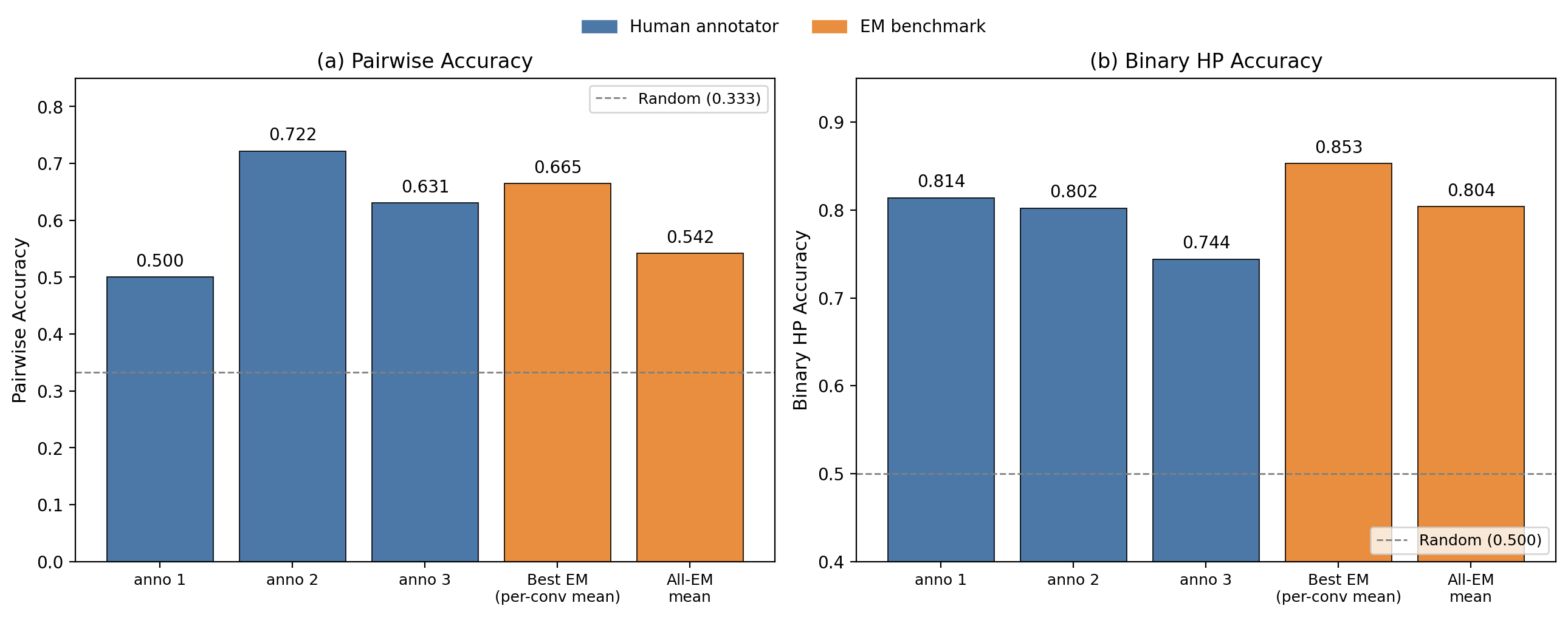
- Binary OM/HP Accuracy: Turn-level behavioral classification metrics measuring agreement with human labels from the observer (OM) and first-person (HP) perspectives. "Binary OM/HP Accuracy (behavioral classification, observer- vs HP-perspective)"
- Cohen's κ: A statistic for inter-rater reliability that adjusts for chance agreement. "Inter-rater Cohen's on Binary HP is +0.38 to +0.51 (moderate)."
- Composite Score: The benchmark’s 0–100 aggregate score combining emotion, verification, and holistic components. "Composite Score is reported on a 0--100 scale"
- Conversational Fit: A conversation-wide metric assessing how well the model’s behavior fit the participant, scored as an exact match on a 4-point scale. "Q3 Conversational Fit (exact match on a 4-point scale; chance = 25\%)"
- Draft Judge: An auxiliary metric where a judge LLM rates the quality of a model’s drafted response. "Draft Judge (LLM-rated draft quality, supplementary)."
- Empathy modeling: Techniques and evaluations focused on how systems recognize and respond to others’ emotional states. "empathy modeling"
- Evaluated Model (EM): The model being assessed against human-grounded annotations for emotional intelligence. "Evaluated Model (EM) is then scored"
- Emotion F1: An exact-match F1 score for predicted emotion tags at the turn level. "Emotion F1 and Emotion VA (PANAS tag prediction: exact F1 and F1 with valence-arousal partial credit, respectively)"
- eta-squared (η2): An effect size measure indicating the proportion of variance explained by a factor. "Emotion~F1 shows limited model-level differentiation ()"
- Four Branch Model: The Mayer–Salovey–Caruso framework of emotional intelligence encompassing perceiving, understanding, facilitating thought, and managing emotions. "Mayer-Salovey-Caruso Four Branch Model"
- Friedman tests: Nonparametric tests for detecting differences across multiple related conditions (e.g., across conversation thirds). "Within-model Friedman tests do not survive correction."
- Goal Identification: A conversation-wide metric evaluating whether the model correctly identified the participant’s goals. "Q1 Goal Identification (set overlap with HP-reported goals)"
- Holm-Bonferroni-corrected: A multiple-comparisons procedure controlling familywise error by stepwise adjustment. "pairwise Wilcoxon contrasts (Holm-Bonferroni-corrected; 55 unique pairs of the 11 models)"
- Holistic comprehension: The model’s ability to synthesize conversation-wide signals beyond turn-level cues. "Some models (Qwen, Mistral, Gemini) excel at holistic comprehension but lag on turn-level metrics."
- Human-centered AI: Approaches to AI that prioritize human needs, values, and usability in design and evaluation. "human-centered AI"
- Kendall τ: A rank-correlation coefficient used to evaluate agreement between preference orderings. "Kendall~ is nearly redundant with Pairwise Accuracy ()."
- Kruskal–Wallis: A nonparametric test used to assess differences between groups of metric scores. "All primary metrics except Emotion~F1 reliably distinguish models (Kruskal-Wallis, each)."
- Likert scale: A rating scale commonly used in questionnaires to capture degrees of agreement or intensity. "consisting of 20 affective descriptors rated on a Likert scale"
- MAE (Mean Absolute Error): The average absolute difference between predicted and true values; used for conversation-wide rating errors. "Four Branch MAE"
- Median-split: A procedure that divides data into “easy” and “hard” subsets at the median of a difficulty metric. "Conversation difficulty (operationalized as median-split of conversations by cross-model mean Composite)"
- MMLU: A broad benchmark for general language understanding used as a point of comparison. "MMLU~\citep{hendrycks2021mmlu}"
- Mood Shift Tags: Participant-provided turn-level annotations marking emotion and intensity changes during conversation. "Mood Shift Tags"
- NRC VAD Lexicon: A lexicon providing valence, arousal, and dominance scores for words, used to embed PANAS items. "via the NRC VAD Lexicon~\citep{mohammad2018, posner2005circumplex}"
- Omniscient mode: An evaluation setting where the model is given the participant’s pre-conversation PANAS and psychometric profile. "Omniscient (provides the HP's pre-conversation PANAS and psychometric profile to the EM)"
- Ordinal distance: A measure of how far predictions are from true labels on an ordered scale. "substantially worse on ordinal distance than all other models"
- Original Model (OM): The model that conducted the initial conversation with the participant, distinct from the model being evaluated later. "Original Models (OMs)"
- Pairwise Accuracy: The accuracy of ranking response options according to participant preferences. "Opus~4.7 first on both Pairwise Accuracy (0.646) and Kendall~ (0.339)"
- PANAS: The Positive and Negative Affect Schedule, a validated instrument that measures affect across 20 descriptors. "Positive and Negative Affect Schedule (PANAS)"
- PANAS B-Adj: A bias-adjusted metric for post-conversation PANAS prediction. "PANAS B-Adj (bias-adjusted post-conversation PANAS prediction)"
- PANAS mood trajectories: Time-evolving affect measurements across the conversation derived from PANAS-based annotations. "annotated for PANAS mood trajectories"
- Pearson r: A correlation coefficient assessing linear association between variables. "conversation-level Pearson , "
- Percentile bootstrap CIs: Confidence intervals computed via bootstrap resampling using percentile-based bounds. "95\% percentile bootstrap CIs (10{,}000 resamples; per-conversation, )"
- Perspective gap: The systematic difference in performance between observer-perspective (OM) and first-person (HP) behavioral judgments. "every model scores higher on OM than HP (perspective gap, \S~\ref{sec:analysis})"
- Preference alignment: The extent to which a model’s responses match what the participant prefers in context. "Preference alignment and response-quality judgments are substantially more model-discriminating than emotion-label accuracy."
- PROMIS: Short-form patient-reported outcome measures for mental health domains such as depression, anxiety, and sleep. "PROMIS Depression-4"
- Psychometric profile: A set of standardized psychological measures characterizing participants (e.g., personality, well-being). "the HP's pre-conversation PANAS and psychometric profile"
- Q3 Follow-up: A conversation-wide question probing models’ ability to identify what felt off in less successful conversations. "Q3 Follow-up: when asked to identify what felt off in lower-rated conversations, neither model returns a correct answer in any conversation."
- Spearman ρ: A rank-correlation coefficient evaluating monotonic association between variables or rankings. "model-level Spearman "
- Stratified by OM: An analysis that conditions results on which Original Model conducted the conversation to control bias. "Pairwise Accuracy stratified by OM confirms headline rankings are stable across OMs"
- Theory of mind: The capacity to infer others’ mental states (beliefs, intents, emotions), used as a capability benchmark for LLMs. "theory of mind~\citep{kosinski2023theory}"
- TIPI: The Ten-Item Personality Inventory, a brief instrument for assessing Big Five personality traits. "Ten-Item Personality Inventory (TIPI)"
- Valence–arousal distance: A continuous metric of emotional difference used for partial credit when predicting emotions. "Emotion VA uses continuous valence-arousal distance for partial credit"
- Valence–arousal space: A two-dimensional framework representing emotional states by positivity/negativity (valence) and activation (arousal). "jittery and nervous sit close in valence-arousal space"
- WHO-5: The World Health Organization Five Well-Being Index, a brief measure of psychological well-being. "WHO-5 Well-Being Index"
Collections
Sign up for free to add this paper to one or more collections.

