- The paper establishes that every self-adjoint extension of the limiting Jacobi operator can be obtained through specific vanishing sequences of the coupling parameter.
- It employs discrete WKB approximations with Airy asymptotics to derive uniform bounds on square-summable solutions and characterizes the resulting spectral spiral behavior.
- The study applies these spectral results to higher-order squeezing in quantum optics, showing that regularization does not select a unique physical evolution.
Essentially Singular Limits of Jacobi Operators and Higher-Order Squeezing
Introduction and Problem Setting
The paper "Essentially singular limits of Jacobi operators and applications to higher-order squeezing" (2605.21355) provides an in-depth analysis of a family of Jacobi operators characterized by diagonal entries scaled by a coupling parameter λ≥0. The authors investigate the limiting behavior of this operator family as the coupling tends to zero, unveiling a nontrivial correspondence between sequences converging to zero and the spectrum of self-adjoint extensions of a limiting symmetric but non-self-adjoint Jacobi operator. This phenomenon, coined an "essentially singular limit," draws an analogy with essential singularities in complex analysis by demonstrating the capacity to approximate any self-adjoint extension via specific vanishing sequences of λ.
The methodology employs discrete WKB approximations, refined with Airy-function asymptotics, to generate uniform bounds on square-summable solutions of difference equations in the small-coupling regime. The analysis extends beyond abstract operator theory, culminating in applications to higher-order squeezing Hamiltonians in quantum optics, where the absence of a unique physically distinguished self-adjoint extension in the zero-coupling limit has substantial consequences.
Jacobi Operator Family and Limiting Behavior
Consider the family of Jacobi operators parametrized as follows: J(λ)=(λf0a00⋯ a0λf1a1 0a1λf2⋱ ⋮⋱⋱),λ≥0
with sequences (an),(fn) satisfying prescribed growth and regularity conditions: an∼nα, fn∼nβ for large n, with β>α>4/3.
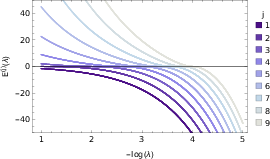
For all λ>0, J(λ) is self-adjoint and bounded from below, with a purely discrete spectrum. In the singular limit λ0, the resulting Jacobi operator λ1 has deficiency indices λ2. Consequently, λ3 admits a one-parameter family of self-adjoint extensions, denoted λ4, each possessing simple, discrete spectra covering λ5 with mutually disjoint spectral points.
The central problem is to characterize the strong resolvent limits of λ6 as λ7. The main theorem establishes:
- Non-uniqueness of Limiting Extensions: For every sequence λ8, a subsequence exists such that λ9 converges in the strong resolvent sense to some J(λ)=(λf0a00⋯ a0λf1a1 0a1λf2⋱ ⋮⋱⋱),λ≥00, and, reciprocally, every extension J(λ)=(λf0a00⋯ a0λf1a1 0a1λf2⋱ ⋮⋱⋱),λ≥01 can be obtained in this fashion.
This phenomenon is aptly termed "essentially singular" since the limit is "maximally nonunique," mirroring essential singularity behavior in complex analytic maps, where a function can attain nearly all values along suitable vanishing sequences.
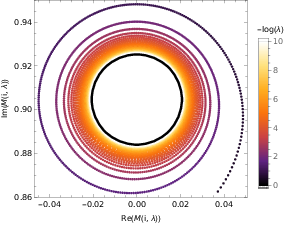
Figure 1: Numerical plot of the values of the Weyl m-function J(λ)=(λf0a00⋯ a0λf1a1 0a1λf2⋱ ⋮⋱⋱),λ≥02 at J(λ)=(λf0a00⋯ a0λf1a1 0a1λf2⋱ ⋮⋱⋱),λ≥03 for J(λ)=(λf0a00⋯ a0λf1a1 0a1λf2⋱ ⋮⋱⋱),λ≥04 as J(λ)=(λf0a00⋯ a0λf1a1 0a1λf2⋱ ⋮⋱⋱),λ≥05, illustrating that different sequences spiral to different points on the limit circle associated with self-adjoint extensions of J(λ)=(λf0a00⋯ a0λf1a1 0a1λf2⋱ ⋮⋱⋱),λ≥06.
Spectral and Resolvent Analysis
The proof framework entails:
- Uniform Asymptotic Bounds: Using discrete WKB and Airy-type asymptotics, the authors derive uniform polynomial decay bounds for square-summable solutions of the recurrence relation
J(λ)=(λf0a00⋯ a0λf1a1 0a1λf2⋱ ⋮⋱⋱),λ≥07
in the regime of small J(λ)=(λf0a00⋯ a0λf1a1 0a1λf2⋱ ⋮⋱⋱),λ≥08. A crucial technical result is that, for any compact J(λ)=(λf0a00⋯ a0λf1a1 0a1λf2⋱ ⋮⋱⋱),λ≥09 domain,
(an),(fn)0
demonstrating uniform decay—a necessary ingredient to translate weak convergence to strong resolvent convergence.
Applications: Higher-Order Squeezing in Quantum Optics
An important application of these spectral-theoretic results is to the analysis of higher-order squeezing operators in quantum optics, generalizing the quadratic (conventional) squeezing Hamiltonian to fn∼nβ0 for fn∼nβ1. Physically, such Hamiltonians are relevant for generating non-Gaussian states, quantum error correction codes, and nonlinear bosonic gates.
It is well-known that for fn∼nβ2, fn∼nβ3 is not essentially self-adjoint on the natural domain, requiring the specification of a self-adjoint extension to define quantum dynamics. Previous heuristic and numeric studies speculated whether regularization—by addition of a "Kerr-type" term fn∼nβ4, with fn∼nβ5 and fn∼nβ6—singles out a physically preferred extension as fn∼nβ7.
By decomposing the regularized Hamiltonians into direct sums of Jacobi operators over symmetry-reduced subspaces, the authors show:
Technical and Numerical Illustrations
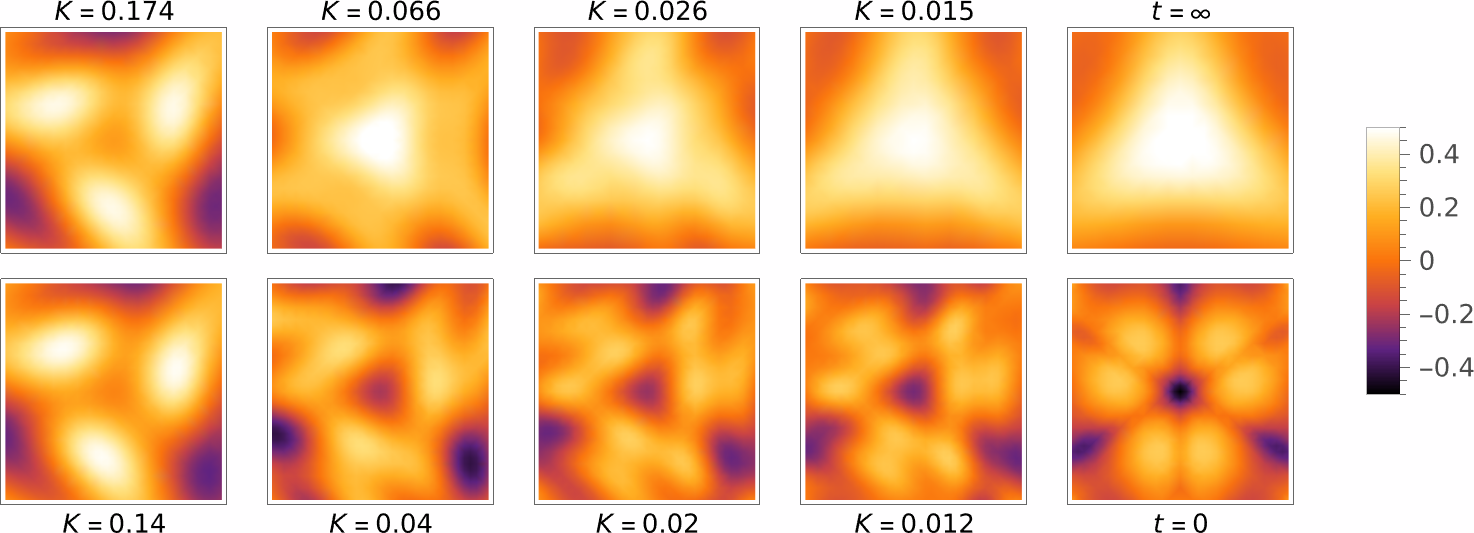
Numerical evaluation and representation further solidify the spectral and asymptotic analysis. The figures demonstrate, for explicit sequence choices, how the spectrum decomposes, the evolution of the Weyl spiral, and the practical indistinguishability of different extensions for small but nonzero coupling unless the limit is taken with infinite precision—underlining the essential singularity in physical terms.
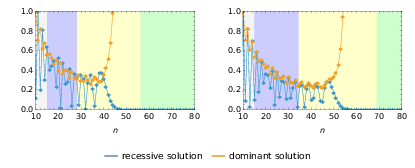
Figure 4: Numerical evaluation of dominant and recessive eigenfunction solutions in different n7 regions; delineates oscillatory, turning-point, and exponential-decay regimes crucial to the uniform bounds achieved.
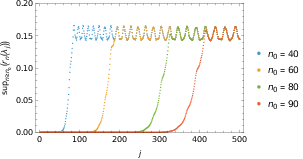
Figure 5: Plot of uniform normalized solution bounds n8, serving as evidence for sharpness of the analytic upper bounds across the three main parameter regimes.
Implications and Future Directions
The analysis has substantial theoretical implications:
- Universality of the Nonuniqueness: The phenomenon demonstrated is not restricted to discrete operators; it suggests that in broad classes of parameter-dependent operators (e.g., certain Sturm–Liouville or Dirac operators with coupling-dependent regularizations), limits as singular as the Jacobi case may arise.
- Selection Principles in Quantum Theories: The work cautions against the expectation that "physical" or "perturbative" regularizations necessarily select canonical quantum evolutions in singular Hamiltonian settings. Any such selection must involve additional, perhaps symmetry-breaking, ingredients.
- Perturbation Theory Beyond Semiboundedness: The techniques exhibit how to extend beyond the standard semibounded or Kato–Rellich paradigm, dealing directly with the nonuniqueness of the strong resolvent limit and its parameterization.
- Discretization and Simulation: The breakdown of direct numerical convergence (e.g., dependence on truncation parity, as detailed for the squeezed vacuum) foreshadows challenges for simulating singular or "borderline" quantum systems—relevant for quantum error correction and nonlinear photonics.
Regarding future developments, generalizing these results to unbounded block Jacobi matrix families and to continuous variable (differential) operators, as well as studying the dynamical consequences (quantum evolution, spectral statistics, control), could reveal new phenomena in both mathematics and quantum technology.
Conclusion
This work delivers a detailed, rigorous account of how essentially singular limits for families of Jacobi operators fundamentally defy selection of a unique self-adjoint extension, even under physically motivated regularizations. The synthesis of asymptotic analysis with operator-theoretic methods not only closes a conceptual gap in the spectral theory of unbounded discrete operators but also delivers critical insight for quantum optics and quantum information applications involving higher-order nonlinearities. The paper sets a new standard for addressing singular perturbation limits in quantum operator algebras, with implications anticipated across mathematical physics and applied quantum systems.