An explicit lower bound for the unit distance problem
Abstract: We show that there are sets of $n$ points in the plane with $n$ arbitrarily large that contain more than $n{1.014}$ pairs of points separated by a distance exactly $1$. This improves on very recent work of a team at OpenAI, who proved the same result with an inexplicit exponent greater than $1$, drastically improving on the best previous lower bound and disproving a conjecture of Erdős. The method is number-theoretic, relying on constructing algebraic number fields of large degree and small discriminant with many primes of small norm via a Golod-Shafarevich criterion argument.
Paper Prompts
Sign up for free to create and run prompts on this paper using GPT-5.
Top Community Prompts
Explain it Like I'm 14
What is this paper about?
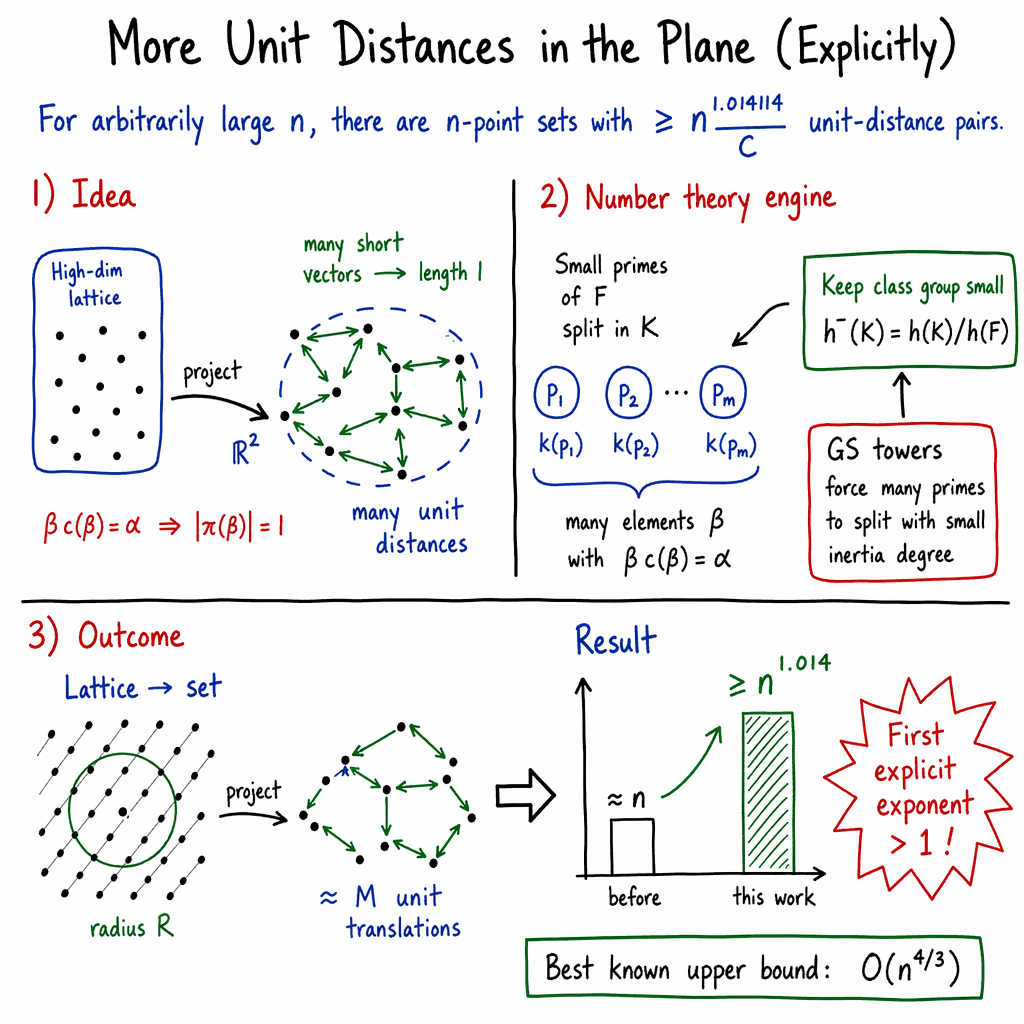
The paper studies a famous question in geometry called the unit distance problem: if you place n points in the plane, how many pairs of points can be exactly 1 unit apart? The author proves that for very large n, you can arrange the points so there are at least about n1.014 pairs at distance 1. This is an explicit improvement on a recent breakthrough (which showed “more than n1 pairs” but didn’t give a clear number), and it improves a decades-old lower bound by Erdős, who thought his bound might be the best possible.
In short: the paper gives a concrete construction showing you can do better than n1 by a noticeable amount, with an explicit exponent 1.014114..., while the best known upper bound is about n4/3.
The main questions
- How many unit-length pairs (distance exactly 1) can you guarantee among n points in the plane?
- Can we prove a lower bound of the form n1+δ with a clear, usable number for δ (not just “some positive δ”)?
- Can we build a method that’s explicit and efficient enough to push δ to around 0.014 (so the total exponent is about 1.014)?
How did they approach it?
Here is the big picture in everyday terms. Think of the approach as building a high-dimensional “grid” of points, then “casting a shadow” onto the plane in a clever way so that many pairs end up exactly distance 1 apart.
Turning the problem into a lattice story
- A lattice is like a grid of points, but possibly in many dimensions. If you choose a big ball in this grid and look at the points inside, some differences between points (vectors) are short.
- If you project (think: cast a shadow of) this high-dimensional grid down onto the plane, many of those short differences still become length 1 in the plane, if you set things up carefully.
- So: build a high-dimensional lattice with many “short vectors” whose shadows in the plane have length 1, then take the shadow of all lattice points in a large ball. That shadow is your set of n points in the plane with lots of unit distances.
Where do the lattices come from?
- The author gets lattices from special number systems called number fields (extensions of the rational numbers that include new “solutions” like square roots).
- In particular, he uses CM fields (certain complex number fields) that come with a natural way to measure sizes when mapped into the complex plane. This set-up makes it possible for many different high-dimensional vectors to have the exact same length when you look at their 2D shadow.
Analogy: Imagine many different 3D sticks that, when lit from a certain angle, cast shadows of the exact same length on the ground. If that shared shadow length is 1, each stick gives you a unit distance in the plane.
Making many unit-length shadows
The heart of the counting uses two ideas:
- Norms and conjugation: In these fields, each element β has a “conjugate” c(β). Multiplying β by c(β) gives a norm (a kind of size) in a smaller field. If many β satisfy β·c(β) = α for the same α, then their shadows have the same length. Scaling that common length to 1 gives many unit distances.
- Ideals: Rather than using the whole ring of integers in the field (the standard grid), the author works with certain sub-grids called ideals. This gives more flexibility and makes it easier to find lots of β with the same norm equation β·c(β) = α.
A smart “pigeonhole” argument (a careful counting argument) shows that under the right conditions, there must be many such β.
Keeping the numbers under control
Two technical measures matter:
- Discriminant: Think of it as a measure of how “complicated” the field is. The smaller (in the right sense), the better.
- Class number: Roughly, how many different ideal “shapes” there are. Smaller is better for counting. The author uses a refined bound (due to Louboutin) to keep this under control.
These bounds ensure the counting doesn’t “leak” too much when you pass between the high-dimensional grid and the 2D shadow.
Building the right number fields
To get an unlimited supply of fields with the desired properties (big enough, well-behaved primes, controlled discriminants), the author uses:
- Golod–Shafarevich theory: A powerful group-theory tool that guarantees the existence of infinite “towers” of number fields with good properties.
- A trick with Frobenius elements: By “modding out” certain actions that measure how primes behave in extensions, he ensures many small primes act nicely (they “split” in the right way), which is crucial for creating many unit distances.
- Carefully chosen sets of primes: The paper picks specific sets of primes T and S_Q and parameters that make all the inequalities work out, producing an explicit exponent.
What did they find?
- Main result: For arbitrarily large n, there exist n points in the plane with at least n1.014114/C unit-distance pairs (C is an absolute constant). In compact form: at least n1.014114 pairs up to a constant factor.
- Context:
- Best known upper bound: about n4/3 (by Spencer–Szemerédi–Trotter).
- Old lower bound (Erdős): about n1 + c / log log n; Erdős conjectured this might be optimal.
- Very recent work (OpenAI team): n1+δ for some δ>0, but δ wasn’t explicit and could be extremely tiny in simplified versions (around 6×10-38).
- This paper: an explicit δ ≈ 0.014114, which is much larger and practical.
Why it’s important: It turns a “there exists some tiny positive δ” breakthrough into a concrete, sizeable improvement, closing a gap between lower and upper bounds.
Why it matters
- It advances our understanding of how dense unit distances can be in the plane and clearly beats a longstanding lower bound.
- It shows that blending geometry with deep number theory (especially class field towers and splitting of primes) can produce strong, explicit combinatorial results.
- It opens paths to push δ even higher with better tools (analytic number theory, refined class number bounds, new towers, or computational parameter tuning).
Limitations and what could come next
- The exponent 1.014114 isn’t believed to be the final word; the upper bound is still n4/3, so there’s a lot of room.
- The method depends on heavy number-theoretic machinery. Improvements might come from:
- Sharper analytic bounds on class numbers in these specific fields.
- Alternative infinite towers that force even more small primes to behave well.
- Better computational search for optimal prime sets and parameters.
The paper also raises two natural follow-ups:
- For how many values of n (not just “infinitely many”) can such point sets be built?
- What is the maximum exponent this general strategy could ever reach?
A short glossary of key ideas
- Lattice: A multi-dimensional grid of points.
- Projection (shadow): Mapping high-dimensional points down to the plane so we can measure distances there.
- Number field: An extended number system built by adding roots (like √2, i) to the rationals.
- CM field: A special kind of number field that pairs nicely with complex conjugation and gives the norm equation β·c(β) = α.
- Ideal: A structured subset of the field’s integers that behaves like a sub-grid.
- Discriminant: A number that measures how “complicated” the field is; smaller is better for this argument.
- Class number: Counts how many distinct “ideal shapes” exist; smaller is better.
- Splitting of primes: How ordinary primes factor in a number field; having many small primes that split helps create many unit distances.
- Golod–Shafarevich criterion: A method to prove there are infinitely many fields in a tower, enabling large, controlled constructions.
In essence, the paper carefully designs a high-dimensional arithmetic structure whose 2D “shadow” has a surprisingly large number of unit-length connections—and proves it with explicit numbers.
Knowledge Gaps
Below is a single, focused list of specific gaps, limitations, and open questions left by the paper that future work could address.
- Make the implicit constant explicit: Track all constants carefully through Lemmas 1–9 and Proposition 10 to produce a concrete numerical value for the absolute constant C in Theorem 1 (currently only stated as “an absolute constant C”), and quantify its dependence on chosen parameters.
- Sharpen the relative class number bound: Replace the use of Louboutin’s general bound with sharper, field-specific estimates for h−(K) (e.g., via explicit analytic class number formulas, zero-free regions, or conditional results under GRH), and quantify the resulting gain in the exponent δ.
- Improve root discriminant control with prescribed local conditions: Construct infinite towers of CM extensions K/F with simultaneously small relative root discriminant rd_{K/F} and many designated small primes with bounded inertia degrees (or splitting) at those primes; provide unconditional constructions beyond the current Golod–Shafarevich approach.
- Relax the Galois-over-ℚ hypothesis: Remove the assumption that K (and thus F) is Galois over ℚ in Lemma 8 and Proposition 10, and develop a version that handles non-Galois F while still controlling splitting/inertia and counting contributions from primes.
- Use alternative CM extensions: Replace K = F(i) by more general CM fields K/F that maximize the set of small primes of F that split in K while keeping rd_{K/F} and h−(K) small; identify criteria (e.g., on CM type or reflex fields) that optimize the tradeoff.
- Strengthen the Golod–Shafarevich step: Explore p-class (p > 2) or mixed-p towers; use refined Golod–Shafarevich inequalities (e.g., Gaschütz/Vinberg refinements, additional cohomological inputs) with controlled Frobenius powers to enlarge the pool of small primes with bounded inertia while keeping the tower infinite.
- Prescribe higher bounded inertia (f | m > 2): Generalize the “quotient by a fixed power of Frobenius” technique to allow inertia degrees bounded by an integer m > 2, quantify how this changes the GS-inequality, and optimize m against discriminant growth and class number bounds.
- Quantify hard upper limits of the method: Derive explicit barriers for the maximum δ achievable by this framework (given constraints from GS inequalities, class number bounds, and discriminant growth), and determine whether meaningful improvements beyond δ ≈ 0.014 are still possible without new ideas.
- Optimize parameter selection systematically: Replace the ad hoc choices of T, S_ℚ, k(p), and R with a rigorous optimization (continuous relaxation + rounding + global/discrete search), and report the best δ achievable under current bounds; provide code, datasets, and reproducible parameter sets.
- Broaden admissible primes in S_ℚ: Remove or weaken the condition that each p ∈ S_ℚ is either inert in some ℚ(√q) (q ∈ T) or p ≡ 1 mod 4 by using different base fields Q (e.g., allowing 2 to be ramified differently) or different auxiliary quadratic subfields, thereby increasing the supply of small admissible primes.
- Tighten the lattice step constants: Improve Lemma 1 by (i) replacing the sup norm with the Euclidean norm or a well-chosen ellipsoidal norm, (ii) using Minkowski’s successive minima or Hermite constants to bound ρ in terms of the index more sharply, and (iii) refining the lattice-point counting to replace the factor (1 − 1/R){2d} (e.g., via smoother windows, better averaging, or annular counting).
- Count norm preimages more precisely: Replace the pigeonhole-based lower bound on M with an analytic count of elements β in an ideal I with β c(β) = α, using Hecke characters/ideal class characters or CM theta-series methods to obtain larger M for comparable N_{K/F}(I)/(α).
- Make the construction algorithmic: Provide an explicit, polynomial-time (in log n) algorithm that, given n, outputs a concrete point set U ⊂ ℝ2 realizing the bound (including an explicit field F, ideal I, and element α), together with bit-size bounds for coordinates, verification procedures, and complexity analysis.
- Density of admissible n: Determine the natural density or lower density of n for which such sets U of size n exist with at least n{1+δ}/C unit-distance pairs (beyond the current “many n ≤ N” remark); quantify the asymptotic and identify the precise growth exponent in N.
- Extend to higher dimensions and other norms: Investigate whether analogous number-field/lattice constructions yield improved lower bounds for unit distances in ℝd (d ≥ 3) or for other norms/metrics in the plane; isolate the dimension- and norm-dependent obstacles.
- Optimize the choice of I versus principal ideals: Systematically study which fractional ideals I maximize M for a fixed N_{K/F}(I)/(α), including possible use of S-integers or non-maximal orders, and quantify gains over the ring-of-integers choice.
- Better control on unit/cokernel factors in G_K: Refine Lemma 6 by exploiting structure of the unit group (e.g., regulators, narrow class groups) to replace the crude 2d factor and reduce the loss in the pigeonhole argument; analyze potential conditional improvements under Leopoldt’s conjecture.
- Larger small-prime supply via alternative base fields: Replace Q = ℚ(√∏_{q∈T} q) by other quadratic (or higher) base fields engineered to maximize the number of small primes with favorable splitting and inertia while keeping the tower unramified and totally real; quantify the net effect on δ.
- Numerical exploration at scale: Perform large-scale computational searches over T, S_ℚ, and k(p) (including primes beyond those used here) and over alternative CM extensions, to empirically map the achievable δ frontier under current theoretical constraints, and publish the best parameter sets.
- Robustness and perturbation: Investigate whether the constructed configurations can be perturbed (e.g., to rational or low-height algebraic coordinates) without losing a positive proportion of unit distances, enabling simpler explicit examples or applications.
Practical Applications
Immediate Applications
The paper provides explicit constructions (with concrete parameters) of planar point sets and associated lattices that realize more than n1.014 unit-distance pairs. Even though the result is primarily theoretical, it enables several practical, near-term uses by turning previously non-explicit ideas into deployable workflows.
- Benchmarking suites for computational geometry and graph algorithms
- Sectors: software, theoretical computer science
- What: Generate explicit 2D point sets with unusually many unit distances to stress-test algorithms for nearest-neighbor search, geometric spanners, proximity graphs (e.g., unit disk graphs), Delaunay/Voronoi routines, maximal independent set, coloring, and clique cover on unit disk graphs.
- Tools/workflows: Implement Lemmas/Proposition pipeline:
- 1) Construct CM fields and ideals meeting the paper’s splitting/ramification conditions (via PARI/GP, SageMath, Magma).
- 2) Produce high-dimensional algebraic lattices, then project to 2D as in Lemma set-from-ideal.
- 3) Export coordinates and verify unit distances with exact arithmetic.
- Assumptions/dependencies: Availability of number-theory software; exact arithmetic for distance tests; the n-values for which constructions exist may be sparse (the paper’s remark outlines how to cover many n up to N).
- Hard instances for wireless/networking algorithms modeled by unit disk graphs
- Sectors: telecommunications, networking
- What: Unit disk graphs model interference and adjacency in wireless networks. The constructed point sets induce dense unit-distance edges, yielding challenging cases for scheduling, channel allocation, topology control, and capacity approximation.
- Tools/workflows: Convert point sets to unit disk graphs; run schedulers and coloring heuristics; compare performance vs. typical random instances.
- Assumptions/dependencies: Idealized unit-radius propagation model; real deployments may deviate, but worst-case algorithmic behavior can still be stress-tested.
- Stress-testing and evaluation of lattice algorithms
- Sectors: cryptography, optimization
- What: The intermediate high-dimensional lattices have many short vectors aligned to the same projected length. These can serve as structured worst-case or corner-case inputs for SVP/CVP solvers and lattice reduction (e.g., LLL, BKZ).
- Tools/workflows: Export lattices from the number-field construction prior to projection; evaluate with fplll, G6K, or custom solvers; quantify performance degradation in the presence of many near-minima.
- Assumptions/dependencies: Careful control of embedding and scaling to maintain condition numbers and representability.
- Reproducible pipelines for AI-assisted mathematical results
- Sectors: academia, AI research, policy
- What: The paper transforms an AI-assisted, non-explicit result into an explicit, verifiable one. It can serve as a blueprint for reproducible workflows that combine AI-generated ideas, human simplification, and explicit parameter choices.
- Tools/workflows: Template for: (i) AI-generated insight → (ii) human simplification → (iii) explicit bounds/parameters → (iv) publicly auditable code/data (e.g., Sage snippets for Kronecker symbol checks).
- Assumptions/dependencies: Community norms for releasing parameters, scripts, and verification logs; availability of computational resources.
- Advanced teaching modules in number theory and discrete geometry
- Sectors: education
- What: A compact demonstration of how algebraic number theory (CM fields, class groups, discriminants) informs Euclidean geometry problems (unit distances). Suitable for graduate mini-courses and capstone projects that culminate in constructing explicit point sets.
- Tools/workflows: Class projects implementing the lemmas to produce small-size examples; comparative experiments with Erdős’s original 2D lattice constructions.
- Libraries/utilities to construct “unit-distance-rich” point sets
- Sectors: software engineering, data science
- What: Add-on packages for SageMath/PARI/GP to generate explicit planar datasets with high unit-distance multiplicity for downstream testing in geometric libraries (CGAL, Shapely).
- Tools/workflows: Wrappers around routines for: (a) assembling sets T and S_Q, (b) building fields via Golod–Shafarevich-guided towers (per Lemmas group-infinite/field-existence), (c) producing 2D projections, (d) verifying counts.
- Assumptions/dependencies: Need careful parameter selection to keep computational cost manageable; exact algebraic verification preferred over floating-point checks.
Long-Term Applications
Beyond immediate benchmarks and educational use, the techniques and refinements in this paper suggest broader impacts if extended or combined with advances in analytic/algebraic number theory and computational tools.
- Sharper constructions influencing worst-case bounds in computational geometry
- Sectors: theoretical computer science, software
- What: Further improvements in the exponent or density of admissible n may recalibrate worst-case analyses for algorithms relying on unit distances or incidence bounds.
- Potential products: Updated complexity/theory benchmarks; refined lower bounds feeding into algorithm design and competitive analysis.
- Assumptions/dependencies: Progress on class-number bounds (e.g., strengthening Louboutin-type estimates), improved control of splitting patterns via tower constructions.
- Structured lattice and code design via number-field towers
- Sectors: communications, coding theory, signal processing
- What: The paper cites prior uses of Golod–Shafarevich towers in constructing high-dimensional lattices and codes. Enhanced control over discriminants and short-vector multiplicities can inspire new spherical codes, modulation constellations, or testing frameworks for decoders.
- Potential products: Prototype constellations with controlled kissing numbers to study error floors; families of challenging code lattices for decoder evaluation.
- Assumptions/dependencies: Translating many-short-vector structures into communication gains is nontrivial; high multiplicity can harm minimum-distance properties but is useful for stress tests and theoretical exploration.
- Foundations for cryptographic parameter exploration in structured number fields
- Sectors: cryptography
- What: Methods to build Galois CM fields with small relative discriminant and controlled splitting could inform exploration of structured-lattice parameters (e.g., in Ring-/Module-LWE contexts) and hardness modeling.
- Potential tools: Field/ideal generators to probe algorithmic behavior across discriminant scales; datasets for analyzing performance/security trade-offs of lattice reductions on structured instances.
- Assumptions/dependencies: No direct attack is implied; relevance depends on how closely these structures align with deployed primitives; careful separation of stress-testing vs. security claims is crucial.
- Generalization to other norms, higher dimensions, and packing/contact problems
- Sectors: robotics (sensor networks), materials modeling, optimization
- What: Extending the projection-and-lattice strategy to other norms or dimensions could generate dense contact graphs for unit ball models in Rd, aiding worst-case analysis for coverage, collision avoidance, or packing heuristics.
- Potential workflows: Multi-dimensional projections with norm tailoring; constructing “contact-rich” scenarios to evaluate packing/coverage algorithms.
- Assumptions/dependencies: Significant theoretical work to adapt norm-specific analogues of the CM-field approach; computational cost escalates with dimension.
- Automated discovery-and-verification pipelines for deep math-geometry links
- Sectors: academia, AI research, policy
- What: The paper’s progression—AI-assisted conjecture → human explicit refinement → verifiable parameters—can be systematized into tools that manage conjecture tracking, dependency management (lemmas, bounds), and parameter tuning.
- Potential products: Open-source platforms integrating theorem-proving, computational algebra, and benchmarking artifacts for reproducibility.
- Assumptions/dependencies: Community adoption and standards for code/data release; integration with proof assistants or certified numerics is an additional step.
- Number-field tower engines with Frobenius control
- Sectors: mathematical software
- What: Software that constructs 2-class field towers with explicit control over Frobenius powers/inertia degrees, as used in the paper to guarantee many small split primes.
- Potential tools: Magma/Sage modules that expose “tower with constrained inertia/splitting” constructors; interfaces to compute relative discriminants and class numbers.
- Assumptions/dependencies: Implementing efficient tower-building with constraint checks is nontrivial; improvements may need new theoretical guarantees.
Notes on feasibility across applications:
- Many immediate uses hinge on implementability in CAS environments and on exact arithmetic to avoid numerical artifacts.
- The improvements are unconditional; however, stronger long-term gains may depend on deeper conjectures/techniques in analytic number theory or on discovering new infinite tower constructions with even tighter discriminant control.
- For some applications (cryptography, communications), these constructions are primarily valuable for exploration and stress-testing rather than direct deployment, pending further specialization and performance analysis.
Glossary
- adelic: Pertaining to adeles; methods or objects defined over the ring of adeles used in number theory. Example: "and thus admits adelic and cohomological descriptions, but the elementary description here is most convenient for us."
- algebraic number field: A finite field extension of the rational numbers. Example: "relying on constructing algebraic number fields of large degree and small discriminant"
- archimedean absolute value: The usual absolute value on embeddings into R or C, as opposed to nonarchimedean p-adic absolute values. Example: "for the archimedean absolute value we will continue to use the standard normalization."
- Chinese Remainder Theorem: A theorem describing solutions to systems of congruences modulo pairwise coprime moduli. Example: "by the Chinese remainder theorem and the product formula"
- class field theory: A major theory describing abelian extensions of number fields via ideal class groups and ideles. Example: "By class field theory, is the cokernel of the natural map from the Galois group of the maximal abelian unramified extension of to the Galois group of the maximal abelian unramified extension of "
- class group: The group of fractional ideals modulo principal ideals; measures failure of unique factorization. Example: "may be described as the class group of a rank one torus over "
- class number: The size of the class group of a number field. Example: "One has bounds for the class number in terms of the discriminant"
- CM extension: A totally imaginary quadratic extension of a totally real field (i.e., a CM field over its maximal real subfield). Example: "find totally real fields with CM extensions "
- CM field: A totally imaginary quadratic extension of a totally real field. Example: "When the number field is a CM field , containing a totally real subfield "
- cohomological: Relating to cohomology, often used to study algebraic structures via cohomological invariants. Example: "thus admits adelic and cohomological descriptions"
- cokernel: For a homomorphism, the quotient of the codomain by the image; measures failure of surjectivity. Example: "is the cokernel of the natural map from the Galois group of the maximal abelian unramified extension of to the Galois group of the maximal abelian unramified extension of "
- cyclotomic field: A number field generated by roots of unity. Example: "the cyclotomic field "
- Dirichlet's unit theorem: Describes the structure of the unit group of the ring of integers of a number field. Example: "since by Dirichlet's unit theorem."
- discriminant: An invariant of a number field (or polynomial) encoding ramification and arithmetic complexity. Example: "and the discriminant of is small."
- exact sequence: A sequence of group (or module) homomorphisms where the image of each map equals the kernel of the next. Example: "We have an exact sequence"
- Euler characteristic: In this context, a cohomological invariant related to generators and relations of Galois groups. Example: "and the Euler characteristic is at most $3$"
- everywhere unramified: An extension in which no (finite) prime ramifies. Example: "with degree a power of $2$, that are everywhere unramified, totally real"
- embedding (field): A field homomorphism into another field, here into C; determines archimedean places. Example: "coming from the embeddings of the number field into the complex numbers."
- Frobenius element: An element of a Galois group associated to an unramified prime, capturing its action on residue fields. Example: "by applying the Golod-Shafarevich criterion to the Galois group after quotienting by Frobenius elements"
- fractional ideal: A finitely generated O_K-submodule of K that becomes an (integral) ideal after multiplication by some nonzero element of K. Example: "Let be a fractional ideal of "
- fundamental domain: A region in a space that contains exactly one representative of each orbit under a group action (e.g., lattice translations). Example: "the point uniformly at random from a fundamental domain for "
- Galois extension: A field extension whose automorphism group has size equal to the degree of the extension; normal and separable. Example: "Assume is a Galois extension of "
- Galois group: The group of field automorphisms of an extension fixing the base field. Example: "Let be the Galois group of the composition of all Galois extensions of "
- Golod–Shafarevich criterion: A criterion relating generators and relations of pro-p groups to infer infinitude; used to build infinite class field towers. Example: "the Golod-Shafarevich criterion to show that a certain Galois group is infinite"
- Golod–Shafarevich theorem: A theorem implying that certain pro-p groups with few relations are infinite. Example: "the Golod-Shafarevich theorem~\cite{GolodShafarevich} in its refined form due to Gasch\"utz and Vinberg~\cite{Vinberg1965,Koch1969} states that is infinite"
- Hasse unit index: The index comparing unit groups in a CM extension, measuring failure of units to be norms. Example: "where is the Hasse unit index of "
- inert prime: A prime that remains prime (does not split) in a field extension. Example: "either inert in for some or congruent to $1$ mod $4$"
- inertia degree: The degree of the extension of residue fields for a prime in a field extension. Example: "the primes of may have large inertia degree (i.e. residue field extension degree) in these fields."
- infinite places: Embeddings of a number field into R or C; archimedean places. Example: "Let be the set of infinite places of ."
- lattice: A discrete additive subgroup of Euclidean space of full rank. Example: "Let be a lattice in ."
- Minkowski bound: A bound on class numbers via geometry of numbers; here contrasted with sharper bounds. Example: "we use \cite{Louboutin2000} instead of the Minkowski bound to get an improved bound on the (relative) class number."
- nonarchimedean absolute value: A non-Archimedean valuation (e.g., p-adic) satisfying the ultrametric inequality. Example: "For the nonarchimedean absolute value we will use the product formula normalization"
- norm map (field norm): The multiplicative map from a field extension to its base field, product of embeddings. Example: "Let be the map from fractional ideals of to fractional ideals of "
- pigeonhole principle: A counting principle stating that more objects than boxes implies some box contains multiple objects. Example: "By the pigeonhole principle, one fiber of this map must have cardinality at least ."
- pro-2 group: A profinite group that is the inverse limit of finite 2-groups. Example: "the minimal number of generators for as a pro-$2$ group"
- profinite group: A compact, totally disconnected topological group; inverse limit of finite groups. Example: "Since is a profinite group, it has arbitrarily large finite quotients"
- product formula: The identity that the product of absolute values of a nonzero element over all places equals 1 (with suitable normalizations). Example: "by the Chinese remainder theorem and the product formula"
- ramification index: The exponent describing how a prime ideal in the base field factors in the extension, measuring ramification. Example: "let be the ramification index of in "
- relative class number: The quotient h(K)/h(F), comparing class numbers in a CM extension. Example: "Let be the relative class number."
- relative root discriminant: The d-th root of the relative discriminant Δ_K/Δ_F. Example: "and be the relative root discriminant."
- residue field: The quotient field O_K/𝔭 at a prime ideal; field of “remainders” modulo a prime. Example: "i.e. residue field extension degree"
- ring of integers: The integral closure of Z in a number field; its elements are algebraic integers. Example: "the rings of integers of number fields"
- root discriminant: The discriminant raised to the reciprocal of the degree of the field. Example: "Recall that the root discriminant of a number field is"
- roots of unity: Complex numbers of finite multiplicative order; elements satisfying xn = 1. Example: "and is the number of roots of unity of ."
- split prime: A prime that factors into more than one prime in an extension. Example: "Assume that each prime ideal in is split in ."
- torus (algebraic): An algebraic group isomorphic over an algebraic closure to a product of multiplicative groups G_m. Example: "the class group of a rank one torus over "
- torsion subgroup: The subgroup consisting of elements of finite order. Example: "to bound torsion subgroups of class groups"
- unit group: The multiplicative group of invertible elements (units) in a ring, such as O_F×. Example: "use the unit group to control them"
- v-adic absolute value: The absolute value associated to a nonarchimedean place v of a number field. Example: "we define $\abs{I}_v$ to be the -adic absolute value of a generator of "
- Weil restriction (of scalars): A functor sending an algebraic variety over an extension field to one over the base field capturing its points via extension. Example: "the kernel of the norm map from the Weil restriction of from to to "
Collections
Sign up for free to add this paper to one or more collections.