- The paper presents an exact solution for static, charged black holes combining Bumblebee gravity, ModMax electrodynamics, and string clouds.
- It demonstrates how Lorentz symmetry breaking, nonlinearity, and string density modify horizon structure, thermodynamics, and phase transitions.
- The study quantifies changes in Hawking temperature, greybody factors, and wave absorption, highlighting observable signatures in gravitational physics.
ModMax Black Holes with String Clouds in Bumblebee Gravity: Thermodynamics, Hawking Emission, and Scattering Properties
Introduction
This work presents a comprehensive study of static, charged black holes within the context of Einstein-Bumblebee gravity, incorporating ModMax nonlinear electrodynamics and a cloud of strings as external matter. The analysis elucidates the role of Lorentz symmetry breaking, topological defects, and non-linear electromagnetic effects on the horizon geometry, thermodynamics, Hawking radiation, and greybody factors for different field spins, extending classical black hole paradigms into a parameter-rich, observationally motivated regime.
ModMax-Bumblebee Black Hole with String Cloud: Spacetime Structure
The authors construct an exact solution for a static spherically symmetric black hole in Einstein-Bumblebee gravity. The action includes a spontaneous Lorentz-violating vector field Bμ, a nonminimal curvature coupling, the ModMax electrodynamics sector (parameterized by nonlinearity λ), and a string cloud characterized by the density parameter α. The resultant metric is:
ds2=−A(r)dt2+B(r)dr2+r2dΩ2,
where
A(r)=1−α−r2M+(2+ℓ)r22(1+ℓ)Q2e−λ,B(r)=A(r)1+ℓ.
Key asymptotics and horizon structure are controlled by α (string cloud), ℓ (Lorentz violation), Q (charge), and λ (ModMax nonlinearity). This generalizes the Reissner-Nordström and string cloud scenarios, with the cloud and bumblebee sector deforming both near-horizon and asymptotic spacetime.
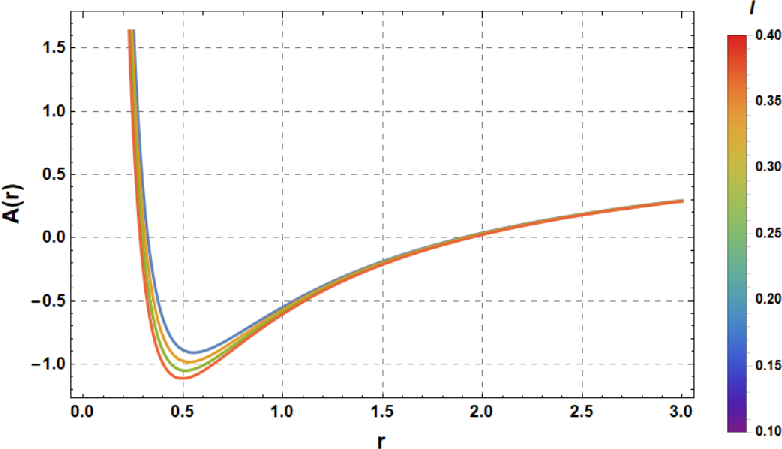
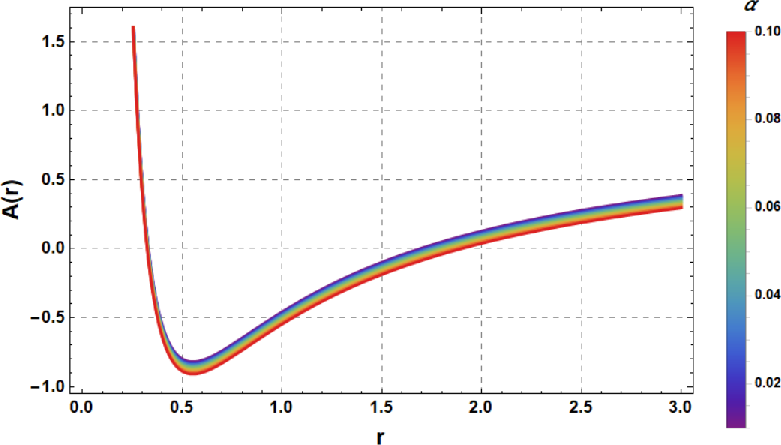
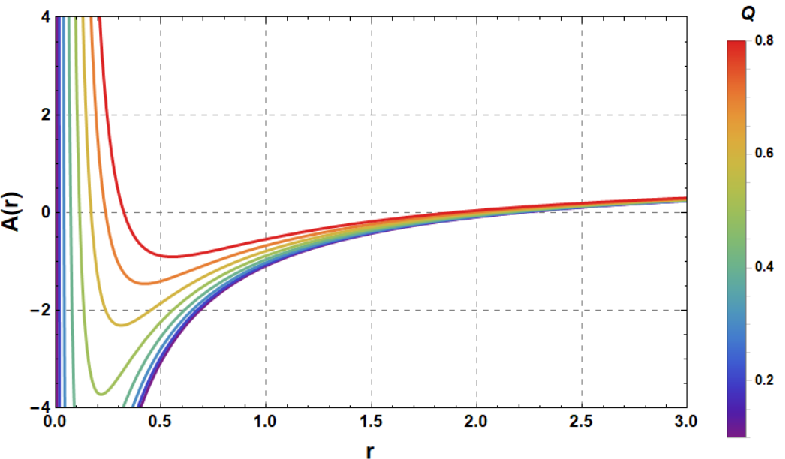
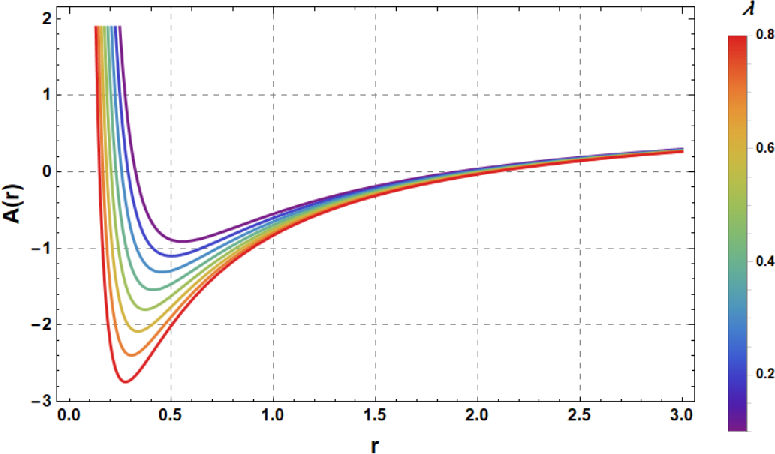
Figure 1: Variation of A(r) with respect to λ0 illustrates modifications to the horizon structure and asymptotic behavior.
Geodesics, Photon Sphere, and Black Hole Shadow
The null geodesic analysis specifies how λ1 modifies photon orbits and establishes the photon sphere radius λ2, which governs shadow size for external observers. The parameters λ3, λ4, λ5, and λ6 modulate critical impact parameters and the photon capture region. Lorentz violation and string cloud terms lead to observable modifications in shadow radius and gravitational lensing. The deflection angle acquires corrections proportional to λ7 for the mass term and is suppressed by λ8 and λ9 for charged configurations.
Thermodynamic Quantities and Stability
The thermal attributes of the solution exhibit a rich parameter dependence:
α0
α1 vanishes at extremality, defining the cold black hole threshold determined jointly by charge, Lorentz violation, nonlinearity, and string cloud density.
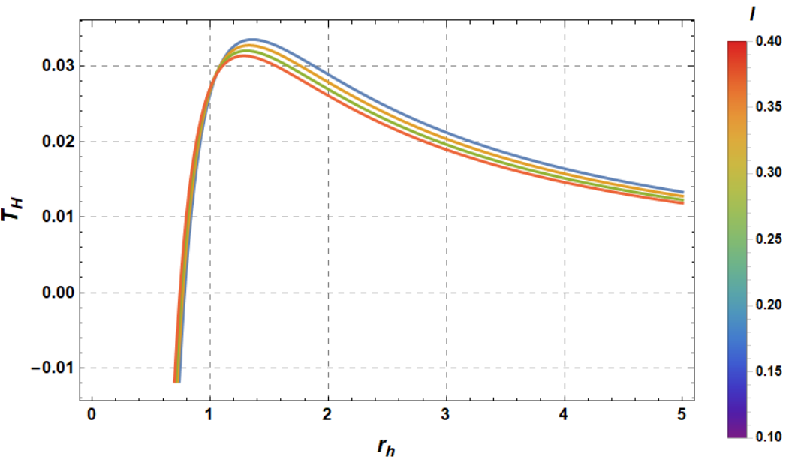
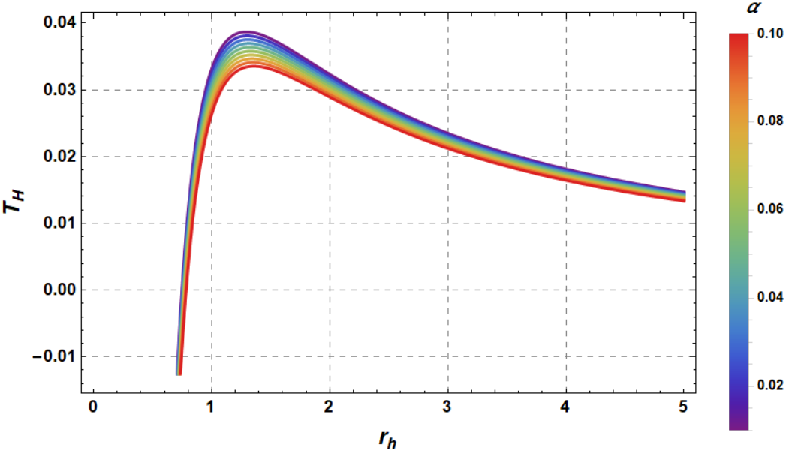
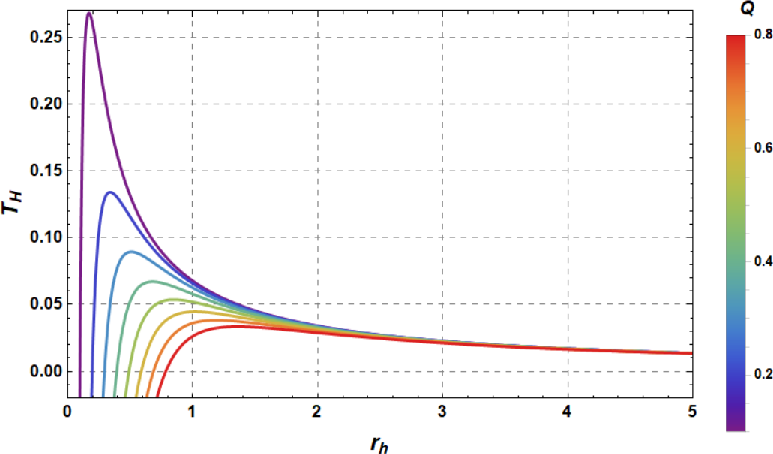
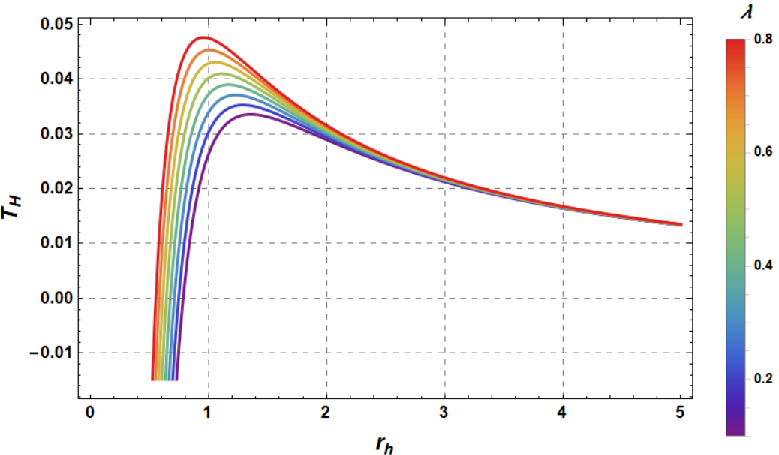
Figure 2: Hawking temperature α2 as a function of α3 is sensitive to the interplay between α4, α5, α6, and α7.
α8
The α9 scaling introduces a Lorentz-violation correction beyond the usual area law.
The sign of ds2=−A(r)dt2+B(r)dr2+r2dΩ2,0 demarcates thermodynamic stability. A divergence at a critical ds2=−A(r)dt2+B(r)dr2+r2dΩ2,1 signals a Davies-type second order phase transition, with the size and existence of stable regions governed by the parameter set.
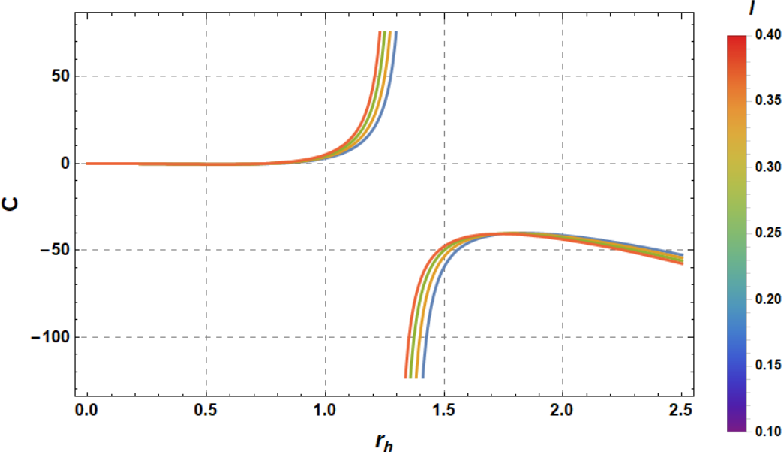
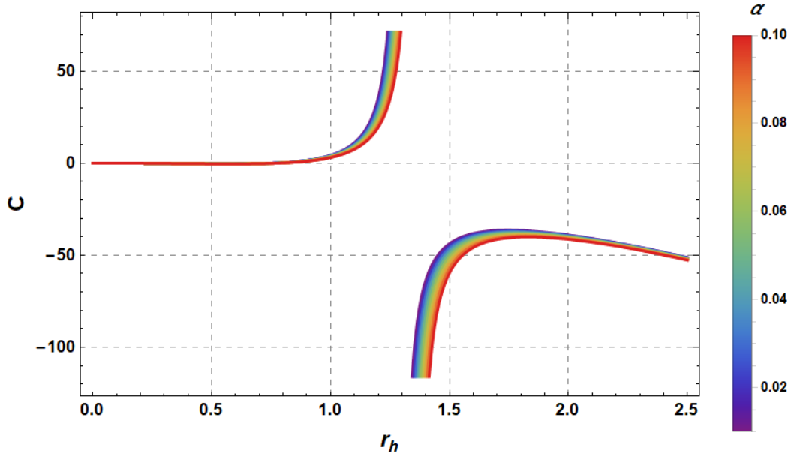
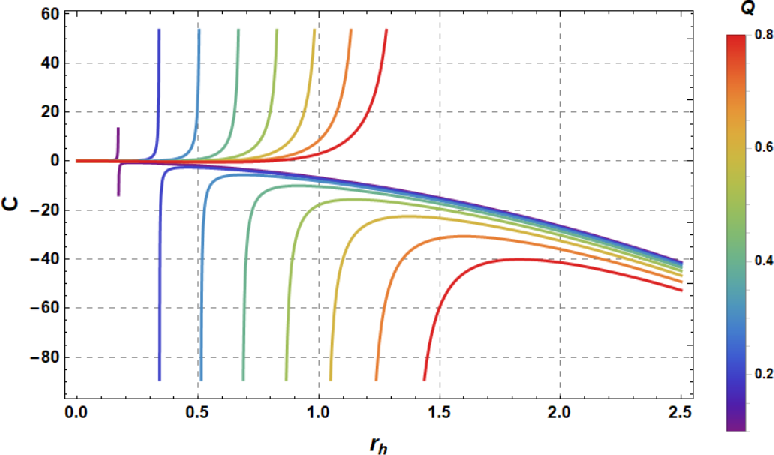
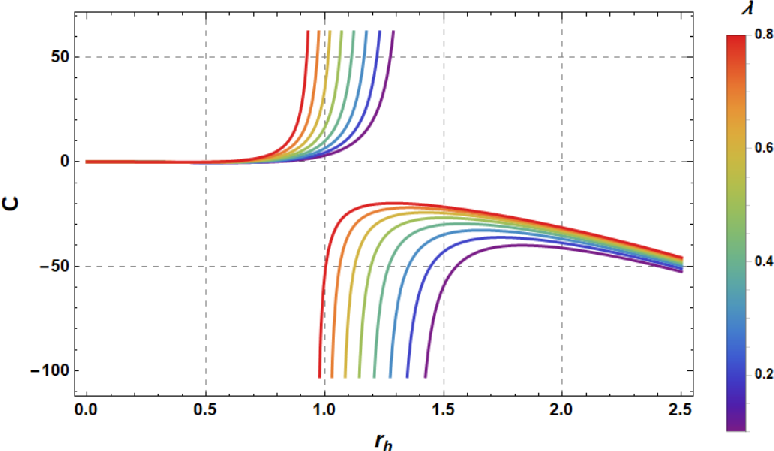
Figure 3: Heat capacity ds2=−A(r)dt2+B(r)dr2+r2dΩ2,2 illustrates parameter-controlled stability transitions, with divergence demarcating phases.
The black hole mass and Helmholtz free energy retain forms analogous to, but deformed from, classical solutions, with explicit dependence on all physical parameters.
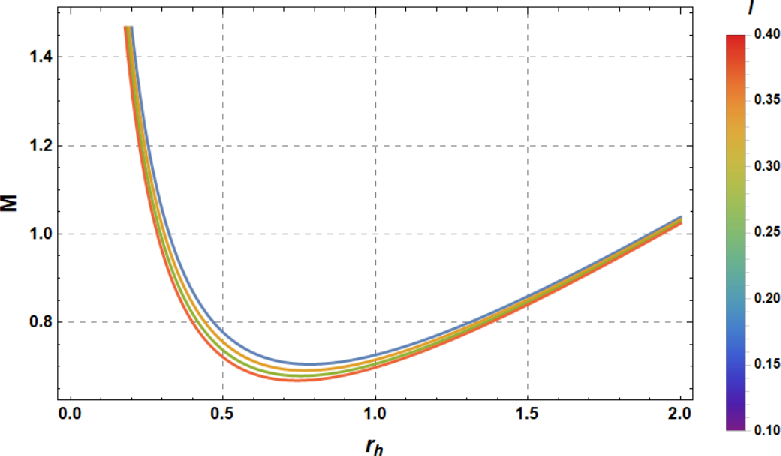
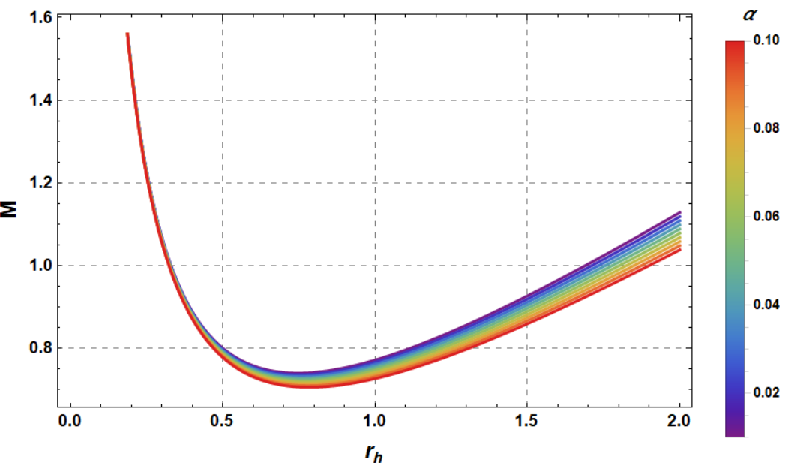
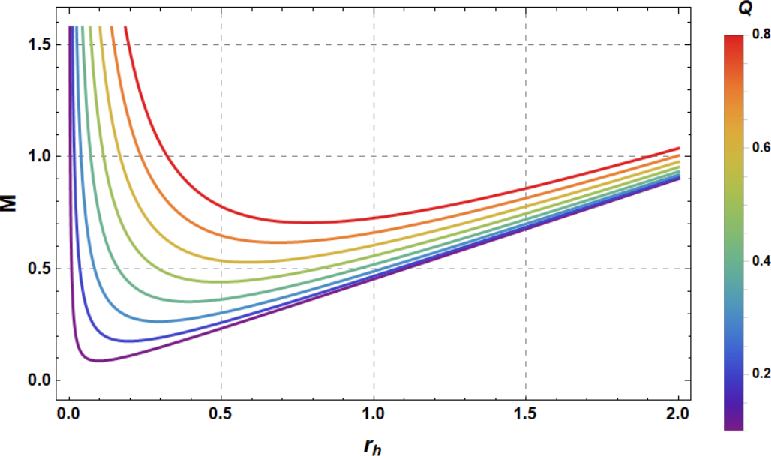
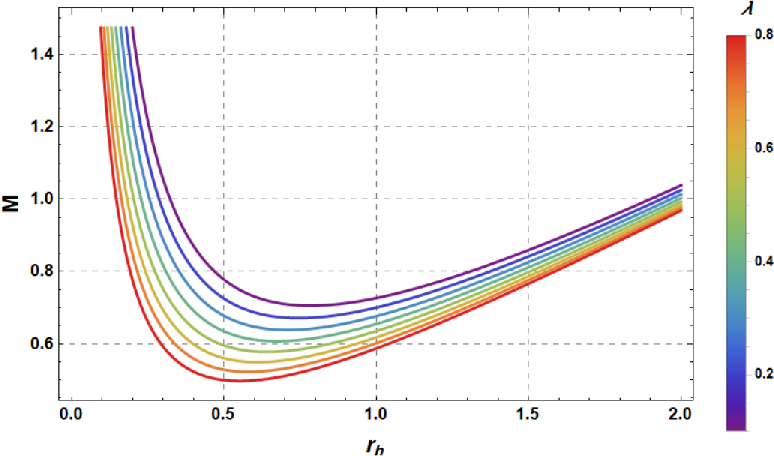
Figure 4: Behavior of mass ds2=−A(r)dt2+B(r)dr2+r2dΩ2,3 as a function of horizon radius for diverse parameter values, showing extremal points and mass deficits.
Sparsity of Hawking Radiation
Sparsity, quantitatively the ratio between the time gap of emissions and the characteristic quantum localization time, is shown to increase under increases of ds2=−A(r)dt2+B(r)dr2+r2dΩ2,4, ds2=−A(r)dt2+B(r)dr2+r2dΩ2,5, or ds2=−A(r)dt2+B(r)dr2+r2dΩ2,6, and to decrease as ds2=−A(r)dt2+B(r)dr2+r2dΩ2,7 grows. Hence, Lorentz-violation, charge, and string cloud effects make Hawking radiation more particle-like and dilute, while nonlinear electromagnetic corrections oppose this trend. In the extremal (ds2=−A(r)dt2+B(r)dr2+r2dΩ2,8) limit, the emission becomes infinitely sparse.
Greybody Factors and Absorption: Scalar, Electromagnetic, and Gravitational Waves
Detailed analysis is performed for greybody factors ds2=−A(r)dt2+B(r)dr2+r2dΩ2,9 and absorption cross sections A(r)=1−α−r2M+(2+ℓ)r22(1+ℓ)Q2e−λ,B(r)=A(r)1+ℓ.0 for perturbations of spin A(r)=1−α−r2M+(2+ℓ)r22(1+ℓ)Q2e−λ,B(r)=A(r)1+ℓ.1, each influenced differently by the parameter set due to the structure of the corresponding effective potentials.
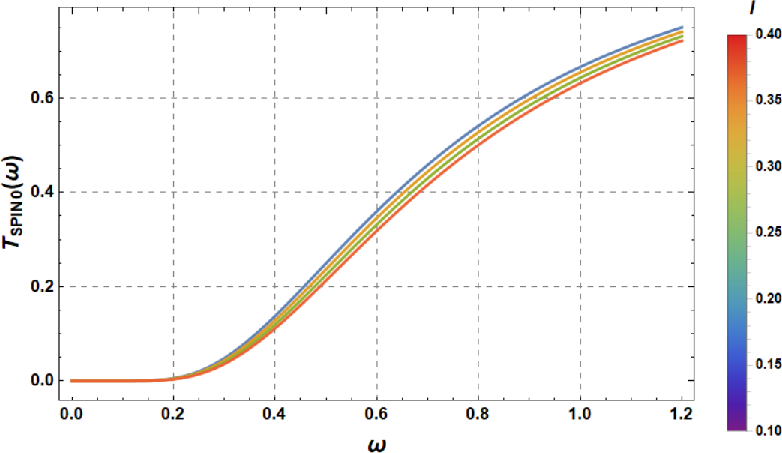
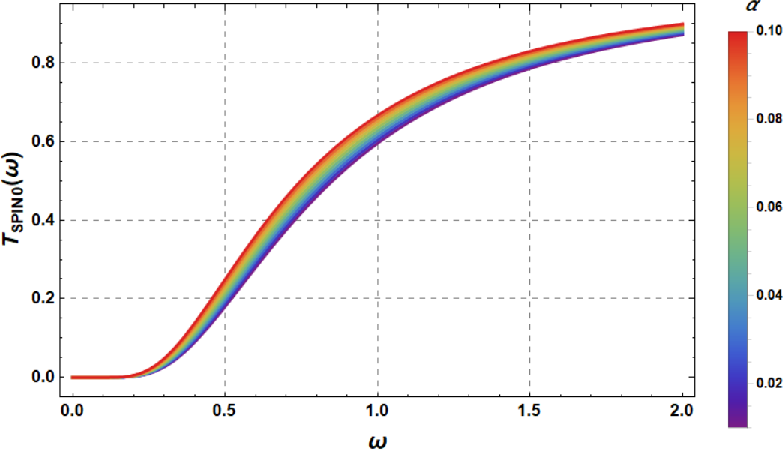
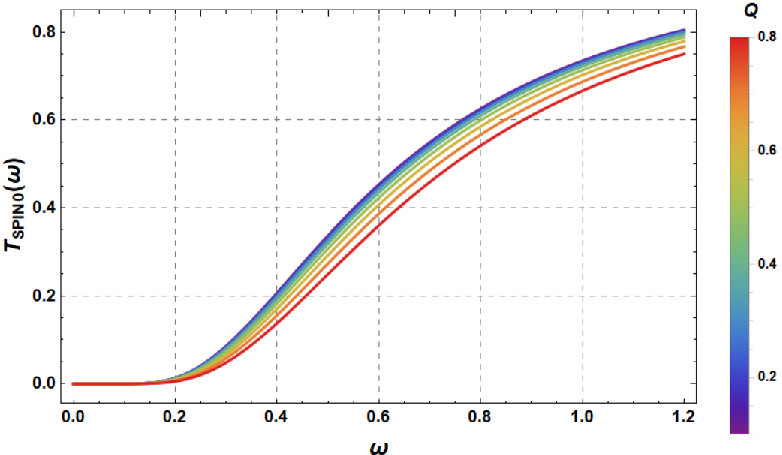
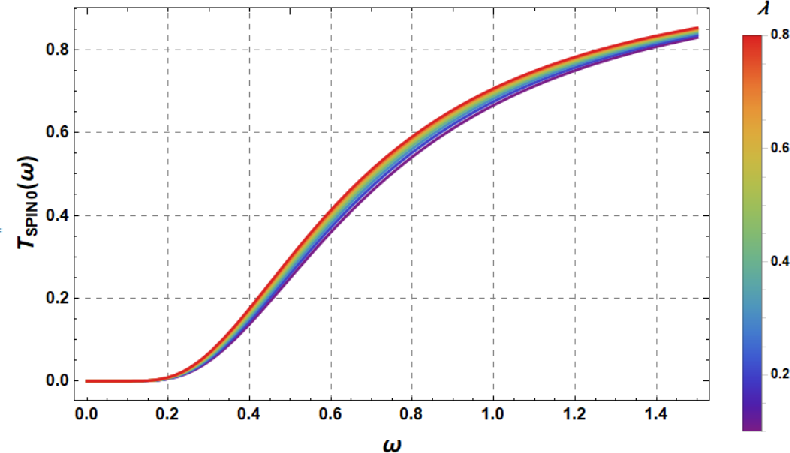
Figure 5: Scalar (A(r)=1−α−r2M+(2+ℓ)r22(1+ℓ)Q2e−λ,B(r)=A(r)1+ℓ.2) greybody factor as a function of frequency, exemplifying suppression by A(r)=1−α−r2M+(2+ℓ)r22(1+ℓ)Q2e−λ,B(r)=A(r)1+ℓ.3 and A(r)=1−α−r2M+(2+ℓ)r22(1+ℓ)Q2e−λ,B(r)=A(r)1+ℓ.4, and enhancement by A(r)=1−α−r2M+(2+ℓ)r22(1+ℓ)Q2e−λ,B(r)=A(r)1+ℓ.5 and A(r)=1−α−r2M+(2+ℓ)r22(1+ℓ)Q2e−λ,B(r)=A(r)1+ℓ.6.
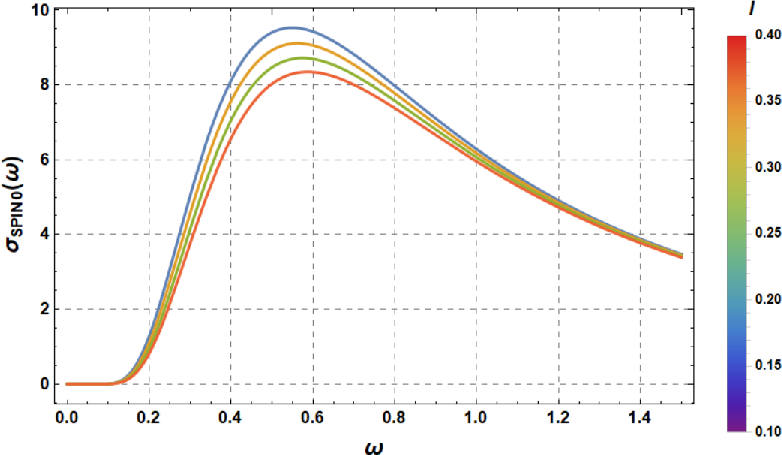
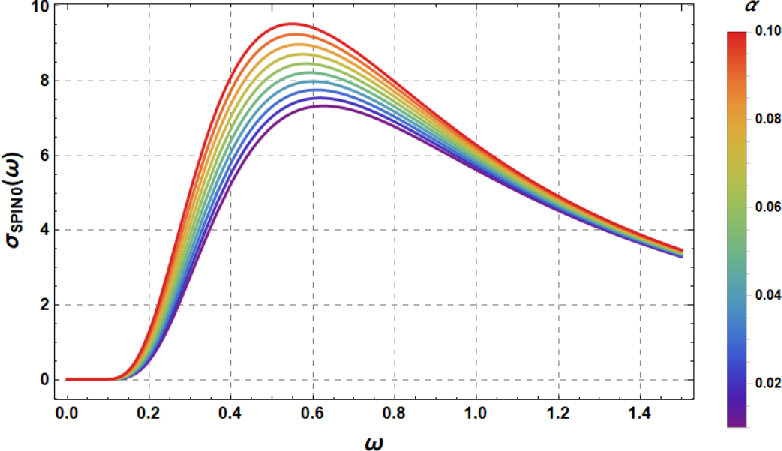
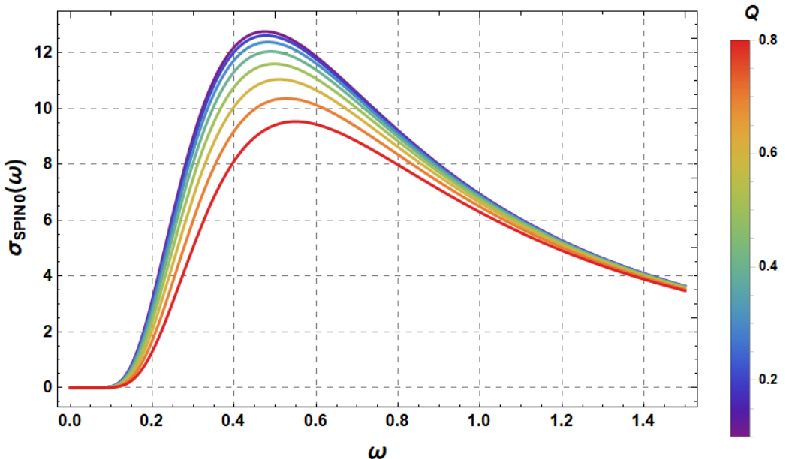
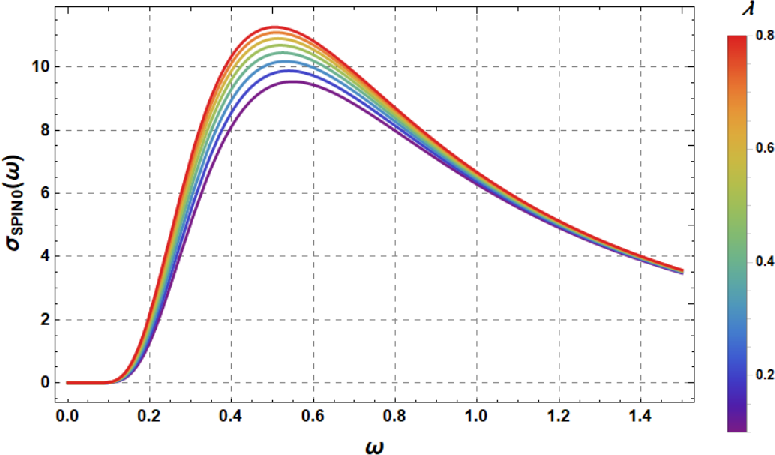
Figure 6: Corresponding absorption cross section for scalar fields; peak locations and amplitude manifest strong parameter dependence.
- Spin 1 and 2 Sectors: The absorption spectra for electromagnetic and gravitational perturbations display qualitatively parallel dependence, with spin-2 modes extending to higher frequencies, broader absorption, and a more pronounced sensitivity to the parameters.
(Figures 7–10)
Figures 7–10: Greybody factors and absorption cross sections for A(r)=1−α−r2M+(2+ℓ)r22(1+ℓ)Q2e−λ,B(r)=A(r)1+ℓ.7 (electromagnetic and gravitational waves), emphasizing increased peak width and shifting with varying A(r)=1−α−r2M+(2+ℓ)r22(1+ℓ)Q2e−λ,B(r)=A(r)1+ℓ.8.
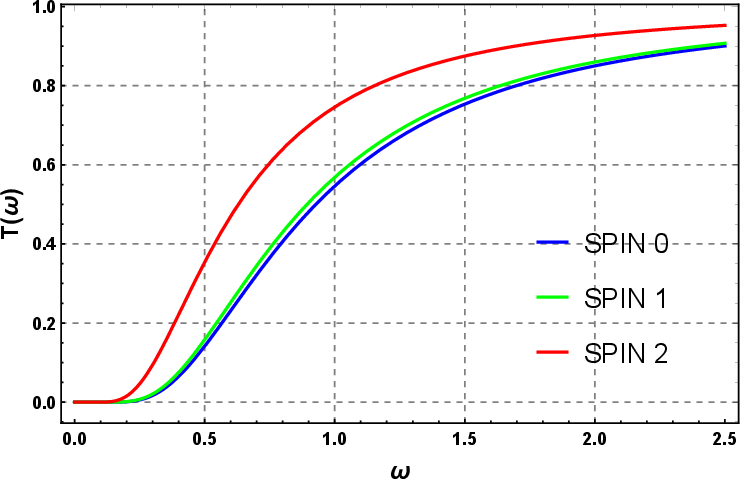
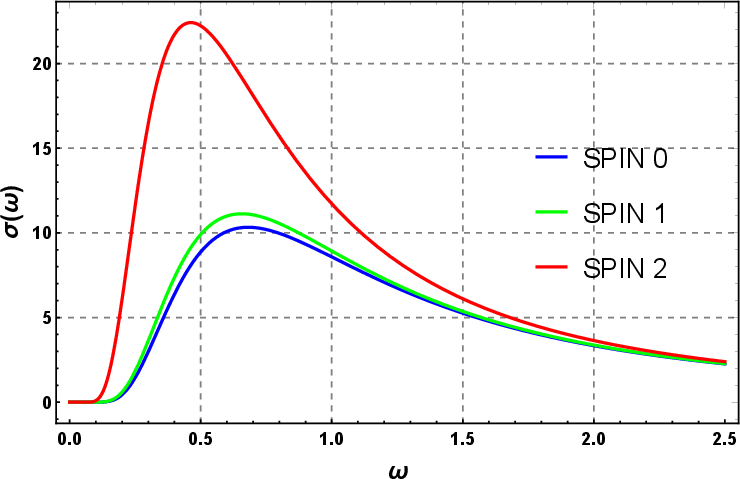
Figure 7: Direct comparison of greybody factors (a) and absorption cross sections (b) for A(r)=1−α−r2M+(2+ℓ)r22(1+ℓ)Q2e−λ,B(r)=A(r)1+ℓ.9 illustrates the spin hierarchy in transmission and absorption profiles.
Physical Implications and Theoretical Significance
The study provides several notable findings:
- Thermodynamics and Phase Transitions: All sectors—gravity, string cloud, ModMax, and Lorentz violation—combine to control extremality, the presence and nature of phase transitions, and conditions for local stability. The explicit parameter dependence implies that astrophysical constraints on black hole shadows, Hawking fluxes, or absorption signatures could, at least in principle, inform or limit new physics sectors.
- Sparsity and Quantum Features: The robust prediction of highly sparse Hawking radiation across large regions of parameter space reinforces the discrete, quantum description of black hole evaporation, modified by the geometry and field content.
- Wave Propagation and Observables: The greybody and absorption behavior point to potentially observable differences in black hole signatures, particularly for gravitational waves and electromagnetic radiation propagating in Lorentz-violating or nonlinear electrodynamic backgrounds.
- Parameter Interplay: The analysis demonstrates no degeneracy between α0—each controls a distinct physical aspect (asymptotics, energy scales, stability, emission rates), leading to a highly tunable phenomenology.
Outlook
The presented model sets the stage for further theoretical and observational studies of black holes embedded in nontrivial fields, especially as astrophysical observations continue to improve in sensitivity. Future directions include:
- Extension to rotating solutions and consideration of time-dependent backgrounds in Bumblebee gravity.
- Inclusion of full quantum corrections and dynamical string network effects.
- Detailed computation of observable gravitational wave signals incorporating greybody-modified emission and propagation in Lorentz-violating geometries.
- Exploration of constraints on α1 from black hole shadow and lensing data.
Conclusion
The analysis systematically demonstrates how Bumblebee gravity, nonlinear ModMax electrodynamics, and exotic matter sources coalesce to profoundly alter all key signatures of black hole physics, spanning thermodynamics, quantum emission, and classical and quantum wave propagation. The intricate interplay between parameters yields a landscape of horizon and emission properties far richer than conventional solutions, motivating both deeper theoretical exploration and precision astrophysical testing of black hole environments.

