- The paper demonstrates that a Lorentz-violating vector field and a global monopole induce significant modifications in black hole horizon structure and thermodynamics.
- It employs a modified Reissner–Nordström metric and WKB methods to analyze changes in entropy, Hawking temperature, and photon sphere characteristics.
- Results indicate that increasing Lorentz violation and monopole strength enlarge the photon sphere, shift orbital stability thresholds, and affect Hawking flux.
Charged Black Holes in Bumblebee Gravity with Global Monopole: Thermodynamics and Shadow
Introduction and Motivation
The paper "Charged Black Holes in Bumblebee gravity with Global Monopole: Thermodynamics and Shadow" (2604.00883) presents a comprehensive analysis of charged black hole solutions in the Lorentz-violating Bumblebee gravity framework, augmented by a global monopole defect. The work addresses both thermodynamic and optical signatures, and connects them with the geodesic structure and wave propagation phenomena in these nonstandard backgrounds. The presence of a global monopole introduces an angular deficit into the metric, fundamentally altering asymptotic properties, while the Bumblebee sector breaks Lorentz invariance via a vector field acquiring a vacuum expectation value. The authors focus on how these geometric modifications, together with electric charge, deform horizon structure, energy emission, shadow observables, and the local dynamics of test particles and fields.
Metric Structure and Horizon Properties
The Lorentz-violating and monopole-augmented Reissner–Nordström-like metric is characterized by a deformation governed by two parameters: the Lorentz-violating parameter ℓ and the monopole parameter η. The metric function f(r) is modified to encapsulate both the conical asymptotics and the charge scale deformation.
The horizon structure is analyzed via the roots of f(r), which shift in response to both ℓ and η. Notably, in parameter ranges studied, two horizons are generically present, with the monopole field increasing the event horizon radius via the solid-angle deficit.
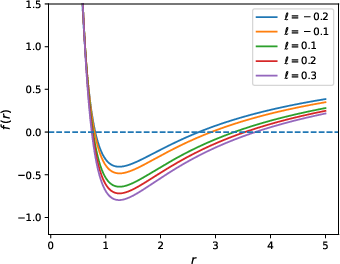
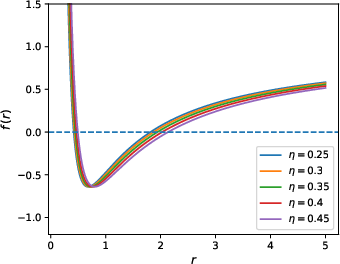
Figure 1: Metric function f(r) for various ℓ and η, demonstrating the shift in horizon locations with fixed Q=0.8.
Thermodynamics
Extensive calculations of horizon entropy, Hawking temperature, ADM mass, Gibbs free energy, and specific heat are presented. Entropy is directly influenced by the conical deficit, scaling as η0 with η1. The surface gravity and Hawking temperature acquire corrections dependent on both η2 and η3.
The Hawking temperature exhibits the typical non-monotonic behavior of charged black holes, with η4 decreasing the temperature peak and η5 introducing milder shifts.
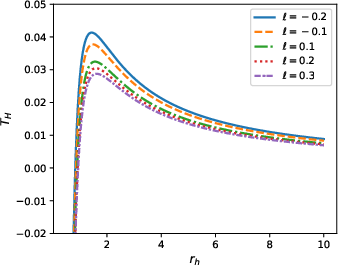
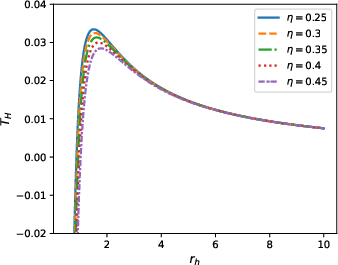
Figure 2: Hawking temperature η6 versus horizon radius η7, highlighting monotonic and non-monotonic regimes across parameter space.
The ADM mass and Gibbs free energy curves show prominent deformation with increasing η8 and η9, reducing the mass and thermodynamic potential compared to standard scenarios.
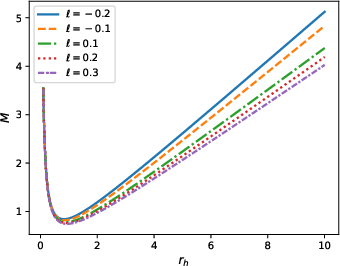
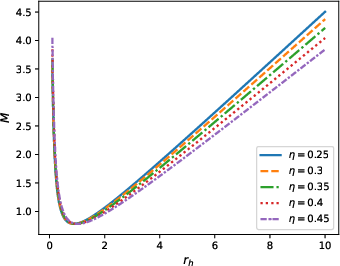
Figure 3: ADM mass f(r)0 dependence on f(r)1, illustrating suppression with increased Lorentz violation and monopole strength.
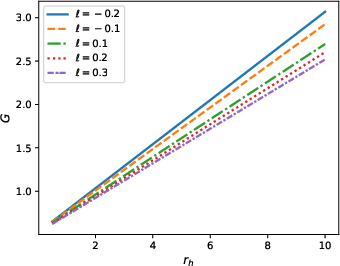
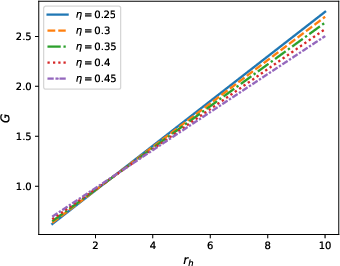
Figure 4: Gibbs free energy f(r)2 as a function of radius, showing monotonic parameter response without signal of phase transition.
Specific heat analysis reveals a divergence, marking the onset of local instability and phase transition. The critical point moves nontrivially with both geometric parameters.
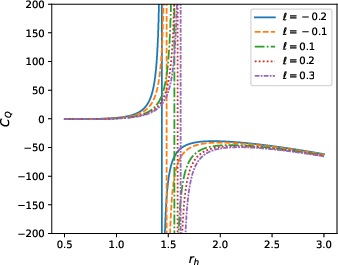
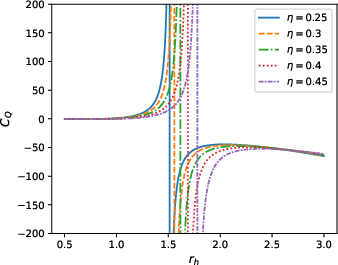
Figure 5: Specific heat f(r)3 profile, with divergence boundary separating stable and unstable thermodynamic branches.
Optical Characteristics: Photon Sphere and Shadow Structure
The null geodesics in the equatorial plane are studied, yielding an effective potential that governs photon capture and escape. The photon sphere radius and shadow size are derived analytically and numerically, with both f(r)4 and f(r)5 expanding the photon sphere and thus enlarging the shadow, i.e., both diminish gravitational focusing due to metric deformation.
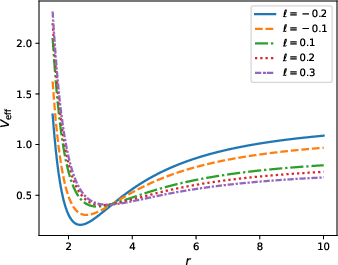
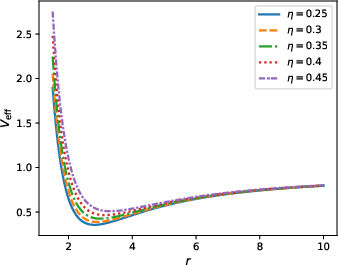
Figure 6: Null effective potential f(r)6 for various parameters, with extrema indicating photon sphere location.
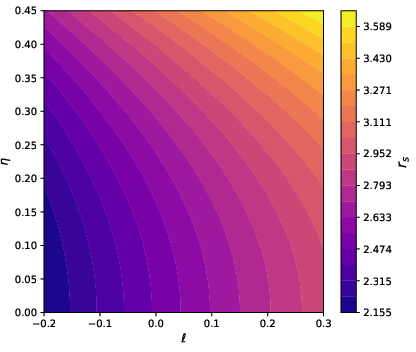
Figure 7: Photon-sphere radius f(r)7 map across f(r)8, providing insight into the joint influence of Lorentz violation and monopole field.
Parametric shadow diagrams demonstrate that, while the shadow remains circular, its radius increases with both parameters.
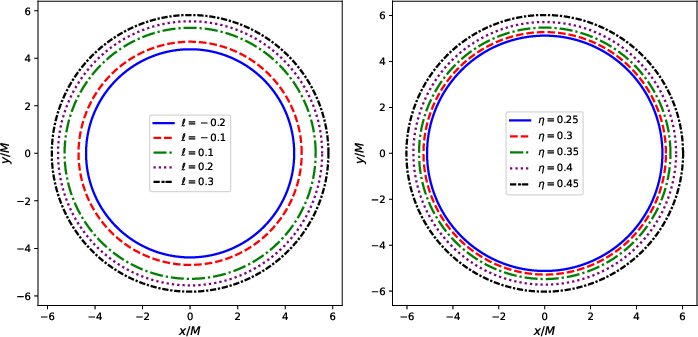
Figure 8: Shadow radius response for fixed f(r)9, across f(r)0 and f(r)1.
Observational constraints using EHT data on Sgr~Af(r)2 restrict the parameters: typically f(r)3 and f(r)4, with stronger charge requiring tighter bounds.
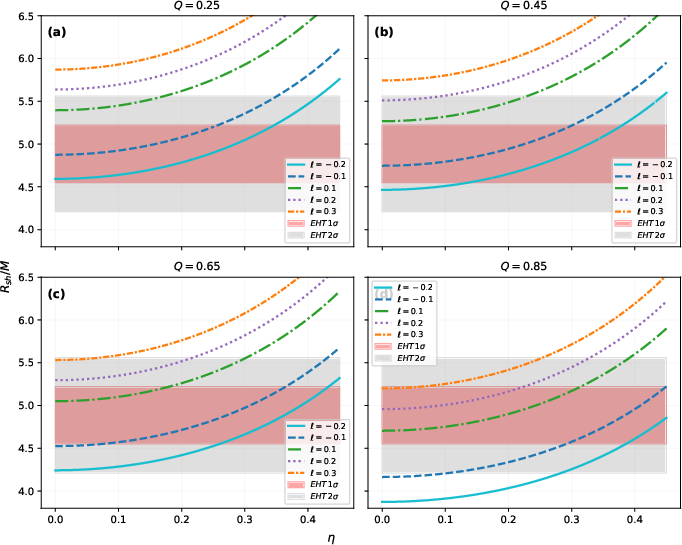
Figure 9: Normalized shadow radius f(r)5 versus f(r)6, overlaying EHT constraints to identify allowed parameter regimes.
Photon Trajectories and Weak Lensing
Photon paths are solved in the weak-field limit, and the finite-distance Gauss–Bonnet method is applied to derive the deflection angle. The topological conical deficit and Lorentz-violating corrections appear explicitly; both parameters increase the weak lensing angle.
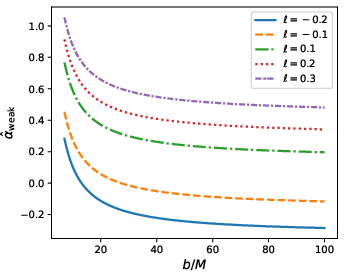
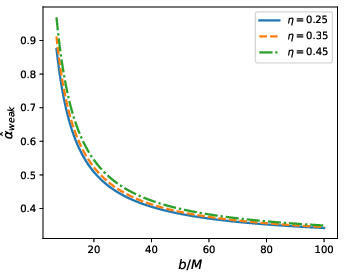
Figure 10: Weak deflection angle f(r)7 as a function of impact parameter for variable geometric deformations.
Dynamics of Test Particles and ISCO Structure
Analysis of timelike geodesics establishes the corrections to perihelion precession and ISCO structure. Both f(r)8 and f(r)9 are found to elevate orbit energy and angular momentum, and shift the ISCO outward, thus reducing effective gravitational binding.
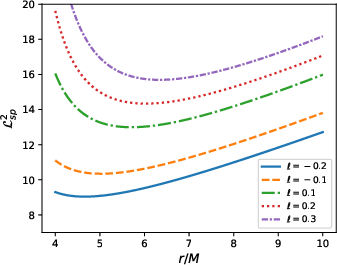
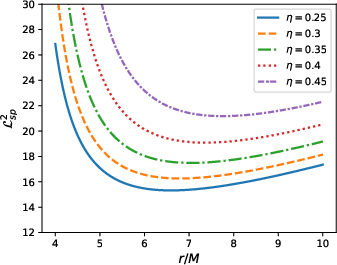
Figure 11: Specific angular momentum squared ℓ0 profiles, minima linked to ISCO transition.
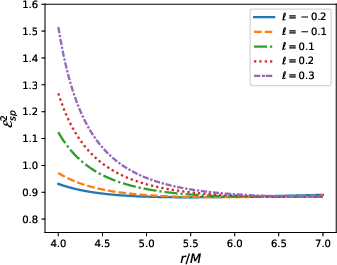
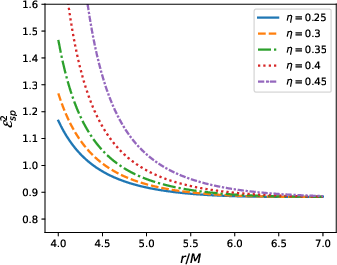
Figure 12: Specific energy squared ℓ1, showing elevation with parameter increase and approach to asymptotic plateau.
Azimuthal angular velocity decreases with both parameters at fixed radius, consistent with suppressed gravitational attraction.
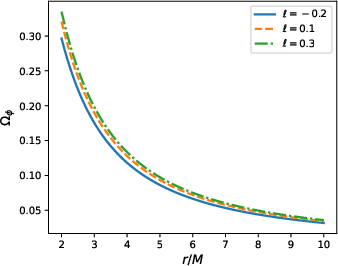
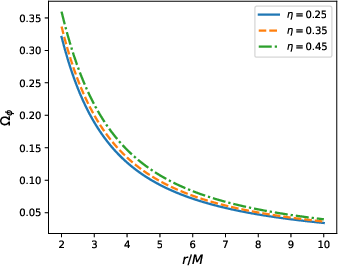
Figure 13: Azimuthal angular velocity ℓ2 responses, with slower orbital motion for enlarged ℓ3.
Perturbative Sector: Scalar Field and Quasinormal Modes
Scalar wave propagation is treated via Klein-Gordon equation, yielding an effective potential with peaked barrier governed by ℓ4 and ℓ5. The barrier height and location shift substantially with parameter variation.
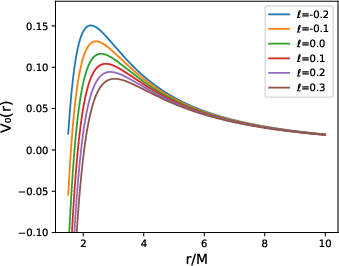
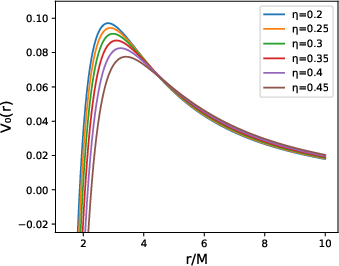
Figure 14: Scalar potential profile for fixed ℓ6 and ℓ7, displaying barrier shift trends.
QNMs are calculated using WKB methods. The real (oscillation) and imaginary (damping) parts of frequency exhibit strong dependence:
- ℓ8 decreases with both LV and GM parameters.
- ℓ9 shows non-monotonic dependence: initial decrease, then increase in magnitude, signifying complex changes in damping rate and radiative stability.
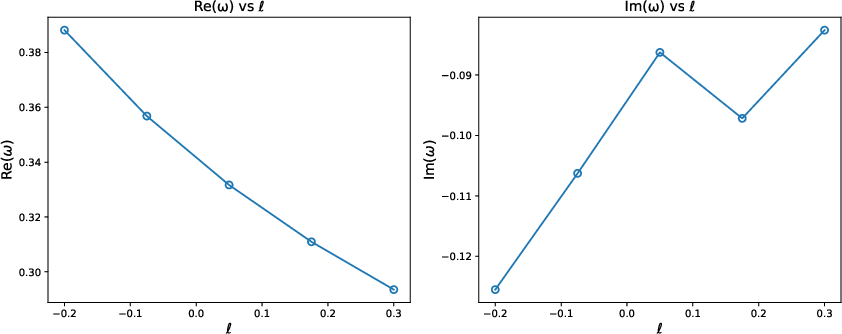
Figure 15: QNM frequency components as functions of η0 for fixed η1, demonstrating suppression and non-monotonicity.
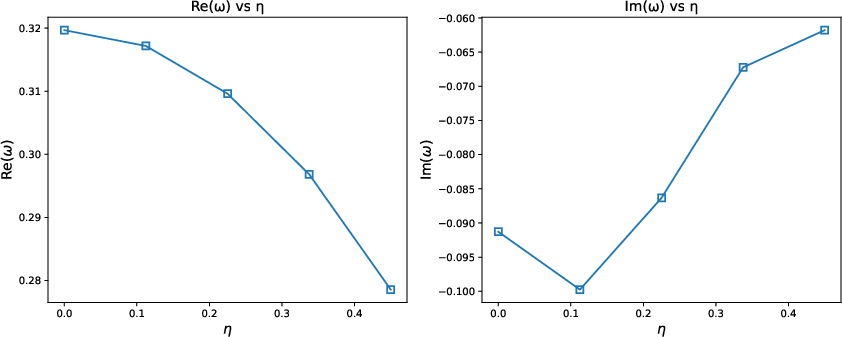
Figure 16: QNM components versus η2 for fixed η3, revealing similar suppression interplay.
Greybody Factors, Energy Emission Rate, and Radiation Sparsity
Greybody factors, computed via semi-analytic WKB bounds, demonstrate that η4 enhances the curvature barrier (lowering transmission at low η5), while η6 reduces it (raising transmission). Reflection decreases with both at high frequency.
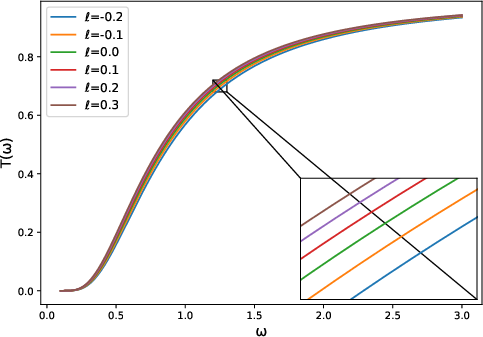
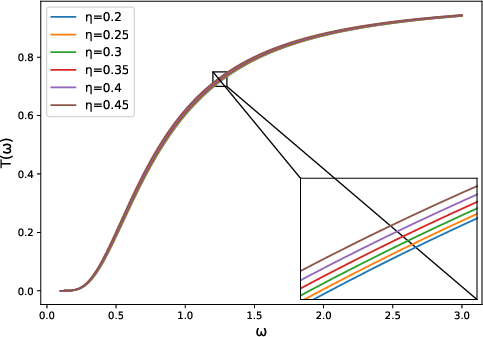
Figure 17: Transmission coefficient η7, with suppression/enhancement trends depending on parameters.
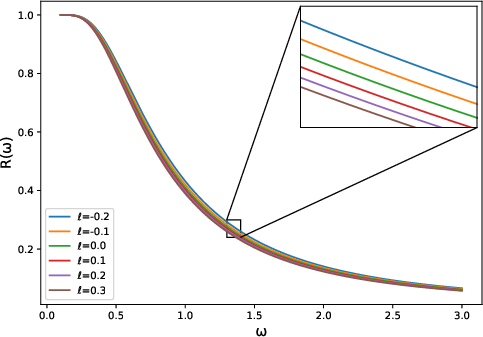
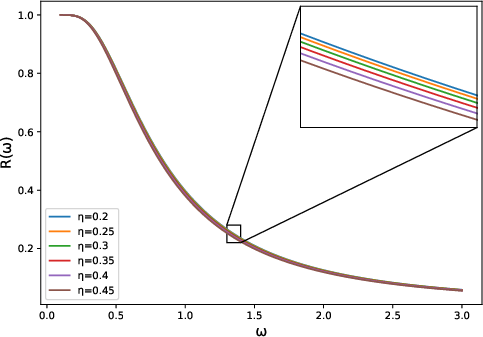
Figure 18: Reflection coefficient η8, demonstrating parameter-linked reduction.
Energy emission rate profile exhibits peak position and height as a function of geometric parameters, controlled by both Hawking temperature and shadow radius.
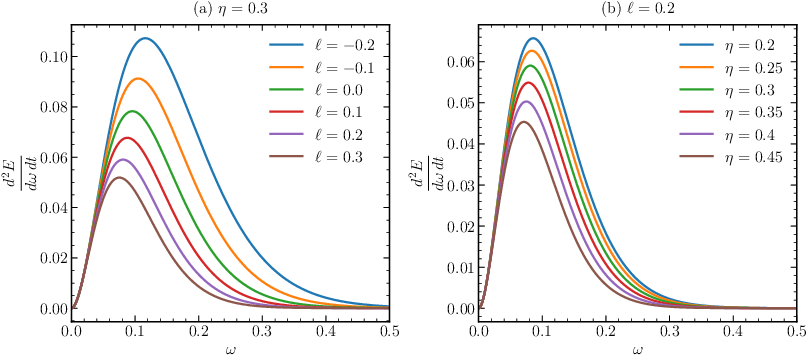
Figure 19: Energy emission rate over η9, with emission peak encoding thermal and optical interplay.
Sparsity parameter quantifies temporal separation of Hawking quanta: increases with both f(r)0 and f(r)1, signifying more intermittent emission.
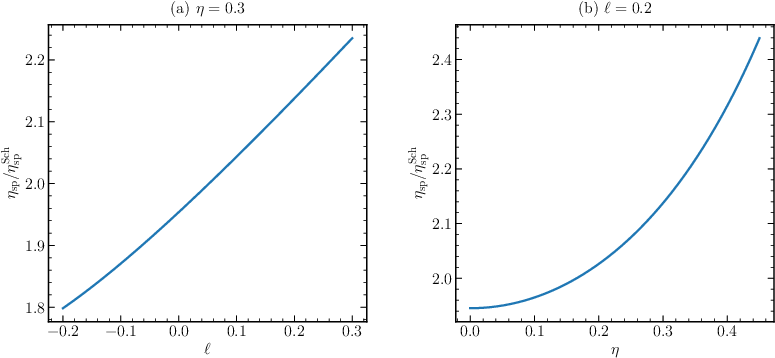
Figure 20: Normalized sparsity parameter f(r)2, illustrating how deviations from Schwarzschild yield more sparse radiation.
Conclusion
The analysis in (2604.00883) offers a multi-faceted characterization of charged black holes in Bumblebee gravity with a global monopole. Deformations from Lorentz violation and topological defects induce significant departures from standard black hole physics in thermodynamics, shadow radius, orbital stability, radiative profiles, and photon/geodesic dynamics. These results not only constrain parameter ranges using event horizon imaging, but also generate explicit predictions for Hawking flux and QNM frequencies in strong gravity regimes.
Future extensions should include rotational generalizations, continued QNM analysis, and further observational tests against black hole imaging and gravitational wave data to probe Lorentz-violating and topologically nontrivial gravity in astrophysical contexts.

