- The paper introduces EpiDiffVO, a geometry-aware visual odometry framework that uses sparse epipolar matching and diffusion-based keypoint refinement.
- It employs a novel Steiner graph and Transformer-based aggregation to enforce geometric consistency and improve pose estimation accuracy.
- Experimental validations on KITTI and TartanAir show reduced Sampson error and enhanced robustness under challenging conditions.
Geometry-Aware Epipolar Diffusion for Robust Visual Odometry: An Expert Analysis
The task of estimating relative pose from image pairs is essential for robust visual odometry (VO) in robotics and autonomous systems. Classical geometry dictates that a minimal set of keypoint correspondences can constrain motion, but contemporary deep learning models generally resort to dense matching and direct regression. These paradigms introduce redundancy, complicate interpretability, and are susceptible to degradation under image noise, wide baselines, and non-ideal environmental conditions. Existing methods insufficiently explicate and enforce geometric consistency, especially when correspondences are affected by compounded sources of structured noise such as motion blur, calibration errors, and deviations from perfect epipolar alignment.
The presented work introduces EpiDiffVO, a geometry-aware visual odometry framework that prioritizes geometric consistency in correspondence selection and refinement. Unlike approaches relying on either simple outlier filtering or global aggregation, EpiDiffVO integrates (1) sparse epipolar match selection, (2) diffusion-driven keypoint realignment, and (3) a graph-theoretic aggregation mechanism for correspondence subset selection. The pipeline enables robust and physically interpretable pose estimation, validated on the KITTI and TartanAir datasets.
Methodological Framework
The architectural pipeline of EpiDiffVO comprises several novel and synergistic modules, as illustrated in (Figure 1).
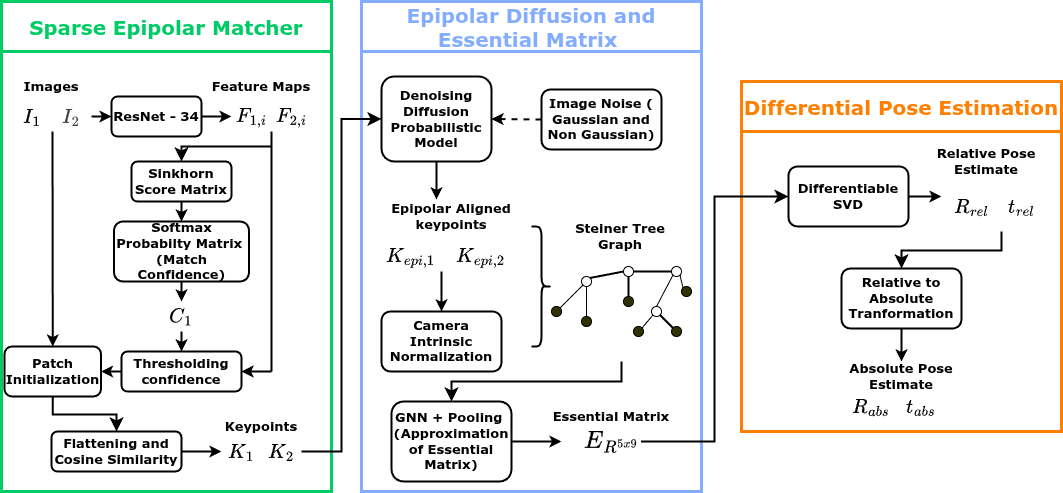
Figure 1: Geometry Diffusion VO module—(a) sparse epipolar matcher for initial keypoint selection, (b) epipolar diffusion and Steiner graph construction for keypoint realignment, and (c) differentiable SVD-based pose estimation.
Sparse Epipolar Matching
The feature map-based matching paradigm computes representations using a ResNet-34 backbone, followed by dense similarity computation and Sinkhorn normalization for probabilistic assignation. A confidence threshold isolates a compact initial set of correspondences. These are projected back into the image domain, and the Top-K matches are selected by cosine similarity in local patch space. This process eliminates much of the redundancy associated with dense methods, emphasizing geometric plausibility.
Keypoint Realignment via Diffusion
Keypoint perturbations are formally modeled through a stochastic process. Diffusion models, specifically a denoising diffusion probabilistic model (DDPM), approximate the uncertainty with isotropic Gaussian noise, reflecting observed physical noise sources—sensor projection, motion estimation, matching ambiguity, and calibration (Figure 2). The reverse diffusion process iteratively denoises candidate matches, guaranteeing progressive alignment to their corresponding epipolar lines and minimizing the Sampson error.
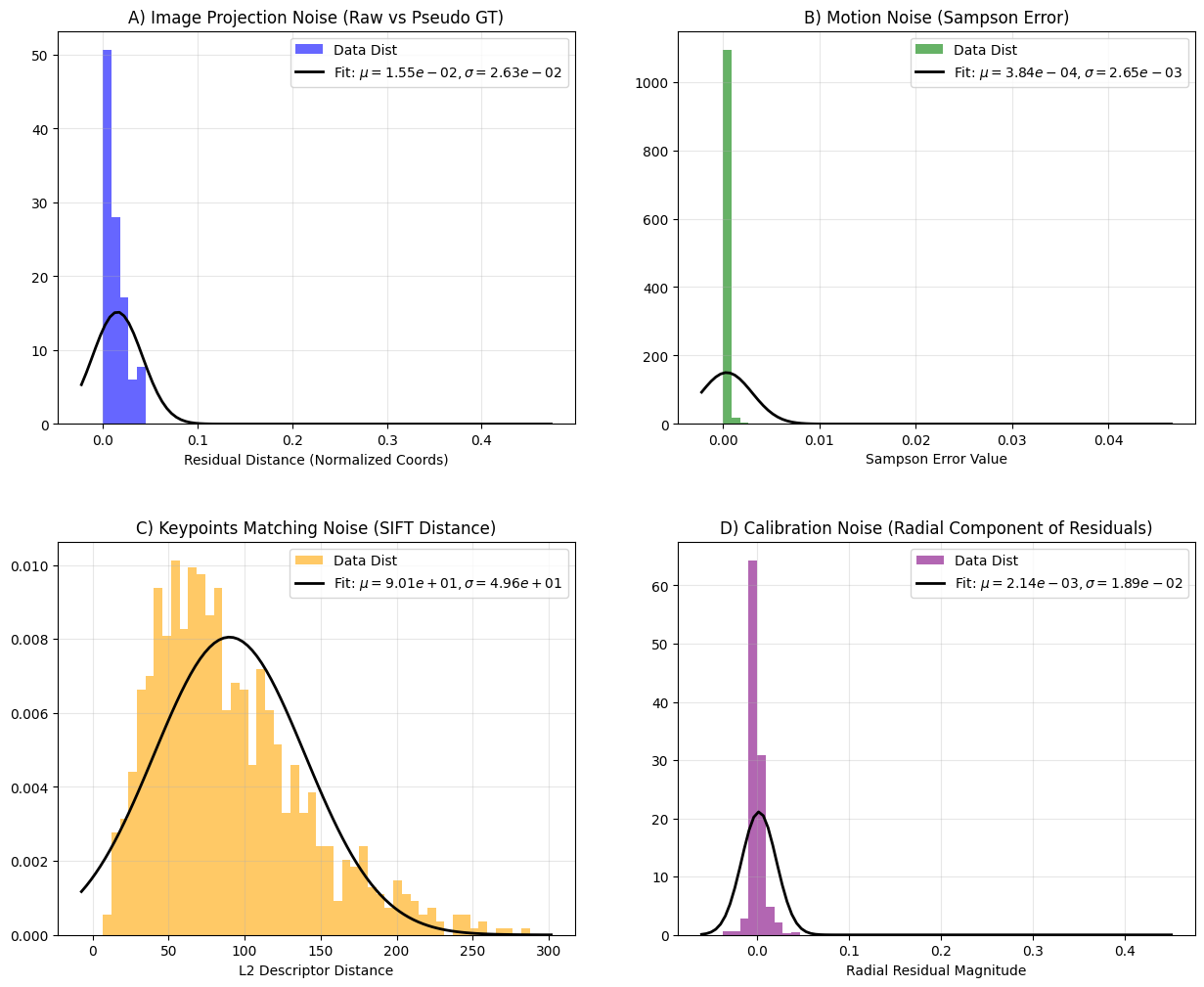
Figure 2: Real-world image and motion noise are accurately modeled as isotropic Gaussian processes.
3D Lifting and Steiner Graph Construction
Refined correspondences are triangulated into 3D coordinates using stereo disparity. EpiDiffVO constructs a Steiner graph by integrating a minimum spanning tree (MST) for global spatial coherence, appended with k-nearest neighbor edges for local consistency. This relational structure encodes both global and local geometrical relationships, mitigating the propagation of outlier correspondences into the pose estimation pipeline.
Graph Neural Aggregation and Geometric Estimation
A series of Transformer-based self- and cross-attention layers processes both spatial and geometrically refined correspondence graphs. The network learns a minimal, informative subset for robust essential matrix estimation, sidestepping the bias and inconsistency risks of direct regression or pure attention strategies. Pose parameters (R,t) are recovered via a differentiable SVD-based solution adhering to classical multi-view constraints.
Key components of the pipeline (sparse matching and diffusion-based keypoint realignment) are visualized in (Figure 3):
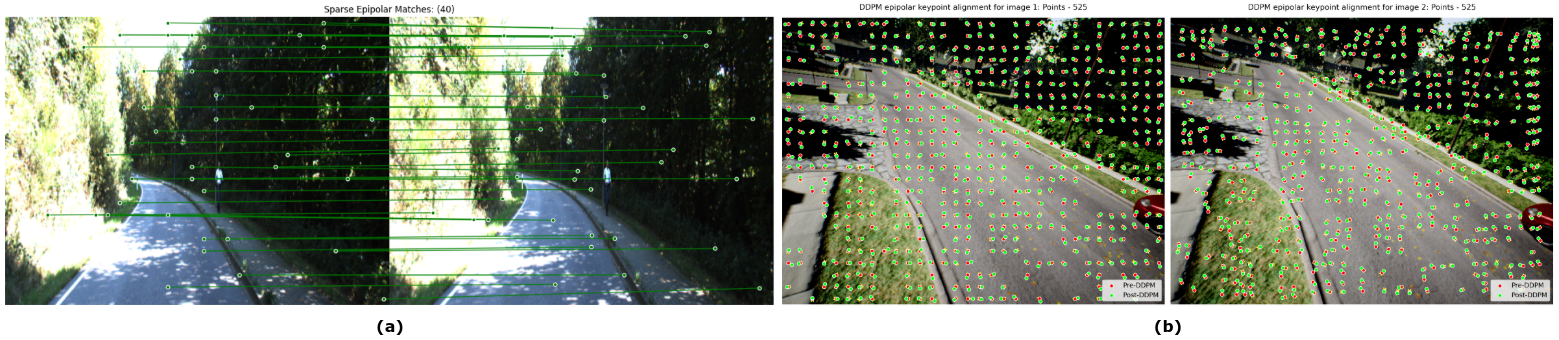
Figure 3: (a) Output of sparse epipolar matching; (b) DDPM-based Transformer refinement ensuring epipolar consistency.
Experimental Validation
Training Protocol
The EpiDiffVO framework is implemented in PyTorch and trained using a modular schedule. Sparse epipolar matching, DDPM keypoint denoising, and differentiable graph-based pose estimation are optimized independently to reduce inter-stage bias. Sampson geometric loss, DDPM denoising loss, and SVD regularization govern the respective optimization objectives.
Keypoint Consistency and Sampson Error
Comparison plots underscore the efficacy of the diffusion module; the DDPM-based refinement yields consistent reductions in Sampson error as compared to raw sparse matches, thereby validating the benefit of structured correspondence denoising.
Relative and Absolute Pose Estimation
KITTI and TartanAir datasets are employed for both relative pose (RRE, RTE, Sampson error) and absolute pose (ATE, APE) evaluation. On KITTI, the proposed method achieves minimal Sampson error and robust estimation, outperforming RANSAC/MAGSAC-classic procedures except for some direct deep regression baselines on isolated metrics. Crucially, on the more challenging TartanAir benchmark (capturing severe motion and viewpoint variance), the addition of DDPM and the graph-differentiable SVD estimator leads to the most stable global pose, evidenced by trajectory visualizations (Figure 4):
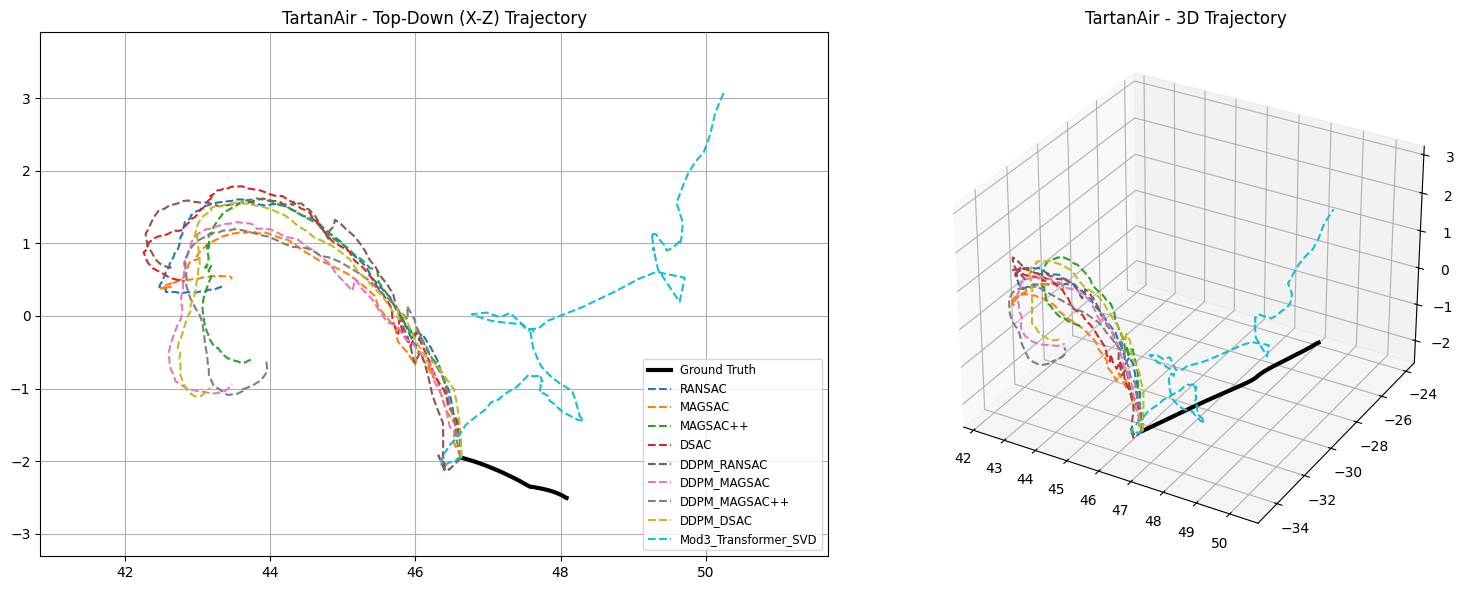
Figure 4: Pose Estimation Evaluation (absolute pose trajectories) benchmarked across methods on the TartanAir dataset.
Implications
Theoretical Implications
EpiDiffVO exposes the limitations of both classical and naive deep approaches that ignore explicit geometric structure. The introduction of diffusion-based refinement tightly couples probabilistic error modeling with epipolar constraints. Steiner graph construction, integrated with GNN modules, provides a compelling mechanism to propagate geometric consistency and outlier rejection in correspondence aggregation—an approach that theoretically unifies geometric vision principles with end-to-end learning, and that could be extended to other multi-view and SLAM problems.
Practical Implications
The pipeline is invariant to baseline and viewpoint variation, mitigating gross errors that often undermine direct regression or dense matching-driven SLAM algorithms. The modularity supports easy extension to event-based sensors, multi-camera rigs, or hybrid visual-inertial stacks. The reduction in correspondence redundancy suggests tangible computational savings for deployment on embedded and autonomous agents.
Prospects for Future Research
Advancing EpiDiffVO to real-time operation, especially for dynamic and low-texture environments, is a logical trajectory. Fusing event vision and IMU modalities, incorporating temporal graph propagation for scale disambiguation, and adapting lightweight graph architectures for edge inference will address remaining limitations and open new application frontiers.
Conclusion
EpiDiffVO represents a structured, geometry-centric approach for robust visual odometry, leveraging minimal sparse matching, learned diffusion-based keypoint alignment, and graph-based geometric subset selection. The framework demonstrates exclusive improvements in Sampson error and absolute pose stability, substantiated across benchmarks. By formalizing a hybrid model, the work closes methodological gaps between data-driven learning and multi-view geometry reasoning, and provides a scalable foundation for next-generation visual odometry algorithms.

