- The paper establishes maximum likelihood decoding as the optimal method in QEC by maximizing posterior probabilities over logical cosets despite its #P-hard complexity.
- It details statistical mechanics approaches that map QEC to disordered spin models, enabling precise threshold evaluation and phase transition analysis.
- It also reviews tensor network and machine learning decoders, offering practical, hardware-compatible strategies for real-time, scalable quantum error correction.
Maximum Likelihood Decoding of Quantum Error Correction Codes
Introduction and Motivation
Quantum error correction (QEC) stands as the cornerstone for scalable, fault-tolerant quantum computation, yet its efficacy fundamentally depends on the classical decoding workload: mapping noisy syndrome records to optimal recovery actions. Among all decoding prescriptions, maximum likelihood decoding (MLD) is theoretically optimal, as it maximizes the posterior probability over logical operators given syndrome data. However, MLD is generically #P-hard, motivating substantial progress across statistical physics, tensor network algorithms, and machine learning formulations.
This work surveys the landscape of MLD in QEC, unifying recent developments from statistical mechanics mappings, tensor-network (TN) contraction, and artificial intelligence approaches, with a focus on the concrete realization of near-MLD decoders under realistic device noise, and providing a roadmap for scalable, hardware-compatible implementations.
Decoding as Statistical Inference in Stabilizer Codes
The decoding problem is formally a statistical inference task. In stabilizer codes, errors manifest as syndromes—measurement outcomes of stabilizer generators—but this mapping is many-to-one: multiple physical error configurations correspond to each syndrome, and errors differing by stabilizer multiplication act identically on logical information. The core decoding task thus becomes determining the most probable logical effect (coset) given the syndrome.
MLD requires summing the probabilities of all physical errors in each logical coset, selecting the logical class with maximal total posterior weight. This process accounts for degeneracy in Pauli errors—a key distinction from minimum-weight matching methods that focus solely on the most likely single configuration.
Statistical Mechanics Approach to MLD
Mapping QEC Decoding to Disordered Spin Models
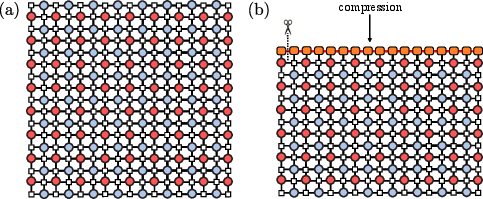
MLD in QEC under Pauli noise is equivalent to evaluating partition functions of carefully constructed classical spin models (random-bond Ising models, spin glasses), where each syndrome pattern maps to a disorder realization and error probabilities become Boltzmann weights. The optimal error threshold for a code corresponds precisely to a phase transition (e.g., ordered-to-disordered) along the Nishimori line, where the model parameters are calibrated to the true physical noise.
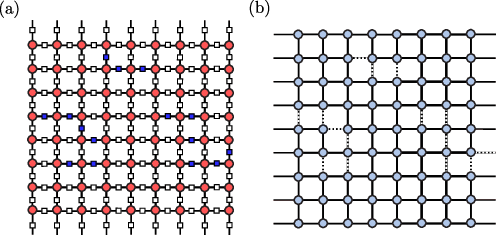
Figure 1: The mapping of the surface code under bit-flip noise to a random-bond Ising model—error chains correspond to frustrated bonds, and coset sums to partition functions in different topological sectors.
On planar graphs (toric code, repetition code), exact evaluation of these partition functions is tractable via Kac-Ward determinants; for the toric code under independent bit-flip noise, this yields the textbook threshold pth≈10.9%. Planarity can persist in practical settings: repetition-code decoding under full circuit-level noise also maps to a planar Ising-type model, enabling exact MLD with polynomial complexity via determinant algorithms.
Beyond Planarity
For generic, non-planar scenarios—including the surface code under circuit-level noise or qLDPC codes—the partition function is intractable to evaluate exactly. Practical approaches include Monte Carlo estimation of coset partition function ratios and block-level belief propagation, notably the BlockBP decoder, which leverages local tensor contractions within a belief propagation framework to efficiently approach MLD accuracy with parallelizable updates.
Tensor Network Perspective
The TN approach operationalizes the coset summation as a structured contraction over a factor graph representing the code and noise model. Two graphical formulations are distinguished:
Boundary matrix product state (MPS) contraction yields accurate approximations to the partition functions for 2D local codes, with polynomial complexity controlled by the MPS bond dimension χ. Benchmarks demonstrate logical error rates indistinguishable from exact MLD for moderate χ, with faster contraction relative to generic combinatorial methods.
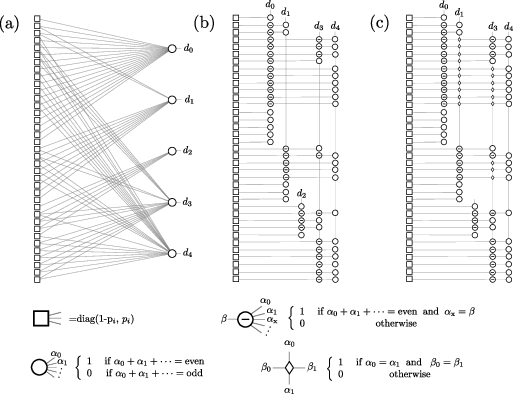
Figure 3: (a) Tensor network from DEM structure; (b) decomposition of high-degree parity tensors; (c) planarization of the network for contraction.
For realistic, irregular DEMs encountered in hardware calibration, preprocessing steps (splitting high-degree parity tensors, adding crossing-resolving pass-throughs) are essential for mapping to a regular lattice, making boundary TN contraction practical.
In the temporal dimension (3D codes or repeated syndrome extraction under phenomenological/circuit-level noise), an efficient contraction requires advanced boundary representations such as MPO-MPS, leveraging the circuit and detector structure to manage scaling.
Artificial Intelligence Perspective: Learned Decoders
MLD may also be approximated by parameterizing the mapping from syndrome to logical correction using machine learning. Here the decoder is typically a deep neural network (NN) trained to minimize cross-entropy with the true conditional logical distribution, effectively learning the coset sum. Key architectures include convolutional NNs for local codes, transformer models, and recurrent networks exploiting temporal translation invariance in repeated measurement (e.g., the AlphaQubit framework).
AlphaQubit integrates a tokenizer, spatial attention, and a recurrent core, achieving state-of-the-art accuracy matching or surpassing hand-designed decoders under circuit-level noise, while enabling hardware calibration and adaptation.
Real-Time and High-Rate Decoding
A central practical bottleneck is real-time decoding, as hardware requires sub-microsecond syndrome-processing latency. Two architectural paradigms are evident:
- Throughput maximization via GPU/TPU batch processing (AlphaQubit 2 achieves <1μs amortized per round up to d=11).
- Strict-latency minimization through FPGAs, employing heavily quantized and pruned neural architectures, yielding successful <1μs inference for surface codes up to d=9.
For high-rate qLDPC codes, where output space scaling becomes a formidable obstacle, autoregressive generative models (e.g., GND) provide a tractable approach. They sequentially sample logical labels, capturing nontrivial logical correlations and outperforming both factorized neural and BP+OSD decoders on high-k benchmarks.
Practical Implications and Experimental Applications
These advances have moved MLD from an abstract benchmark to a practical tool. Exact planar MLD decoding has corrected previous logical failure rate estimates, revealing hardware performance gains masked by suboptimal decoders. Differentiable TN decoders (dMLE) now serve both inference and hardware-tailored noise calibration, improving logical rates by up to ~30% for repetition code and ~8% for surface code datasets by optimizing decoder priors.
Experimental validation comes from large-scale repetition- and surface-code experiments (up to d=7), with MLD-class and learned decoders demonstrating both improved post-processed logical rates and calibration insight.
Open Challenges and Outlook
Key research directions remain:
- Scalability: For d>15 codes, contraction and inference costs escalate, calling for hierarchical, modular, or windowed schemes.
- High-rate codes: For generic expander-graph qLDPCs, neither TN nor local feature-based NNs suffice—advances in expander-compatible TNs or graph NNs are needed.
- Hardware co-design: Decoders and hardware must be jointly optimized; quantized, highly parallel NN architectures are progressing, but further algorithm-hardware integration is demanded.
- Non-Pauli and correlated noise: MLD approaches assuming Pauli noise need robustification or generalization for realistic platforms exhibiting leakage, coherent errors, and correlated faults.
Conclusion
MLD for QEC provides a rigorous, unifying foundation for decoder optimality. The synthesis of statistical mechanics, tensor-network algorithms, and machine learning has closed the gap between theoretical and practical decoding accuracy for many codes of current interest. By integrating these perspectives, MLD is now both a standard for benchmarking new decoders and a practical tool for error correction and noise calibration in experimental devices. As quantum hardware scales, efficient, flexible MLD-class decoders—both fast and hardware-aware—will be central to reaching and certifying true quantum fault-tolerance.