- The paper demonstrates that minimal prepare-and-measure setups achieve quantum advantage only by leveraging high-dimensional entanglement and adaptive, non-projective measurements.
- It employs a systematic polytope analysis to derive facet inequalities that certify quantum communication protocols even with limited classical messaging.
- The results imply that adaptive LOCC protocols with real-time measurement updates are critical for advancing practical quantum networks and device-independent tests.
Overview and Motivation
The paper "Entanglement in prepare-and-measure scenarios without receiver inputs" (2603.29625) delivers a rigorous and comprehensive analysis of the minimal settings in which quantum correlations—specifically entanglement—yield operational advantages in prepare-and-measure (PM) communication complexity tasks with the constraint that only the sender (Alice) holds an independent input and the receiver (Bob) has none. The primary focus is on the elementary PM scenario, revealing fundamental features around the necessity of entanglement, real-time measurement adaptivity, and the unexpected importance of non-projective measurements. The scenario has both conceptual significance for foundational quantum information theory and practical relevance as a device-independent, black-box test of adaptive one-way LOCC capability—a key requirement for modern quantum communication protocols including teleportation and quantum networking.
Classical vs. Quantum Communication in the PM Scenario
In classical PM scenarios without receiver inputs, Alice encodes her input into a limited-size classical message and Bob attempts to decode it to generate an output. For nontriviality, the communication channel's alphabet size d must be strictly less than Alice's input space ∣X∣, and outputs ∣B∣ must not trivialize the task by allowing direct transmission of Alice's input.
Quantum advantages in these settings necessitate two conditions:
- Shared entanglement between Alice and Bob.
- Adaptive measurements by the receiver, informed by the communicated message.
Without these, Bell nonlocality cannot be exploited and classical protocols saturate the maximal achievable performance. Quantum correlations in such a scenario are characterized by
p(b∣x)=m=1∑dTr(Am∣x⊗Bb∣mψAB),
where Am∣x and Bb∣m denote adaptive quantum measurements, and ψAB is the shared entangled state.
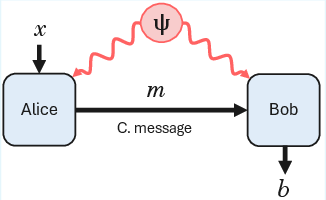
Figure 1: Classical communication in PM scenario; quantum advantage arises only when the receiver's measurement adapts in real time to the message.
Minimal Scenario for Quantum Advantage
A systematic polytope analysis identifies the minimal PM scenario admitting a quantum advantage: Alice encodes three inputs into binary messages (d=2) and Bob produces four possible outputs (∣B∣=4). The critical classical facet inequality is
S1=41i=0∑2[2p(i∣i)+p(⊥∣i)]≤1,
interpreted as state discrimination with a partial reward for inconclusive answers.
Quantum strategies for this scenario, even with two-qubit maximally entangled states, yield suboptimal violations; maximal quantum violation (∣X∣0) is achieved only with high-dimensional entanglement (e.g., a four-dimensional partially entangled state). An explicit optimal construction showcases non-maximal entanglement outperforming maximally entangled states, highlighting the essentiality of increased dimensionality.
Certification of Adaptive One-Way LOCC
To facilitate practical certification—maximal entanglement, noise-resilience, minimal input/output spaces—the next-to-minimal PM scenario (∣X∣1) is analyzed. The classical polytope facet inequality
∣X∣2
can be violated (∣X∣3) using a protocol structurally akin to the Tsirelson-bound measurements in a CHSH Bell test with maximally entangled qubits. This connection ensures significant noise-resilience and operational practicality.
High-dimensional entanglement further increases the quantum violation, confirming the irreducibility of dimensionality as a resource—even in a scenario closely related to CHSH nonlocality. Notably, violation of ∣X∣4 is not equivalent to CHSH violation; the physical scenario and correlation structure are distinct.
Facet Inequalities and Generalizations
A family of facet inequalities, parameterized by ∣X∣5, generalizes the minimal scenario:
∣X∣6
The task involves state discrimination with optional inconclusive answers, and the classical polytope's structure ensures tightness and facetness of these inequalities, as confirmed through detailed vertex enumeration and affine hull dimensionality arguments.
Quantum Communication: Qubit Messages and Non-Projective Measurements
Quantum communication protocols upgrade classical messages to qubits. When Bob reads out the quantum message and then uses the classical outcome to select a measurement on the entangled particle (rather than performing a joint measurement or entangled detection), the scenario becomes operationally simple yet structurally rich (Figure 2).
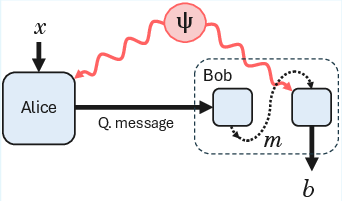
Figure 2: Quantum communication in the PM scenario; Bob's measurement adapts to both entanglement and classical read-out from a quantum message.
Contrary to prior expectations and to the Frenkel-Weiner theorem, qubit messages do provide an advantage in entanglement-assisted settings, but only when Bob's read-out is a genuinely non-projective measurement (e.g., trine POVMs). Non-projective measurements, in this context, more than double the quantum advantage originally achievable via classical communication and are indispensable for achieving violations unattainable by any protocol based on only projective measurements.
Implications, Connections, and Future Directions
From an operational perspective, the characterized quantum correlations serve as black-box certificates of adaptive one-way LOCC, with direct application in quantum networks, real-time feed-forward tasks, and benchmarking of quantum memories. The foundational importance extends to the certification and operational relevance of non-projective measurements, challenging the prevailing narrative that they are peripheral in device-independent studies.
Theoretical ramifications include:
- Demonstrated necessity for high-dimensional entanglement to maximize quantum advantage, even in settings with restrictive communication channels.
- Facet inequalities enabling semi-device-independent tests for non-projective measurement capabilities.
Future research directions include:
- Extension to informationally restricted (entropic) quantum correlations, differentiating classical polytope structures of dimension-restricted vs. information-restricted communication.
- Development of operational tests for high-dimensional entanglement and non-projectivity within practical quantum network architectures.
- Exploration of adaptive LOCC protocols for distributed quantum computation beyond state discrimination or function evaluation.
Conclusion
The systematic analysis of PM scenarios without receiver inputs establishes that quantum advantage in such settings requires the synthesis of shared entanglement and real-time adaptive measurements by the receiver. High-dimensional entanglement and non-projective measurements emerge as critical resources, surpassing classical and projective-only constraints. The findings enable both rigorous theoretical characterization and practical certification of advanced quantum communication capabilities, underpinning future advances in quantum networks and device-independent quantum technologies.

