- The paper introduces c-MVEP as a novel flicker-free paradigm that integrates broad-band coding with pseudo-random motion to reduce visual fatigue.
- The paper demonstrates that while c-MVEP outperforms SSMVEP in accuracy and response time, it currently lags behind c-VEP and SSVEP in overall performance.
- The paper highlights potential improvements through tailored temporal and spatial filtering and decoder optimization to advance practical BCI applications.
Code-Modulated Motion Visual Evoked Potentials: A New Paradigm for Flicker-Free BCI
Introduction and Motivation
The study introduces the code-modulated motion visual evoked potential (c-MVEP) as a novel stimulation protocol for non-invasive brain-computer interface (BCI) systems. Developed as an alternative to high-contrast flickering paradigms like code-modulated visual evoked potentials (c-VEP) and steady-state visual evoked potentials (SSVEP), c-MVEP aims to reduce visual and mental fatigue by replacing flickering with pseudo-random motion stimulation. By integrating the broad-band, reliable coding sequence of the c-VEP protocol with the flicker-free characteristics of SSMVEP, c-MVEP seeks to achieve high BCI performance while enhancing user comfort—a persistent challenge in practical BCI deployments.
Methodology
Experimental Design
Two experimental protocols were implemented: one offline and one online.
- Offline Analysis: Single stimuli were sequentially presented under four conditions: c-MVEP (pseudo-random code-modulated motion), c-VEP (pseudo-random flickering), SSMVEP (steady-state motion), and SSVEP (steady-state flickering). EEG responses were recorded and analyzed in time, frequency, and spatial domains.
- Online BCI Evaluation: A 4-class selection task was used to assess the practical feasibility and decoding performance of each paradigm for BCI control.
Stimulus Generation
c-MVEP employed radial zooming based on a smoothed m-sequence, ensuring fluid motion. For c-VEP, the original binary sequence modulated target luminance. SSMVEP and SSVEP used distinct frequency modulations implemented via sinusoidal motion or square-wave flickering, respectively. Key parameters were harmonized for fair comparison, employing a monitor refresh rate of $360$\,Hz and standardized stimulus geometry.
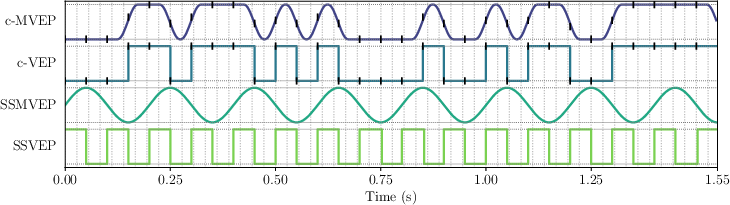
Figure 1: Stimulation waveforms for c-MVEP (smoothed pseudo-random zooming), c-VEP (binary flicker), SSMVEP (sinusoidal zooming), and SSVEP (frequency flicker) used in offline experiments.
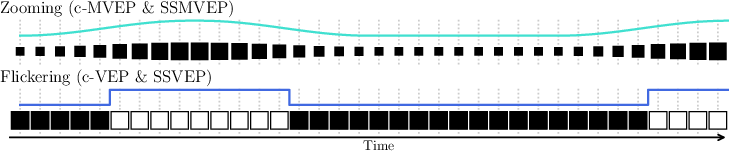
Figure 2: Partial waveforms showing zooming and flickering dynamics for each paradigm, with corresponding stimulus modulation.
Data Processing and Decoding
EEG signals were acquired via a 16-channel montage, preprocessed with bandpass and notch filtering. For online decoding, a unified template-matching CCA classifier was employed to remove decoder bias. Dynamic stopping criteria ensured reliable feedback without forced selection upon timeout.
Results
Response Characteristics
Time-domain and SNR analyses confirmed that c-MVEP and c-VEP produced broad-band responses, with c-MVEP more focused in lower frequencies. Spatial analyses indicated that motion-based protocols (c-MVEP, SSMVEP) elicited more distributed activation beyond Oz, aligning with literature on motion–temporal area engagement.
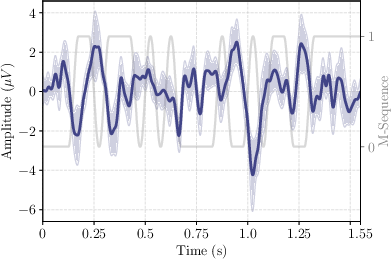
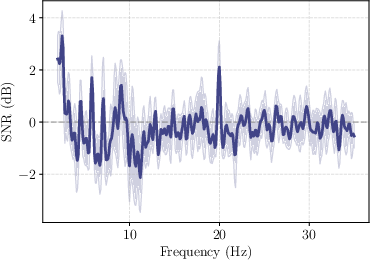

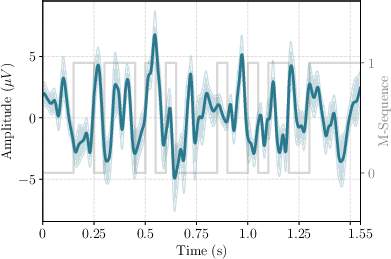
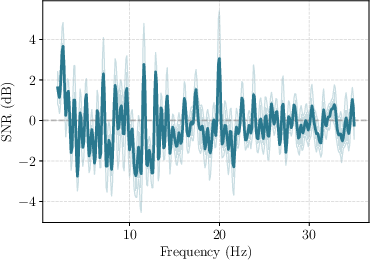

Figure 3: c-MVEP and c-VEP responses showing grand-average evoked waveforms, SNR spectra at Oz, and spatial distribution of 20 Hz power.
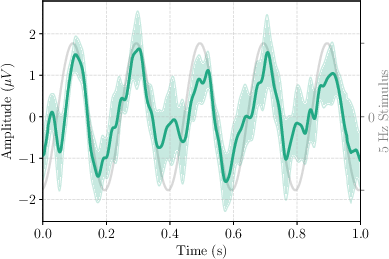
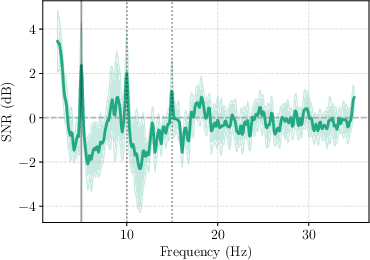

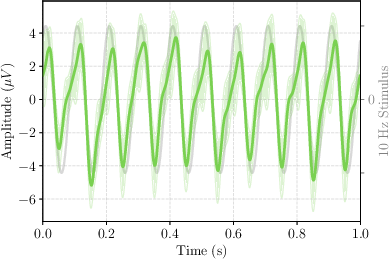
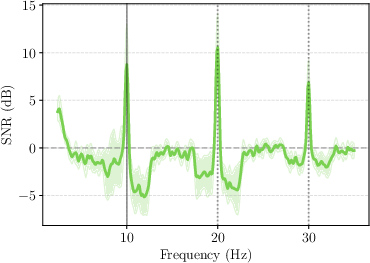

Figure 4: SSMVEP and SSVEP responses showing sinusoidal evoked waveforms, SNR spectra at Oz, and spatial topography of 5–10 Hz power.
Oscillatory paradigms (SSMVEP, SSVEP) exhibited clear harmonics; SSVEP achieved higher SNR than SSMVEP, confirming stronger occipital engagement.
Subjective Ratings
Questionnaire data collected both offline and online did not indicate significant differences in comfort, disturbance, ability to concentrate, or eye strain across the four paradigms. Forced-choice preference questions yielded no significant favorability for motion over flicker.
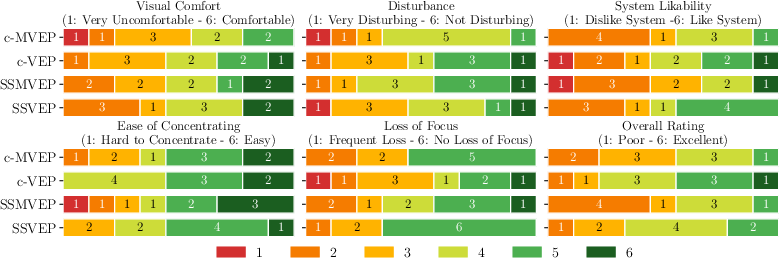
Figure 5: Offline experiment questionnaire results on comfort, concentration, disturbance, focus loss, likability, and overall rating for each paradigm.
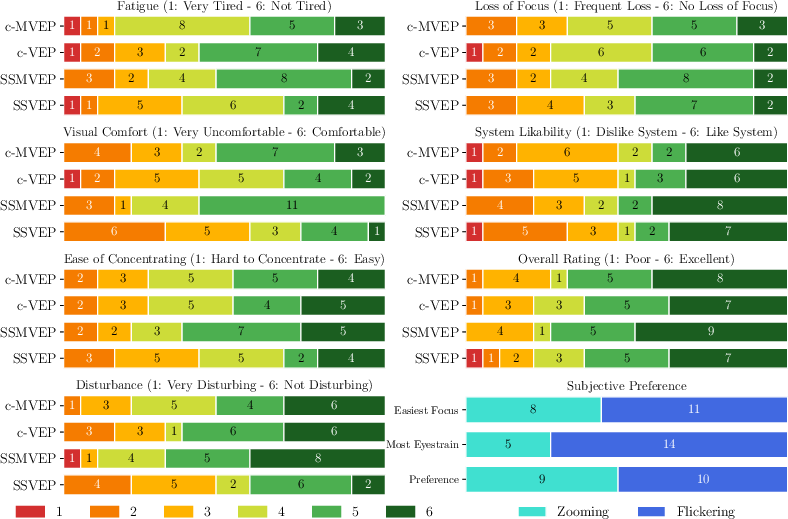
Figure 6: Online experiment subjective ratings and forced-choice preferences between zooming and flickering paradigms.
The 4-class selection task yielded:
- c-VEP: Highest mean accuracy (97.81%), fastest selection ($1.15$\,s), highest ITR (35.56bits/min).
- SSVEP: Near-optimal accuracy (93.42%), moderate selection time ($1.94$\,s), high ITR (28.12bits/min).
- c-MVEP: Accuracy (85.67%), selection time ($2.61$\,s), ITR (20.11bits/min).
- SSMVEP: Lowest accuracy (97.81%0), slowest selection (97.81%1\,s), lowest ITR (97.81%2).
Statistical testing confirmed c-MVEP outperformed SSMVEP in all metrics, but was consistently outperformed by c-VEP and SSVEP. The effect of adding motion was significantly more detrimental for SSVEP (28.5% drop) than for c-VEP (12.1% drop), suggesting greater robustness of code-modulation to motion-based stimulation.
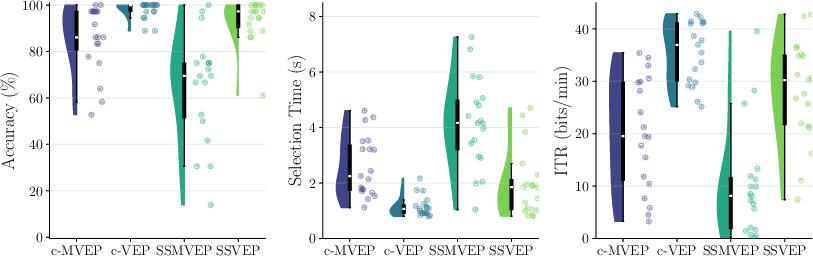
Figure 7: Raincloud plots of decoding accuracy, selection time, and ITR distributions for all participants and paradigms in the online experiment.
Discussion
The c-MVEP paradigm, utilizing code-modulated pseudo-random motion, achieves a compromise between the reliability and broadband coding of c-VEP and the reduced fatigue potential of SSMVEP. Despite substantial promise, c-MVEP performance remains below both c-VEP and SSVEP in accuracy and bitrate but surpasses SSMVEP. The subjective data indicate no significant comfort advantage for motion-based protocols under the tested parameters, contradicting some prior SSMVEP studies but aligning with others reporting parity in subjective comfort.
Notably, the unified decoding approach enables rigorous protocol comparison, but may underutilize paradigm-specific decoding optimizations (e.g., reconvolution-based CCA for c-VEP). The broad-band response of c-MVEP suggests avenues for tailored temporal and spatial filtering, potentially narrowing the performance gap with c-VEP.
The shifted spatial distribution of c-MVEP responses supports theoretical claims on motion stimulus engagement of middle temporal regions, and may inform future spatial filtering strategies. The absence of strong subjective benefits for motion further motivates refinements in amplitude, speed, or visual texture to minimize fatigue.
Implications and Future Directions
Pragmatically, c-MVEP offers an alternative for BCI users unable to tolerate flickering, particularly in high-fatigue contexts or environments where flicker is undesirable. Theoretically, the paradigm opens new lines for broadband motion-coded EEG response exploitation. Moving forward, stimulation parameters (zooming amplitude, sequence smoothness) and paradigm-optimized decoders warrant investigation. Additionally, competitive performance under conditions of visual distractors or after extended usage should be empirically evaluated.
The robust code-modulation architecture may enable c-MVEP to serve as a fallback or personalized BCI protocol. Further, hybrid stimuli (motion plus flicker) or alternative motion cues (moving textures) may improve both ERP response and user comfort. Integration with advanced spatial filters and component analysis could yield performance gains closer to flicker-based systems.
Conclusion
Code-modulated motion visual evoked potentials represent a technically rigorous advancement in BCI stimulation paradigms, offering a flicker-free, broadband alternative to conventional VEP-based control. While accuracy and bitrate currently trail c-VEP and SSVEP, c-MVEP is superior to SSMVEP and delivers competitive comfort. Continued protocol and decoding optimization, informed by response characteristics and user experience, may further enhance its practical and theoretical utility in the BCI domain.
Reference: "Beyond Flickering: Introducing Code-Modulated Motion Visual Evoked Potentials for Brain-Computer Interfacing" (2605.15801)

