- The paper introduces NormWear-2, a model that combines chaos-theoretic pretraining with dual intuition-insight latent inference for enhanced physiological signal forecasting.
- It employs chaos metrics like the Lyapunov exponent and detrended fluctuation analysis to balance training data and improve model generalization.
- Empirical results show that NormWear-2 outperforms state-of-the-art models in both time-domain and frequency-domain performance across varied clinical scenarios.
Chaos-Theoretic Latent Dynamics for Generalizable Physiological World Modeling
Introduction and Motivation
Modeling physiological time series such as ECG, EEG, and other biosignals demands approaches that can capture multi-scale, nonstationary, and often chaotic dynamics inherent to living systems. Prevailing representation learning methods in digital health center on static or supervised paradigms, primarily targeting tasks such as classification or event forecasting. This constrains inferential capabilities, eschewing the rich, predictive, and intervention-aware simulation of physiological evolution central to world modeling. "Toward World Modeling of Physiological Signals with Chaos-Theoretic Balancing and Latent Dynamics" (2605.15465) addresses this gap via NormWear-2: a world model that integrates chaos-theoretic data balancing, latent state dynamical inference, and unified representation of diverse physiological and intervention variables.
Methodological Framework
Model Architecture and Dual Inference Pathways
NormWear-2 encodes multivariate physiological and intervention time series into a unified latent space, modeling temporal evolution as a stochastic dynamical system. The method introduces a bifurcated inference process:
- Intuition: Prior knowledge captured by large-scale pretraining on balanced, diverse dynamical regimes.
- Insight: Post-hoc latent transition modeling, adapting state propagation based on contextual observation using nonparametric estimation and clustering.
This dual process guarantees both strong priors for generalization and adaptation to scenario-specific trajectories, yielding coherent multi-horizon forecasts across variable sampling rates and clinical interventions.
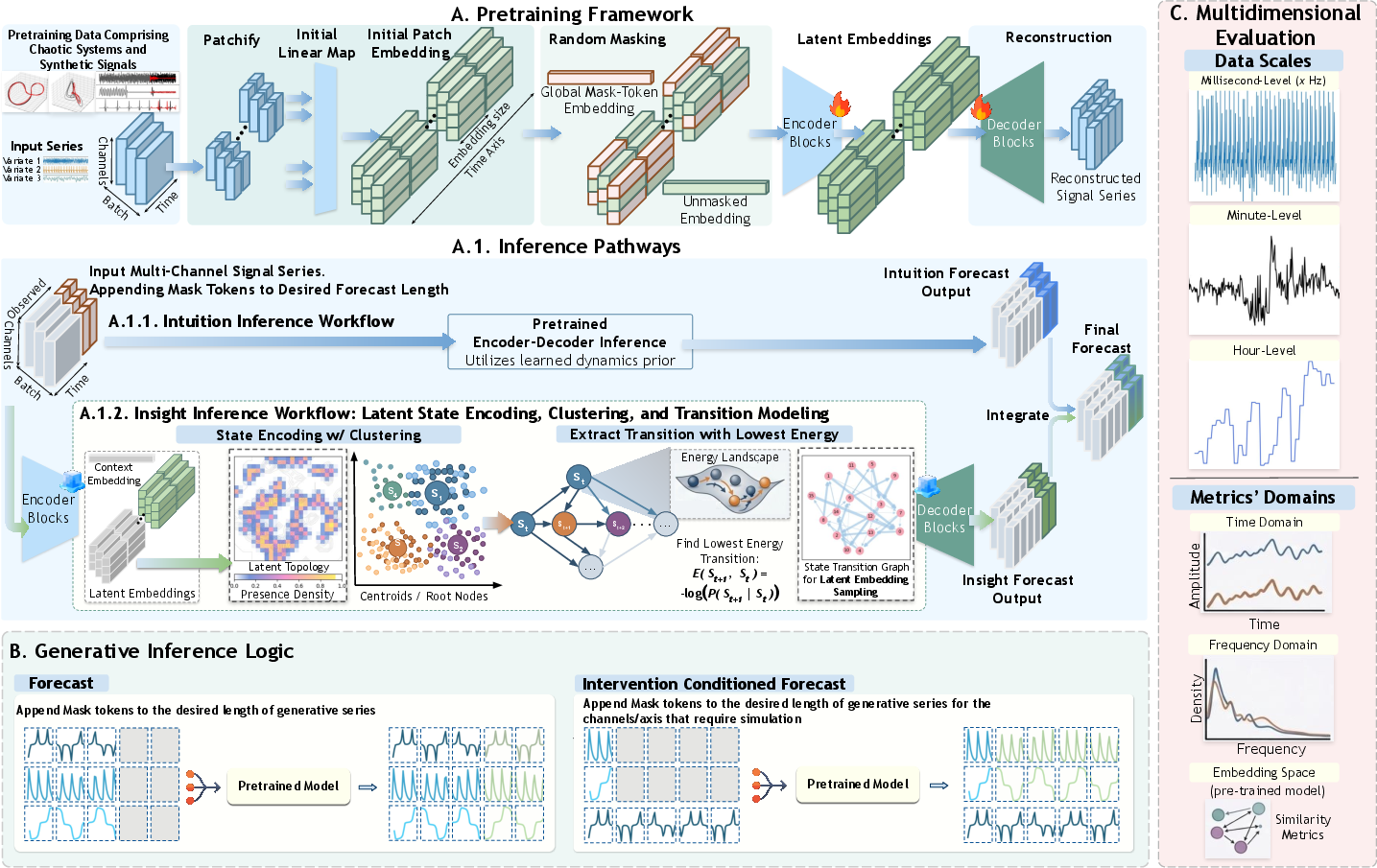
Figure 1: Schematic overview of the modeling workflow, detailing preprocessing, dual inference mechanisms, and multifaceted evaluation across temporal and metric domains.
Chaos-Theoretic Data Balancing
A central finding is the inadequacy of pretraining datasets dominated by a single regime (e.g., regular or strongly chaotic dynamics) for robust physiological world modeling. The authors employ chaos-theoretic metrics—Lyapunov exponent (LE), detrended fluctuation analysis (DFA), and persistent entropy (PE)—to stratify and cluster time series by dynamical type. They demonstrate that a smaller, but chaos-balanced, corpus empirically yields superior generalization and dynamical regime coverage compared to a larger, regime-skewed dataset. K-means clustering and entropy-derived homogeneity/granularity measures guide both the construction and assessment of pretraining data balance.
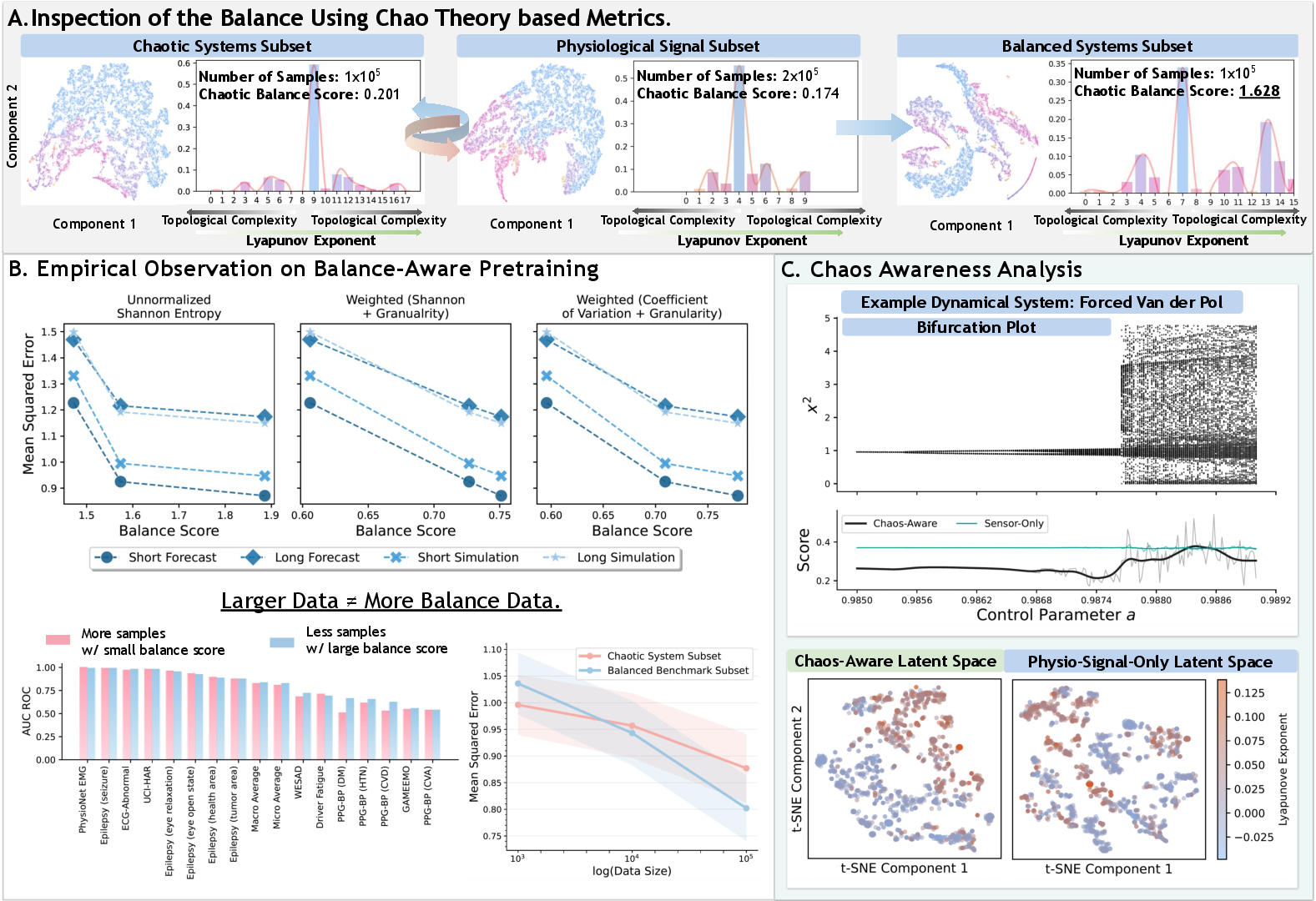
Figure 2: Data balance analysis and generative performance stratified by chaos-theory-derived regimes, supporting the necessity of balance in modeling robustness.
Latent-state Markov Dynamics and Action Conditioning
Following pretraining, input sequences are segmented, embedded, and clustered to define a discrete latent state sequence. Transition matrices—conditioned both on latent state and, when present, intervention/action variables—are constructed empirically from context segments. Forecasting becomes probabilistic latent-space rollout: sampling transitions, then reconstructing observable time series via pretrained decoders. Action variables (e.g., medication, machine control) are handled by embedding and concatenation in the latent space, with transition likelihoods marginalized or conditioned as appropriate.
Evaluation Protocol
A multidimensional evaluation framework is adopted:
- Pointwise and morphological: Mean absolute error (MAE), Dynamic Time Warping (DTW).
- Spectral: Cosine/EUclidean similarity in FFT domain.
- Latent semantics: Cosine/Euclidean similarity in pretrained latent embedding space.
Metrics are aggregated into a composite final score, reflecting trade-offs between fidelity to local trajectory, frequency characteristics, and semantic representation.
Empirical Results and Analysis
NormWear-2 outperforms established time-series foundation models (Chronos-2, TiReX, Panda, Sundial) across all benchmarked physiological domains—perioperative monitoring, sports tracking, diabetes management, hemodialysis—spanning temporal resolutions from milliseconds to hours. Especially notable are consistent improvements in DTW (temporal alignment), frequency-domain, and latent alignment metrics.
Importantly, chaos-balance-aware pretraining consistently yields lower generative error compared to larger but less balanced baselines, corroborating the central hypothesis. Statistical tests confirm the significance of NormWear-2’s margin over previous state-of-the-art approaches.
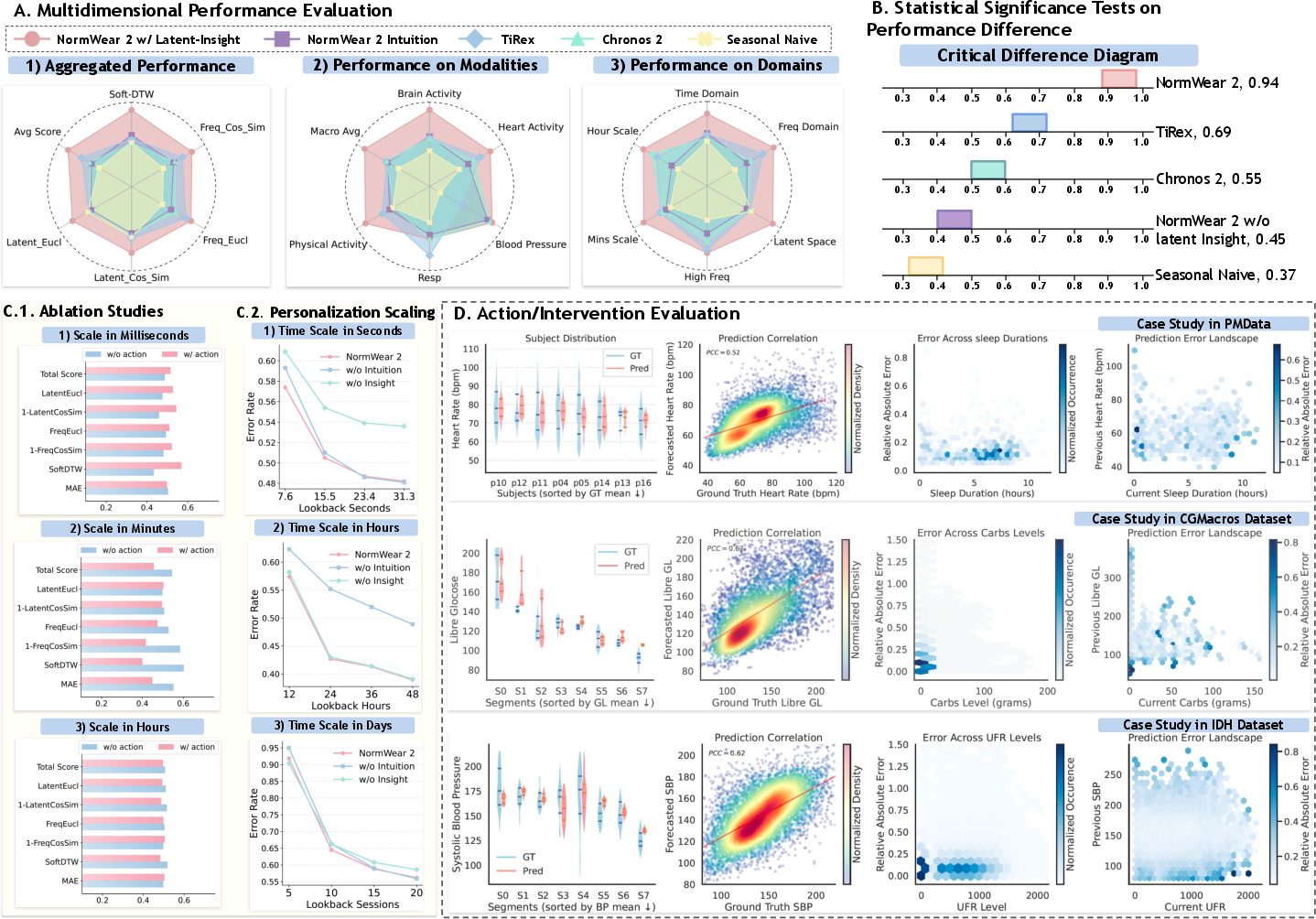
Figure 3: Comprehensive quantitative evaluation showcasing forecasting quality, ablation study effects, and action-aware forecasting accuracy.
Qualitative Dynamics and Visualization
Visualization of phase-space trajectories and latent evolution reveals that NormWear-2, via intuition-only and intuition-plus-insight rollouts, recapitulates nuanced dynamic regimes, including correct topological transitions even in ambiguous forecasting scenarios. Failure cases typically correspond to underdetermined contexts, wherein latent insight rectifies ambiguity via short-term adaptation.
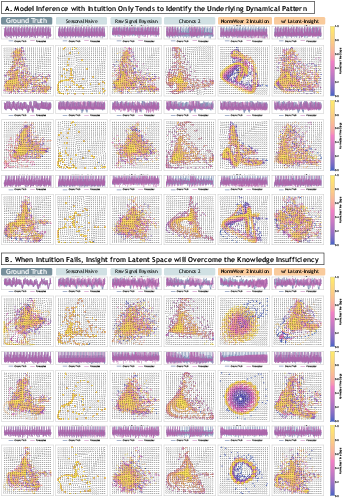
Figure 4: Qualitative depiction of generated phase-space trajectories; latent insight resolves ambiguities unseen in deterministic intuition-only forecasts.
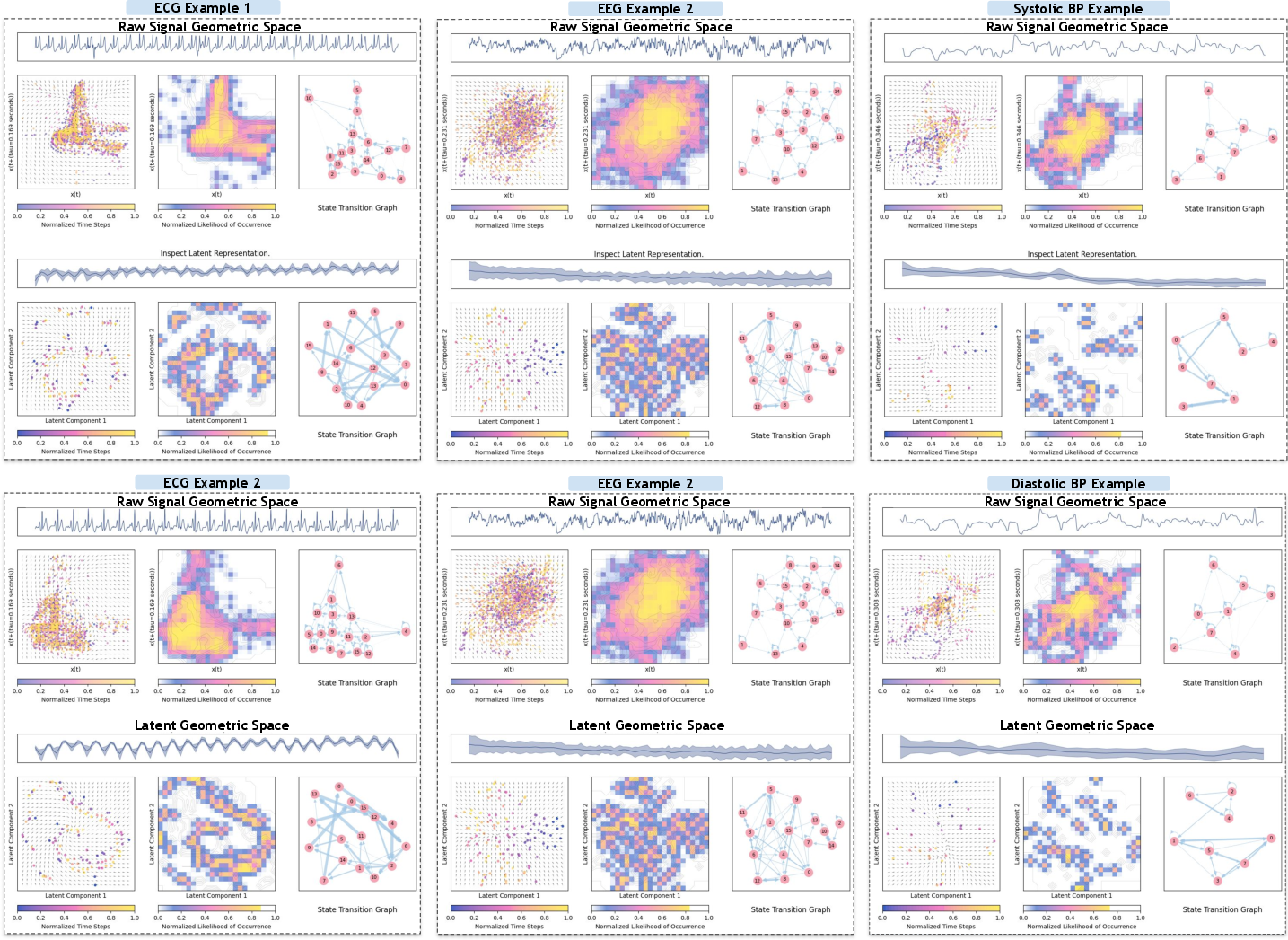
Figure 5: Latent representations preserve key temporal structures—including attractor geometry—critical for faithful reproduction of physiological and chaotic dynamics.
Action/intervention Awareness
In clinical intervention scenarios (e.g., hemodialysis machine control), NormWear-2's latent-state transitions capture action-conditioned responses (e.g., ultrafiltration rate changes impacting blood pressure) with low prediction error and physiologically plausible trends. Failures are localized and correspond to idiosyncratic patient responses, highlighting the importance of ongoing personalization.
Ablations and Modular Integration
Ablation studies demonstrate that the latent dynamical transition mechanism provides additive improvements when integrated with diverse backbone architectures, including univariate, attention-based, and joint-embedding predictive models. Further, increased individual historical data yields monotonic improvement in personalized forecasting, underscoring practical relevance for longitudinal monitoring.
Implications and Future Directions
The demonstrated synergy between chaos-theoretic data balancing and latent dynamical modeling addresses core deficiencies in current time series foundation models—namely, brittleness to dynamical regime shifts and inability to generalize across heterogeneous, intervention-rich healthcare scenarios. Practically, such models enable robust forecasting, counterfactual simulation, and early warning for health deterioration—key steps toward adaptive, agentic digital health systems.
Theoretically, the work animates the necessity of bridging dynamical systems theory and modern self-supervised representation learning. Moving forward, augmenting these models with reinforcement learning objectives (policy optimization over latent dynamics) remains an open challenge, critical for decision support and closed-loop health management.
Conclusion
NormWear-2 advances physiological signal world modeling by integrating chaos-informed pretraining, dual intuition-insight inference, and action-aware latent-state dynamics. This enables superior forecasting across diverse regimes, temporal resolutions, and applications, while providing a modular paradigm for future general-purpose predictive and simulation systems in digital health and beyond.