- The paper presents Sonata, a compact hybrid model using a latent world objective that improves clinical discriminability and robustly captures gait dynamics.
- It employs LongConvBlock and Gated DeltaNet together with SIGReg regularization to suppress artefact memorization and bolster predictive accuracy over MAE baselines.
- The lightweight design enables on-device deployment, paving the way for sensitive longitudinal monitoring and enhanced early detection of movement disorders.
Sonata: A Hybrid World Model for Clinical-Grade Inertial Kinematics under Data Scarcity
Motivation and Clinical Domain Constraints
Sonata addresses the intrinsic limitations of wearable sensor representation learning in clinical neurology, where cohort sizes are fundamentally bounded by recruitment, regulatory, and instrument constraints. The early manifestations of movement disorders, notably Parkinson's disease and multiple sclerosis, are encoded in continuous kinematic time series, accessible via six-axis IMU sensors at the lumbar spine. Clinically relevant dynamics include stride regularity, rotational trunk instability, and postural asymmetry, which are not adequately captured by conventional accelerometry alone or by web-scale masked reconstruction objectives. The design imperative is to learn interpretable, robust representations under strict data scarcity, with sensor placement, modality, and data fidelity selected to maximize biomechanical signal and minimize artefact encoding.
Corpus Curation and Preprocessing Pipeline
Sonata is pretrained on a harmonized corpus of nine public datasets comprising 739 subjects and 190,000 five-second windows. Inclusion gates require trunk-mounted, six-axis IMU recordings with gravity-retained channels—criteria rigorously enforced to preserve the full translational and rotational state of the trunk (ISB axes resampled to 100 Hz, harmonized windowing, and fixed-range scaling). The corpus spans movement disorders, prospective fall-risk cohorts, community dwelling elderly, and healthy controls, with fall events upsampled for sufficient positive coverage. On-the-fly augmentation reflects real-world deployment uncertainty: placement tilt, parity reflection, gyroscope drift, and percentile censoring. These pipeline constraints anchor model generalizability strictly to clinically interpretable biomechanical variation.
Architecture: Hybrid Sequence Modeling with Latent World Model Objective
Sonata employs a parameter-efficient hybrid backbone: [C,C,C,G]×3 where C denotes LongConvBlock (global spectral filters, FFT convolution) and G denotes Gated DeltaNet (multi-head recurrent state, content-dependent gating, Householder memory erasure). This structure ensures spectral organization and targeted temporal compression, matching capacity to kinematic degrees of freedom. State injection across block boundaries supplies the recurrent modules with temporally compressed summaries, facilitating stride-scale memory horizons and oscillatory latent modes critical for gait modeling.
The pretraining objective is a two-term Latent World Model (LWM) loss: the current latent state predicts the next window’s latent state (linear transition head), regularized by Sketched Isotropic Gaussian Regularization (SIGReg). This architectural discipline suppresses memorization of sensor artefacts and incentivizes organization of the latent space around predictive biomechanical dynamics—validated mathematically by recent JEPA theory, removing the need for EMA-based target encoders or stop-gradients. Controlled baselines rigorously isolate the effect of this objective: sequence-level forecasting (MAE baseline) vs. latent-state prediction, with a shared backbone and probe interface.
Representation Evaluation: Discriminability, Robustness, Structure
Sonata’s performance is assessed across a fourteen-arm evaluation suite: clinical discriminability, fall-risk prediction, cross-cohort transfer, noise robustness, latent structure, and forecasting fidelity. The latent world-model objective yields higher clinical discrimination (PD vs healthy AUC-ROC +12.5 points over MAE baseline), more effective rank (59.1 vs 33.0), greater dynamical separation (H-stat +3.18), straighter latent trajectories, and stronger robustness to injected noise—all under frozen-probe evaluation with no head finetuning.
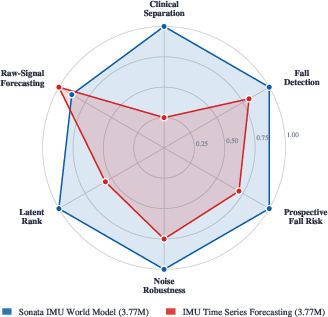
Figure 1: Radar summary comparing Sonata to a forecasting baseline across six evaluation domains; Sonata achieves superior discriminability, robustness, and latent quality, with forecasting only stronger on signal reconstruction.
Token-level prediction heads (linear and MLP) outperform sequence-level predictors (Transformer, Gated DeltaNet) on label-scarce transfer and multicohort discrimination—a categorical effect rather than a smooth degradation with capacity, indicating that temporal scope, not just expressivity, modulates frozen representation utility.
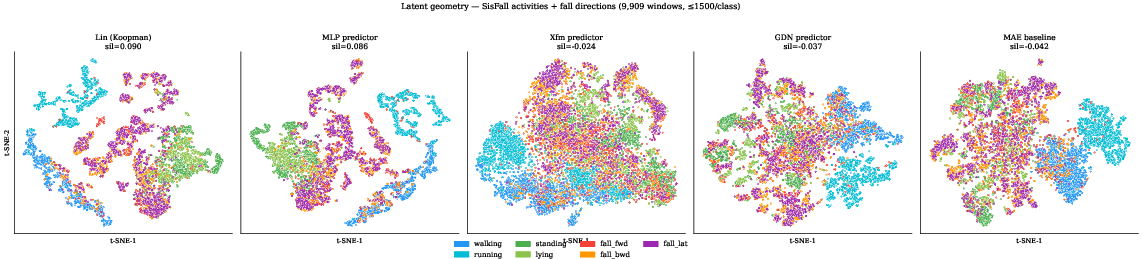
Figure 2: Latent geometry for SisFall activities via t-SNE: world-model variants (LIN/MLP) yield more coherent local clustering than sequence-level or raw-signal forecasting, consistent with quantitative discriminability gaps.
Predictor ablations show that linear transition heads are optimal in the data-scarce clinical regime, preserving inductive pressure for the encoder to internalize structure relevant to downstream discrimination rather than absorbing dynamics in the predictor.
Architectural Refinement: Eigenvalue Spectrum and Regularization
Ablations confirm several critical architectural dependencies. The SIGReg penalty is load-bearing: disabling it induces catastrophic collapse, with multicohort macro-F1 dropping below random and PD/HC AUC near chance. The regularization weight λ admits a broad flat optimum ([0.1,0.2]), with lighter values favored for fall-risk and stronger values for multicohort discrimination. The Gated DeltaNet’s extended eigen spectrum ([−1,1]) is essential: constraining to positive values improves pretraining loss but degrades clinical discriminability, as sign-alternating modes are necessary for capturing periodic gait dynamics.
Practical and Theoretical Implications
Sonata’s lightweight ($3.77$ M parameters) configuration is compatible with on-device inference in wearable IMU systems. Embedded deployment removes sensitive kinematic data from off-device transmission, minimizing privacy and regulatory risks. The structured latent space enhances auditability: failures in discrimination can be traced to biomechanical features rather than sensor statistical noise, simplifying regulatory validation.
The theoretical implications are significant: the world-model objective reframes representation learning from waveform reconstruction to short-horizon biomechanical prediction, organizing the latent space around patient-centered dynamical trajectories. This offers a principled solution to the longitudinal monitoring problem in neurology: population thresholds are coarse, but deviation from personal latent trajectories, smoothly evolving under SIGReg pressure, is a sensitive indicator of disease progression that factors out inter-subject variability. If prospective validation bears out this hypothesis, trajectory-based latent monitoring could supplant episodic clinical rating scales for early-stage detection and fine-grained outcome measurement.
Future Directions
Immediate extensions are planned to relax single-lumbar placement, supporting variable sensor arrangements and multi-IMU setups without loss of sensor geometry or cross-body coordination. At larger data scales and more diverse placements, the same world-model approach should facilitate broader transfer, greater zero-shot generalization, and richer longitudinal assessment. Ultimately, a general-purpose kinematic world model for neurological clinical trials would enable more sensitive detection of treatment effects and empower statistical power-limited studies.
Conclusion
Sonata establishes a compact, robust latent world model for clinical-grade IMU kinematics under inherent data scarcity. The latent predictive objective yields richer latent structure, superior clinical discriminability, and stronger robustness versus forecasting baselines, demonstrating that objective choice fundamentally determines representational properties in the clinical regime. The framework is practically deployable and theoretically motivated for personalized longitudinal monitoring, with scalable extensions targeting more general and flexible sensing modalities.
References
For full bibliographic references and mathematical details, see (2604.18058).

