- The paper derives a closed-form expression equating expected regret with the covariance between costs and optimal decisions, plus a residual term for nonlinearity.
- It demonstrates that for linear programs and unconstrained quadratic programs, the residual term vanishes, allowing exact, simulation-free regret computation.
- The analytical framework offers significant computational speedups and integrates directly with decision-focused learning pipelines for efficient model validation.
The paper "Regret Equals Covariance: A Closed-Form Characterization for Stochastic Optimization" (2605.14019) provides a general analytical framework for evaluating expected regret in stochastic optimization, with strong implications for operations research, machine learning (including decision-focused and predict-then-optimize pipelines), and financial applications. It establishes the claim that the expected regret incurred by optimizing for the mean of a random cost vector, rather than for its realized value, admits a closed-form representation as the covariance between the costs and optimal decisions, plus a residual under nonlinearity in the decision map. This relaxes the traditional dependence on computationally intensive simulation-based methods such as Sample Average Approximation (SAA), shifting the focus to efficient second-moment computations.
Let c∈Rd denote a random cost vector, and Z⊆Rd a feasible region (which may be combinatorial or non-convex). The optimal decision for cost realization c is π∗(c)=argminz∈Zc⊤z. The expected regret of using π∗(E[c]) instead of π∗(c) is
Regret(c)=E[c⊤π∗(c)]−E[c⊤π∗(E[c])]
which, by definition, is nonpositive.
Main Theoretical Results: Covariance Decomposition
The central result proven in this work is the following decomposition:
Regret(c)=Cov(c,π∗(c))+R(c)
where
- The covariance term is the scalar-valued Cov(c,π∗(c))=E[c⊤π∗(c)]−E[c]⊤E[π∗(c)];
- R(c)=E[c]⊤(E[π∗(c)]−π∗(E[c])) is a residual quantifying the nonlinearity (or non-affinity) of the optimizer with respect to Z⊆Rd0.
Critically, the paper proves that for linear programs (LPs) and unconstrained quadratic programs (QPs), the residual term Z⊆Rd1 vanishes exactly, making regret equal to the covariance. For other problem classes, Z⊆Rd2 is bounded above in terms of problem regularity (Lipschitz and smoothness constants) and the cost covariance.
Exactness for LPs and Unconstrained QPs
- For LPs with absolutely continuous cost distributions, the optimizer is piecewise constant almost everywhere, and the residual vanishes by a measure-theoretic argument.
- For unconstrained QPs, where the optimizer is an affine function of Z⊆Rd3 (i.e., Z⊆Rd4), regret is exactly the trace of the product of the inverse Hessian and the cost covariance.
This shows: for all LPs and unconstrained QPs, regret admits a strictly closed-form, simulation-free formula as a covariance.
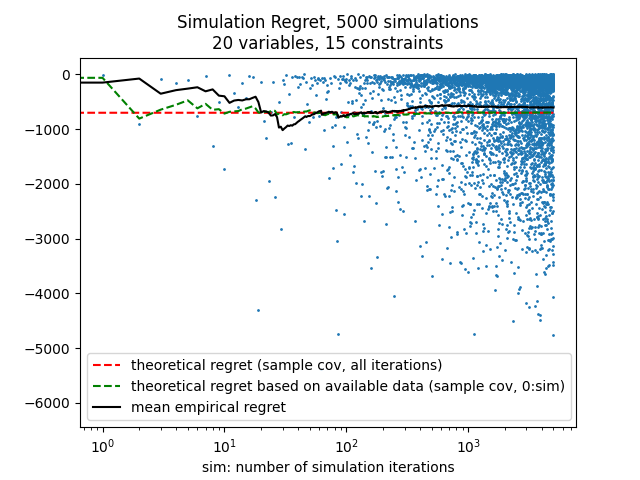
Figure 1: Linear Programming: Empirical versus theoretical (covariance-based) regret, demonstrating convergence and zero population discrepancy for LPs.
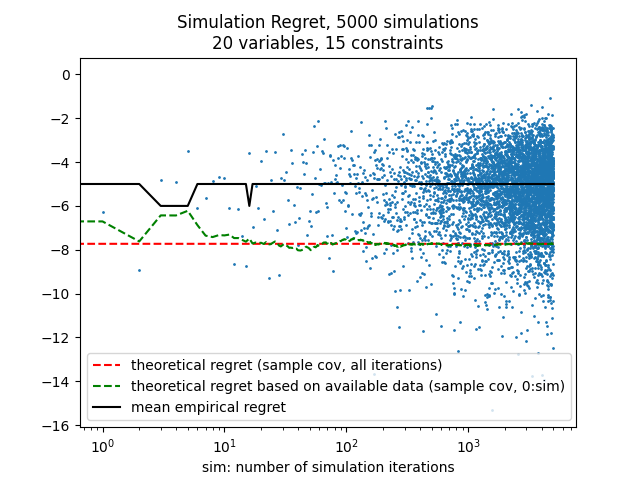
Figure 2: Quadratic Programming: Empirical versus covariance regret for QPs; note the rapid convergence and minor finite-sample discrepancy.
For constrained QPs and general smooth problems, Z⊆Rd5 is of higher order (scaling as Z⊆Rd6 for QPs), thus the covariance provides a highly accurate approximation.
Statistical Efficiency and Computational Complexity
A significant implication is computational: estimating regret traditionally involves SAA, i.e., solving the optimization problem independently for Z⊆Rd7 sampled cost scenarios, with cost scaling as Z⊆Rd8. In contrast, the covariance formula requires only a single pass over Z⊆Rd9 historical cost-decision pairs, with cost c0. For unconstrained QPs, the regret can be computed analytically from the cost covariance alone, requiring no additional optimization solves whatsoever.
This yields orders-of-magnitude speedup in settings where regret must be calculated frequently, as in model selection, online monitoring, or during repeated validation in learning pipelines.
Statistical Theory and Estimation
The paper details finite-sample concentration inequalities and a central limit theorem for the sample covariance estimator, providing confidence intervals that are valid at the usual c1 rate.
In the presence of c2, an unbiased estimator for the residual is also developed, and its properties characterized theoretically.
Empirical validation includes LP, QP, and integer programming instances, with error in the covariance proxy for integer programs shown to be substantial, justifying caution when applying the formula to combinatorial problems.
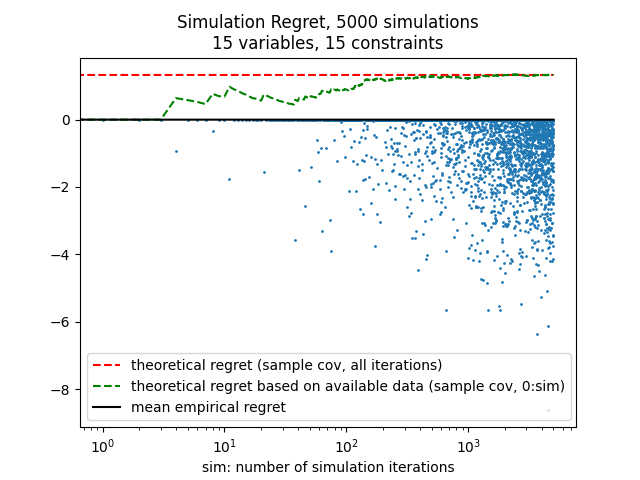
Figure 3: Integer Programming: Empirical versus theoretical regret; note high approximation error, confirming limitation for nonconvex/discrete cases.
Application: Financial Portfolio Optimization
A substantial empirical application is given to Markowitz portfolio selection, using ten years of real equities data. Portfolio regret measured by the covariance estimator tracks observed realized regret robustly over time, and the covariance-based prediction is shown to be a practical real-time monitoring tool that is orders of magnitude faster to compute than scenario-based SAA.
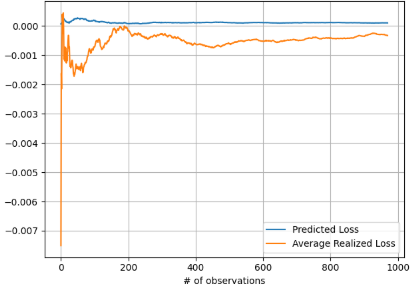
Figure 4: Covariance-predicted regret vs. realized regret for rolling-window portfolio construction in real financial data. Theoretical predictions closely shadow observed shortfall.
Integration with Predict-Then-Optimize and Decision-Focused Learning
An important implication is for ML frameworks wherein models are trained to minimize regret with respect to downstream optimization (PtO/DFL). As the analytical covariance formula is differentiable, it can be efficiently embedded into training and validation loops, enabling fast model comparison and checkpoint selection at negligible computational overhead compared to SAA-based validation.
For example, in an LP-based shortest path experiment, the covariance oracle is shown to yield 70–100× lower validation latency than SAA per call, with no difference in ultimate test regret of selected models.
Theoretical and Practical Implications
This work provides a new structural characterization for regret in stochastic optimization:
- Regret equals covariance whenever the optimizer is affine (or piecewise constant almost everywhere, as in LPs).
- For general problems, closed-form upper bounds and corrections for the residual are provided. This facilitates a spectrum of applications in sensitivity analysis, robust control (via tight links to Wasserstein distances), and learning (via direct gradients of the regret with respect to model parameters).
- Practical consequence: In any decision system with access to a historical archive of cost-decision pairs, expected regret can now be tracked, monitored, or bounded with a single pass over the archive, providing immediate feedback for distributional drift, degradation, or policy recalibration, at scale.
Limitations and Future Directions
The main limitation is for combinatorial (integer) programs, for which the covariance formula can yield significant error (over 100% in simulations). Extension to approximate or relaxed representations, or hybridization with variance-reduced sampling, is a promising future research direction. Additionally, interfaces with risk-averse optimization (e.g., CVaR or DRO) and robustness to discrete distributions require further theoretical treatment.
In AI, these results will likely inform the design of end-to-end differentiable optimization layers, the interpretability and benchmarking of decision-focused learning, and model selection under distribution shift.
Conclusion
This paper establishes a precise, computationally efficient correspondence between operational regret in stochastic optimization and the second-order statistics of the cost-decision joint distribution. By showing that regret exactly equals covariance (modulo an explicit, characterized residual), it unifies regret analysis with classical sensitivity theory and modern PtO/DFL paradigms, while delivering nontrivial computational, theoretical, and practical dividends across domains. This analytical framework will serve as a foundation for both methodological innovation and scalable, real-time deployment of model monitoring and learning-to-optimize approaches in high-dimensional stochastic settings.