- The paper demonstrates that both flickering variability and magnetisation critically influence AGN jet morphology, with high magnetisation enhancing susceptibility to current-driven kink instabilities.
- It employs 3D RMHD simulations to reveal that fluctuating jet power induces distinct asymmetries, broken morphologies, and observable variations in radio images.
- Results imply that integrating magnetic effects and temporal variability is essential for precise interpretation of AGN radio maps and jet feedback cycles.
Morphological and Dynamical Impacts of Flickering Variability and Magnetisation in Radio-Loud AGN Jets
Introduction and Physical Context
The morphology and stability of radio-loud AGN jets exhibit significant diversity, traditionally categorized into Fanaroff-Riley types I and II and further revealed by surveys such as LoTSS. Previous theoretical and numerical analyses have highlighted that jet morphology arises from complex interplay among jet power, environment, magnetisation, and temporal variability. Magnetisation stabilizes the jet against Kelvin-Helmholtz (KH) instabilities but enhances susceptibility to current-driven kink (CDK) instabilities. Furthermore, variability in AGN jets is supported by accretion theories (e.g., CCA), which predict flickering and longer-timescale modulation.
This work systematically investigates, for the first time, the joint and individual impacts of flickering variability and magnetisation on AGN jet morphology, stability, and observable radio structure via 3D relativistic MHD (RMHD) simulations using PLUTO. The study covers constant and variable power jets at two magnetisation regimes, with simulated radio images at multiple epochs and viewing angles.
Simulation Framework and Jet Model
The simulations employ a 60 kpc cubic domain with 40 pc resolution. Four configurations are considered: constant and flickering jet power, each at low and high peak magnetisation (σB,peak=0.001,0.01). Flickering jet power follows a lognormal distribution with pink noise spectrum, reflecting realistic accretion variability. The injected jet possesses a toroidal magnetic field, initially in pressure equilibrium, per established analytic MHD prescriptions [2022ZdziarskiSimpleJets].
Jet power is realized via parametrically controlled Lorentz factor, with magnetisation fixed in the comoving frame for variable power configurations. The model ensures dynamical significance of the magnetic field throughout the jet, critical for capturing magnetisation-driven instabilities.
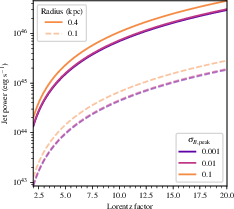
Figure 1: Jet power as a function of Lorentz factor for various peak magnetisations; power is only weakly dependent on σB,peak, allowing consistent parametrisation.
Morphological Evolution: High Magnetisation and Variability
Emergent Structures and Stability
The variable high magnetisation jet exhibits complex temporal evolution, with the cocoon shape strongly contingent on recent jet power history. High-power episodes yield narrower, pointed cocoon morphologies and enhanced hotspot pressure, while low-power phases promote lateral cocoon expansion and higher sphericity. Notably, these jets frequently depart from the central axis, forming misaligned, asymmetrical lobes in both density and magnetic field distribution.
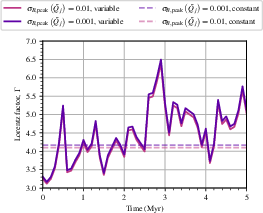
Figure 2: Lorentz factor as a function of time for the four simulations, showing power modulation and its translation into dynamical jet speed.
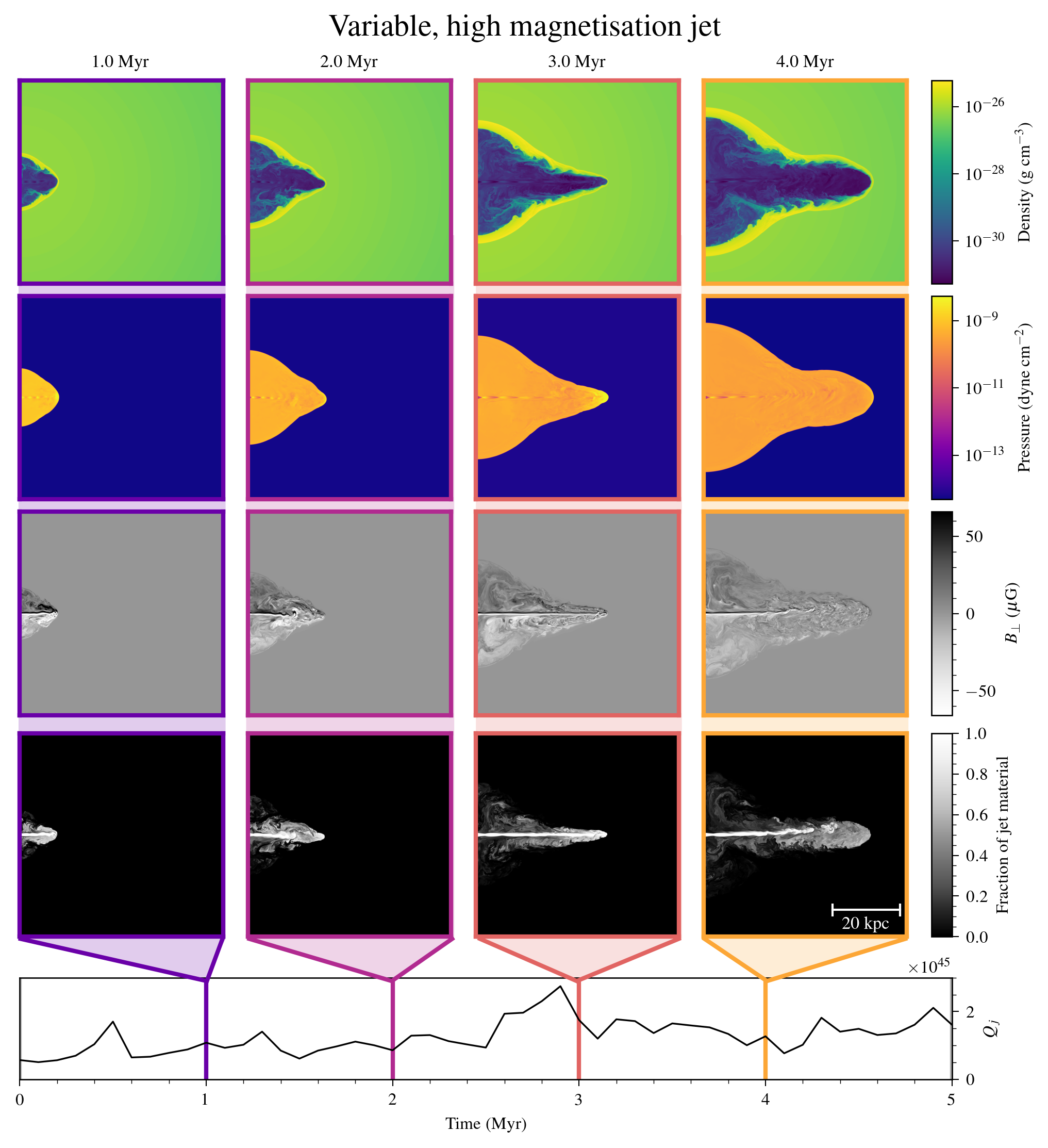
Figure 3: Central slices illustrating density, pressure, toroidal magnetic field, and jet tracer during variable, high magnetisation evolution. The cocoon shape is highly time-dependent, with significant off-axis motion and jet discontinuities.
Asymmetries and Misalignment
Jets with high magnetisation (both constant and variable power) induce large-scale asymmetries not seen in low magnetisation runs. Constant high magnetisation jets spend extended periods misaligned, creating persistent cocoon asymmetry and one-sided backflows. Conversely, variability interrupts prolonged off-axis activity, maintaining greater large-scale symmetry but enabling transient misalignments.
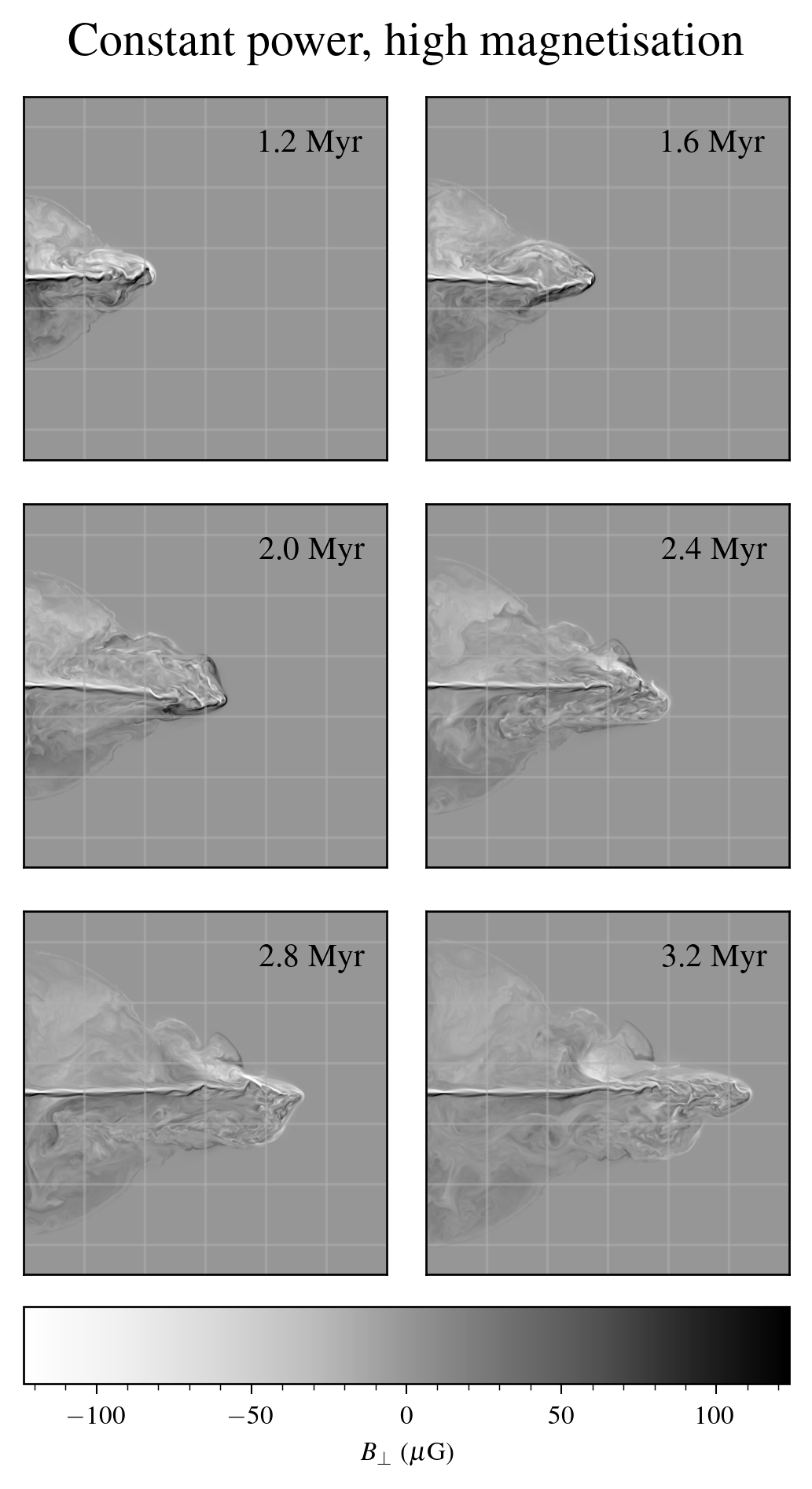
Figure 4: Evolution of asymmetrical cocoon structure in constant power, high magnetisation jet. Asymmetry develops near the jet head and persists over Myr timescales.
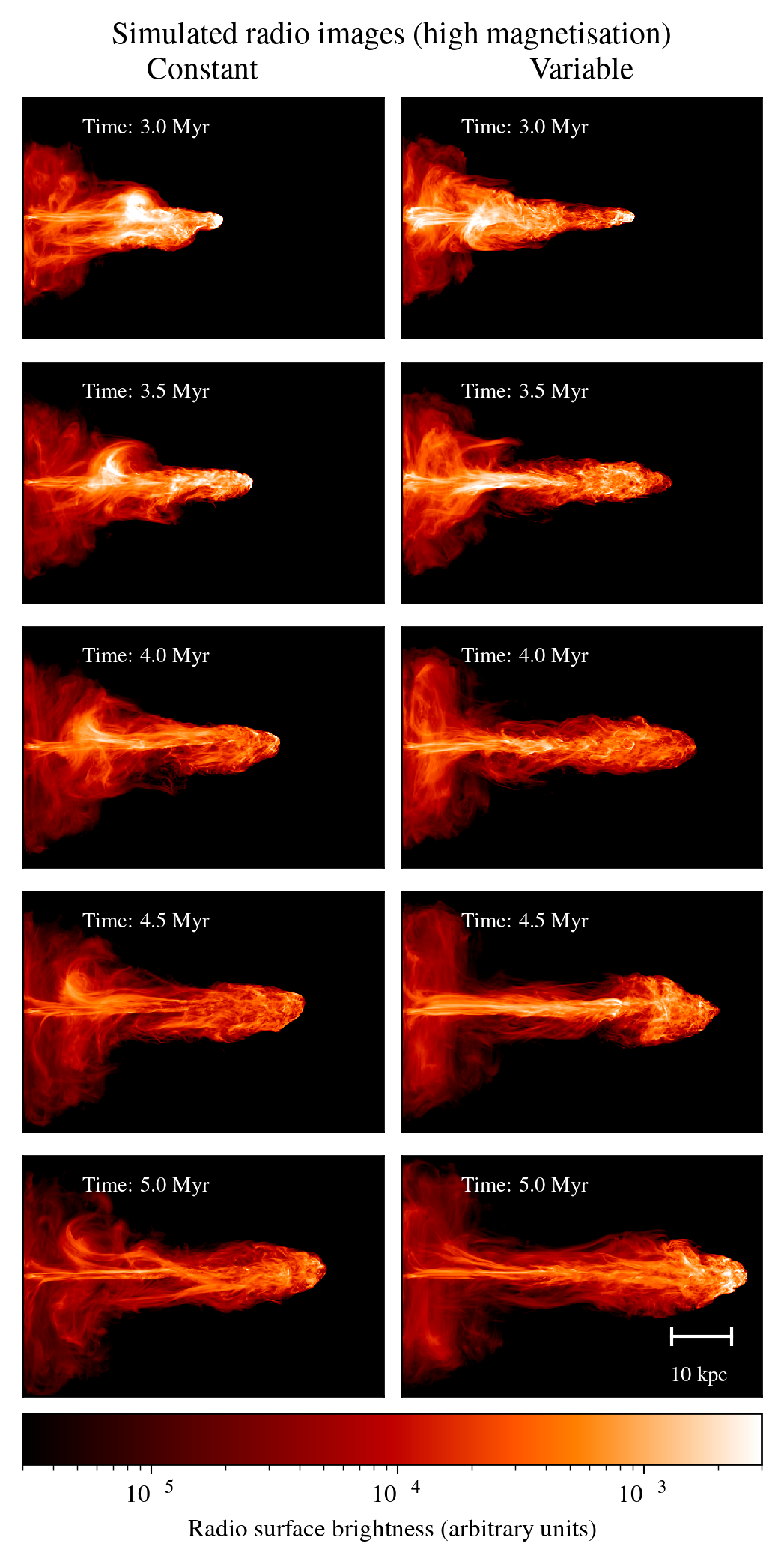
Figure 5: Simulated radio images comparing cocoon morphologies of constant and variable high magnetisation jets at successive epochs. Cocoon asymmetry and beam misalignment are recurrent features.
Discontinuities, Kink Instabilities, and Broken Morphologies
Variable high magnetisation jets uniquely develop discontinuous, 'broken' jet beams, characterized by clumps of jet material separated by sharp boundaries. The interaction between internal shocks (driven by power flickering) and strong magnetic fields triggers kink and helical instabilities, resulting in jet fragmentation and non-linear breakage.
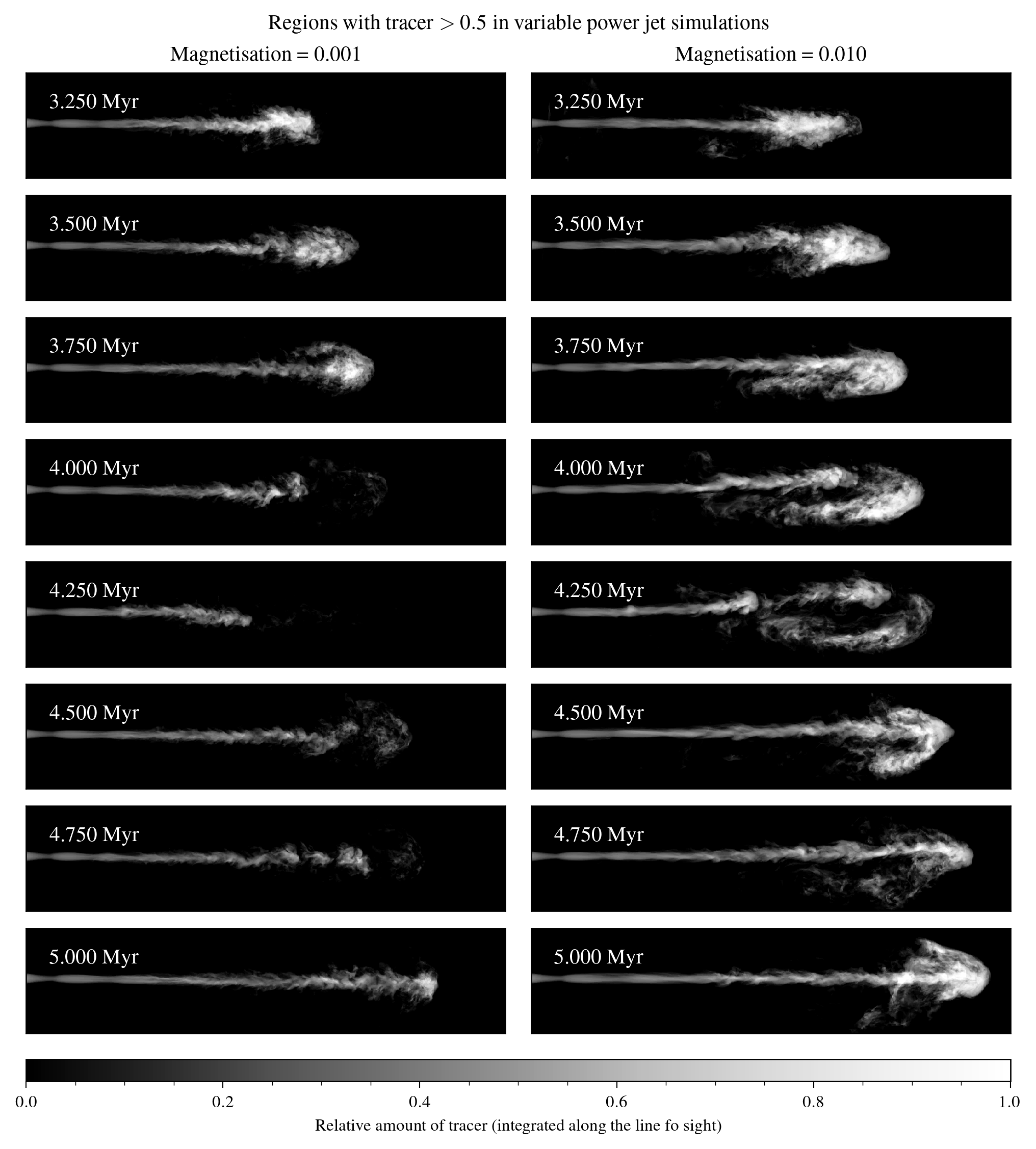
Figure 6: Line-of-sight rendered jet tracer showing discontinuous jet beams in high magnetisation, variable power runs. Clumped jet material persists due to suppressed KH mixing.
Detailed slice analysis reveals that transient increases or decreases in jet power induce propagating pressure disturbances and recollimation shocks, which amplify local CDK instabilities and precipitate beam breakage. The resulting clumps exhibit both abrupt and smooth concentration transitions, with helical magnetic morphology observable before non-linear disruption.
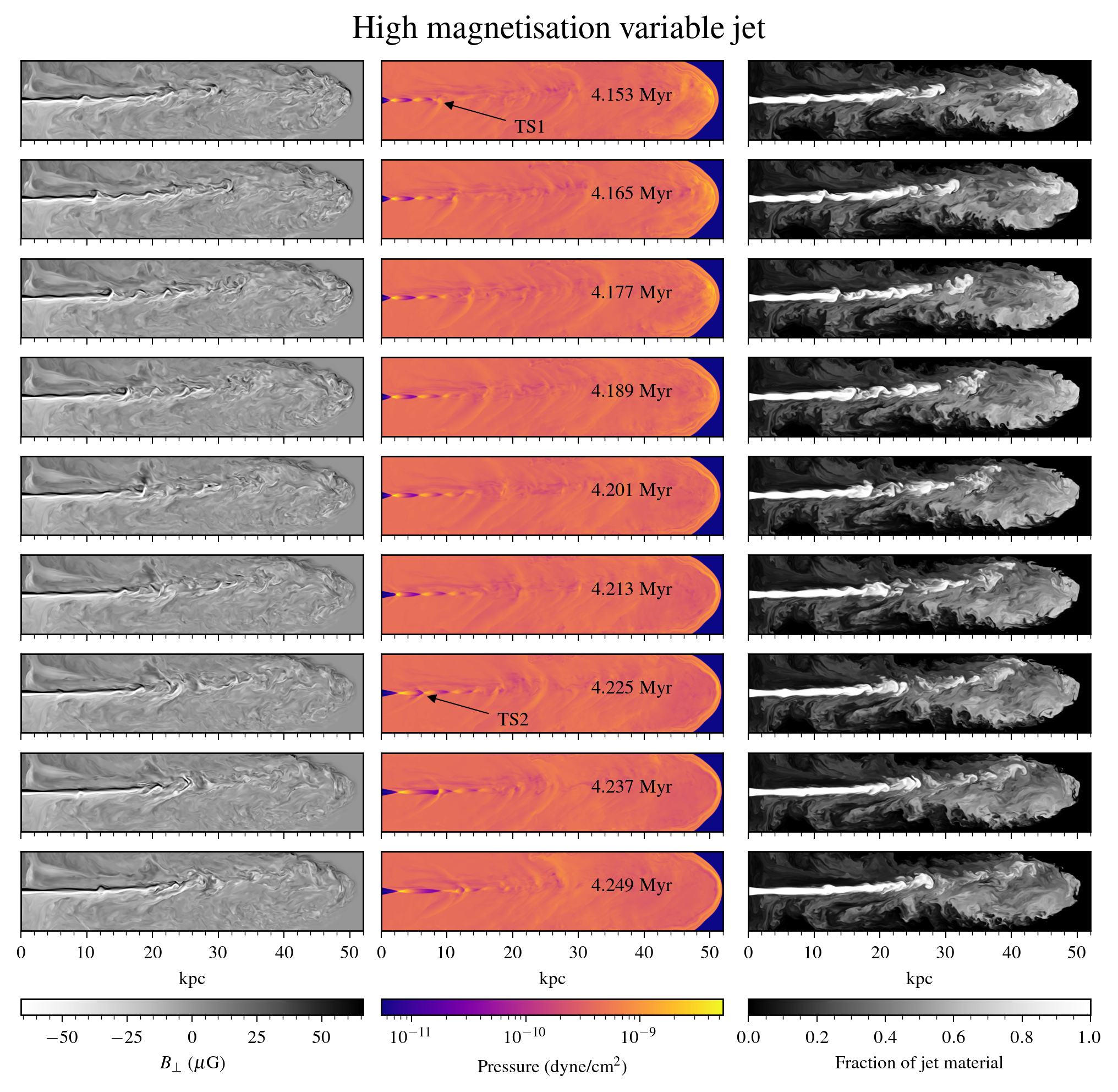
Figure 7: Growth and breakage of kink structures via pressure disturbances and magnetic instability. Travelling shocks correlate spatially with the onset of beam fragmentation.
Low magnetisation jets, by contrast, experience rapid KH-driven mixing, preventing persistent clumping and broken structure formation.
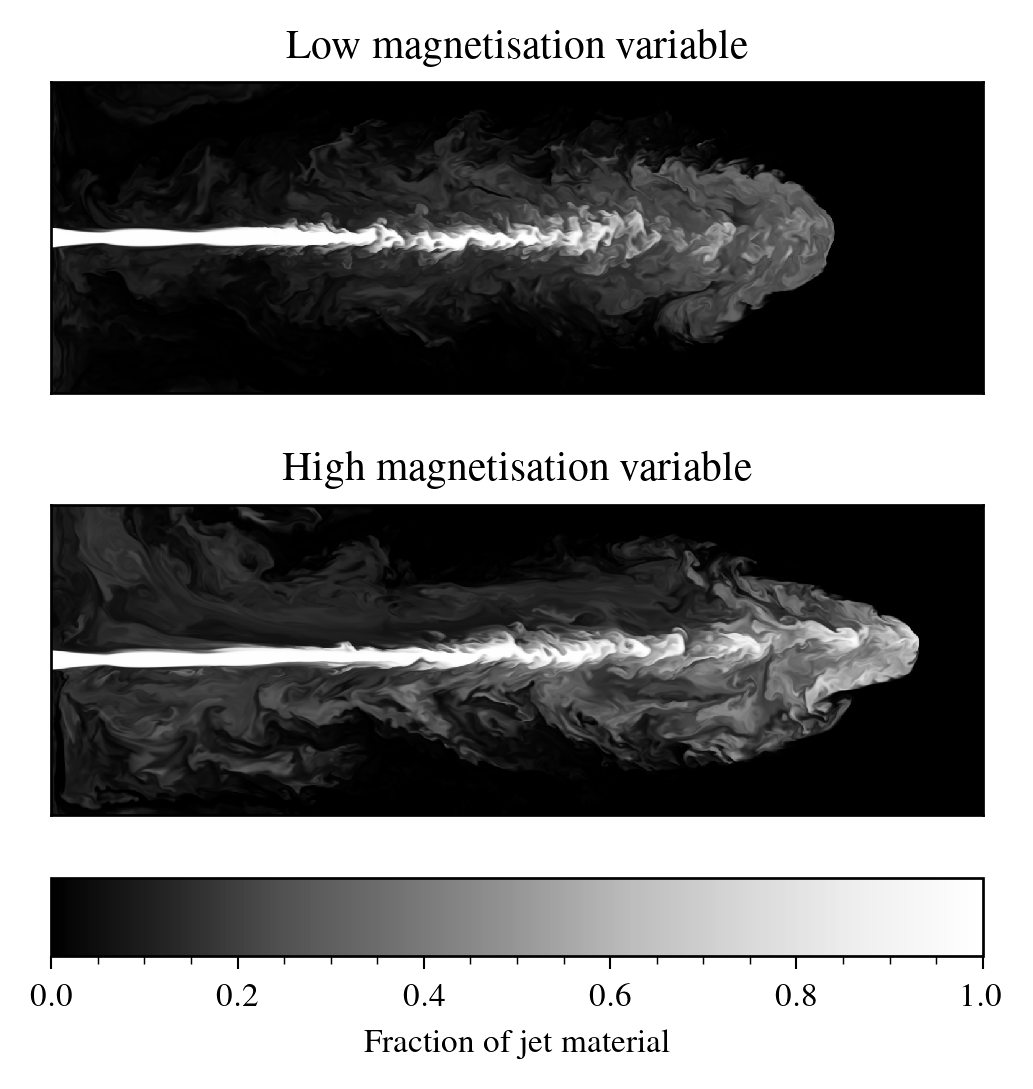
Figure 8: Comparison of jet tracer slices for high and low magnetisation variable jets; KH instabilities dominate in low magnetisation cases, leading to heavy beam mixing.
Beam Stability and Instability Analysis
Analytic stability analysis confirms that the injected jet structure is initially in stable pressure-magnetic equilibrium, suppressing axisymmetric (m=0) instabilities and supporting weak restoring forces for m=1 kink modes. Departure from equilibrium—via external cocoon interaction or internal shock compression—reduces restoring force, enabling growth of CDK instabilities at kpc-scale wavelengths resolvable by the simulation.
Wavelike and helical structures emerge when the jet beam is locally destabilized, particularly downstream of shocks. These features are short-lived, transitioning rapidly to non-linear fragmentation. Sustained equilibrium is only achievable near the base; further downstream, perturbations from variability and environment dominate.
Simulated Radio Images and Observational Implications
High magnetisation, variable jets display observable broken morphologies and helical structures in synthetic radio images, with some jet sections failing to reach the cocoon terminus and others showing transient bright clumps offset from the axis. Such features are brightest in Doppler-boosted, approaching jets due to relativistic effects.
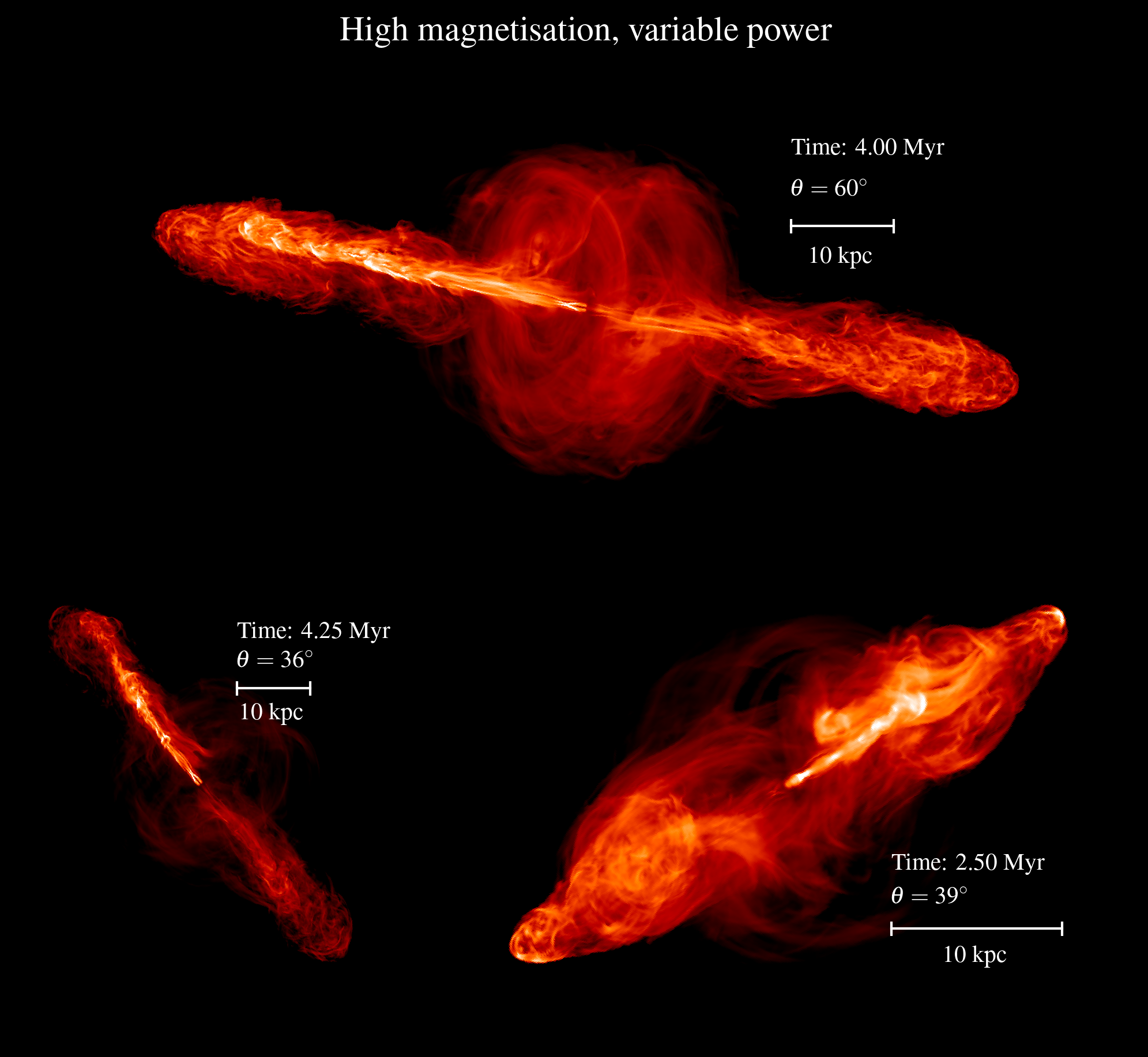
Figure 9: Radio images of high magnetisation, variable jet, illustrating broken structure and helical beam patterns at three epochs and lines of sight.
Viewing angle critically affects the apparent morphology; rotation about the jet axis and variations in inclination alter the prominent asymmetry and brightness due to relativistic boosting and projection. Light travel time effects further compound interpretation for inclined sources.
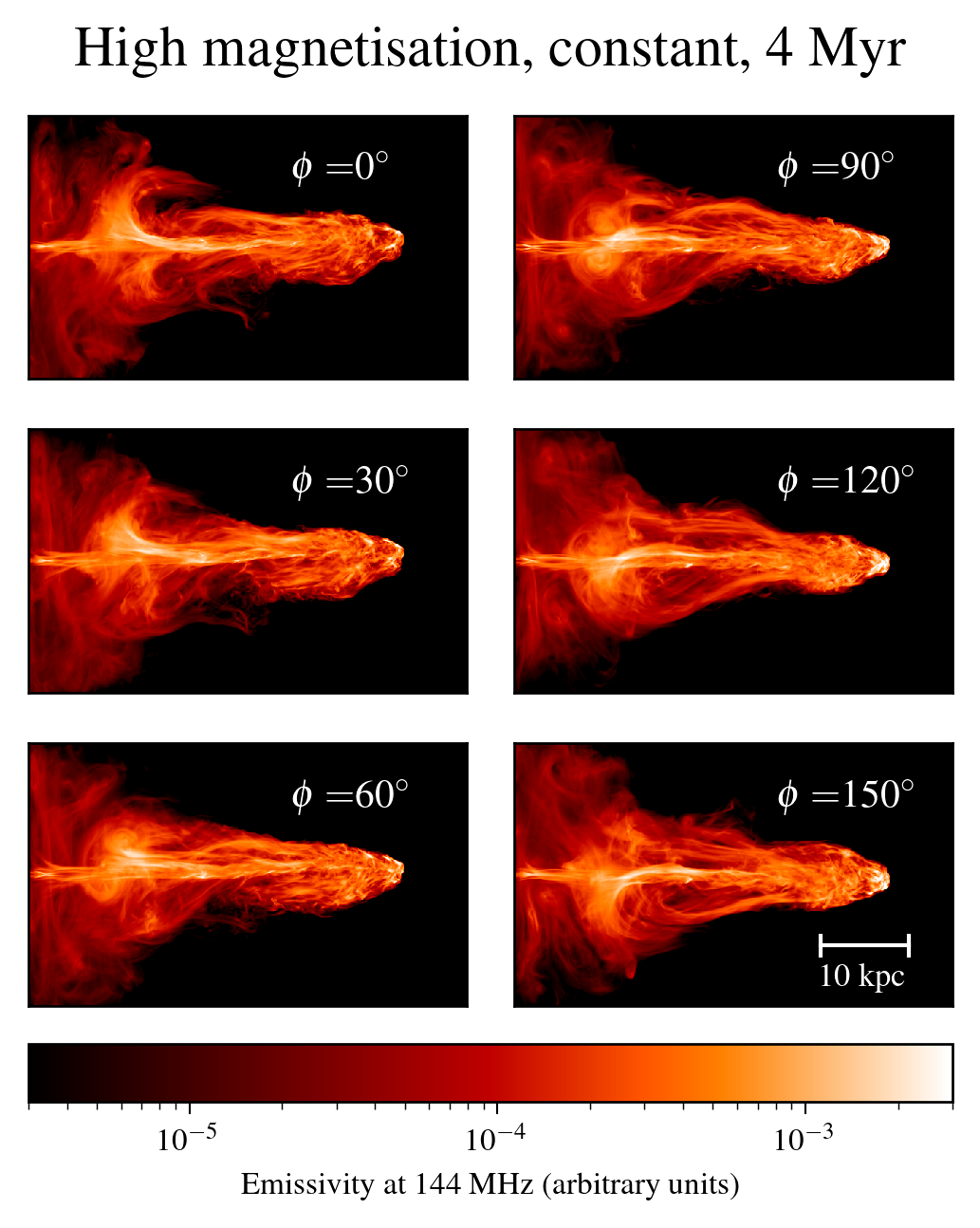
Figure 10: Constant high magnetisation jet at 4 Myr, seen from multiple azimuths, showing strong viewing-angle-dependent cocoon asymmetry and hotspot brightness.
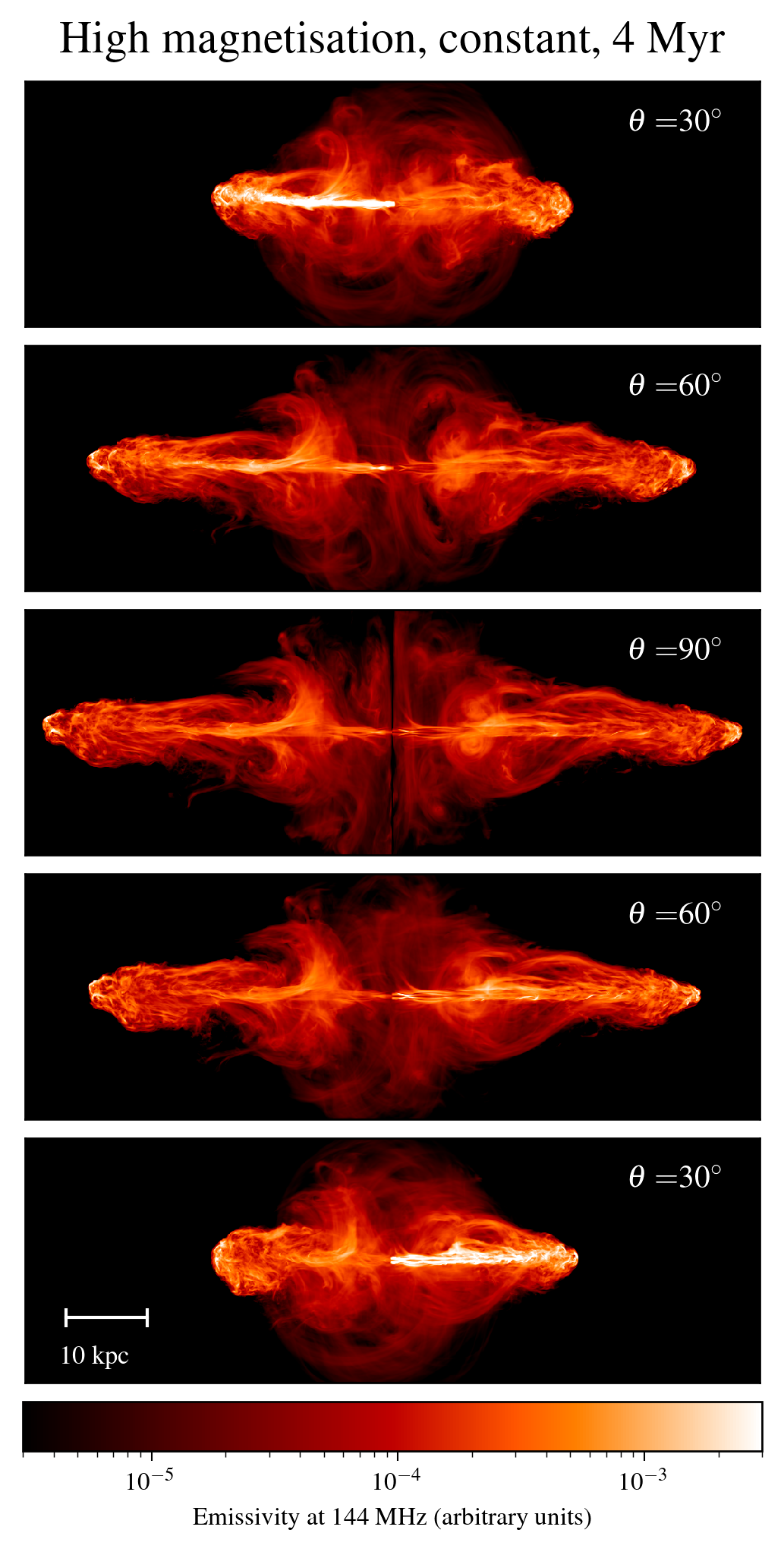
Figure 11: Radio images across varying inclination angles; Doppler boosting accentuates jet brightness and sharpens structural asymmetries.
Comparison to observed sources (e.g., Cygnus A, 3C 98, IC 4296) demonstrates qualitative agreement between simulation features and real AGN jets: misaligned beams, one-sided backflows, broken structures, and extended filamentarity are all reproduced. The simulation library enables robust mapping between simulated physics and observed diversity.
Practical and Theoretical Implications
The findings establish that both magnetisation and flickering variability are essential determinants of AGN jet morphology, independent of jet power or environment. High magnetisation provides resilience against KH modes but enhances kink instability susceptibility, especially when interacting with internal shocks arising from flickering. Broken morphologies and asymmetries can occur without disk precession, complicating inference of jet activity cycles and feedback history from observed radio structure alone.
Practically, the results imply that interpretations of observed AGN jet radio maps must account for these dual effects. The simulation-generated radio image library facilitates comparison across source populations, aligning simulation and observational taxonomy.
Theoretically, these outcomes inform models of particle acceleration (magnetic reconnection at CDK sites), jet feedback cycles, and the conditions for FRII/FRI dichotomy, complementing analytic and semi-analytic frameworks [2016TchekhovskoyThreeDichotomy, 2024RossiDifferentFlows]. Future developments should extend simulation duration, explore higher magnetisation regimes, and refine electron energy distribution modeling for enhanced synthetic imaging.
Conclusion
This RMHD study demonstrates that flickering variability and magnetisation jointly drive AGN jet morphology, instability evolution, and radio observability, producing a range of asymmetrical, broken, and misaligned jet features. Viewing angle and Doppler effects critically influence observed structure. These findings underscore the necessity of incorporating both effects in theoretical models and population-based analyses of radio-loud AGN jets (2605.13469).