How Plasma Properties of the Fanaroff-Riley Jet can Shape its Morphology
Abstract: Extragalactic jets are broadly classified into two categories based on radio observations: core-brightened jets, known as Fanaroff-Riley Type I (FR I), and edge-brightened jets, classified as Type II (FR II). This FR dichotomy may arise due to variation in the ambient medium and/or the properties of the jet itself, such as injection speed, temperature, composition, magnetization, etc. To investigate this, we perform large-scale three-dimensional magnetohydrodynamic (3D-MHD) simulations of low-power, supersonic jets extending to kiloparsec scales. We inject a jet beam carrying an initially toroidal magnetic field into a denser, unmagnetized, and stratified ambient medium through a cylindrical nozzle. Our simulations explore jets with varying injection parameters to investigate their impact on morphology and emission properties. Furthermore, we examine jets with significantly different plasma compositions, such as hadronic and mixed electron-positron-proton configurations, to study the conditions that may drive transitions between FR I and FR II morphologies. We find that, under the same injection parameters, mixed plasma composition jets tend to evolve into FR I structures. In contrast, electron-proton jets exhibit a transition between FR I and FR II morphologies at different stages of their evolution.
Paper Prompts
Sign up for free to create and run prompts on this paper.
Top Community Prompts
Explain it Like I'm 14
Overview
This paper explores why some gigantic jets shooting out of distant galaxies look one way (FR I) and others look another way (FR II). These jets are streams of very hot, electrically charged gas (plasma) blasted out from around supermassive black holes. On radio images:
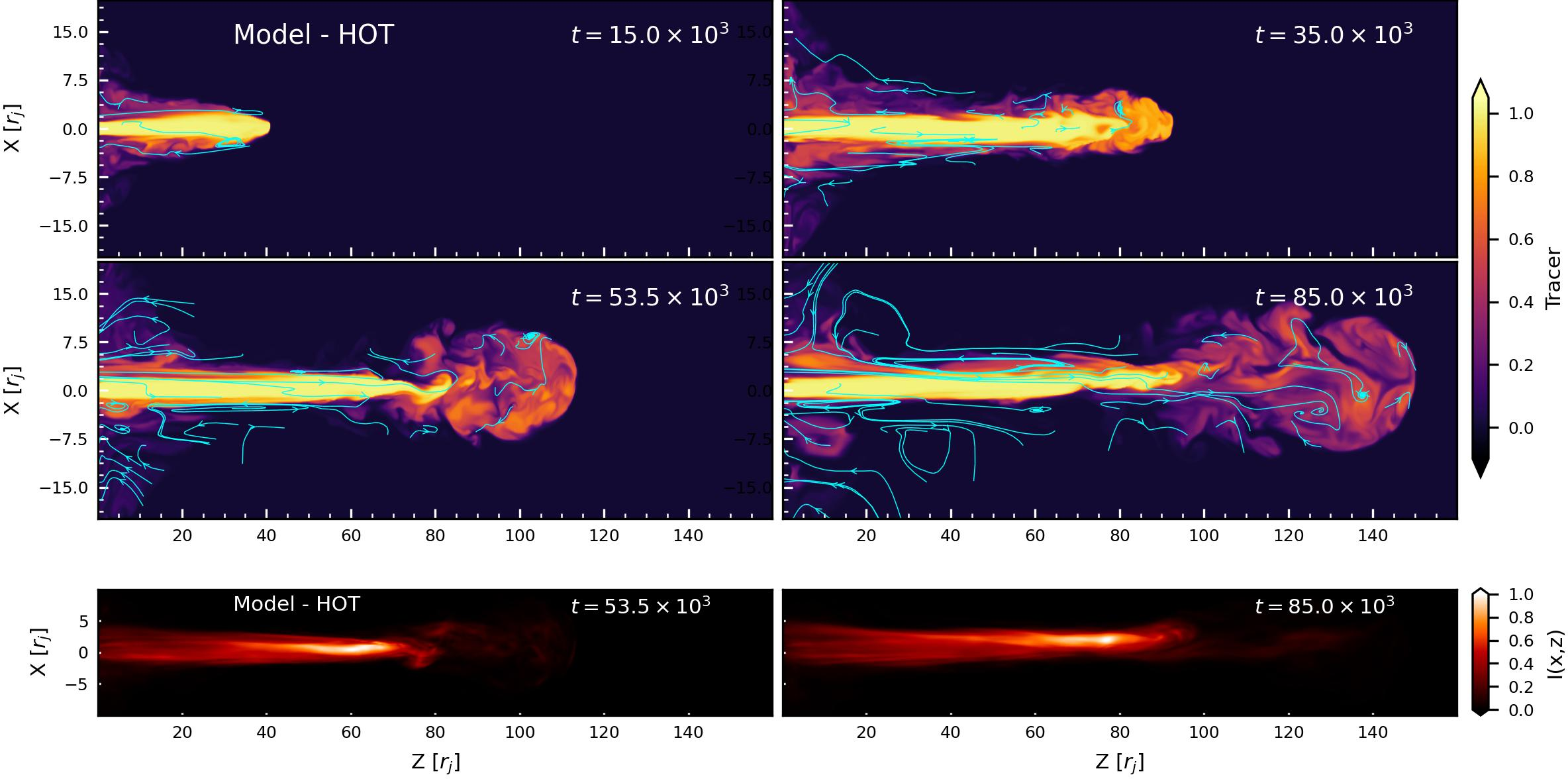
- FR I jets are brighter near the galaxy’s center and fade as they go out.
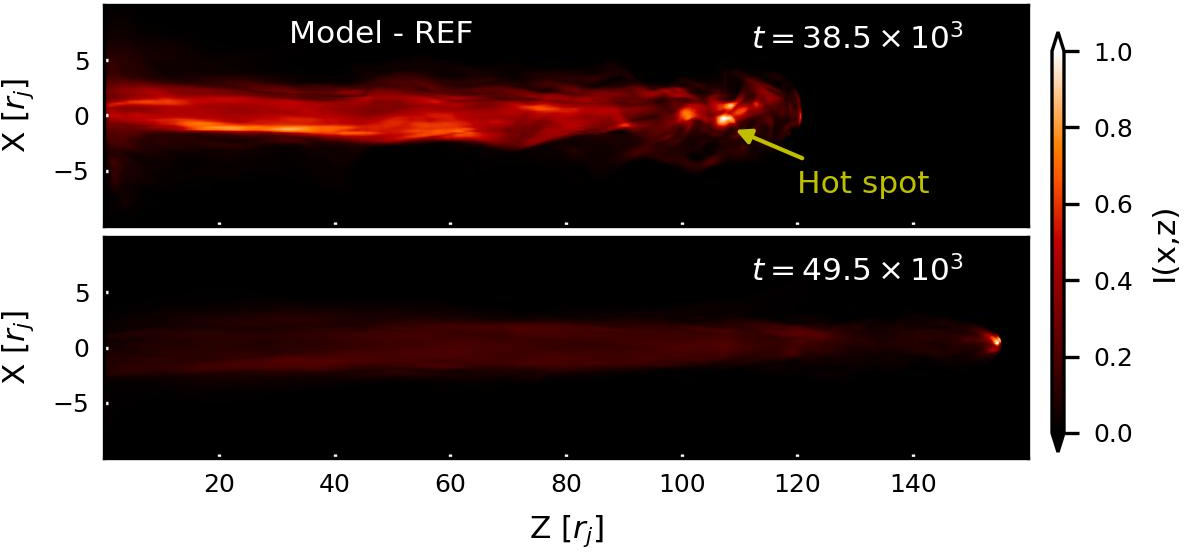
- FR II jets look brighter at their edges and have powerful “hotspots” where the jet slams into surrounding gas.
The authors use large 3D computer simulations to test how the jet’s speed, temperature, magnetic fields, and the kinds of particles inside the plasma can change the jet’s shape and brightness over time.
What questions were they asking?
Put simply, the paper asks:
- Can the “ingredients” of the jet’s plasma (electrons, protons, and positrons) change the jet’s appearance from FR I to FR II?
- How do the jet’s speed, temperature, and magnetic strength affect whether it stays narrow and makes a bright hotspot (FR II), or spreads out and fades (FR I)?
- Do jets switch between FR I and FR II as they evolve, and what causes those switches?
How did they study it?
They ran 3D magnetohydrodynamic (MHD) simulations. Here’s what that means in everyday terms:
- Magnetohydrodynamics: Imagine the plasma as a kind of “electrified fluid.” MHD equations describe how this fluid moves and how magnetic fields push and pull on it.
- The setup: They “inject” a jet through a circular nozzle into a larger box filled with denser, still gas. The jet carries a toroidal magnetic field (think of magnetic lines wrapping around the jet like a rubber band around a pipe).
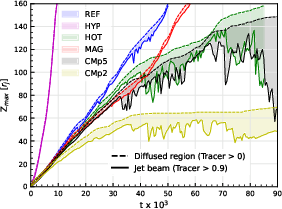
- A tracer dye: Like putting colored dye in water, they track the jet material and see how much it mixes with the surroundings.
- Plasma-beta (β): This measures whether gas pressure (like air pressure) or magnetic pressure dominates. Low β means strong magnetic fields; high β means gas pressure dominates.
- Mach number: How fast the jet is compared to the speed of sound in the plasma. Higher Mach number means more supersonic.
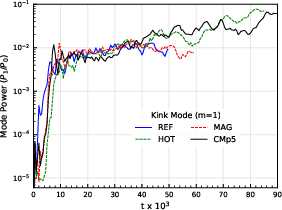
- Kink instability: Picture a high-pressure garden hose wriggling and bending when you turn it on—this wobbling can disrupt the jet and make it spread out.
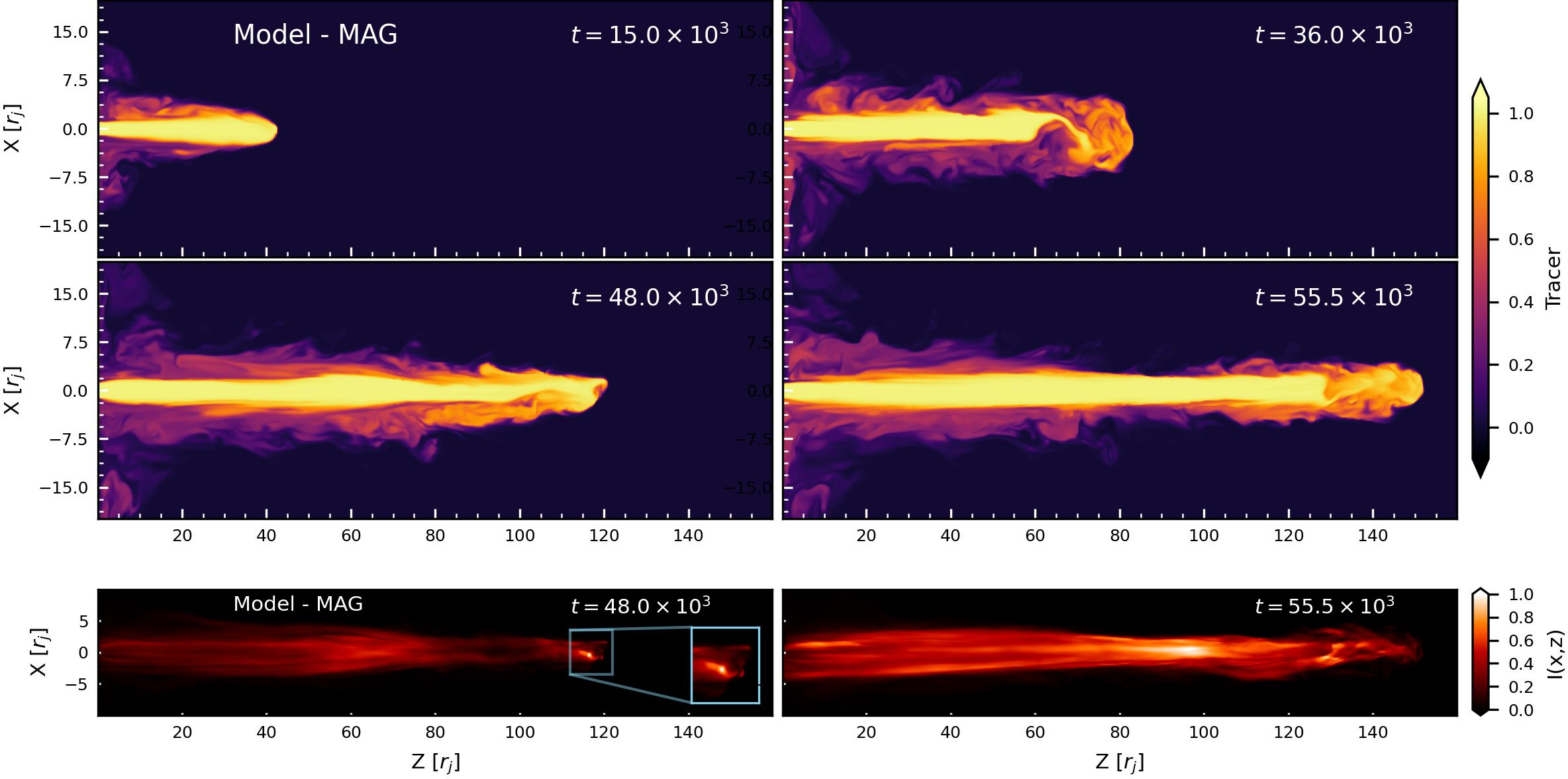
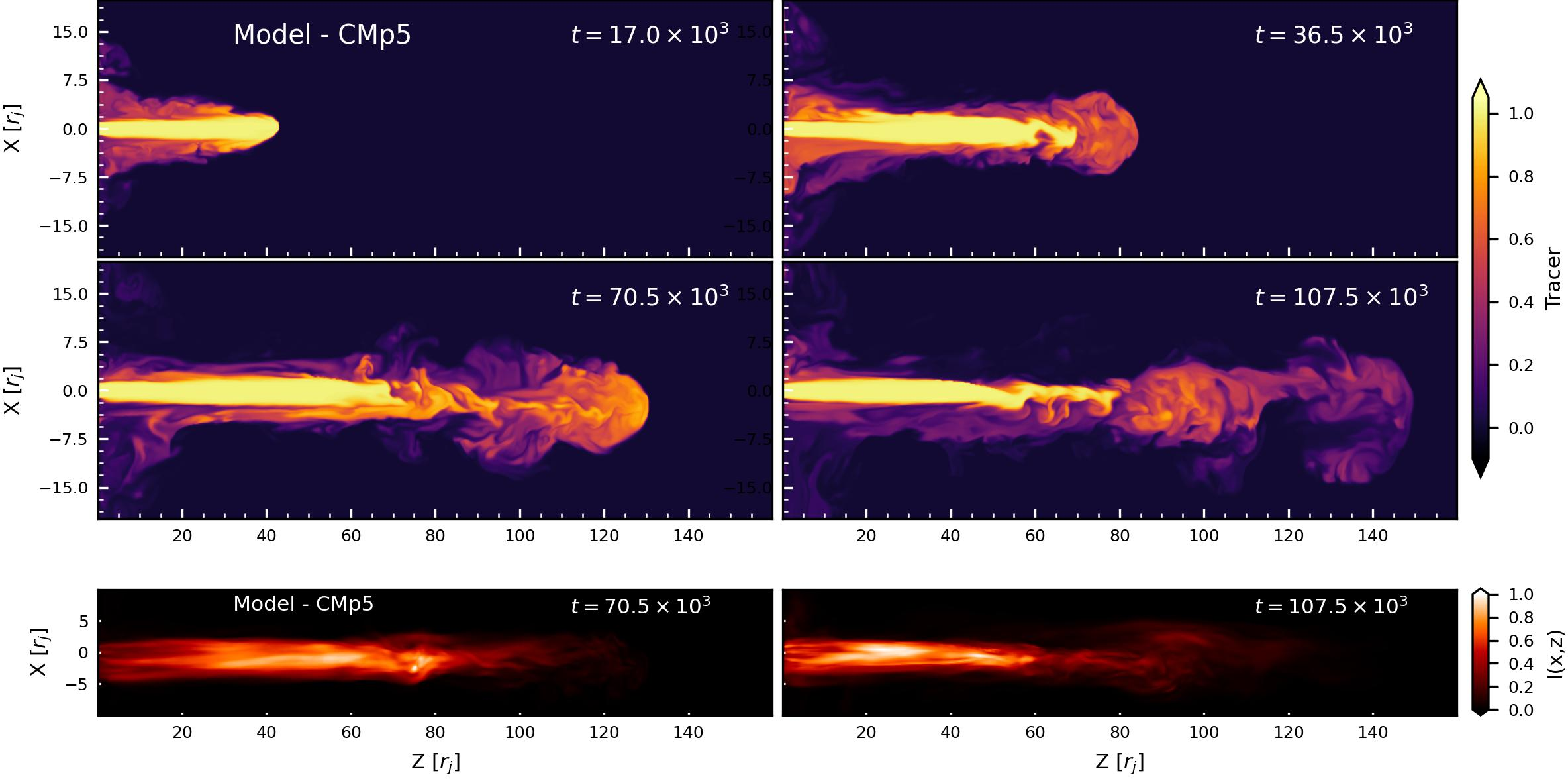
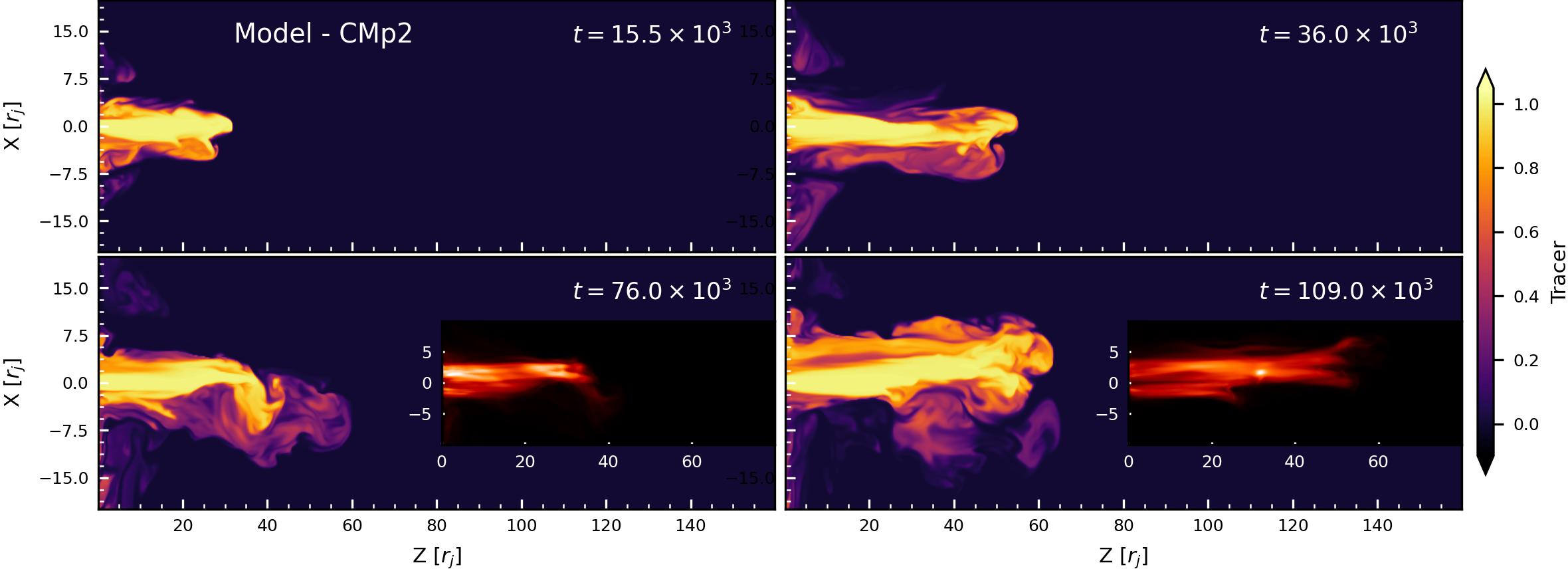
- Synthetic radio maps: After simulating, they estimate how bright the jet would look in radio light (synchrotron emission), similar to what telescopes see. This helps decide whether a jet looks like FR I (bright along the core, no strong hotspot) or FR II (dim core, bright hotspot at the edge).
They tested six different jet “models,” changing one thing at a time: speed, temperature, magnetization, and particle mix (how many protons vs electrons and positrons).
What did they discover?
Big picture: what the jet is made of and how it’s launched really matters.
- Mixed plasma jets (electrons + positrons + fewer protons) tend to become FR I. They wobble more, spread out, and lose energy gradually along the beam, so they don’t make strong edge hotspots.
- Electron–proton jets (no positrons) can switch between FR I and FR II over time. If they’re faster and more supersonic, they stay FR II; if they’re hotter or more magnetized in certain ways, they can wobble and diffuse, looking FR I for a while.
Here’s a quick summary of each model’s behavior:
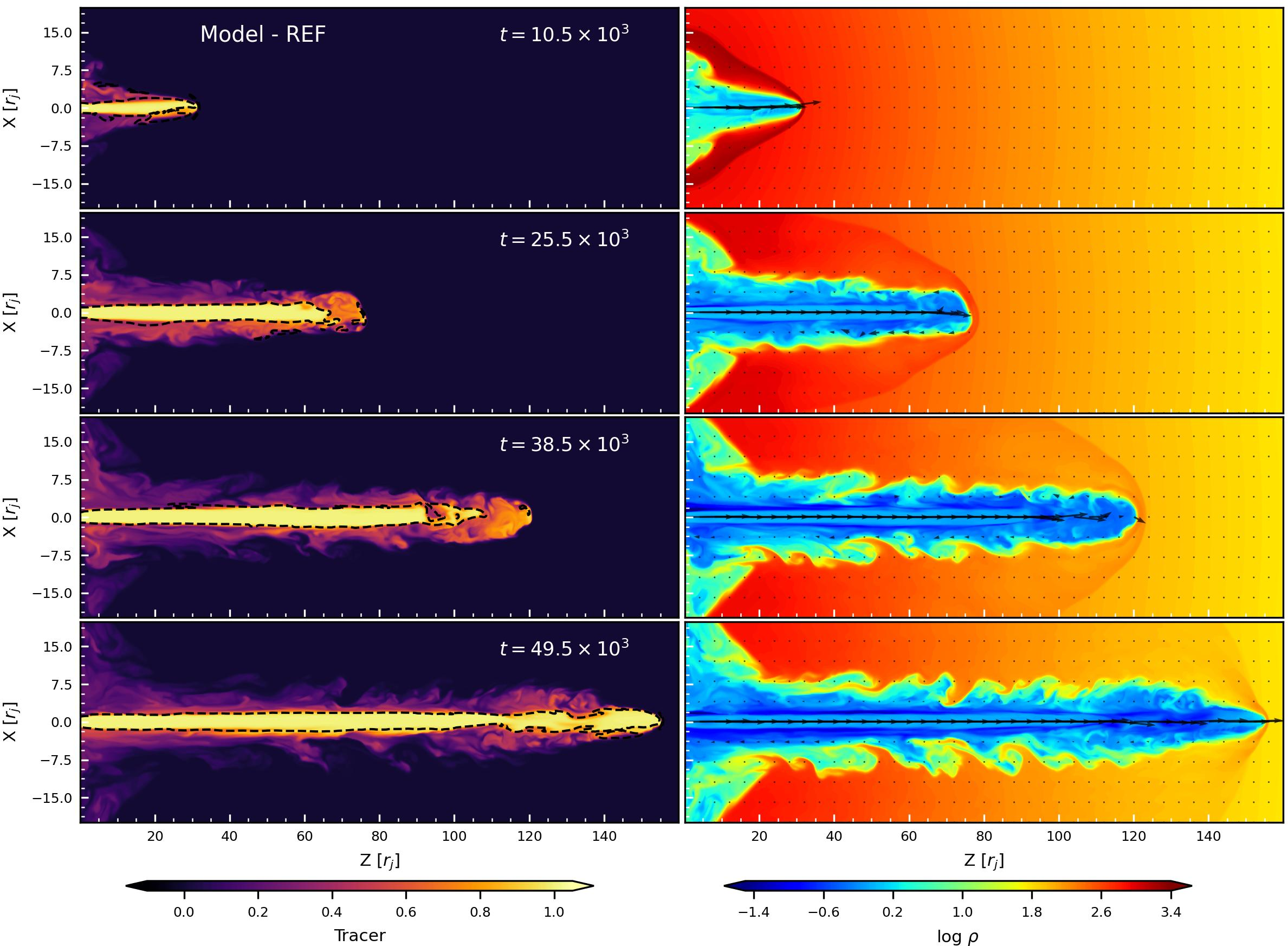
- REF (reference, electron–proton): It switched between FR I and FR II at different times. Sometimes the beam diffused (FR I), later it recovered and made a hotspot (FR II).
- HYP (higher speed): Stayed FR II. The jet was fast, narrow, and built a strong terminal hotspot, with the beam itself relatively dim.
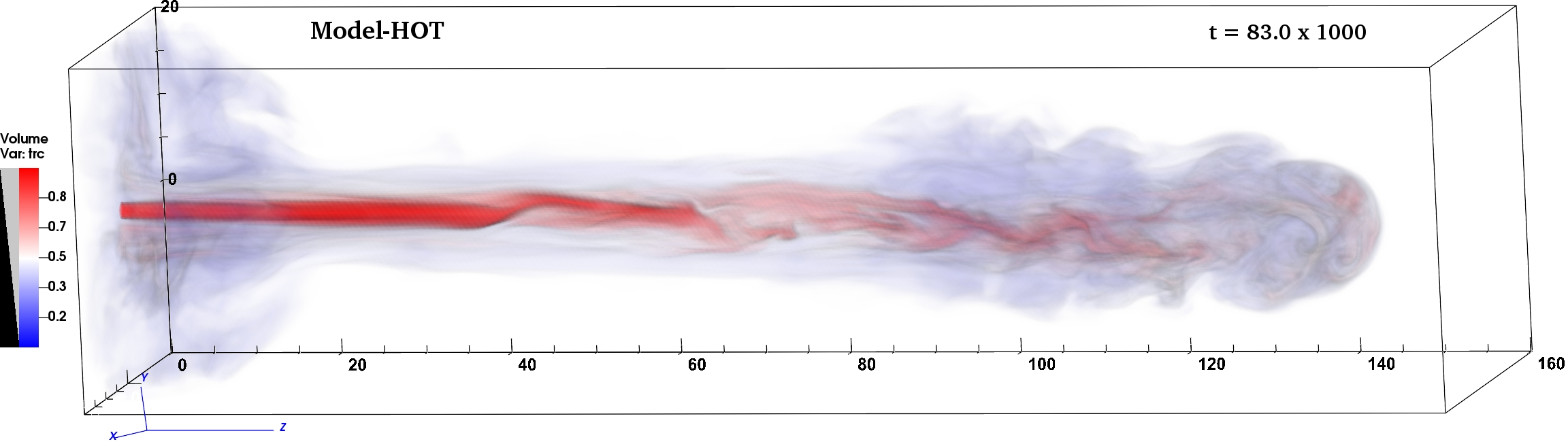
- HOT (hotter environment and jet): Stayed FR I. The hotter conditions lowered the Mach number and encouraged the kink instability. The beam wiggled, spread out, and lost energy gradually without a strong hotspot.
- MAG (stronger magnetic field): Switched between FR I and FR II. Strong magnetization helped keep the beam collimated at first, but later non-axisymmetric instabilities broke it up, producing “warm spots” (bright patches not at the very edge).
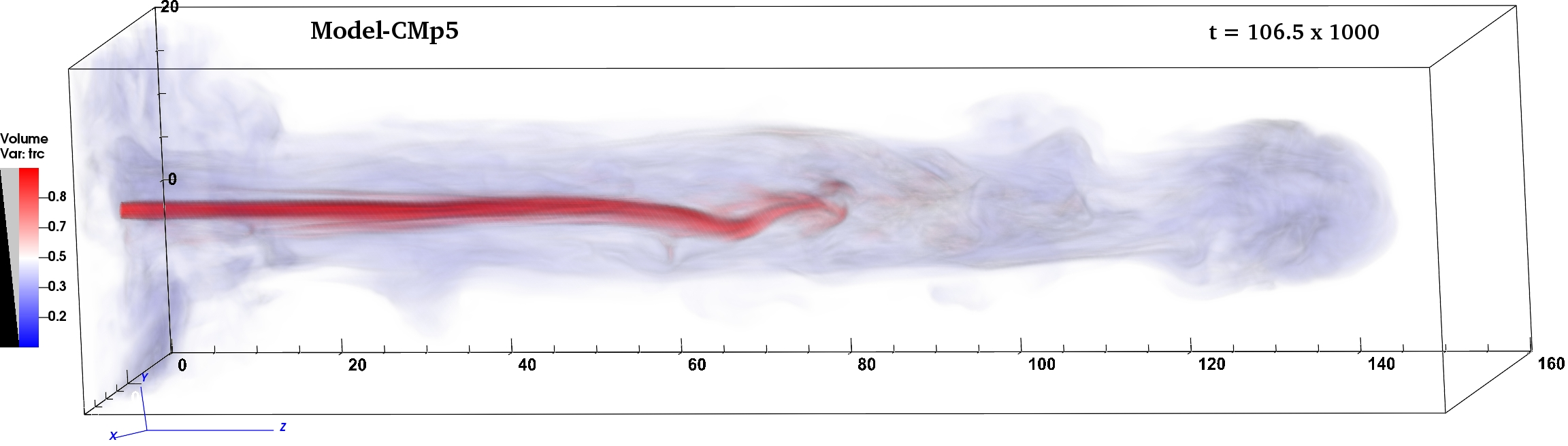
- CMp5 (mixed composition, half as many protons as electrons): Stayed FR I. The lepton-rich jet (more electrons/positrons, fewer heavy protons) had higher sound speed, lower Mach number, and stronger kink effects. The head became diffuse, and brightness was spread along the beam.
- CMp2 (even fewer protons): Strong FR I behavior. The jet stalled early, bent strongly, and couldn’t push the head far. Brightness was in patches along the beam, without a terminal hotspot.
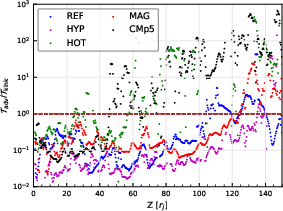
A key physical insight the authors tested is the race between how fast the jet moves forward (advection timescale) and how fast the kink instability grows (kink timescale):
- If the jet moves forward faster than the instability grows, the jet stays narrow and stable (more FR II).
- If the kink grows faster, the jet wriggles, spreads out, and diffuses (more FR I).
Fast jets (like HYP) advect the instability away, staying FR II. Hotter or lepton-rich jets grow the kink faster and diffuse, staying FR I.
Why is this important?
- Explains the FR I/FR II “split”: The study supports the idea that differences in jet appearance don’t necessarily mean different black holes. Instead, jet interactions with their environment, their speed, temperature, magnetization, and especially their particle make-up can tip them toward FR I or FR II.
- Composition matters: Including positrons (making the jet “lighter” and more thermally responsive) can push jets toward FR I by enhancing instabilities and lowering the effective Mach number.
- Time variability: The same jet can look FR I at one time and FR II later, matching real observations where jet morphology can change, and helping explain hybrid sources (HYMORS) where the two sides look different.
- Observational guidance: The synthetic radio maps connect the simulations to what radio telescopes actually see—diffuse beams and “warm spots” for FR I, sharp hotspots for FR II—offering clues for interpreting real data.
- Galaxy evolution: Jets dump energy into their surroundings and can shape galaxy growth. Understanding when and how jets spread out or punch through with hotspots changes how we think about “feedback” in galaxies and clusters.
Final takeaway
Think of a cosmic fire hose: if it’s very fast and steady, it slams into the far wall and makes a bright splash (FR II). If it’s hotter, lighter, or more magnetically tangled, it wiggles, spreads its water along the way, and ends more gently without a big splash (FR I). This paper shows that the jet’s internal “ingredients” and launch conditions can steer it toward one look or the other—sometimes switching back and forth—helping us understand the rich variety of radio jets we see across the universe.
Knowledge Gaps
Below is a single, focused list of the paper’s unresolved knowledge gaps, limitations, and open questions that future work could address.
- Non-relativistic MHD framework: The study assumes already-decelerated, subrelativistic jets at kpc scales and does not model the parsec-to-kpc deceleration process or relativistic dynamics; how do the reported FR I/II transitions change in fully relativistic 3D MHD/RHD with realistic Lorentz factors?
- Ideal MHD and lack of explicit dissipation: Magnetic reconnection, resistivity, viscosity, and anisotropic conduction are not included; what is the impact of explicit (physical) dissipation on jet stability, kink growth, and energy dissipation pathways?
- Ambient medium magnetization: The external medium is unmagnetized; how do realistic IGM/ICM magnetic fields (strength, topology, turbulence) alter jet collimation, stability, entrainment, and FR morphology?
- Magnetic field topology at injection: Jets are initialized with purely toroidal fields (Bφ), with Bz generated only by stretching; how do different injected field geometries (poloidal, helical with prescribed pitch, spine–sheath configurations) change kink onset and FR outcomes?
- Limited parameter space exploration: Only six models were run with sparse sampling of Mach number, plasma-β, temperature, and composition; what are the quantitative thresholds and phase boundaries in (Mach, β, ξ, ambient stratification) that govern FR I/FR II transitions?
- Composition treatment and advection: The composition parameter ξ appears fixed per run and not advected as a species field; how does local ξ evolve under mixing/entrainment, and how would an advected multi-species composition field (with charge neutrality constraints) modify thermodynamics and stability?
- Single-temperature EoS approximation: A one-temperature CR EoS is used despite noted ep coupling limits (𝒯ep ≳ 𝒯adv); how do two-temperature (electron–ion) EoS and energy exchange models affect sound speeds, Mach disks, kink growth, and emission?
- Radiative processes omitted in dynamics: No radiative cooling/heating (synchrotron, IC, bremsstrahlung) is coupled to the MHD; what is the dynamic impact of radiative losses on jet pressure support, stability, and morphology over 10–30 Myr?
- Thermal synchrotron emissivity only: Synthetic emission assumes thermal synchrotron; how do non-thermal particle acceleration (shock, reconnection) and power-law electron distributions change surface brightness, hotspots, spectral indices, and FR classification?
- Lack of multi-frequency and polarization diagnostics: No spectral or polarization maps (e.g., spectral aging, RM, EVPA) are produced; can polarization and Faraday diagnostics distinguish B-field geometries and validate kink vs KH-dominated scenarios?
- Orientation and Doppler beaming: Emission is integrated along a single LOS (y-axis) without relativistic beaming; how sensitive are FR classifications to viewing angle and Doppler effects, especially for mildly relativistic segments?
- No explicit entrainment/mass loading physics: Entrainment is inferred via tracer mixing but not quantified or sourced (stars, clouds, ambient turbulence); how do controlled entrainment rates and clumpy media affect deceleration and FR I transitions?
- Ambient stratification and pressure equilibrium: Ambient density follows a King profile with uniform pressure and no gravity; how do hydrostatic equilibrium (including gravity), pressure gradients, and ambient turbulence alter jet propagation and stability?
- Kink growth rate modeling: The kink timescale uses a linear, cold-flow formula (λmax ∝ vA/P0) while flows are warm/hot; how accurate are these estimates, and what is the role of finite thermal pressure and realistic pitch profiles on nonlinear kink evolution?
- Competing instabilities: Focus is on m=1 kink mode power; what is the relative role of Kelvin–Helmholtz and other current-driven modes across the parameter space, and how do they interact to set FR morphology?
- Resolution and convergence: The grid resolves the beam radius with only 6 cells and no convergence study is reported; do the diffusion, mixing, kink onset, and emission features persist under higher resolution and different numerical schemes (e.g., CT vs divergence cleaning)?
- Boundary conditions and domain size: Outflow boundaries and a reflective base are used to mimic counterjets; how sensitive are results to boundary treatments, domain size, and nozzle geometry (radius, magnetization radius a) on backflows and instabilities?
- Magnetization scan is narrow: Plasma-β is varied from 10 to 4 only; what is the broader dependence of FR outcomes on magnetization (including β ≤ 1), and can warm spots vs hotspots be mapped to specific magnetization regimes?
- Pair physics and microphysics: Pair creation/annihilation, Coulomb coupling, and kinetic micro-instabilities (e.g., firehose, mirror) are neglected; do kinetic effects materially change stability and emission in pair-rich jets (ξ < 1)?
- Quantitative entrainment and energy budgets: The study uses tracer thresholds (Φ > 0, Φ > 0.9) but does not report mass entrainment rates, momentum fluxes, or detailed partitioning of energy (thermal, magnetic, kinetic); can these diagnostics clarify where and how jets dissipate?
- Robust FR classification metrics: FR identification relies on forward-shock presence and qualitative brightness patterns; can more objective, observationally anchored metrics (e.g., edge-brightening indices, hotspot compactness, lobe-to-core contrasts) be developed and applied?
- Source-specific validation: No direct comparison to well-studied FR I/FR II/HYMORS sources (e.g., M87) is provided; how do simulated morphologies and synthetic observables scale to real systems (sizes, powers) and match multi-band data?
- Time variability of the engine: Injection is steady; how do realistic variability (flares, precession, duty cycles) impact jet stability, kink growth, and FR switching behavior?
- Ambient temperature/density diversity: Only two ambient temperatures and a single density core radius are considered; how does broader ICM thermodynamic diversity and cluster environment (cool-core vs non-cool-core) affect jet morphology?
- Reconnection-driven particle acceleration: With ideal MHD, particle acceleration at reconnection sites is unmodeled; does explicit resistive MHD or hybrid (MHD+test particles/PIC-informed models) change hotspot/warm-spot properties?
- Helical pitch and stability thresholds: The study infers that hotter or lepton-rich beams suppress Bz development; what injected helical pitch ranges (P0 = r Bz/Bφ) stabilize against kink while preserving realistic collimation?
These gaps outline concrete avenues for expanding the physical realism, parameter coverage, diagnostics, and observational validation needed to robustly connect plasma properties to FR I/FR II jet morphologies.
Practical Applications
Below are actionable applications that follow directly from the paper’s findings, methods, and innovations. They are grouped by time horizon and tagged with relevant sectors, with explicit assumptions and dependencies noted where they affect feasibility.
Immediate Applications
The following can be deployed or prototyped with existing data, infrastructure, and software.
- Morphology-informed interpretation of radio jets
- Sectors: academia, observatories (radio/optical/X-ray), software
- Application: Use the paper’s synthetic synchrotron pipeline and morphological diagnostics (e.g., presence/absence of forward shock/hotspot, “warm spots,” diffused jet head, kink signatures) to reclassify archival and ongoing observations into FR I/FR II or transitional states, and to infer likely physical drivers (Mach number, magnetization, ambient temperature, plasma composition).
- Potential tools/workflows: A lightweight analysis package that ingests radio surface-brightness maps and outputs morphology tags plus qualitative parameter hints; standardized checklists for identifying warm spots vs hotspots.
- Assumptions/dependencies: Thermal synchrotron approximation; single-temperature CR EoS; line-of-sight fixed (here y-axis); non-relativistic, kpc-scale regime; requires sufficient image depth and angular resolution to see hotspots/warm spots and diffused heads.
- Rapid stability screening using the kink-disruption criterion
- Sectors: energy (fusion), academia (laboratory plasma, space/plasma physics), software
- Application: Apply the advection-to-kink growth timescale ratio (T_adv/T_kink ≥ 1 → likely disruption) to quickly assess susceptibility to current-driven kink instabilities in magnetized plasma columns or jets.
- Potential tools/workflows: A calculator or module that takes v_z, B_φ, B_z (pitch P0 = rB_z/B_φ), density, and geometry to return a stability flag; integration into experimental planning or control dashboards.
- Assumptions/dependencies: Growth-rate formula assumes negligible thermal pressure; accurate local measurements or estimates of B-field components and Alfven speed; translation from astrophysical to laboratory parameter ranges must be validated.
- Targeted sample selection and catalog augmentation
- Sectors: academia, observatories, policy (survey design)
- Application: Use compositional and ambient-temperature dependencies (lepton-rich/mixed e±p → FR I tendency; hotter ambient/jet → lower Mach, more diffusion; higher injection speed → FR II stability) to define selection criteria for sources likely to be FR I, FR II, or HYMORS-like. Augment catalogs with “likely composition/magnetization/Mach regime” tags.
- Potential tools/workflows: Survey planning guidelines; catalog post-processing scripts; cross-matching with X-ray ambient temperature maps to predict FR outcomes.
- Assumptions/dependencies: Population-level inference (true time variability is on Myr scales); relies on proxies (polarization, spectral indices) for composition and magnetization.
- Training datasets for machine learning classifiers of FR morphology and jet states
- Sectors: academia, software/AI, observatories
- Application: Use simulation-derived synthetic maps to generate labeled data (FR I, FR II, transitional, “warm spot,” kinked beam) for ML models that automate morphology classification and flag instability signatures in large surveys.
- Potential tools/workflows: Data augmentation pipelines; benchmark splits with multiple lines-of-sight; integration with existing radio survey ML pipelines.
- Assumptions/dependencies: Domain gap between synthetic and real data (noise, beam effects, nonthermal electron populations); requires careful augmentation and validation.
- Integration of a relativistically-correct multispecies EoS into existing MHD codes
- Sectors: software/HPC, academia
- Application: Port or replicate the CR EoS (variable Γ with composition ξ) in commonly used codes (e.g., PLUTO, Athena++), enabling multispecies, temperature-dependent thermodynamics in jet and plasma simulations now.
- Potential tools/workflows: Open-source plugin/module; unit/regression tests; example notebooks.
- Assumptions/dependencies: Single-temperature approximation; non-relativistic flow regime in this paper’s runs; performance impacts need benchmarking.
- HPC benchmarking and workflow optimization
- Sectors: software/HPC, industry (cloud/HPC vendors), academia
- Application: Use the presented code architecture (HLLD solver, PLM + minmod, TVD-RK2, hyperbolic divergence cleaning, MPI domain decomposition) as a baseline to benchmark hardware and optimize parallel runs for 3D-MHD parameter sweeps.
- Potential tools/workflows: Reproducible HPC benchmarks; containerized workflows; scalable parameter sweep templates.
- Assumptions/dependencies: Resolution dependence (6 cells per r_j here); performance varies with problem size, solver choice, and divergence control.
- Outreach and education using high-quality jet animations
- Sectors: education/outreach, daily life (public engagement)
- Application: Use the paper’s visualizations (kink development, diffused heads, morphology transitions) in courses, museum exhibits, and online content to teach MHD stability and AGN feedback concepts.
- Potential tools/workflows: Annotated videos; interactive web viewers.
- Assumptions/dependencies: None beyond licensing and narrative framing.
Long-Term Applications
These require additional research, scaling, new data, or technology maturation.
- Bayesian parameter inference for jet composition, Mach number, and magnetization from multi-band observations
- Sectors: academia, observatories, software
- Application: Build an inversion framework that links morphology and emission patterns (including warm spots, beam brightness profiles, hotspot strength) to posterior distributions over ξ, β, Mach number, and ambient temperature, using simulation-trained surrogates.
- Potential tools/products: End-to-end “observation-to-physics” inference toolkit; cloud-hosted service for observatory pipelines.
- Assumptions/dependencies: Expanded simulation grids; relativistic and two-temperature physics; nonthermal particle distributions and radiative transfer; robust priors on ambient profiles.
- Incorporation of FR I/FR II transitions into galaxy-evolution and feedback models
- Sectors: academia (cosmological simulations), policy (large-scale computing proposals)
- Application: Update sub-grid AGN feedback prescriptions to reflect morphological state and stability (e.g., FR II delivering energy in hotspots vs FR I gradual beam dissipation), tied to environment and composition.
- Potential tools/workflows: Coupled RMHD–radiative–cosmological codes; parameterized feedback modules.
- Assumptions/dependencies: Multiphase ambient media; realistic cooling/heating; time variability on Myr scales; computational cost.
- Design of observational campaigns to test composition and instability predictions
- Sectors: observatories (SKA, VLA, LOFAR, Chandra/XMM), policy (time allocation)
- Application: Polarization and spectral-index mapping to infer B-field pitch and lepton fractions; multi-frequency imaging to differentiate warm spots from terminal hotspots; population studies of HYMORS to isolate environmental vs engine effects.
- Potential tools/workflows: Coordinated multi-band proposals; standardized data products for pitch and stability proxies.
- Assumptions/dependencies: Long time baselines (evolution is typically not human-timescale); model-to-observable mapping (nonthermal electrons, Faraday effects).
- Fusion-reactor control strategies inspired by jet stability physics
- Sectors: energy (tokamaks, stellarators, linear devices), robotics/control
- Application: Explore active control of kink instabilities using axial flow manipulation, magnetic pitch optimization (increase B_z relative to B_φ), and advection-time management, translating the T_adv/T_kink concept to reactor-relevant regimes.
- Potential tools/workflows: Simulation-experiment loops; diagnostics to estimate pitch and Alfven speed; real-time control algorithms.
- Assumptions/dependencies: Scaling laws from astrophysical to laboratory plasmas; inclusion of pressure, resistivity, and boundary effects; regulatory and safety constraints.
- Digital twins of AGN jets for interactive exploration and hypothesis testing
- Sectors: software, academia, education/outreach
- Application: Build interactive platforms that let users vary ξ, β, v_inj, and ambient profiles to see real-time morphology and emission predictions, aiding proposal planning and teaching.
- Potential tools/products: Web-based RMHD simulators with GPU acceleration; curated scenario libraries.
- Assumptions/dependencies: Fast surrogate models; validated across regimes (relativistic speeds, radiative losses).
- Next-generation RMHD simulations with two-temperature EoS and full radiative transfer
- Sectors: academia, software/HPC
- Application: Extend to relativistic, two-temperature CR EoS; include nonthermal particle acceleration, synchrotron/IC cooling, and polarized radiative transfer to improve fidelity of synthetic maps and parameter inference.
- Potential tools/workflows: Modular physics plugins; cross-code validation campaigns.
- Assumptions/dependencies: Significant computational resources; detailed microphysics; code sustainability.
- Cloud-based, reproducible pipelines for large parameter sweeps and survey-scale model–data matching
- Sectors: software/HPC, observatories, policy (open science mandates)
- Application: Offer managed services (containers, notebooks, data lakes) that run ensembles of 3D-MHD simulations and align outputs with survey data to produce morphology statistics and physical parameter maps at scale.
- Potential tools/products: Workflow orchestration; FAIR-compliant data repositories; API integrations with archives.
- Assumptions/dependencies: Cost and governance; standardized metadata; community buy-in.
- Laboratory magnetized jet experiments to validate kink and composition effects
- Sectors: academia (high-energy-density physics), energy
- Application: Produce scaled magnetized jets in pulsed-power or laser facilities to test how pitch, axial flow, and effective mass (proxy for composition) affect collimation, kink onset, and terminal shock formation.
- Potential tools/workflows: Diagnostics for B-field geometry and flow speed; cross-validation with simulations.
- Assumptions/dependencies: Achievable parameter similarity; diagnostics sensitivity; safety and funding.
- Public engagement products that connect black hole jets to everyday plasma and stability concepts
- Sectors: education/outreach, daily life
- Application: Interactive curricula tying astrophysical jet instabilities to familiar fluid and electrical phenomena (e.g., garden hose kinks, transmission line instabilities).
- Potential tools/workflows: Apps, museum kiosks, VR experiences.
- Assumptions/dependencies: Effective analogies; sustained support for STEM programs.
Notes on cross-cutting assumptions and dependencies common to many applications:
- Physics regime: Simulations here are non-relativistic, single-temperature, ideal MHD; real jets may require RMHD, two-temperature EoS, resistivity, and radiation feedback.
- Emission model: Thermal synchrotron approximation; nonthermal electron populations and polarized transfer are needed for high-fidelity matches to observations.
- Geometry and environment: King-profile ambient, toroidal base field; real galaxies have multiphase, anisotropic environments and complex field topologies.
- Resolution and scalability: 6 cells per r_j in this study; some phenomena (small-scale turbulence, reconnection) may need higher resolution.
- Timescales: Observable morphology changes occur over 105–106 years; “transitions” are mainly for population studies rather than real-time monitoring.
Glossary
- Active galactic nuclei (AGNs): Extremely luminous galactic centers powered by accretion onto supermassive black holes, launching relativistic jets. "active galactic nuclei (AGNs)"
- Adiabatic index: The ratio relating pressure to internal energy in an EoS; here treated as variable to capture relativistic thermodynamics. "with variable adiabatic index ()"
- Alfven velocity: The propagation speed of magnetic disturbances in a magnetized plasma, set by magnetic field strength and density. "v_A is the Alfven velocity"
- Baryonic plasmas: Plasmas containing baryons (e.g., protons) rather than being purely leptonic. "including both purely leptonic and baryonic plasmas"
- Composition parameter (ξ): The ratio of proton number density to electron number density controlling thermodynamics in the CR EoS. "We tune our composition parameter () defined as the ratio of the proton number density to the electron number density."
- Equation of state (EoS): A relation linking thermodynamic variables (e.g., pressure, density, temperature) used to close fluid equations. "We use an approximate yet relativistically correct EoS"
- Fanaroff-Riley Type I (FR I): Core-brightened, diffuse radio jets that fade toward the lobes and lack strong terminal hotspots. "Fanaroff-Riley Type I (FR I)"
- Fanaroff-Riley Type II (FR II): Edge-brightened radio jets with powerful hotspots at the lobes where energy dissipation is concentrated. "Type II (FR II)"
- Forward shock: The leading shock front produced as a supersonic jet drives into the ambient medium. "generates a forward shock"
- Godunov-type schemes: High-resolution shock-capturing numerical methods for hyperbolic conservation laws. "Godunov-type schemes to piecewise linearly (PLM) reconstruct the cell-centered primitive variables"
- HLLD approximate Riemann solver: A fast, robust MHD flux solver that resolves more wave families than HLL, improving accuracy for discontinuities. "HLLD approximate Riemann solver"
- Hot spot: A bright, compact emission region at the jet head produced by a strong terminal shock in FR II sources. "A strong forward shock at the jet head gives rise to a prominent hot spot"
- HYMORS (HYbrid MOrphology Radio Sources): Radio galaxies exhibiting FR I morphology on one side and FR II on the other. "HYMORS (HYbrid MOrphology Radio Sources)"
- Hyperbolic divergence cleaning: A technique to enforce ∇·B≈0 by propagating and damping divergence errors in MHD. "the hyperbolic divergence cleaning scheme"
- Ideal magnetohydrodynamics (MHD): A fluid model of conducting plasmas neglecting resistivity, described by the ideal MHD equations. "time-dependent ideal MHD equations of motion"
- King-like profile: A spherically stratified density model commonly used for galactic atmospheres and clusters. "spherically stratified according to a King-like profile"
- Kink instability: A current-driven, non-axisymmetric (m=1) instability that causes jet bending and potential disruption. "the onset of the kink instability"
- Mach disk: A strong shock (terminal Mach surface) where a supersonic jet decelerates abruptly. "its weakened Mach disk"
- Mach number: The ratio of flow speed to the local sound speed, defining supersonic or subsonic regimes. "the Mach number of injected jet flow"
- Magnetization radius: The characteristic radius defining the toroidal field/current distribution at injection. "where is the magnetization radius"
- Pair-plasma: Plasma composed mainly of electrons and positrons rather than electrons and protons. "pair-plasma (composed of electrons and positrons)"
- Plasma-beta (β): The ratio of gas (thermal) pressure to magnetic pressure, indicating magnetic dominance when β≪1. "the plasma- parameter"
- Polytropic index: Parameter linking pressure and density in a polytropic relation; here derived from the CR EoS. "the polytropic index is calculated as,"
- Runge-Kutta (TVD-RK2): A second-order, total variation diminishing time-integration scheme for stability and accuracy. "the second-order total variation diminishing Runge-Kutta (TVD-RK2) scheme is used for the time integration"
- Solenoidal constraint: The divergence-free condition on magnetic fields required in MHD (∇·B=0). "to maintain the solenoidal constraint on the magnetic field"
- Synchrotron emission: Radiation from relativistic electrons spiraling in magnetic fields, used to produce synthetic brightness maps. "Synthetic synchrotron map"
- Toroidal magnetic field: An azimuthal magnetic field component circling around the jet axis. "a purely toroidal (azimuthal) magnetic field"
- Tracer field: A passive scalar advected with the flow to distinguish jet material from ambient gas. "a tracer field (denoted as ) is solved to distinguish between the jet material and ambient medium"