- The paper introduces the NOD architecture, which enhances reliability by combining explicit state tracking with selective oversight in LLM-based agents.
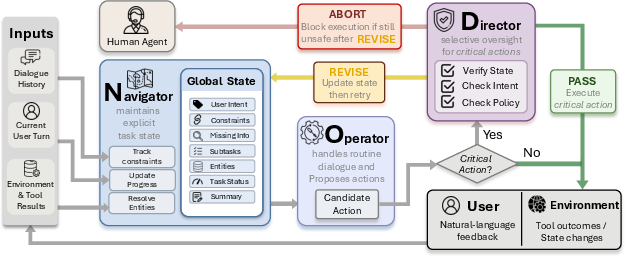
- It decomposes agent functionality into Navigator, Operator, and Director modules, addressing common failure modes such as policy violations and tool hallucinations.
- Empirical evaluations report up to 23.7% higher success rate and 25.8% greater critical action precision compared to standard baselines.
No Action Without a NOD: A Heterogeneous Multi-Agent Architecture for Reliable Service Agents
Motivation and Problem Definition
The paper "No Action Without a NOD: A Heterogeneous Multi-Agent Architecture for Reliable Service Agents" (2605.12240) addresses persistent reliability issues in LLM-based service agents, particularly in long-horizon settings involving sequential decision-making and external environment interaction. Notable failure modes include policy violations, tool hallucinations, and user-intent misalignment, which can result from implicit task state fragility and unreliable intrinsic self-correction.

Figure 1: (a) Implicit task fragility in single-agent models, leading to brittle long-horizon execution. (b) Unreliable intrinsic self-correction that hampers trajectory recovery once deviation occurs.
Standard single-agent LLM architectures maintain task state implicitly in dialogue context, leading to increased error susceptibility as interactions lengthen. Moreover, using the same model for self-correction is empirically unreliable, as deviations may reinforce rather than repair erroneous states.
NOD Architecture: Explicit State and Structured Oversight
To systematically address these failure sources, the paper introduces NOD, a heterogeneous multi-agent architecture decomposed into three functional modules: Navigator, Operator, and Director.
This structured approach treats reliability as a control problem, with explicit state maintenance and targeted intervention before environment-changing actions.
Empirical Evaluation and Strong Numerical Results
The architecture is benchmarked on the Retail and Airline domains of τ2-Bench, using multiple open-weight and frontier backbones. Metrics include Success Rate (SR) and Critical Action Precision (CAP), the latter focusing strictly on actions that reach the environment.
Key findings are:
- NOD achieves up to 23.7 points higher SR and 25.8 points higher CAP than baselines.
- REVISE-only variants deliver maximal SR, while ABORT-based blocking further increases CAP by preventing unsafe executions.
- Gains are consistent across both local and frontier backbones, with heterogeneity amplifying, but not solely explaining, the reliability improvements.
Failure Mode Reduction and Mechanism Analysis
A granular breakdown reveals that NOD substantially reduces policy violations and tool hallucinations relative to vanilla LLM agents. Director's selective oversight is the principal driver behind the observed improvement, with explicit state tracking contributing to better long-horizon control, especially in lengthy dialogues.
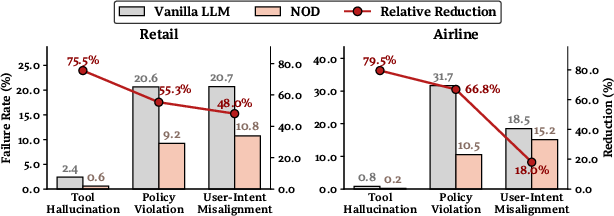
Figure 3: NOD reduces policy violations, tool hallucinations, and intent misalignment across backbones and domains.
Isolating architectural components:
- Explicit state tracking increases SR, notably in long exchanges.
- Director strength is critical—using a frontier model improves oversight's effectiveness.
- ABORT-based blocking primarily enhances CAP, filtering error-bearing or hard trajectories while incurring limited SR cost.
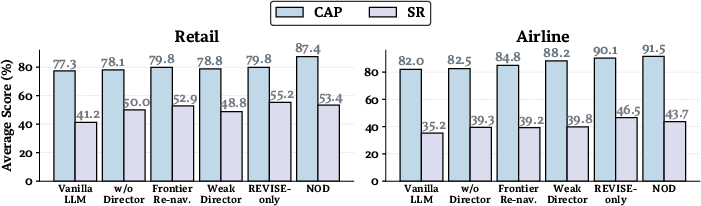
Figure 4: Component-wise ablation analysis: explicit state, revision, director strength, and ABORT impact on SR and CAP.
Director policy calibration further allows domain-sensitive control, with stricter oversight boosting CAP at the expense of SR.
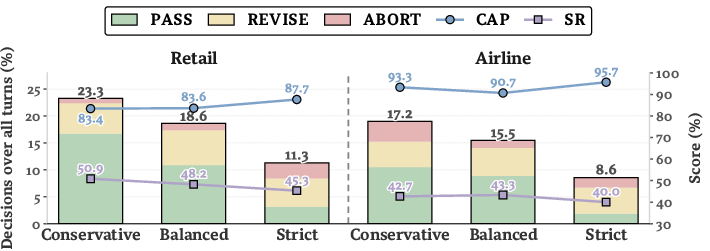
Figure 5: Director policy strictness shifts distribution from PASS to ABORT, increasing CAP but reducing SR in both domains.
Director interventions are sparse, primarily targeting critical points without frequent involvement, indicating reliability gains derive from selective, not pervasive, frontier-model input.
Implications and Future Directions
NOD represents a concrete shift from implicit, monolithic architectures toward explicit, structured control in agent reliability. By externalizing task state and applying selective oversight using stronger models, NOD mitigates long-horizon error propagation and unsafe behaviors in practical service deployments.
The architecture is modular and adaptable: gains persist in homogeneous frontier deployments, establishing that control architectural design is as significant as backbone strength. Director strictness can be tuned for domain-specific safety-performance trade-offs. Sparse intervention facilitates efficient operation even with frontier oversight.
Potential future directions include optimizing Global State updating to minimize token costs and brittleness, integrating independent state maintainers, and extending NOD-style structured control to broader agent-based applications (e.g., system-level task orchestration, autonomous resource management).
Conclusion
The NOD architecture systematically improves reliability in service agent execution by combining explicit task-state tracking with targeted oversight before critical actions. The empirical gains in both task completion and safety metrics substantiate its design. NOD's modularity, sparse frontier intervention, and sensitivity to oversight calibration position it as a key control paradigm for practical, reliable LLM-based agents.