- The paper introduces Delightful Policy Gradient (DG) which uses a gating mechanism based on the product of advantage and surprisal to eliminate exponential corner traps in RL.
- DG offers a provable global convergence rate of O(1/t) and achieves logarithmically faster escape from sub-optimal corners compared to vanilla policy gradients.
- Empirical results on tabular and MNIST contextual bandits substantiate DG’s robustness and rapid recovery from poor initializations under small reward gaps.
Delightful Gradients Accelerate Corner Escape: An Expert Analysis
Introduction and Motivation
The paper "Delightful Gradients Accelerate Corner Escape" (2605.11908) addresses a persistent pathology in softmax policy gradient (PG) methods: exponentially slow escape from sub-optimal corners of the simplex, a critical bottleneck in reinforcement learning (RL) algorithms and large-scale RL for LLM alignment. Near deterministic sub-optimal policies, negative-advantage actions reinforce corner concentration, causing a self-trapping phenomenon that severely degrades transient optimization. Entropy regularization or geometry modification (e.g., natural policy gradient, policy mirror descent) do not fundamentally eliminate this issue when following the vanilla gradient direction.
The paper introduces Delightful Policy Gradient (DG), which gates the policy-gradient term by the product of advantage and action surprisal, thereby suppressing harmful actions in a rarity-sensitive fashion and removing the corner trap in both the zero-temperature limit (Enlightened Gradient, EG) and finite-temperature settings.
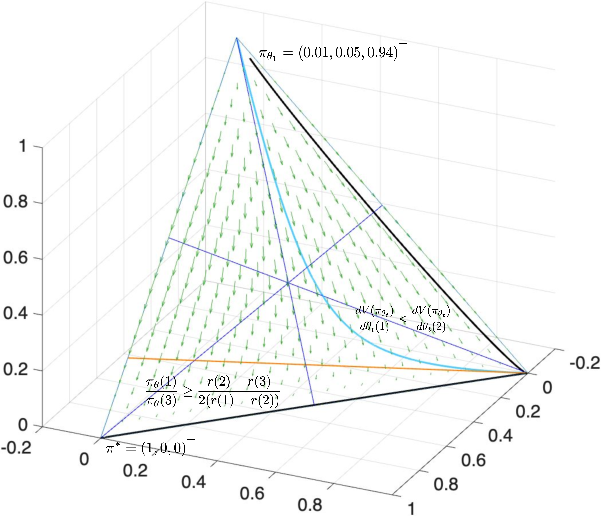
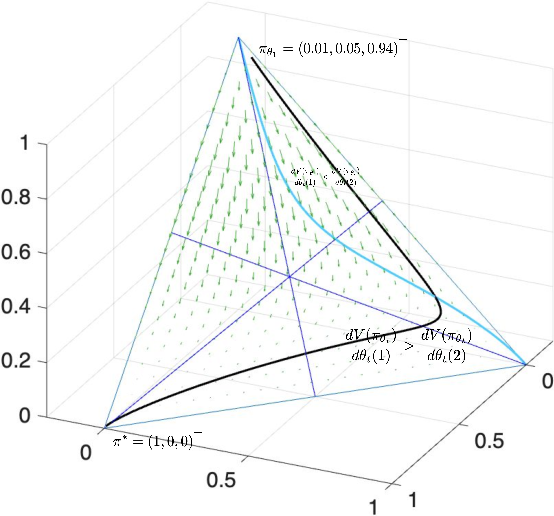
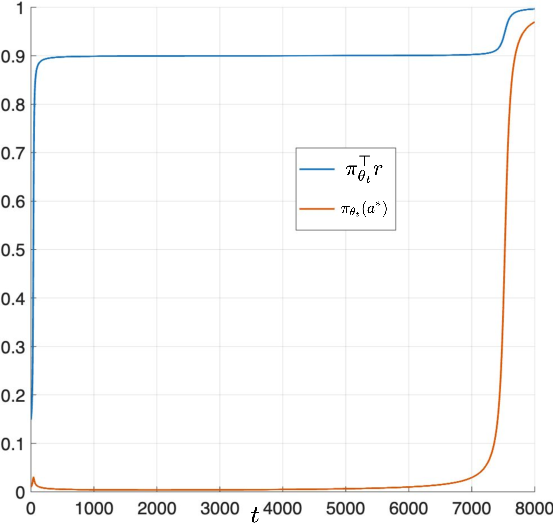
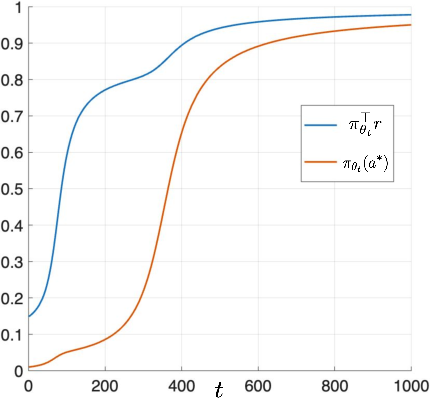
Figure 1: PG gradient flow illustrates exponential corner trapping, while DG modifies gradient dynamics to ensure direct escape from the wrong corner.
Mechanism and Algorithmic Structure
DG is formalized for K-armed bandits and tabular MDPs, leveraging a softmax policy parameterization. The key insight lies in the gating function w(a)=σ(U(a)ℓ(a)/η), where U(a) is the advantage, ℓ(a)=−logπ(a) is the action surprisal, and η is a temperature hyperparameter. In the zero-temperature limit (η→0), gating acts as a hard threshold, removing negative-advantage terms entirely (EG); at finite temperature, the gate polynomially suppresses rare and harmful actions.
This gating ensures that, near any sub-optimal corner, the optimal action receives unconditional gradient improvement, whereas harmful actions are vanishingly weighted. The paper proves, via a logit-gap decomposition, that all arms better than the corner action are allies and provide non-negative contributions to escape, and that the optimal arm logit increases at a rate Ω(ε/K) (where ε measures deviation from the corner).
Corner Escape Analysis
The analytical centerpiece is a sector bound: for any sub-optimal corner, EG guarantees that the optimal arm's logit grows faster than the corner’s, yielding a first-exit escape bound logarithmic in the initial probability ratio—exponentially faster than PG.
The mechanism is detailed via quantitative drift inequalities, showing that DG (and EG) remove or polynomially suppress the self-trapping effect caused by negative-advantage actions. The product structure of delight (U(a)⋅ℓ(a)) is proved to be structurally necessary. Without surprisal, advantage gating alone cannot suppress harmful arms when they are rare, and the corner trap persists.
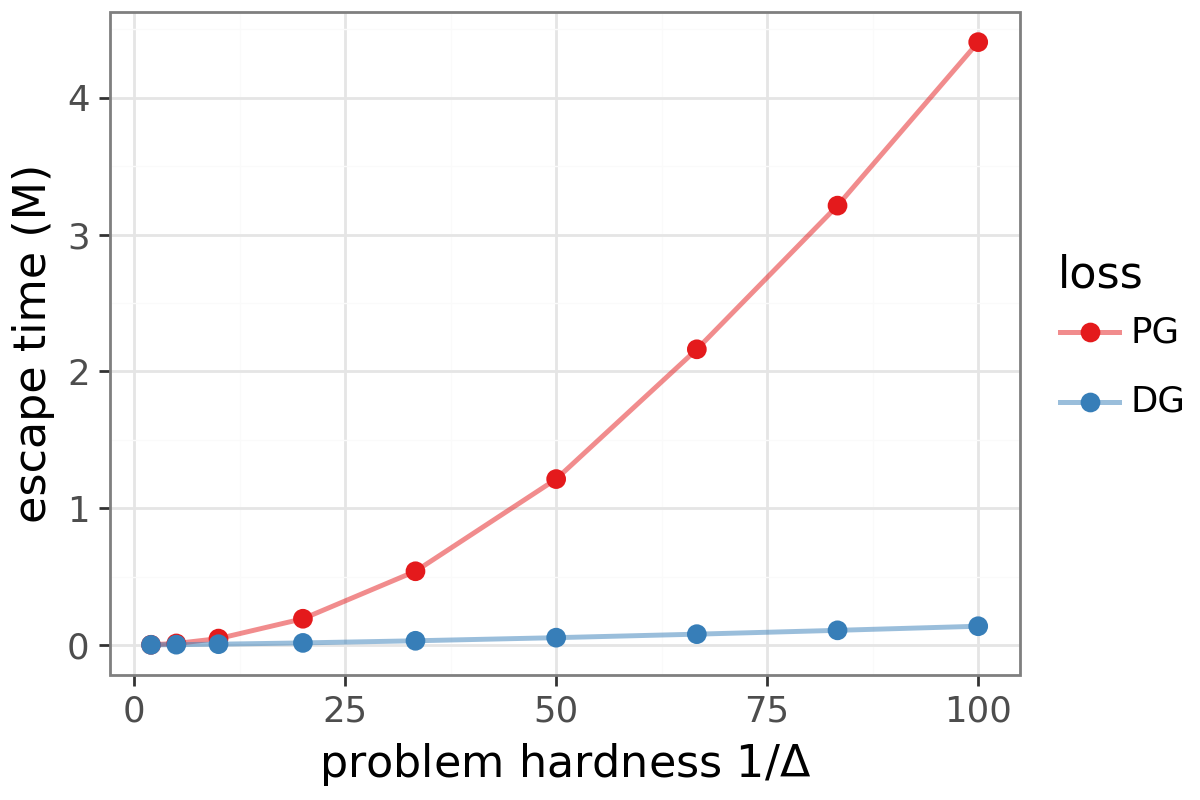
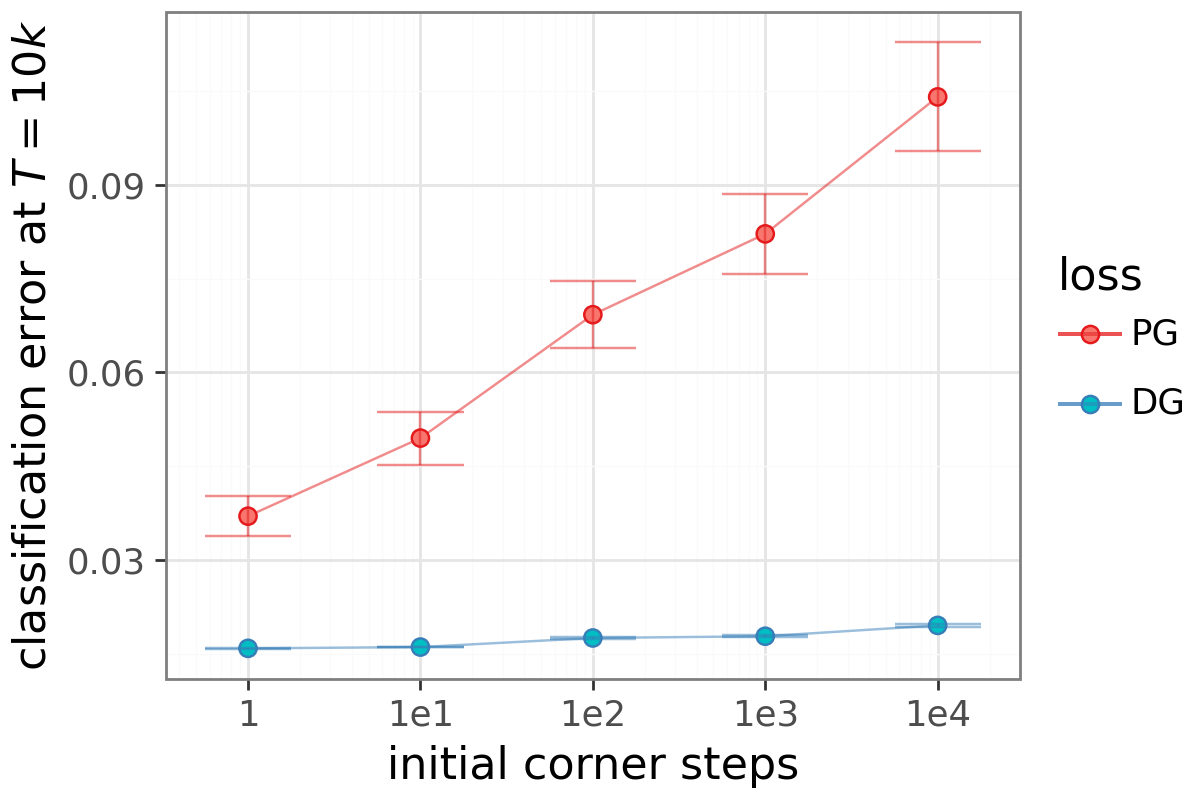
Figure 2: Left: Escape time vs. 1/Δ for PG and DG. PG grows superlinearly, DG remains near-linear. Right: MNIST classification error at w(a)=σ(U(a)ℓ(a)/η)0 steps vs. corner depth. DG maintains flat error; PG error degrades steadily.
Global Convergence Guarantees
A significant theoretical contribution is the global convergence proof for EG (and DG) in both bandits and tabular MDPs, at an w(a)=σ(U(a)ℓ(a)/η)1 rate. The analysis hinges on monotonic value improvement, instability of sub-optimal corners (now measure-zero repellers rather than attractors), and a convex combination argument enforcing convergence to one-hot optimal policies under distinct rewards.
The paper extends the analysis to tabular MDPs, demonstrating that the local corner escape property holds state-by-state and aggregates into global value improvement. The mechanism is robust to reward gaps: DG’s escape time scales logarithmically in the corner depth, whereas PG’s scales superlinearly or exponentially.
Implications under Function Approximation
An exact counterexample is provided, showing that DG’s corner escape mechanism may fail under shared parameterization, where conflicting advantages across states lead to sub-optimal interior fixed points. However, empirical results on MNIST contextual bandits with a shared-parameter MLP demonstrate that DG still recovers from bad initializations faster than PG, marking a practical boundary rather than a theoretical prohibition.
Experimental Validation
Numerical results substantiate the theoretical claims. In tabular bandits, DG’s escape time from the corner remains linear with respect to w(a)=σ(U(a)ℓ(a)/η)2, and PG’s grows superlinearly. On MNIST contextual bandits, DG consistently achieves robust recovery from artificially induced corners, while PG’s performance degrades with increased corner depth, confirming the superiority of DG’s mechanism for practical optimization landscapes.
Implications and Future Directions
Practically, DG offers a robust means to mitigate the pathological transient dynamics that afflict softmax PG methods. Theoretically, the delight gating mechanism exposes a structural avenue—surprisal-weighted advantage—for achieving rarity-sensitive suppression of harmful actions. Limitations in function approximation highlight the need for new architectural or algorithmic protocols to safely handle state coupling, particularly under conflicting advantages.
Potential future directions include:
- Adapting delight gating for continuous action spaces and off-policy settings.
- Exploring hybrid schemes that combine DG with geometric regularizers such as natural gradients or mirror descent.
- Investigating anomaly detection and state-wise gating under function approximation to bypass or mitigate the shared-parameter counterexample.
- Extending the mechanism to large-scale RL alignment tasks, particularly in the context of LLM reinforcement learning from human feedback.
Conclusion
Delightful Policy Gradient (DG) fundamentally alters the transient escape dynamics in policy gradient RL by gating updates with the product of advantage and surprisal. This removes exponential corner traps, achieves global w(a)=σ(U(a)ℓ(a)/η)3 convergence, and ensures rapid recovery even under challenging initializations and small reward gaps. The necessity of surprisal gating is rigorously established, and practical experiments affirm DG’s efficacy. DG stands as a structural improvement for RL optimization, with implications extending to tabular, neural, and potentially large-scale aligned RL settings. Limitations under shared parameterization delineate boundaries for further theoretical and algorithmic innovation.