- The paper introduces Dingo-Pop, a simulation-based inference framework using transformers to directly map gravitational-wave strain data to population hyperparameters.
- It leverages event embeddings and a neural spline flow to bypass per-event parameter estimation, significantly reducing computational bottlenecks.
- Empirical results demonstrate well-calibrated posteriors and competitive performance with classical hierarchical Bayesian analyses as catalog sizes scale.
Introduction and Motivation
Population inference of compact binaries via gravitational-wave (GW) data is essential for extracting astrophysical, cosmological, and fundamental physics insights from the rapidly growing catalogs of GW events observed by LIGO, Virgo, and KAGRA. Hierarchical Bayesian Analysis (HBA) has been the standard paradigm, combining per-event posteriors to infer properties such as merger rates, source distributions, and cosmological parameters. However, as GW event catalogs grow (e.g., GWTC-4.0 has 218 events and next-generation detectors will yield orders of magnitude more), these methods become computationally prohibitive and are subject to increasing Monte Carlo variance—scaling as O(N2) in the number of events—due to repeated stochastic integral approximations.
This work presents Dingo-Pop, a simulation-based inference (SBI) framework for direct population inference from GW strain data using transformers. By bypassing per-event parameter estimation, amortizing inference across variable catalog sizes, and deploying fast, end-to-end transformers on learned event embeddings, Dingo-Pop addresses both computational and statistical bottlenecks endemic to classical HBA approaches.
Dingo-Pop Framework and Methodology
Dingo-Pop is designed for inference on variable-size GW catalogs, mapping directly from detector strain data to posteriors over population hyperparameters. The method proceeds in three principal stages:
- Event Embedding: Each GW event’s high-dimensional strain data is compressed into a low-dimensional (32-dimensional) embedding via a pre-trained Dingo encoder, focused only on parameters relevant to the population model (masses, luminosity distance).
- Population Encoding: Embeddings are mapped to event tokens, which are input into a transformer encoder (with 10 layers and dimension 1024). A learnable summary token enables the architecture to produce a compact, permutation-invariant summary of the entire catalog.
- Posterior Estimation: The summary token conditions a neural spline flow (14 steps, 1.5×10⁸ total parameters) to yield the posterior over hyperparameters.
Efficient training is enabled by two auxiliary neural networks:
- An estimator for the detection probability pdet(θ), facilitating rejection sampling without generating unobserved events.
- A conditional normalizing flow emulator for detected event embeddings, producing Z directly conditioned on source parameters.
This architecture is depicted in the following diagram.
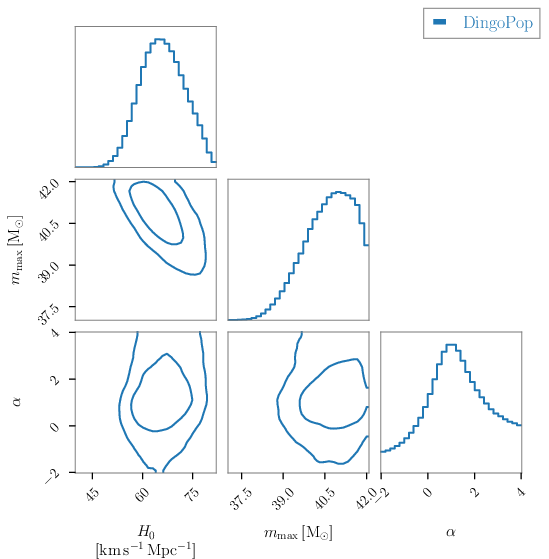
Figure 1: Dingo-Pop architecture for end-to-end population inference from GW strain; inference (left) and efficient simulation-based training (right) using auxiliary surrogates for detection and embedding.
The loss is the negative log-likelihood over batches of simulated catalogs, with hyperparameters and catalog sizes randomly drawn per batch, supporting amortization over N=25--$1000$ events.
Validation and Empirical Results
The Dingo-Pop network is validated on simulated GW event catalogs for a "power law + peak" mass distribution and flat ΛCDM cosmology (H0 variable). The network is trained on 108 parameters, seeing over 106 unique populations in training.
Posterior Calibration
Extensive calibration tests are performed using probability-probability (P–P) plots across 2500 simulated catalogs with variable sizes. For well-calibrated methods, the empirical CDF of true hyperparameter percentiles is uniform. Dingo-Pop achieves calibration consistent with statistical expectations (combined 1.5×1080-value of 0.20), with posterior coverage across the nine-dimensional hyperparameter space.
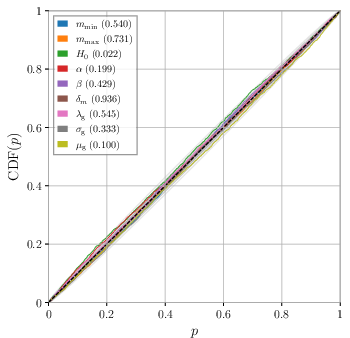
Figure 2: P–P plot over 2500 simulated catalogs, demonstrating well-calibrated posteriors across a large range in catalog size.
Comparison to Hierarchical Bayesian Analyses
Dingo-Pop posteriors are compared directly with HBA using conventional parameter estimation pipelines (Dingo + Bilby, population inference via icarogw) for catalogs of 500 events. Agreement is obtained to within Monte Carlo uncertainty. Discrepancies between Dingo-Pop and HBA (e.g., on the scale of the selection-function estimate variance) are subdominant, and Dingo-Pop posteriors tend to be slightly broader, consistent with the absence of per-event MC noise.
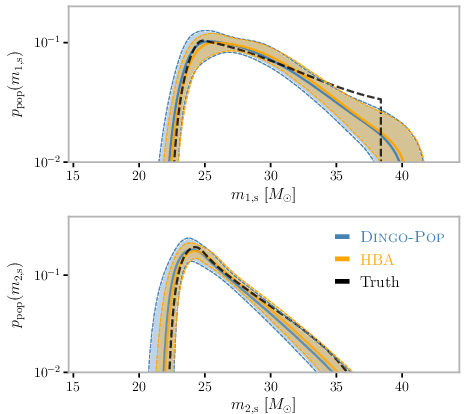
Figure 3: Hyperparameter posterior and reconstructed mass spectrum for Population 2, demonstrating consistency between Dingo-Pop and HBA pipelines to within credible intervals.
Scaling of Cosmological Constraints
The speed of Dingo-Pop permits systematic studies that are impractical with classical analyses. The scaling of 1.5×1081 uncertainty with catalog size is explicitly studied: for 128 simulated populations, posteriors are computed as the event count grows. The relative 1.5×1082 uncertainty falls to 1.5×108323% at 200 events, 1.5×108415% at 1000 events, with an empirical scaling 1.5×1085 over this range.
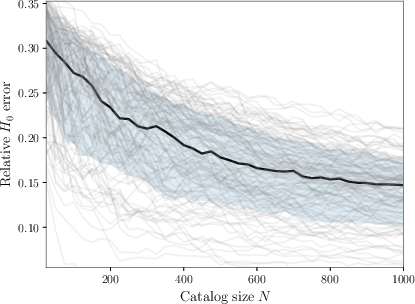
Figure 4: Relative uncertainty (21.5×1086/median) in 1.5×1087 as a function of catalog size across 128 simulated populations, showing statistical convergence properties.
Implications and Future Directions
Dingo-Pop represents a structural advance in GW population inference pipelines, fundamentally decoupling computational cost from catalog size. The method's key strengths are:
- Avoidance of per-event parameter estimation MC variance and computational expense
- One-second end-to-end inference amenable to catalog sizes up to 1.5×1088 events and beyond
- Inference amortized across variable catalog sizes
- Direct operation on strain data, simplifying retraining for new simulation-based scenarios, and enhanced support for direct comparison with population synthesis or alternative population models
The framework's transformer backbone is inherently capable of capturing correlations across events, presenting a path to extend GW population inference to scenarios with non-i.i.d. events—e.g., lensed sources, systems jointly constrained by GW and electromagnetic or galaxy catalog data, or cross-correlations with large-scale structure observations.
Technical and Practical Considerations
Direct application to LVK data sets will require:
- Calibration of the detection-filter network 1.5×1089 to experiment-specific thresholds (e.g., as determined by LVK injection sets)
- Coverage of the embedding models for all relevant event types, detectors, and data quality/conditioning situations
- Robustness to population model misspecification, where out-of-distribution effects (untreated by classical HBA) may degrade amortized inference performance
This work opens avenues for real-time population inference during observing runs, and for systematic studies—e.g., forecasted precision as a function of event composition, systematic biases from selection or population model assumptions, and efficient propagation of detector characterization uncertainties on population-level inference.
Conclusion
Dingo-Pop establishes a new paradigm for fully end-to-end GW population inference, fusing simulation-based training, modern representation learning (via transformers and normalizing flows), and scalable amortized inference. The method rigorously matches, and often exceeds, the fidelity of standard HBA pipelines in both posterior calibration and accuracy, while being operationally orders of magnitude more efficient. The approach is poised to enable key scientific programs with next-generation GW detectors, supporting real-time cosmology and astrophysics with pdet(θ)0 event-scale catalogs (2605.11274).